
The enterprise conversation on generative and agentic artificial intelligence (AI) is shifting from exploration to execution. Discussions are no longer focused on possible use cases, pilot success, output accuracy, or potential benefits. Instead, attention is turning to questions such as: What is the optimal deployment approach? How much autonomy should be granted? What are the quantified benefits and risks? How can human oversight prevent those risks? How can organizations comply with the regulations? What is the expected return on investment? What is the break-even period?
However, the deployment decision, contrary to conventional thinking, is neither linear nor binary. The reason is simple: all business processes comprise a sequence of heterogeneous activities performed using a combination of traditional software code, rule engine, machine learning, and human judgment. Not all activities benefit equally from generative AI or present the same level of risk. Companies are beginning to realize that the deployment of generative AI is not merely a technology implementation, but also a significant organizational transformation involving people and processes.
This article presents a decision framework built around four lenses and 12 evaluation axes to help companies determine whether to deploy generative AI in a business process. While companies may already be conducting this analysis, the framework provides a methodical approach to the decision.
Where to begin?
The journey from pilot to production begins with the key questions: where and how to begin. While companies may currently be exploring some aspects of AI in simple, low-risk use cases, they know that, in due course, they must expand across a wide spectrum of capabilities and processes. The lingering dilemma is whether they should begin with an enterprise-wide IT capability-building exercise or focus on specific business outcomes.
IT-led capability-building prioritizes creating centralized infrastructure, foundational model access layers, and unified data pipelines before business applications are deployed. This approach suits companies with a long-term capability-building strategy; however, they are currently bogged down by low AI and data maturity and high technical debt. It requires significant upfront investment and can delay time-to-market for business units. The benefit is that a scalable AI foundation reduces the cost and effort of future deployments.
A business outcome-based approach, on the other hand, identifies high-value business challenges and deploys targeted solutions. This path is typically chosen by companies facing competitive pressure and the risk of falling behind in AI adoption. The advantage is that it attempts to deliver rapid validation of business value. However, when a company lacks a baseline level of AI and data maturity, this band-aid approach can deliver less-than-optimal benefits and increase technical debt.
Given that the current AI wave, despite being just over three years old, took companies by surprise with its rapid emergence and exponential growth, many were left unprepared, with technology environments that were not ready for AI. As a result, they continue to carry a significant legacy footprint, fall short on AI and data maturity, and face pressure to accelerate AI adoption. Consequently, despite its limitations, the more commonly adopted approach is often short-sighted and business-outcome-driven.
To Deploy or Not?
Regardless of the approach, the central question companies face is whether AI should be deployed in a specific process or activity. As this is neither a linear nor a binary decision, answering the question requires an assessment of both business and technological viability. The assessment can be structured through a framework (see Figure 1) comprising four lenses (suitability, risk, operations, and transformation) and 12 axes. While each lens defines the dimension being assessed, each axis represents a specific aspect that influences the deployment choice.
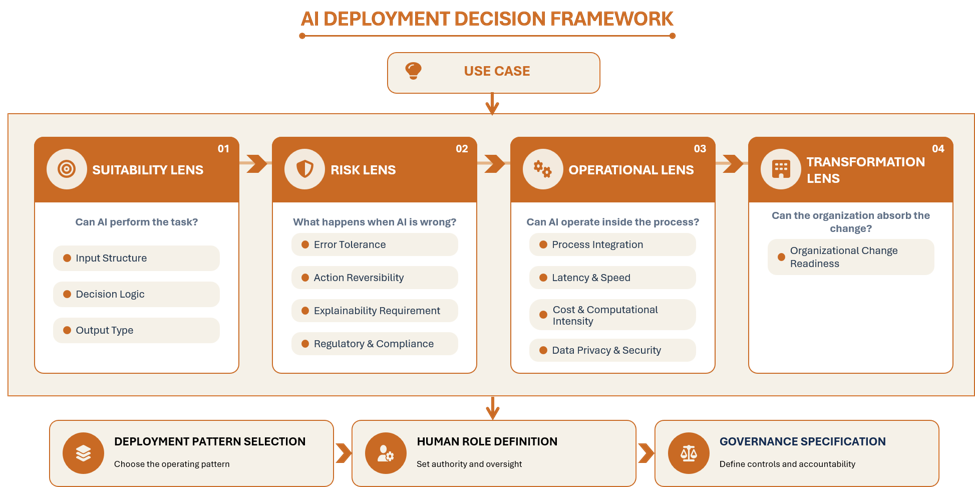
Figure 1: AI Deployment Decision Framework
Suitability Lens
The focus of the suitability lens is to analyze a task and determine whether AI can perform the task technically. This lens examines three aspects of the task, namely input structure, decision logic, and output type. It begins by ascertaining whether the task is a rule, a prediction, judgment, or generation problem. This classification helps identify the most appropriate approach to be deployed, such as software code, rule engine, machine learning, human judgment, or generative AI.
Input structure.
This axis measures the degree to which the inputs to process steps are predictable, standardized, and machine-readable. If the input is fully structured, it favors code or ML, and generative AI is probably unnecessary. If it is unstructured, generative AI becomes the primary candidate for interpretation and extraction and is worth evaluating, subject to the other axes.
Decision logic.
This axis deals with the style of reasoning or rules needed to process inputs into outputs. The implementation approach depends on the type of decision required. For example, deterministic decisions are best handled through code and rules, pattern-based decisions through ML, and creative tasks through generative AI with human review. Decisions that require judgment should remain human-led, with generative AI playing a supportive role. The ground rule is to never substitute a probabilistic system for a deterministic requirement.
Output type.
The structure of the output type is an important parameter in deciding the approach used to produce it. Binary outputs (accept or decline, approve or deny) are best suited to code or traditional ML. Numerical risk scores or rankings (risk score, fraud probability, severity estimate) are naturally suited to traditional ML with code-applied thresholds. Structured data outputs (extraction, form population, data transformation) can be handled with code, ML, or generative AI. Unstructured outputs (free-text narratives, summaries, correspondence) are best suited to generative AI.
Risk lens
The focus of the risk lens is to assess the capability of the organization to safely tolerate AI in a specific task. This lens examines four aspects of the task, namely error tolerance, action reversibility, explainability requirements, and regulatory and compliance exposure. It begins by answering the question, "What happens when AI is wrong?" to determine the consequences of AI failure. This helps identify whether autonomous execution is prohibited or permitted and, if permitted, the necessary controls to mitigate risk and maintain compliance.
Error tolerance.
Error tolerance defines the level of error an organization can accept for a task before the consequences become unacceptable. Steps with zero error tolerance, such as regulatory violations, safety controls, and financial calculations, must always be correct. These tasks are unsuitable for probabilistic systems as final decision-makers, making deterministic controls, code-based execution, and human oversight the preferred approach. Tasks with moderate error tolerance can accommodate errors if they are detectable and corrected before causing material impact. These tasks are suitable candidates for generative AI when supported by human review and exception-handling workflows. Tasks with high error tolerance have limited consequences and can be corrected easily, allowing generative AI to operate with greater autonomy while risk is managed through periodic human monitoring.
Action reversibility.
Action reversibility assesses whether the consequences of an AI error can be undone once a task has been executed. Before approving any AI design for a process step, assess whether the actions triggered at that step are reversible and the impact that irreversibility would cause. Irreversible actions in high-risk or high-impact tasks require near-zero error tolerance from the AI system and human approval. In these cases, human approval must not be treated as an optional escalation path but must be built as a mandatory step in the workflow before the action is taken.
Explainability requirement.
Explainability is the ability to reconstruct, interpret, and defend a decision after it has been made. In many business contexts, this requirement is not merely technical but also a legal, regulatory, or ethical obligation. For probabilistic systems, explaining intermediate reasoning requires significant technical design effort, which can result in slower processes. System design therefore involves a trade-off between speed and explainability. Based on the business context, a system can be designed to provide explainability at the overall action level rather than the step level. If every element of a process must be fully traceable, it generally favors code, constrained ML, and human review. Where the requirement for explainability is partial or low, and only a rationale rather than full reconstruction is required, generative AI is appropriate.
Regulatory and compliance exposure.
Regulatory and compliance exposure assesses the extent to which a process step is subject to legal, regulatory, or compliance obligations. These obligations must be mapped before designing the technical architecture. Some process steps carry direct regulatory exposure, produce outputs subject to adverse action disclosure, or create systemic regulatory risk. An error at these steps does not simply cost money or compromise customer experience. It creates legal liability, triggers regulatory examination findings, and may require remediation. This axis must be evaluated independently of explainability and error tolerance because its consequences are qualitatively different. If the step has no direct regulatory exposure, it offers broader latitude for AI. However, when there is direct regulatory exposure, AI may assist; however, deterministic audit trails, human accountability, and regulator-ready documentation are mandatory.
Operational Lens
The focus of the operational viability lens is to assess whether AI can operate efficiently within a specific task or process. This lens examines four aspects of the task, namely process integration, latency and speed, cost and computational intensity, and data privacy and security. It determines the practicality of deploying AI in a production environment. This helps identify if the solution is limited to a pilot, production-ready, scalable at the enterprise level, or economically infeasible.
Process integration.
Process integration measures how closely a task is connected to other workflows, systems, and external actors. An isolated task has different requirements from one that is part of a larger process, where it may need to trigger downstream actions, interact with multiple systems, or coordinate with actors outside its own boundary. Unlike the other axes, process integration does not distinguish between code, traditional ML, and generative AI. In all three cases, the workflow path is predefined, including the systems involved, the sequence of steps, and the decision rules.
This axis becomes more important with agentic processes, where the path is dynamic and determined at runtime. Instead of following a fixed sequence, the process must choose the next step and may require coordination across multiple systems, APIs, approvals, and handoffs based on intermediate results. Such workflows require an orchestration layer that determines the execution path before any individual step is performed.
Latency and speed.
Latency and speed requirements assess the time sensitivity of a task and the speed at which an output is required. Regardless of how well a task scores on other axes, tasks that require real-time or sub-second execution are generally better suited to traditional code or machine learning. Generative AI may be unsuitable for such tasks unless the deployment is specifically engineered for sub-second response times and the model is heavily constrained. In production environments, token-by-token inference, multi-step reasoning, and tool calls introduce latency. When tasks can be executed synchronously within acceptable response times or asynchronously, generative AI and agentic AI become more practical options.
Cost and computational intensity.
Cost and computational intensity assess the economic viability of AI deployment by evaluating the cost per transaction and the overall budget impact of operating the solution. A technically effective approach that is uneconomical at the required scale is not a viable option. The cost assessment should also cover governance, verification, exception handling, and the continuing operational overhead of maintaining the system. It should also account for common platform investments that are incurred upfront and can be shared across multiple use cases. As a rule of thumb, high-volume tasks with already low transaction costs often make generative AI economically unattractive, even when it is functionally suitable, because token-based processing and multi-step reasoning can increase operating costs beyond the value delivered.
Data privacy and security.
Data privacy and security assess the sensitivity of the data involved in a task and the level of privacy, security, and compliance controls required for its use. This axis influences which AI infrastructure is appropriate, not whether AI should be deployed. The nature of the data should be classified before selecting the deployment architecture. Public or non-sensitive data provide the broadest latitude for AI approaches and hosting models. The use of internal intellectual property, highly regulated data, or personal data does not automatically preclude AI adoption. Instead, it constrains the choice of infrastructure and controls. While public or weakly governed AI environments are generally unsuitable, such use cases require enterprise-controlled or private deployments that adhere to private-by-default architectures, deterministic controls, data-masking pipelines, and human accountability.
Transformation Lens
The focus of the transformation lens is to assess the organization's ability to adopt, operate, and sustain an AI solution. This lens examines the factors that determine the level of organizational, process, and capability change required to support the solution. It begins by answering the question, "Can the organization operate the solution after deployment?" and assesses the level of organizational change required. This helps identify whether the solution fits the existing operating model, requires targeted process and capability changes, requires enterprise-wide transformation, or is not viable because of organizational constraints.
Organization change readiness.
Organization change readiness assesses the extent to which an organization is prepared to adopt and operate an AI solution. It is based on the premise that technical suitability alone does not guarantee success. To score highly on readiness, an organization must have executive sponsorship, a well-defined AI strategy, clean data, skilled practitioners, governance infrastructure, process maturity, and the change management capacity to absorb a new operating model. Regardless of the other lenses, organizations that score low on readiness may be unable to deploy AI successfully. It is suggested that organizations scoring low on change readiness address foundational gaps before pursuing major AI initiatives.
The Decision Path
Applying the four lenses and 12 axes without a clear decision sequence can create analysis paralysis. The journey starts by selecting a priority process for which the organization is actively considering AI investment and mapping each step in granular detail. The override axes, namely latency and speed, action reversibility, regulatory and compliance exposure, and data privacy and security, should be assessed first because failure on any of these aspects can eliminate an otherwise attractive option regardless of how well it performs on the remaining axes. If a step passes assessment against the override axes, the remaining axes should be evaluated individually. After documenting the axis profile and recommendation, the human role should be defined, ranging from no human involvement to a human acting as the sole decision-maker. Finally, governance specifications should be established for every step where AI is deployed.
The enterprise narrative around AI has assumed that technological capability creates an obligation to automate. This assumption is now demonstrably incorrect. As a ground rule, the principle of correct design is to apply the simplicity principle by choosing the simplest approach that can meet the business requirement for each step. Escalation from traditional code to ML to generative AI to agentic AI should be made only when the simpler approach genuinely cannot do the job and the step genuinely requires the additional capability. Solution complexity is a cost, not a benefit. Every additional layer of technical complexity in a process design adds cost, introduces failure modes, increases governance burden, and makes the system harder to understand, maintain, and improve.
The 12-axis framework guides AI enthusiasm and forces organizations to ask, at every stage of decision-making, "What does this step need?" It forces the answer to be specific, not aspirational. It then directs that answer toward the simplest and most efficient approach, rather than the most fashionable one.