This is the third of three parts. The first two parts are here and here.
The biggest mistake we can make regarding artificial intelligence is to underestimate it. – Murat Durmus
Artificial intelligence (AI), especially generative and agentic AI, has evolved in ways that changes the foundations on which insurance coverages are constructed. These systems that not long ago only supported human decision-making now generate outcomes, pursue objectives, and act with limited or no supervision. When decision-making becomes autonomous, the sources of loss stop adhering to the assumptions on which traditional coverages were designed.
The emergence of any significant technology has brought efficiency gains alongside new uncertainties. The insurance industry has responded by absorbing these technologies into its processes and recalibrating its risk portfolio, adjusting existing coverages or introducing new ones as needed. Through this iterative adaptation, the industry has been comfortable with uncertainty that emerges slowly and averages out across populations. This article examines how the disruption caused by generative and agentic AI is introducing structural tension that reshapes the insurance coverage landscape.
The Structural Misfit
The disruption introduced by generative and agentic AI is unprecedented in nature, pace, and magnitude. These systems compress time, amplify reach, and embed decisions directly into operations. The result is not simply increased risk, but risk that accumulates and manifests through unfamiliar loss pathways. Not all risks arising from generative and agentic AI belong to new categories. Some map to existing liabilities, though they emerge through radically different mechanisms and can be addressed through targeted modifications to existing lines and policy structures. For many others, existing structures will prove insufficient, leaving coverage gaps that require new coverage constructs. These will require fundamentally novel approaches that recognize autonomy and governance failure as primary risk drivers. (See Figure 1).
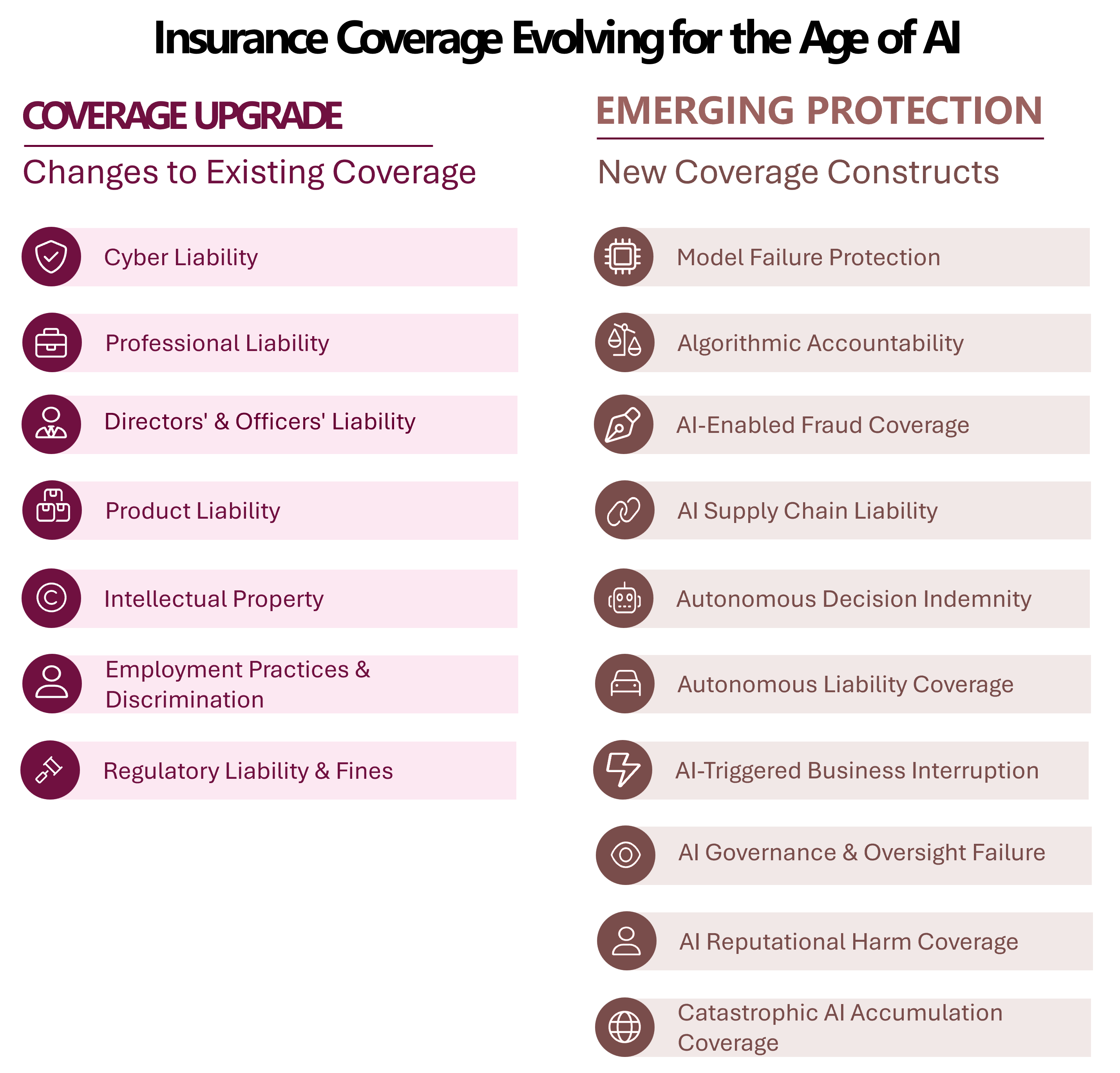
Figure 1: Insurance Coverages
Changes to Existing Coverage
Generative and agentic AI systems will amplify the existing risks across categories such as cyber, professional liability, product liability, directors' and officers' cover, intellectual property, discrimination, and regulatory exposure. However, their triggers and assumptions regarding loss arising from the systems that learn, act autonomously, and operate at machine scale will be radically different from those of traditional systems. As autonomy increases, these coverage lines address only fragments of AI-driven loss. The corrective action for these risks does not require reinventing insurance, but requires recalibration of how risk is assessed, priced, and bounded. Risk assessment must move from static design-time review to continuous evaluation of live system behavior, with emphasis on autonomy, interaction effects, and loss accumulation velocity. Pricing must reflect governance maturity, and the capacity to intervene before loss escalates, rather than relying solely on historical frequency.
Cyber Liability
Existing cyber policies are designed to cover risks such as unauthorized access, data breaches, and system failure. They are not designed for AI-specific attack vectors such as data poisoning, adversarial prompt injections, and model inversion. Insurers must design explicit coverages for risks such as AI-generated fraud, including synthetic identity attacks, deepfake-enabled social engineering, and fabricated claims evidence. Policy language must also clarify whether AI-initiated actions constitute covered events or excluded intentional acts, and whether autonomous agents fall within the policy's definition of an insured actor. Accumulation provisions require recalibration, as a single model compromise can generate simultaneous losses across all deployments of that model, a correlation structure that conventional cyber sub-limits and aggregation clauses were not designed to contain.
Professional Liability
Insurance products for professional liability and errors and omissions were designed with the core premise of a human professional making a demonstrably sub-standard decision. AI disrupts that model. New coverage must respond when a professional error results from reliance on an AI output that was hallucinated, degraded, or mis-calibrated, rather than from a direct failure of human judgment. Policy language must also address whether deploying AI without adequate validation constitutes a failure of professional duty, as courts may affirm that it does. Where AI delivers professional services directly to clients, coverage must respond to AI-generated errors without requiring proof that a named professional was personally at fault.
Directors' and Officers' Liability
D&O exposure from AI accumulates rapidly. Primary exposures include securities claims arising from misleading AI-related disclosures, such as overstated capability, understated risk, or failure to disclose material AI dependencies. They also include derivative claims where boards failed to establish adequate AI governance before a material loss, and enforcement actions under emerging AI regulatory frameworks that carry personal liability for designated responsible persons. Policies must confirm coverage for regulatory defense costs and fines where insurable under applicable law. Coverage for individual executives subject to AI-specific personal regulatory liability should be explicitly confirmed.
Product Liability
AI-embedded products create liability exposure that existing product liability frameworks address only partially. Coverage must respond to harm caused by AI components that operate within the specified terms but generate harmful outputs in deployment contexts the developer did not anticipate. This behavior does not constitute a traditional defect, and standard product policy triggers do not capture it. Post-sale updates to a model that changes the behavior of the product without the buyer's knowledge create new liability events. When products integrate third-party AI models, deploying organizations may face liability for behavior they did not design, test, or control. Coverage for such indemnity claims must be explicit and should not be assumed to follow automatically from primary product liability wordings.
Intellectual Property
AI-generated content creates IP exposure that existing media liability and IP policies address inconsistently. Coverage must explicitly address copyright infringement arising from AI training on proprietary data and from outputs that reproduce or closely resemble protected works. Coverage must also address trade secret misappropriation where confidential information was included in training datasets or can be recovered through model inversion. It must also address claims that AI-generated content amounts to passing off, false attribution, or violations of personality rights. These exposures are currently split across cyber, media liability, and professional indemnity policies, creating gaps at the boundaries.
Employment Practices Liability and Discrimination Coverage
AI-driven hiring, performance management, and customer pricing tools create active discrimination liability. Coverage must respond to third-party discrimination claims where AI systems produce disparate impact on protected classes and to class action exposure where harm results from the aggregate effect of individually defensible algorithmic decisions. The applicability of employment practices liability to AI-generated discrimination is contested and should not be assumed without explicit language addressing algorithmic decision-making.
Regulatory Liability and Fines Coverage
AI regulatory frameworks emerging across multiple jurisdictions are creating a significant risk of regulatory action for organizations that deploy AI in consequential contexts. As the fine structures vary by jurisdiction in terms of amount and in terms of whether they are insurable, policy language must specify the regulatory regime being covered and must confirm insurability under applicable law. Policy language must also explicitly confirm coverage for regulatory defense costs and fines where insurable, rather than whether such costs fall within existing management liability wordings. Policies must further distinguish between fines arising from AI system failures and fines arising from governance failures, as governance-related fines are frequently uninsurable and should be explicitly excluded to avoid ambiguity and coverage disputes.
New Coverage Constructs
Generative and agentic AI systems introduce risks that legacy liability models cannot address merely through recalibration but instead require a structural response. Risk in autonomous systems rarely traces back to a single human decision or omission. These losses are shaped by distributed contributions across infrastructure, models, data, integration layers, and governance. Errors can originate at multiple points and propagate at machine scale, making causation non-linear and responsibility shared across developers, platform providers, integrators, and deploying organizations. As a result, recalibrating existing coverage may not close these gaps. Insurers must distinguish sources of failure across internal model failure, agent-initiated actions, supply chain failure, and systemic governance failure to construct distinct coverage for each risk.
Model Failure Protection
Model failure protection provides first-party cover for economic loss caused by an organization's own AI models producing systematically incorrect outputs. The exposure is structurally novel because a core analytical system can be wrong in direction and magnitude beyond what capital reserves were provisioned for to absorb. The error may remain invisible until losses have already accumulated. An insurance model that systematically misprices a class of risk may compound losses over months or years before experience diverges enough to trigger review. The coverage provides contingent capital that activates when model performance deviates beyond a defined threshold. It supplies liquidity while the model is retrained or replaced and the affected portfolio restructured.
Algorithmic Accountability Coverage
Algorithmic accountability coverage addresses liability arising from the systematic operation of algorithmic systems, where harm emerges over time rather than from isolated decisions. A pricing or underwriting algorithm can produce disparate impact on a protected class through the aggregate effect of thousands of individually defensible calculations. The resulting liabilities, such as regulatory fines, mandatory restitution, class action settlements, and model remediation costs, may be substantial and may materialize years after deployment. The coverage responds to these aggregate exposures. It also serves as a critical governance function by the insurer, as underwriting requires assessment of model governance quality, bias testing, explainability infrastructure, and audit trail adequacy.
AI-Enabled Fraud Coverage
AI-generated fraud has matured from a targeted threat to a scalable one. Deepfake impersonation, synthetic identity creation, and fabricated evidentiary material are no longer exceptional events but operational risks that existing cyber and professional indemnity policies were not designed to absorb. The risk threatens insurers directly through fabricated claims, synthetic identities in underwriting, and social engineering attacks on financial authorization processes. These are first-party exposures to the insurer and must be addressed in underwriting guidelines. It also creates policyholder liability through executive impersonation fraud and legal costs arising from disputed synthetic evidence. These are third-party liability exposures requiring explicit coverage confirmation.
AI Supply Chain Liability
Most organizations deploying generative AI operate across a technology stack they do not own. That stack is developed, hosted, deployed and maintained by others. When this stack produces harmful output, liability is distributed across all contributors in the chain. Existing technology errors and omissions and product liability policies focus on the deploying organization and do not trace liability upstream to model providers or downstream to integration partners with sufficient precision. AI supply chain liability coverage is structured as a difference-in-conditions cover that fills gaps where primary policies exclude or limit losses.
Autonomous Decision Indemnity
Autonomous decision indemnity provides first-party protection to the insured against direct financial loss caused by an AI agent acting within delegated authority without specific human instruction. As agentic systems operate autonomously, existing coverage does not clearly assign loss when their actions cause harm. The individual or organization did not make the decision that caused the loss, the developer did not deploy the agent in this context, and the operator may have followed reasonable precautions. This coverage provides a financial backstop across that attribution gap while liability is resolved through separate legal or contractual processes.
Autonomous Liability Coverage
Autonomous liability coverage protects owners and operators against third-party claims arising from harm caused by machine decisions. Traditional liability requires proof that a person failed to meet a standard of care. When the proximate cause of loss is an autonomous system that followed its training and optimization objectives rather than acting carelessly, that standard is difficult to apply. The system did not act carelessly but followed its training and optimization objectives. Those objectives may be reasonable in aggregate while still producing harm in a specific instance.
AI-Triggered Business Interruption
As AI becomes embedded in critical revenue workflows, suspending automated decision making can disrupt operations, delay service delivery, and cause material financial loss even without physical damage or an external event. This interruption reflects not infrastructure failure but the activation of control, where stopping the system is the necessary response to emerging risk. Standard business interruption policies require physical damage or an external trigger and do not respond to this loss structure. AI-triggered business interruption coverage responds when an autonomous system is mandatorily shut down by a regulator or board in response to harmful output. It also responds when the system is suspended pending investigation, and when it is voluntarily halted for retraining where operational continuity depends on that system. Loss measurement covers revenue loss during suspension, manual workaround costs, and contractual penalties for service delays.
AI Governance and Oversight Failure Coverage
Regulators are increasingly trying to distinguish between harm caused by an AI system and harm caused by an organization's failure to establish effective oversight, documentation, audit processes, and intervention controls. Governance failure is separately insurable because it is prospective, precedes harm by design, can be evidenced from governance records, and is assessed against defined regulatory standards. Existing management liability policies lack the defined triggers such as AI-specific assessment criteria and remediation cost coverage that AI governance failure requires. Core coverage components include regulatory defense costs and fines where insurable, indemnity for individuals designated as responsible persons under AI regulation, and the costs of mandatory remediation programs.
AI Reputational Harm Coverage
An AI system's public failure, harmful output, or misuse can cause reputational damage that is distinct from legal liability. Existing reputational harm endorsements were designed for executive misconduct and publication liability and do not fit AI-generated incidents that may involve no identifiable human decision. Coverage triggers include public disclosure of a material AI failure resulting in measurable brand damage, regulatory sanction arising from AI-generated harm, and viral spread of harmful AI-generated content linked to the insured's system. Loss measurement covers revenue decline attributable to the incident, crisis communications, brand recovery costs, and AI system remediation required to restore public confidence.
Catastrophic AI Accumulation Cover
A single defect in a widely deployed foundation model, compromised shared infrastructure, or a regulatory action affecting multiple AI-dependent operations can produce correlated losses that exceed any individual insurer's capacity. This accumulation risk is the primary structural obstacle to underwriting AI liability at scale. Catastrophic AI accumulation coverage addresses this through parametric or industry loss triggers that activate when aggregate insured AI losses across a defined market segment exceed a specified threshold. Index-based settlement provides rapid liquidity and avoids causation disputes that are structural in AI claims, given the difficulty of attributing loss across a distributed stack. Without a mechanism to transfer catastrophic accumulation risk to capital markets, insurers cannot write limits sufficient to meet enterprise demand. The main technical obstacle is index construction.
Toward Relevant Coverage
The evolution of generative and agentic AI does not simply expand the volume of insurable risk. It alters the structure of loss itself. Autonomous systems generate exposures that accumulate faster and arise from delegated decision-making authority rather than discrete human acts. Traditional coverage models anchored in negligence, defect, or one-off events no longer respond coherently to this risk. The coverage constructs outlined represent an indicative, not exhaustive, response to that shift. They require insurers to operate not only as a retrospective payer of loss, but as an active participant in governing how intelligent systems behave in production. As AI becomes embedded in consequential decision making, coverage adequacy will depend less on categorizing technology and more on understanding behavior, control, and accumulation.