
An acquisition can close in every way that matters on paper — the deal is signed, the brand of the company being bought is retired, its old website redirects to the acquirer's, the press release goes out — and still not be finished. Not because of anything left undone in the integration plan, but because of something almost nobody's integration plan accounts for: The acquired brand's identity still exists inside AI answer engines.
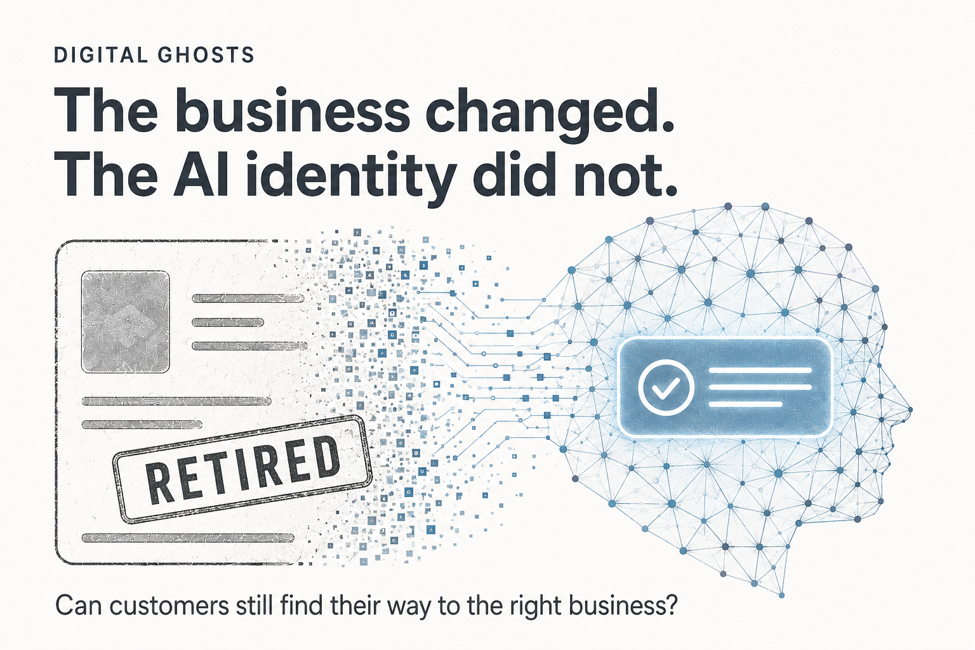
We've started calling this pattern a digital ghost — a retired, rebranded, or acquired brand that ChatGPT, Gemini, Perplexity, Copilot, or Claude continues to describe as if it were still an active, standalone option. The business is gone. The AI's understanding of the business hasn't caught up.
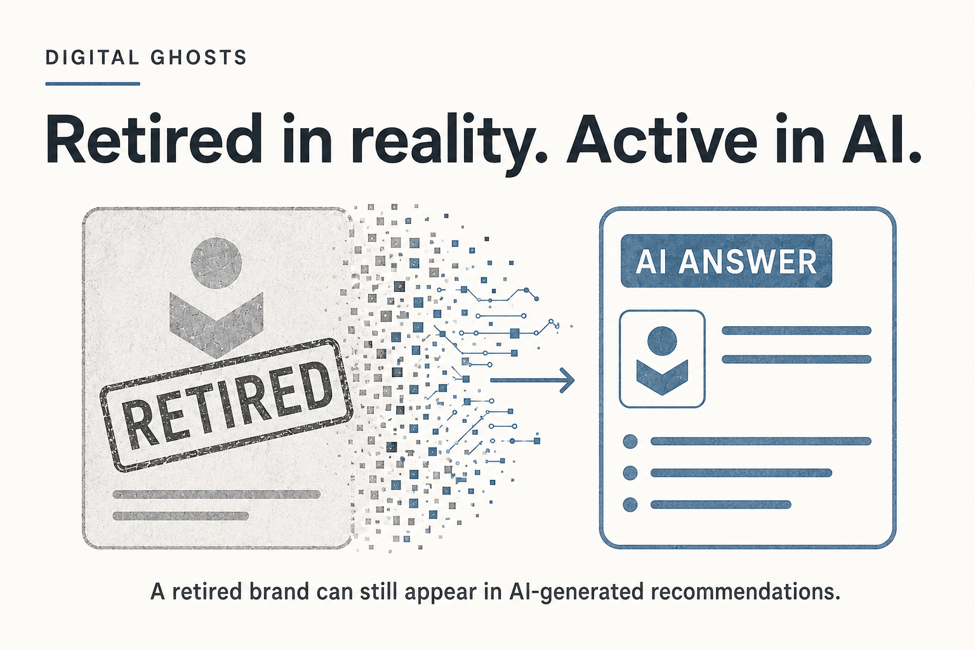
Retired in reality. Active in AI.
The clearest example we've found comes from our own Q2 2026 AIVI Insurance Benchmark, a study of how five major AI systems retrieve, cite, and recommend 134 insurance brands. Liberty Mutual confirmed the retirement of the Safeco brand on April 25, 2026. In the same quarter's data — after that confirmed retirement — Safeco still generated measurable AI-answer presence: real mentions, a 43% recommendation rate, and zero citations connecting any of it back to Liberty Mutual.
That last number is the important one. It's not that the AI systems got the brand wrong. It's that nothing in their answers pointed a customer toward who actually underwrites the policy now. A consumer asking an AI assistant for a recommendation could walk away with a real, specific answer that has no path back to the company actually offering the product today.
This isn't a hallucination in the usual sense — it's not inventing a fact. It's closer to a synchronization failure. AI systems build their understanding of brands from a mix of training data and retrieved web content, and neither updates on the same schedule as a corporate transaction. A press release, a 10-K filing, and a website redirect are all real signals that a business changed hands. None of them is a message an AI system is guaranteed to receive, weigh correctly, or propagate into the next thing it tells someone.
The website moved. The AI identity did not.
The instinct, understandably, is to treat this as a technical SEO problem: redirect the old domain, update the schema markup, merge the entities in the knowledge graph, and move on. Those steps matter — but they solve the problem search engines have, not the one AI answer engines have.
A 301 redirect tells a crawler where a page went. It doesn't tell a language model to stop describing the old brand as though it still exists independently, because the model isn't re-crawling your site every time someone asks it a question — it's drawing on a learned, compressed representation of what it already knows, refreshed unevenly and on nobody's predictable timeline. You can do everything right on your own domain and still have an AI system confidently describe your acquired brand as a going concern, months or years after it stopped being one.
That's the uncomfortable part for anyone running post-merger brand integration: the tools that fixed this problem for search don't fully fix it for AI. It needs to be treated as its own layer of the integration plan, not a byproduct of the ones already in place.
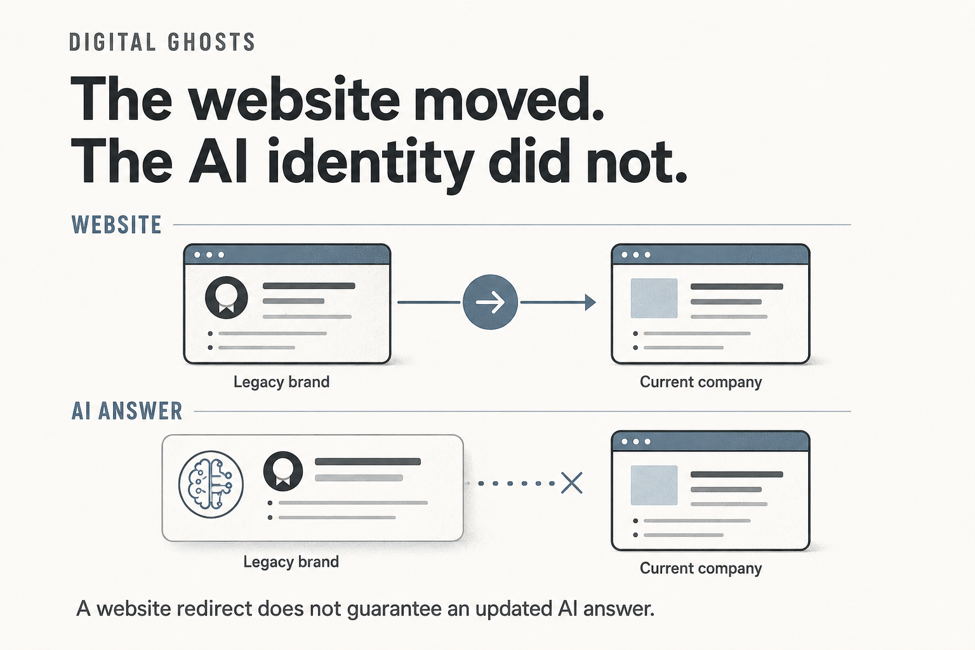
The business changed. The AI identity did not.
Nothing about this is specific to insurance, or to Safeco, or to any one deal. Every industry that runs on M&A — and few run on it as continuously as insurance, between carrier consolidation, MGA acquisitions, and insurtech wind-downs — produces the exact conditions a digital ghost needs: a legacy brand identity, a change in ownership, and an AI-answer layer with no obligation to catch up on its own schedule. The mechanism is the same regardless of what industry the acquired brand competed in.
What varies is how much the problem matters, and that's a harder question than it looks. It's tempting to reach for a dollar figure — X% of AI-driven inquiries times a conversion rate times a customer value, an instant "cost of the problem." We built several versions of that calculation before deciding none of them held up to our own scrutiny. Every version required assumptions about customer behavior — whether someone recommended a defunct brand name actually abandons the purchase, gets confused, or finds their way to the real company anyway — that we can't verify from outside data. Getting a defensible number requires either a controlled study of real customer behavior or access to the acquiring company's own conversion data. Anything short of that is a guess wearing a decimal point.
What doesn't require a guess is the underlying question, which any brand or integration leader can actually test: can a customer who encounters your retired brand's name in an AI answer find their way to the right product, agent, or service channel today? Verify what the AI systems are actually saying. Walk the paths a confused customer would walk — the old domain, the agent directory, the quote flow, the phone line — and see where they lead. What comes back from that exercise usually sorts into one of a few honest categories: a real problem worth fixing now, a real problem worth measuring more before committing budget to it, an inconsistency that turns out not to matter because the recovery paths already work, or simply not enough information yet to say either way. All four are legitimate answers. None of them require inventing a number to be worth acting on.
What this means for the next deal
M&A integration checklists were built for a world where a retired brand's presence outside the company was mostly a matter of search rankings and leftover backlinks — things that decay naturally and don't actively mislead anyone in the meantime. AI answer engines don't decay the same way. A digital ghost can sit at full strength for years, confidently recommended, with nothing correcting it, because there's no browser tab open to notice.
The fix isn't complicated to describe, even if it's not yet a standard line item: know what AI systems are actually saying about the brand you retired, and know whether a customer who hears it can still find their way to the business that's actually there. Most integration plans don't ask that question yet. Most of the acquisitions currently closing will eventually need to.