
OpenAI's recently released GPT-6 Astra again pushes AI capabilities forward. It is smarter, can handle more tasks, and makes it even easier to feel that AI is gradually moving toward "understanding the world." But the model leaves a question open:
How do we tell whether the model truly understands? And what, exactly, does it understand?
Not long ago, I happened to read an article from HalfJourney Lab about AI image generation. The author wrote:
There are effects without a cause.
That issue doesn't just affect images but relates broadly to how AI comes to know the world and is increasingly hard to notice.
To explore that problem and how to think about it, let's start with AI's drawing errors.
1. AI Image Problems Are No Longer Just "Drawing Mistakes"
In the past, obvious errors in AI-generated images were not difficult to spot. An extra finger, distorted facial features, garbled text, or broken object structures could often be recognized at a glance.
Today, the situation is different. AI can generate highly natural-looking skin, lighting, depth of field, and materials. In many images, each individual element can look convincing on its own, with no obvious flaw. The real issue has shifted from whether each object is drawn well or correctly to whether, once the elements are placed together, they still obey the rules of the real world.
Let us start with this example.
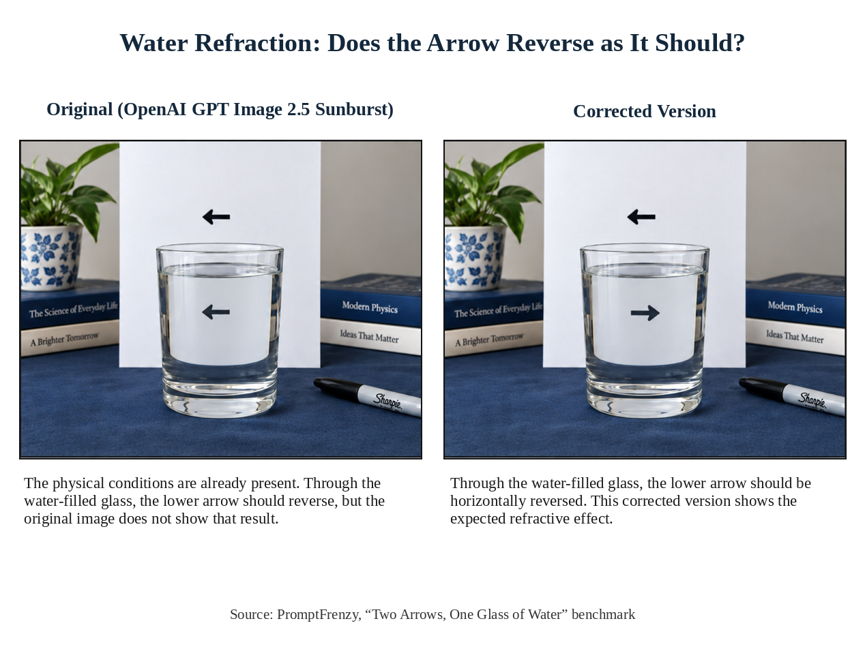
Both arrows on the paper point in the same direction, with a glass of water placed in front of the lower arrow. The glass, the water, and the arrows all look quite natural.
But once the physical conditions are in place, the expected result does not follow.
A cylindrical glass of water causes refraction, so the lower arrow viewed through the water should appear horizontally reversed. In the original generated image, however, both arrows still point in the same direction.
That is what makes the example interesting. AI did not draw the glass incorrectly, nor did it draw the water or the arrows incorrectly. It got the objects in the scene right, yet failed to derive the result that should necessarily emerge when those objects are placed together.
Now look at the second example.
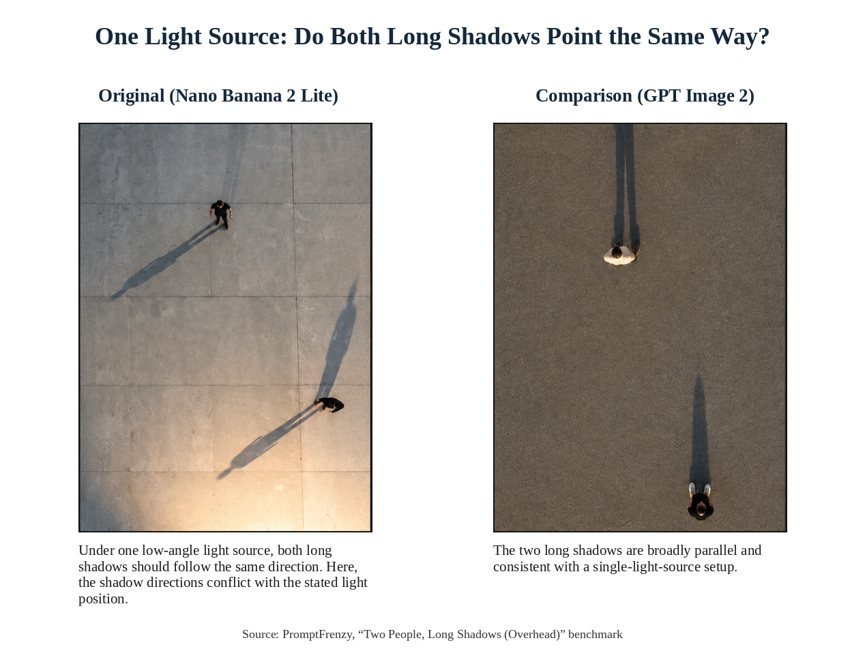
Two people stand under a low-angle light source, and the long shadows themselves look quite natural. If we look at either person in isolation, it is difficult to say that anything is wrong with the image.
But there is only one light source. The position of that light source, the positions of the people, and the directions of their shadows should therefore share a consistent geometric relationship.
Once we examine the whole image as a single physical space, the problem becomes visible: AI can generate highly realistic-looking shadows without reliably preserving the relationship between the light source and those shadows.
This is also why today's AI images are becoming harder to judge simply by asking, "Where is the drawing mistake?"
What exposes the problem is the relationship.
2. Photography, Painting, and AI Generation
This made me think again about what, exactly, separates photography, painting, and AI-generated images.
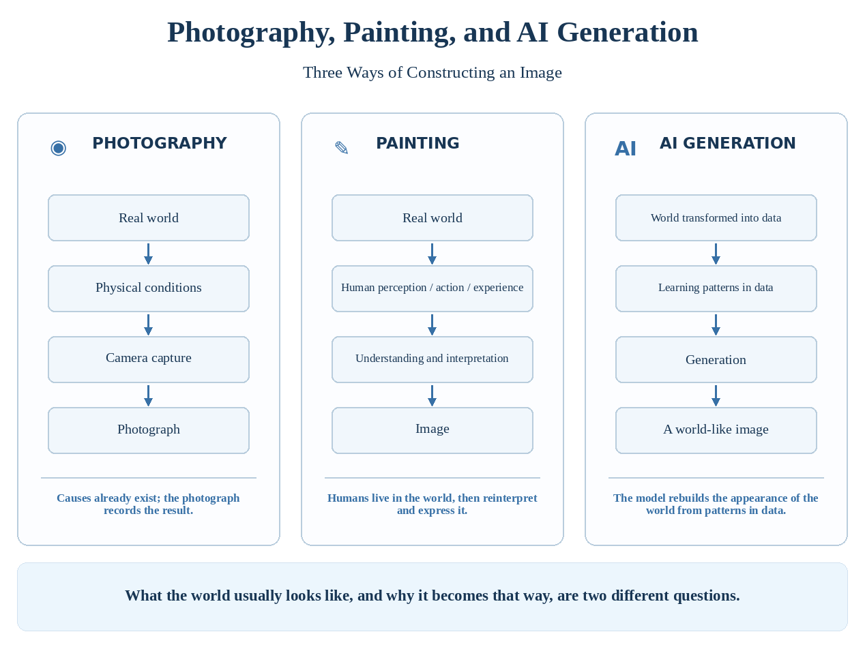
Photography begins by capturing the real world.
Cameras differ in capability, and photographers in skill, but the light, shadows, reflections, and depth of field in a photograph are, in principle, produced by physical conditions that actually existed at the moment of capture. An object blocks light, so a shadow appears. Light reaches the eyes or lenses, so a reflection may appear. The distances between objects and the lens, together with aperture, focal length, and other conditions, produce different degrees of depth of field.
A photograph therefore records a result whose causes already existed before the shutter was pressed.
Painting is different.
A painter does not directly capture reality, but reinterprets it. The painter relies on tools, technique, and an understanding of the world to reconstruct light, shadow, space, and objects on a canvas.
A painter knows where a shadow should fall not simply because they have seen many shadows, but because they live in this world. They have watched light move, seen what happens when an object blocks it, and can change their own position and observe how the world in front of them changes in response.
In form, AI image generation is closer to the latter. It does not directly capture reality. It generates a scene that looks like the real world according to patterns it has learned.
The difference is that human understanding of the world develops over time through perception, action, and feedback; AI does not live in the world in the way humans do.
Its starting point for knowing the world is data. Its mechanism is to learn recurring patterns in that data and then use those patterns to regenerate and depict the world.
It has seen countless examples in which eyes appear with catchlights, portraits with blurred backgrounds, and glasses, reflections, shadows, and scenes recur in familiar combinations.
From this data, the model learns what the world looks like. But what the world usually looks like and why it becomes that way are two different questions.
3. Reproducing the World and Understanding It
Today's AI can generate photographs that look real, language that sounds human, and analyses that resemble those of experts. It can also produce strong results across many complex tasks. These abilities are signs of technical progress, but a system's ability to reproduce an outcome does not prove that it has mastered the mechanism that produces it.
Drawing a shadow is not the same as understanding how a shadow forms. Generating a reflection is not the same as knowing which light source should produce it. The real dividing line here, I believe, is causality.
If "reproducing the world" mainly answers the question, what do things usually look like? then "understanding the world" must at least go one step further: Why did this result appear? If the conditions change, how should the result change? Which phenomena merely occur together frequently, and which are linked by more stable generative relationships?
This is why an AI-generated image can look highly realistic in each local detail while still producing a scene that is physically impossible as a whole. A model can learn from data what an outcome usually looks like without necessarily possessing a sufficiently stable causal structure to constrain all of those local outcomes within the same world.
So the important issue is not simply "effects without causes" or "causes without effects." It is that, within AI's worldview, the relationship between cause and effect can break down.
Sometimes AI generates a shadow or reflection without reliably grasping the conditions that produce it, leading to physically inconsistent results. At other times, as in the glass-and-arrow example, the physical conditions are already present but the expected refractive result does not appear. These problems look different, but they point to the same underlying issue:
AI can reproduce the appearance of the world without necessarily possessing a stable grasp of the causes that produce those appearances.
4. When AI Starts to Look Like an Expert
This question is worth carrying beyond images, because what AI generates today is no longer limited to images. It answers questions in medicine, finance, law, insurance, manufacturing, and management; it organizes data, analyzes risk, makes recommendations, and increasingly produces language and reports that sound like the work of experts.
At that point, it is easy to make a further inference: if AI's answers already look so much like an expert's, has it acquired expert capability?
The image examples remind us to be careful with that inference. A correctly shaped shadow in an image does not prove that the system understands how light produces shadows. In the same way, an answer that matches an expert's answer does not, by itself, allow us to infer that AI went through the same process of judgment.
Consider an underwriter making an underwriting decision. Behind that decision may lie relationships among medical histories, projections of future risk, judgments about data reliability, exceptions, and years of accumulated experience. If we hand the same task to AI, even when it reaches the same conclusion, we still cannot confirm which of those relationships it has actually mastered, or whether those relationships will continue to hold when the conditions change.
Some people may say: But can't we already see AI explain its reasoning step by step?
Reasoning, however, is not causality. The ability to produce a chain of reasoning does not mean that a system has mastered causal relationships in the real world. A model can organize reasons, steps, and conclusions into a highly coherent explanation based on learned patterns. The real question is whether, when one condition changes, it can reliably identify which outcomes must also change. That is the causal capability I am referring to here.
A correct answer, or a line of reasoning that appears plausible, is not enough on its own to prove that a system has formed a stable causal understanding. That is why I prefer to describe "expertise" this way:
AI can learn how expertise should appear without necessarily understanding how expertise is produced.
This is not a denial of AI's capabilities. Precisely because AI is becoming increasingly good at reproducing expert outcomes, we need to know whether what we are seeing is similarity in the result, or whether the ability to produce that result is also beginning to form.
The two are not the same.
5. Causality May Be One Threshold for Understanding the World
The arrival of GPT-6 Astra is simply another round of technological evolution. We can expect the next generation of models to be stronger still, capable of handling more tasks and further narrowing the gap between humans and AI in outward performance.
As that gap becomes smaller, the question "Does AI understand the world?" becomes larger, not smaller. The closer the outward performance, the harder it becomes to infer from results alone what is happening underneath.
When outputs are still crude, it is easy to see what a model does not know. But when the results become realistic enough, professional enough, and in some tasks even better than the performance of most people, can we still distinguish whether AI is reproducing the world or has begun to understand it?
Causality is one important threshold.
A system that truly understands the relationship between light and shadow should change the shadows, reflections, and brightness patterns across an entire scene when the light source moves. A system that truly grasps professional judgment should, when conditions change, do more than regenerate an answer that sounds more expert. It should know which judgments must change as well, and why.
That is why I think the line 'There are effects without a cause' carries a broader warning. As AI becomes increasingly good at reproducing the world, we also need to keep one distinction clear:
We cannot equate "looking like it understands" with "understanding."
The appearance of the world can be learned. Understanding why the world works as it does is a different, higher-order capability.
As AI's outward performance grows closer to human performance, and even surpasses it in some tasks, reproducing the world and understanding the world need to be treated as two distinct things.