Paul Carroll
As part of our push for insurers to increasingly adopt a Predict & Prevent model, I’ve been tracking water sensors for a long time. Leaks cause so much damage to homes. The sensors I’ve tracked have improved a lot, getting ever closer to the point where they make clear economic sense—where the savings from prevention exceed the cost of deployment. You have a different approach that has convinced a lot of insurers that you’ve passed that tipping point.
To start us off, would you tell us what your approach looks like?
Craig Foster
We work with 28 insurers around the world. All our partners offer the sensor for free. If you say “yes” to an agent or click on the button, the device arrives in the post. The sensor has a clip on the back, and you attach it to your home’s main water pipe, near the shutoff valve. It takes a couple of minutes.
That unit can detect a leak anywhere on the main water system, and it's sensitive down to about a teaspoon of water per minute—we say five milliliters per minute in the U.K. It's about 100 times more sensitive than an ultrasonic sensor, which is the next best approach without physically cutting the pipe.
If we detect a leak, we'll tell you what to do through the app. If it looks like you've got a hidden problem, we'll send a LeakBot plumber to the house. And there's absolutely no charge for that—it's all paid for by the insurance company.
Paul Carroll
A lot of leak sensors shut off the water automatically when they detect a problem. Why do you take a different approach?
Craig Foster
This is a key point. We're detecting really small leaks before they've had a chance to build up and cause a big problem.
The first response is often what you've said, Paul: "Wait a minute. Don't you need a shutoff valve to stop the damage?" But the important insight is that plumbing rarely goes from being fine to a sudden high release of water without any problem in between—unless there's some kind of DIY mistake or a pipe freezes and thaws, and there’s a break.
In those instances, we'll alert the customer and say, "Hey, water's running. Do you know what it is?" But we deliver the ROI for partners by catching leaks much, much earlier—months earlier. Leaks start very small, with drips, then get exponentially worse over time, but you don't know about it as the homeowner because the leaks are hidden. They're in cavity walls. They're in ceilings. They're down the back of cupboards. They're in places where you just don't see them.
Carriers will tell us, "We get a lot of claims on water heaters. They’ll fail and suddenly leak gallons and gallons of water in a basement, and it's a $40,000 claim. You wouldn't be able to shut the water off in time." But we’ll show them that that sort of problem is a really high percentage of what our plumbers fix every day.
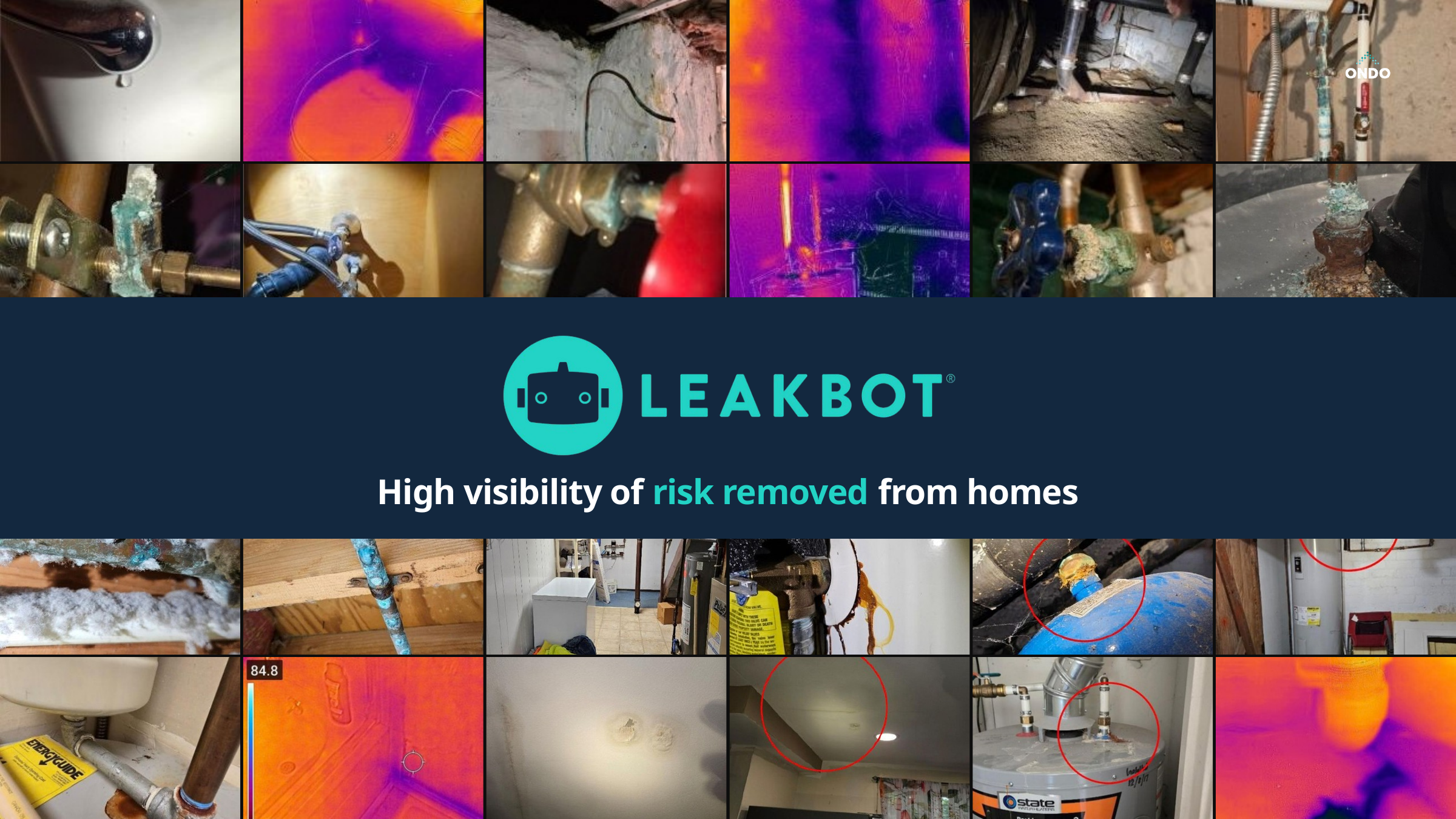
We'll get alerted to a leak, go to the home, and find a pinhole leak on the pipe into the water heater—sometimes with just a bit of green calcification and a tiny drip. It could keep getting exponentially worse until there is a faster flow, and then the pipe pops. That would normally be the first time the homeowner knows there’s a problem—but we’ve fixed it.
In the U.S., it's almost like carriers have been trained that a shutoff valve is the gold standard. They’re expensive, so carriers will sometimes talk to us as they look for a cheaper alternative. But we convince them that we’re not just more cost-effective, we’re a better solution.
Paul Carroll
Once you know a home is leaking a teaspoon of water a minute, how do you find the problem? Homes are big places.
Craig Foster
If we're detecting a small leak, we'll alert the customer and guide them through steps to check common causes. Maybe they’ve been in the garden and haven’t completely turned the hose off. Or they’ve had guests, who’ve used a bathroom they don’t use all the time, and the tap is dripping. 60% of the time, customers solve the problem themselves.
If the customer says, "I can't see what it is. Can you help me?" then we suggest booking one of our plumbers. The genesis for the company was actually as part of a home services group in the U.K. that also has a big business in the U.S. called HomeServe. So we have a heritage in plumbing and brought a lot of expertise with us when we spun out.
Our plumbers use thermal imaging cameras, and we have patented technology that pressure tests the property. The plumbers will find and fix a problem, then run the test again. Sometimes they fix one thing, sometimes two—I think the record is 11 things, in a big house in Virginia. They'll keep going until the property is leak-free.
We train our plumbers to think like adjusters. They take pictures of what they fixed, before and after. And let’s say they fix a hidden feed into a tap or a toilet in an upstairs bathroom—they go to the room below and take a wide photograph of that space. All that information goes into partner portals so our insurance partners can review the evidence of the risks we're removing from properties. If you show these reports to anyone in the claims team, they recognize them instantly.
The other day, someone at a carrier partner who used to work in claims looked at a photo of a basement where we fixed a leak and said, "Oh, man, that would have been a $30,000 claim." Why so expensive? He said, "Look at the floor—it's continuous all the way through that finished basement. If that gets damaged, even a small section, we have to replace the whole floor."
Even before we get to the statistical evidence about the ROI we provide, this all feels right to the claims guys. We’re fixing the things that definitely do cause them claims.
Paul Carroll
The economic argument for prevention is always complex. Homeowners save on the deductible and avoid enormous hassle, while the carrier saves money by preventing losses and presumably improves retention by increasing customer satisfaction. But how do you assemble those four, sometimes amorphous benefits into a case that convinces a carrier to distribute leak detection devices for free?
Craig Foster
We have a very simple proposition. Our solution delivers a straight return on investment on the claims saved versus the cost of deployment. And we make that return easy to measure.
We charge a single fee for an active device in an insured home: $60 a year. That fee includes everything. There's no extra hardware fee. There's no shipment fee. There’s no fee for customer support, including us sending a plumber into the home as many times as we need to get that property leak-free. The carrier only pays for the devices that are installed. If you ship 100 to your customers, and 70 get installed, we take the hit on the other 30.
So all you need to know is if you're going to save more than $60 in underwriting costs a year per home.
This is really the nub of our recent white paper. We've proved, time and time again, based on a highly statistically relevant sample, that we can reduce the frequency of leak claims by 60%. In the U.S., on average, that delivers a 40% return on investment, and that’s just based on frequency. There is a severity benefit, too, because we tend to take out the bigger claims. Customer satisfaction is also fantastic.
Nevertheless, we put all that to the side because the ROI case is clear and easy to measure.
Paul Carroll
I found the analysis in the white paper to be quite sophisticated. For instance, it takes into account the bias that can occur during pilot programs due to self-selection—something many companies conveniently ignore. It also acknowledges that claims actually increase early on as previously unknown problems are discovered and solved, before declining over time. But you’ll keep learning as you continue to scale, so I wonder both where you are now and where you expect to be in the next two or three years.
Craig Foster
We're now up to 360,000 exposure years of data—devices active in homes where we've been consistently sending plumbers and generating thousands and thousands of claims mitigation reports. We ask partners for as much information as they can provide about claims still being experienced by the cohort with LeakBot sensors, and we’re iterating to make the system better.
The biggest issue, by the way, is with customers who got an alert but didn’t think there was a problem and didn’t call out our plumbing service
Paul Carroll
I imagine you see some interesting patterns.
Craig Foster
We've learned a lot about different cohorts and different countries. For example, pipes in 1970s Denmark are particularly high-risk because of the type of plastic used. Victorian properties in the U.K. are very risky because they've got old copper plumbing and lots of bathrooms. We work with NFU, the National Farmers Union, and we're fixing leaks in these huge farmhouses in the middle of the countryside. They've all got like six bathrooms, and the plumbing is 100 years old, so they're just full of leaks.
Paul Carroll
Have you explored joint marketing opportunities with other companies in adjacent spaces, beyond your existing carrier partnerships?
Craig Foster
Bob Marshall [CEO of Ting Labs, whose device detects electrical problems that can cause fires] and I have met many times and exchanged notes a lot. There are lots of synergies.
For one, Bob’s success with Ting has changed the mindset of carriers. We're moving past, “Predict & Prevent sounds like it might be a good idea, but will it really work? Let's maybe do a small test." The mindset is now, “Predict & Prevent is the future.” It's now a question of what the real solutions are that actually deliver a return on investment.
Our partners have found that if a customer has already installed a Ting, they don’t even need to ask if the customer would like a LeakBot. They just send one, and we get the same installation rate as through the opt-in process.
Ting is a great solution, and their success helps us, as well.
Paul Carroll
Any final thoughts?
Craig Foster
The question from U.S. carriers was, “You're a U.K. company. Can you really get this working in the U.S.?”
We're now in 26 states, and we've got the actuarial evidence in the U.S. We're not reliant on the European data, although it's, funnily enough, remarkably consistent.
So we very much see that tipping point, and the U.S. is the key for us in terms of the scale of the opportunity. That's the focus for the business going forward.
Paul Carroll
Thanks, Craig.