

When companies talk about understanding customer needs, they often assume a simple path:
Underlying Need → Observed Demand
A customer has an underlying need, even if they cannot fully articulate it. Through questions, data, and observed behavior, companies try to work backward from what the customer says or chooses, to understand what that person actually needs.
Demand discovery has therefore traditionally been treated as a process of finding something that already exists.
In a previous article, I argued that reproducing an outcome is not the same as understanding the causal mechanism that produced it. The same distinction applies to customer demand: observing what customers choose is not the same as understanding why that choice emerged.
What deserves more attention is the arrow in the middle.
The path from underlying need to observed demand is never empty. What customers see, how they are questioned, what recommendations they receive, and how they interact with a system can all shape the demand that eventually becomes visible.
AI makes this issue more important.
When systems begin deciding what to present, how to rank options, what question to ask next, what to recommend, or what action to take based on a prediction, the observed demand that companies ultimately see may already contain the influence of the system itself.
How much of the demand we observe reflects what the customer already needed, and how much emerged through the interaction itself?
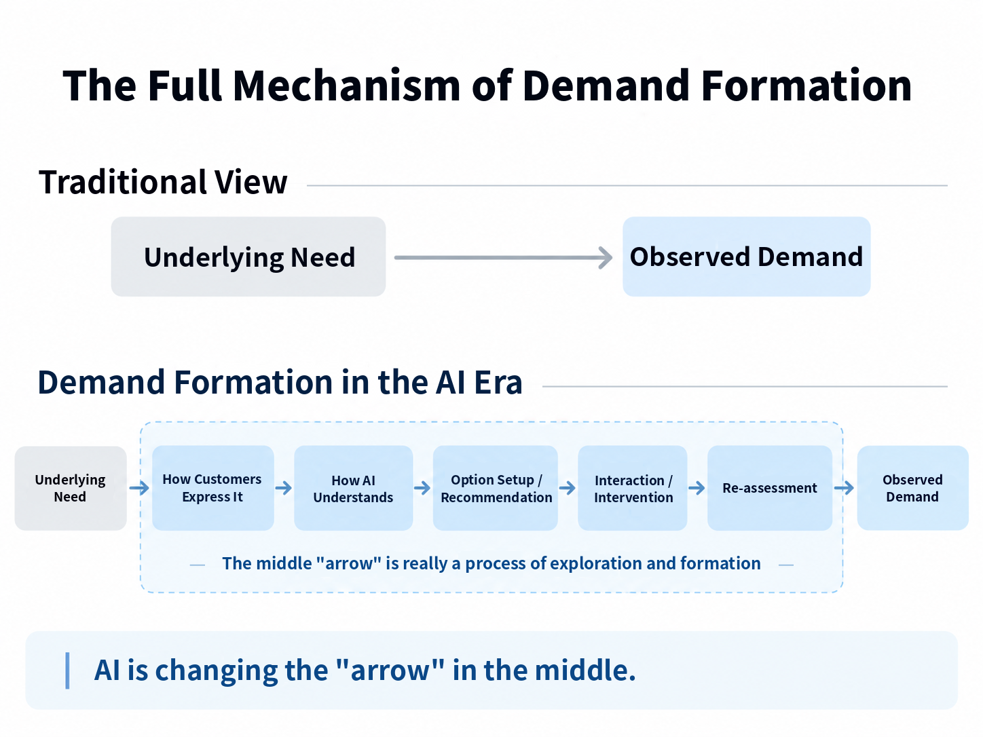
Figure 1. The full mechanism of demand formation.
1. We Have Treated the "Arrow" as Too Simple
Suppose a customer chooses Product A from three options. The intuitive conclusion is straightforward:
The customer chose A, so A must best reflect their preference.
But before making that inference, there is another question:
Why did this customer see these three options in the first place?
In the age of recommendation systems, different customers are rarely shown identical choices. A system may use previous behavior, income, browsing history, search activity, and other signals to determine which products are most relevant to present. The real process may therefore look more like this:
The system evaluates the customer → determines which options the customer sees → the customer chooses from those options.
In 2021, researchers from Cornell and Stanford described this problem in a paper titled "Choice Set Confounding in Discrete Choice." Many preference models infer what people prefer from the choices they ultimately make. But the choice set itself may already depend on the chooser's characteristics and existing preferences. Recommendation systems are a classic example.
If that mechanism is ignored, two different things can easily become mixed together:
What the customer already preferred, and what the system chose to place in front of them.
The hotel-booking example in the study makes this easy to understand.
Suppose a recommendation system has already filtered hotels based on a user's preferences, and the user consistently chooses the cheapest hotel among those presented. A model might conclude that price is the dominant factor in that person's preference.
But that conclusion may overstate the importance of price. Location, star rating, or other attributes may already have been filtered earlier in the recommendation process. Once researchers accounted for this confounding, price became less dominant, and other factors became more important.
Preference is not the same as underlying need. But choices and expressed preferences are important behavioral signals companies use to infer what customers need.
That means demand discovery cannot focus only on what the customer ultimately chose. It must also consider the choice environment in which that decision was made.
2. AI Does Not Just Influence What We See. It Can Change What We Choose.
Choice set confounding tells us that a final choice cannot be understood independently of the options that preceded it. But there is an even more direct question:
Can AI recommendations themselves change what people choose?
A 2026 Pension Portfolio Experiment posted on arXiv provides a clear example. Researchers recruited 400 South Korean employees who were actually enrolled in workplace defined-contribution pension plans. In a simulation, participants first allocated a hypothetical pension balance across 11 investment products. They were then randomly assigned one of two AI-generated recommendations: one relatively aggressive and concentrated, the other relatively conservative and diversified.
Participants could then revise their original portfolios. Three findings stand out:
- 81% changed their portfolios after receiving the AI recommendation.
- Among those who revised, 95% moved in the direction suggested by the AI.
- The difference between the two AI recommendations was partially transmitted into the final portfolios: the resulting difference between the two participant groups was about 37% as large as the original difference between the recommendations.
In other words, people did not simply follow the AI wholesale. But different AI recommendations still produced different final decisions.
The effects went beyond superficial portfolio changes. Participants who received the more aggressive recommendation ended up with higher expected returns and volatility, less exposure to low-risk products, and more exposure to high-risk products. The study did not find a significant improvement in risk-adjusted performance, but AI clearly changed the risk structure participants ultimately accepted.
The important point is the causal relationship:
Different AI recommendations produced different final choices.
Participants still retained much of their original judgment. The final decision was therefore neither purely human nor purely AI-generated. It emerged from the interaction between the two.
Now consider what happens next. If a company later observes those revised portfolios and records them as new evidence of "customer preference," that data already contains some of the influence created by the AI itself.
At that point, saying "The customer chose A, therefore the customer prefers A" is no longer a sufficient inference.
3. When a Model Begins to Influence the World It Will Later Observe
This leads to another important idea: Performative Prediction.
In 2020, researchers at UC Berkeley used this term to describe situations in which a prediction, once used to support a decision, changes the very outcome being predicted.
Consider a simple credit example. A bank predicts that a borrower has a high probability of default and therefore charges a higher interest rate. But the higher interest rate increases the borrower's repayment burden, which may itself increase the probability of default. The sequence becomes:
Prediction of high default risk
↓
Higher interest rate
↓
Actual default risk changes
The model appears to describe the world, but once deployed, it also begins to influence the world it is describing. Similar dynamics can occur in traffic prediction, policing, recommendation systems, and financial markets. Applied to demand discovery, the mechanism might look like this:
The model predicts that a customer may need A
↓
A is shown more prominently
↓
A is recommended
↓
The interaction increasingly centers on A
↓
The customer ultimately chooses A
At this point, the first layer of influence has already occurred: AI has affected the customer's choice.
The pension experiment shows that this can happen in practice. But there is a second layer. If the company then uses that choice as training data for the next generation of its model:
The customer chooses A
↓
The system records "customers like this prefer A"
↓
Similar customers are more likely to be shown A in the future
The company is no longer merely observing demand. It is beginning to participate in the formation of the demand it will later observe. This does not mean the model is necessarily wrong. The problem arises when companies forget that their own ranking, recommendation, and interaction mechanisms have already entered the causal process. They may then treat outcomes partly produced by the system as if they were pure evidence of the customer's original preferences.
4. The Path From Underlying Need to Observed Demand Is a Formation Process
The apparently simple relationship:
Underlying Need → Observed Demand
can therefore be expanded into something closer to this:
Underlying Need
↓
Customer Expression
↓
AI Interpretation
↓
Option Configuration / Recommendation
↓
Interaction / Intervention
↓
Customer Reassessment
↓
Observed Demand
Several mechanisms operate inside this process.
- Choice architecture: determines what the customer sees and how alternatives are arranged.
- Interaction: determines how the system asks, responds, and continues the conversation.
- Recommendation: introduces new information and direction into the customer's judgment.
- Intervention: occurs when the company acts on the model's judgment in ways that affect subsequent responses or decisions.
None of these mechanisms is entirely new. What AI changes is its scale, personalization, speed, and ability to operate continuously. There is also an important distinction to make. The fact that demand is shaped through interaction does not necessarily mean it is being distorted.
In many real situations, customers themselves may not fully understand what they need at the beginning. A well-designed discovery process can use questions, comparisons, and different scenarios to help customers clarify what they actually value.
The interaction therefore has two simultaneous functions. On one hand, it generates new signals and reduces uncertainty about the underlying need. On the other hand, the way questions are asked, options are presented, and recommendations are made can also influence how customers think and respond.
In the past, demand discovery was easier to think of primarily as a form of measurement. With AI, measurement and intervention increasingly occur at the same time.
The challenge is therefore not to eliminate intervention altogether. It is to distinguish between signals that reflect a relatively stable underlying need and signals that were caused by a particular question, choice set, or recommendation.
5. From Collecting Answers to Identifying Causes
If a company relies mainly on correlation, the logic is straightforward:
The customer chose A → therefore the customer needs A.
But once the system itself has participated in presenting, recommending, and explaining A, that inference becomes less reliable.
The more important question becomes: If the conditions were different, would the same need still appear?
- Would the customer still choose A if A had not been recommended first?
- If the price changed, would the customer still value the same type of protection?
- If the customer saw a different set of alternatives, would the expressed preference remain?
- If family responsibilities changed, would the need for protection change as well?
These are fundamentally counterfactual questions: If a particular condition had been different, would the outcome also have been different?
The contrast can be summarized as a shift from a traditional approach based on observed behavior and correlation to a causal approach that varies conditions and interventions to test demand hypotheses.
By introducing different conditions and interventions, companies can test competing demand hypotheses. Some changes should theoretically have little effect on a genuine underlying need. Other causal factors, when changed, should produce corresponding changes in demand. When customer responses behave consistently with these causal hypotheses, companies have stronger grounds for believing they are identifying the underlying need rather than merely predicting an observed response.
The choice set confounding research points in the same direction. When companies understand the variables used to assign choice sets and the mechanism by which those choice sets were generated, causal methods such as inverse probability weighting and regression controls can help reduce confounding and recover preferences more accurately.
AI therefore does not make genuine customer needs impossible to understand. But it changes what understanding requires. Companies cannot simply accumulate more behavioral data and expect the truth to emerge automatically. They need to understand the conditions under which each signal was generated, and whether the signal still holds when those conditions change.
A more mature AI demand-discovery process therefore cannot stop at:
Ask questions → collect answers → predict demand
It also needs to:
Form a demand hypothesis
↓
Design appropriate questions and scenarios
↓
Observe responses under different conditions
↓
Control for possible confounding
↓
Continuously revise the judgment of the underlying need
For example, a customer may ultimately choose Product A for very different reasons:
- The customer genuinely needed A from the beginning.
- The system placed A in front of the customer first.
- The system repeatedly recommended A.
- The way the questions were framed directed the customer's attention toward A.
- Other relevant alternatives were never presented.
The observed choice may look identical in every case, but the mechanism that produced it is not.
Interaction is therefore no longer just a way to collect more data. Every interaction can also become a test of a demand hypothesis. The goal is therefore not simply to improve the predictive accuracy of observed demand. It is to improve the company's causal ability to identify underlying need.
Conclusion: Put the Company Back Into the Causal Chain
Traditionally, the challenge of demand discovery has been to look beyond surface-level statements and choices to understand what customers actually need. AI adds a layer. Once a system begins participating in option design, recommendation, questioning, and decision-making, the observed demand that a company sees may already contain the influence of its own AI.
Companies can therefore no longer ask only: How do we infer underlying need from observed demand?
They must also ask: Through what mechanism was this observed demand produced?
And once measurement and intervention can no longer be cleanly separated, companies need more than stronger predictive models. They need causal methods that can continuously improve their ability to identify underlying needs while interacting with and influencing customers.
A mature AI demand-discovery system should incorporate intervention into its design so that every question, option, and interaction helps distinguish among three things:
what the customer already needed, what the system itself helped cause, and what became clearer through the interaction.
If companies want to understand demand in the AI era, they must begin by putting themselves back into the causal chain.