

An international insurance program can give the impression of a single organization acting across several countries. A common renewal date is agreed, instructions are circulated, and the network is expected to deliver a coherent result. Much of what makes that possible, however, remains outside the direct control of whoever coordinates the program. Underwriting authority belongs to local insurers, clients hold information required for policy issuance, and intermediaries work through relationships developed in their respective markets. The network brings these capabilities together without acquiring unrestricted access to them. Each participant must continue to manage its own commitments, resources and commercial priorities, even when the multinational program requires everyone to act within the same timetable.
The coordination challenge at renewal
The difference becomes particularly apparent as renewal approaches. A policy representing a modest premium for a local insurer may be the last outstanding placement in a program spanning 20 countries. For the master broker, a delay threatens the wider renewal timetable. For the insurer, the account still competes with other submissions and technical demands. Between them sits a local intermediary expected to obtain an answer, sometimes without the authority to decide or to change the insurer's priorities. Much of the work we call coordination takes place between the technical ability to do something and the capacity to make it happen when another organization needs it.
An economic framework for understanding coordination
The more I reflect on these situations, the more I am inclined to see an economic structure beneath what we usually describe as problems of responsiveness, cooperation or communication. Those explanations can be fair, although they do not always account for why a straightforward instruction consumes so much time. People allocate scarce attention between obligations with different degrees of urgency and commercial value. Some can decide, others can only request, and those requests come from positions of unequal influence. Supply and demand offer a useful way of examining these differences. The conventional relationship in Figure 1 gives us a reference point before we consider how it changes within an international insurance network.
The four figures are heuristic illustrations. Their curves have not been calibrated against operational data, their intersections are conceptual reference points, and they cannot predict the cost or timing of an individual decision. I use them to make familiar constraints easier to discuss: where capacity becomes scarce, how additional effort is absorbed and what changes in the organization of work might achieve. They offer an interpretation for practitioners to test against experience rather than a mathematical model of network performance.
FIGURE 1
The conventional supply-and-demand equilibrium
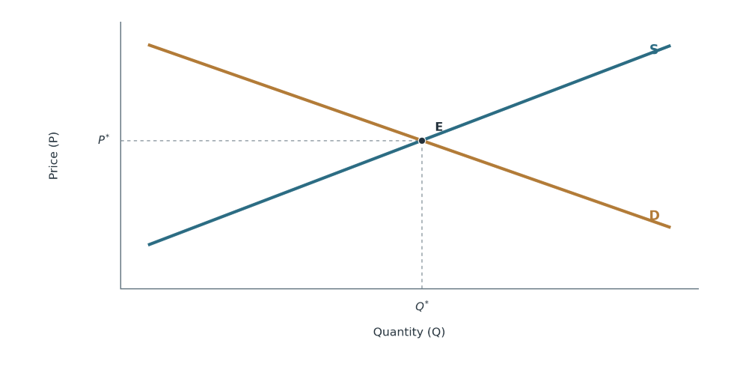
In a conventional market, supply S and demand D intersect at equilibrium E. Price P* and quantity Q* represent the market-clearing outcome. The curves are illustrative.
Adapting supply and demand to coordination effort
In a conventional market, supply and demand describe the price at which buyers and sellers are willing to transact. International insurance coordination has no comparable market price for an underwriter's attention, a client schedule or an authorized decision. The cost of securing an answer is spread across follow-ups, technical exchanges, senior involvement and attention diverted from other files. Accordingly, the vertical axes of the adapted figures represent marginal coordination effort: the additional organizational resources required to obtain one more timely decision or intervention. This is a conceptual measure of the burden involved, without implying that those resources have been converted into a common monetary value.
The demand side also requires care. A program cannot simply discard compulsory local coverage because obtaining it is difficult, although it can vary the attention devoted to securing a decision within a particular deadline. The adapted demand curves express the effort that securing additional timely decisions might justify. The supply curves reflect how much effort those decisions require as readily available capacity is absorbed. Delays, reprioritization and the reassignment of work are often how a shortage is experienced in practice. The diagrams do not assume that instructions are cleared through a real price mechanism, nor that every request can be accelerated by spending more effort.
Identifying where constraints actually lie
I have become more attentive to the different reasons an instruction can remain unresolved. If the client has not provided a schedule, another reminder to the insurer will not create it. An approval sitting with an underwriting committee may have to wait for an authority that cannot be delegated. A smaller account receiving little attention presents a different problem, since a commercial discussion might influence its priority. All three situations can appear on a servicing report as the same outstanding item. Their consequences are similar for the renewal, but the appropriate response depends on where the constraint actually lies.
Choosing the wrong intervention has a cost that rarely appears against the account itself. When a senior manager becomes involved in one urgent renewal, less attention remains for another client, a major claim or a difficult technical question. Sometimes the potential consequences of a gap in cover justify that concentration. In other cases, considerable effort is spent bringing forward an answer that would have arrived through normal channels. The decision to escalate therefore depends on what the intervention can realistically change, the importance of the result and what other work will be displaced.
When local capacity becomes scarce
Consider several instructions reaching a local insurer within the same narrow renewal period. Its underwriting team may be capable of handling each policy under ordinary conditions while having little capacity to absorb them all at once. As existing resources are occupied, obtaining the next decision within the deadline can demand progressively more effort. Technical colleagues are brought into the exchange, calls are repeated, and senior contacts are asked to intervene. Figure 2 shows demand for timely decisions increasing against a supply curve that steepens as immediately accessible capacity becomes scarce. Some placements can move forward, although bringing one to the front of the queue may delay another. The diagram illustrates this growing burden without assigning numerical values to it.
FIGURE 2
Scarcity raises the cost of timely decisions
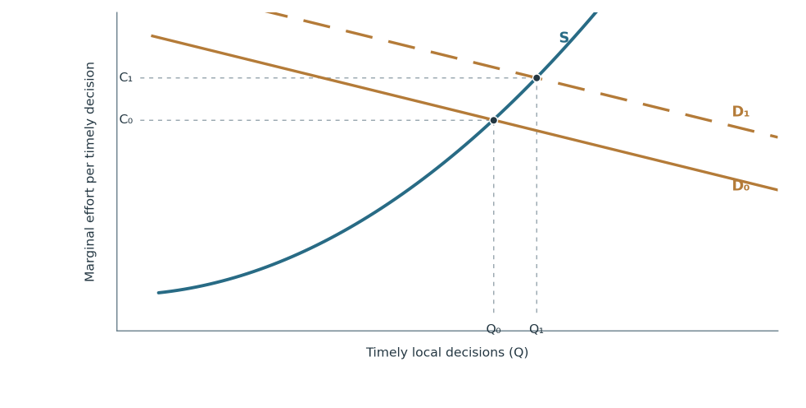
As demand for timely local decisions shifts from D₀ to D₁, scarce short-term capacity makes further decisions increasingly demanding to obtain. Curves are illustrative.
Misaligned incentives and workload
From the insurer's perspective, a local policy may require technical work disproportionate to the premium it generates. The multinational deadline may also have been agreed without much regard for the underwriting team's other commitments. For the master broker, the same policy remains essential to completing the program. The local intermediary is caught between priorities it cannot fully reconcile. It would be too simple to interpret every delay as poor cooperation. The underlying relationship may be functioning in line with its commercial incentives, even while the outcome is unsatisfactory for the program. Recognizing that difference helps identify whether another reminder, a technical clarification or a senior commercial discussion is likely to make a difference.
The allocation of work and remuneration deserves similar attention. A placement of strategic importance to a master broker may generate relatively modest income for the local intermediary responsible for quotations, documentation, technical exchanges and international reporting. Local partners may place value on the wider relationship, and some arrangements include specific servicing fees. Nevertheless, responsibilities and economic rewards can diverge substantially. What is described as a lack of responsiveness may partly reflect the amount of work expected from an organization relative to the resources and incentives available to it. This is a question of how multinational programs are designed and serviced, and it warrants a conversation about expectations, support and remuneration rather than assumptions about a particular partner's commitment.
How preparation shifts effective supply
Preparation can change some of these conditions before a renewal becomes urgent. Collecting schedules earlier, discussing requirements with the technical team and establishing who can authorize the final decision may remove several rounds of correspondence later. This work consumes attention when there appears to be little to resolve. Its benefit often arrives as exchanges and escalations that never become necessary and therefore never appear in the records. A successful last-minute intervention is easier to notice than an uncomplicated renewal made possible by earlier preparation, even where the latter has used far fewer resources.
Two renewals handled by the same underwriting team help illustrate the difference. In one, information arrives late and questions circulate between contacts who are unsure who should answer them. In the other, the documents have been reviewed beforehand, and the authorized decision-maker is already involved. Staffing and underwriting authority remain unchanged, while the second arrangement makes more capacity available within the renewal window and reduces the effort needed to obtain timely decisions. Figure 3 represents that improvement as a rightward shift in effective supply. Better organization can release capacity already present in the network, although it cannot overcome every technical or regulatory constraint.
FIGURE 3
Preparation shifts effective supply
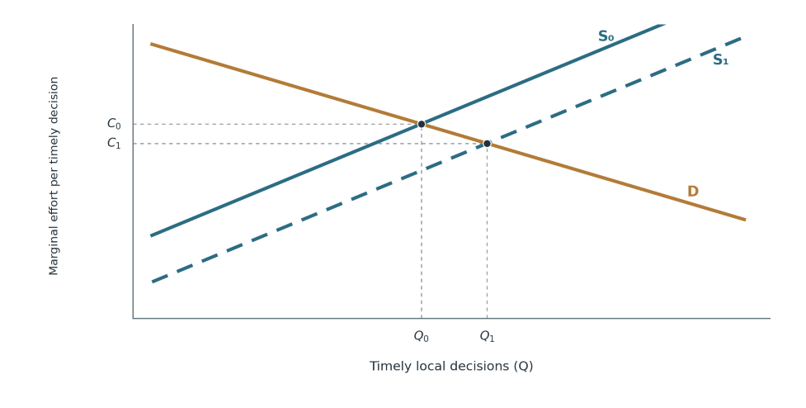
Preparation and access to authorized decision-makers shift effective supply from S₀ to S₁. The same resources can support more timely decisions with less additional effort.
The limits of exceptional intervention
Preparation has limits of its own. Clients and intermediaries must find time to gather information earlier, and an insurer or regulator may still have to decide within a timetable that cannot be compressed. Giving one account priority can also move the difficulty elsewhere. The useful distinction is whether an intervention changes the route through which comparable instructions are handled or merely secures an exception for the immediate case. Clearer procedures reduce repeated exchanges across organizations. A senior conversation that has to be repeated for every difficult placement leaves much of the underlying dependence intact.
There is something counterintuitive about this dependence because the immediate outcome can be so persuasive. An urgent approval is obtained, the policy is issued, and everyone understandably regards the intervention as successful. Where coverage might otherwise lapse, that judgment is reasonable. But if difficult decisions routinely pass through the same exceptional route, local teams and introducers can begin to rely on a small group of people at the center. The network becomes accustomed to obtaining help from a resource shared across many programs. This can improve its ability to rescue particular cases while making the coordination function more vulnerable to competing demands.
When local bottlenecks converge centrally
That vulnerability becomes apparent when several countries need assistance at the same time. Each local insurer may face a separate technical problem, and each intermediary may have exhausted the ordinary decision route. Their requests nevertheless converge on the same international coordination team, specialist or senior commercial contact. Difficulties that originated independently become connected through the support required to resolve them. The scarcity has moved from several local decision points towards a central resource whose attention cannot be multiplied on demand.
The pressure rarely arrives as a single identifiable capacity problem. One country awaits approval, another disputes a technical requirement and a third needs help securing an insurer's attention. Each escalation is understandable in isolation. Taken together, however, they compete for the same hours and the same ability to influence decisions. Figure 4 illustrates this combined demand against a central supply curve that becomes steep as available support is occupied. Additional attention can still unblock selected cases, but there is less room to accommodate them all promptly. Time spent on one country is unavailable to another, allowing a local delay to affect markets whose own servicing arrangements may be functioning reasonably well.
FIGURE 4
Local bottlenecks become central scarcity
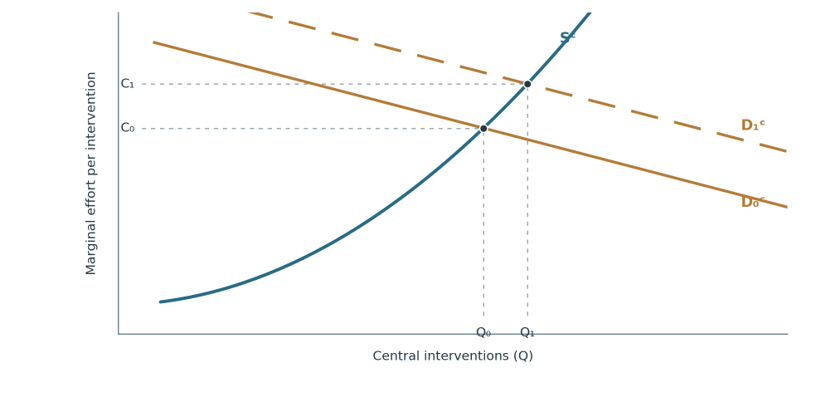
Escalations from separate markets shift demand for shared central support from D₀ᶜ to D₁ᶜ. Available support becomes harder to expand as requests converge.
The hidden cost of managing delays
I have seen how quickly attention can be absorbed by managing the fact that an answer is late. Further updates are requested, more people enter the correspondence, and the center spends time explaining the status of a decision it may have no authority to make. These requests are understandable from the perspective of a client or introducer awaiting confirmation. They nevertheless use resources that could support the underlying work. Additional technical assistance may relieve a genuine bottleneck, while a senior discussion may change an insurer's priorities. Where the missing decision rests with a designated local authority, repeated central intervention has a more limited return. That distinction matters when many markets are requesting help at once.
What servicing indicators miss
I have increasingly questioned how much conventional servicing indicators reveal about the resources needed to deliver a multinational program. A policy may be issued on time after weeks of technical discussion, difficult follow-ups and senior involvement, while another reaches the same recorded outcome through established procedures with little central attention. Both count as successful renewals. The difference in organizational effort has consequences for the volume of work the network can accommodate and its ability to respond when several programs encounter problems simultaneously. Recorded reliability tells us what was delivered, though much less about what delivering it required.
Central hours alone cannot capture the entire cost. A local intermediary may have absorbed extra work, and an insurer may have postponed other submissions to accommodate the multinational deadline. A complicated claim or a deliberate investment in a relationship can justify intensive coordination without indicating inefficiency. An assessment therefore needs to consider how long a complete instruction takes to produce a usable decision, where exceptional help was required, and how workload or complexity affected the case. This would reveal more about the organization of servicing than a completion rate viewed in isolation.
Aligning responsibilities with resources
These considerations also change the conversation between master brokers and their local partners. International reporting, technical exchanges and rapid confirmation may look like routine obligations from the center, while the intermediary delivering them experiences staff time and responsibilities that may exceed what was initially envisaged. Program arrangements should be clearer about who collects information, who follows up with the insurer, what technical support is available, and when escalation becomes appropriate. In some cases procedures need revision, in others the distribution of fees or resources deserves attention. Clearer responsibilities cannot create underwriting authority, but they can help prevent ordinary servicing from placing avoidable demands on central coordination.
Understanding the true cost of coordination
I believe we should pay closer attention to what lies behind the apparent reliability of an international insurance network. Completing a multinational program on time remains a meaningful achievement when so many independent organizations contribute to it. Understanding the effort required to secure those decisions, and who bears that effort, gives us a fuller account of how the network operates. Geographical reach and servicing results tell only part of the story. The economic value of coordination also depends on whether scarce attention is being used where it can change an outcome, whether responsibilities match the resources available to fulfill them, and whether the center can support several markets without becoming their common bottleneck.