


In planning conversations with carriers this fall, the first request is a familiar one: to cut technology and consulting budgets. Easy to see why. Commercial insurance prices have now fallen for nine straight quarters, property is softening fastest, and forecasters expect premium growth to slow and returns to drift back toward the cost of capital over the next two years.
Carriers are entering this phase from a position of strength. 2025 was the industry's best underwriting year in a decade, and the first half of 2026 looked even better. Much of that strength, though, came from reserve releases and a quiet catastrophe season. Although the underlying margins will be tested as lower rates work through the books, the cushion buys time to make deliberate choices -- to look at the whole cost structure, decide what each part of it returns, and invest where the payoff is clearest.
Where the money goes
The NAIC's latest profitability report shows how a premium dollar is spent. In 2024, about 62 cents went to claims and roughly 35 cents to running the business:
- 16.7 cents on selling (commissions to agents and brokers, plus marketing and underwriting)
- 9.5 cents on investigating, defending, and settling claims
- 6.4 cents on general overhead, which includes much of IT
- 2.3 cents on premium taxes, licenses and fees
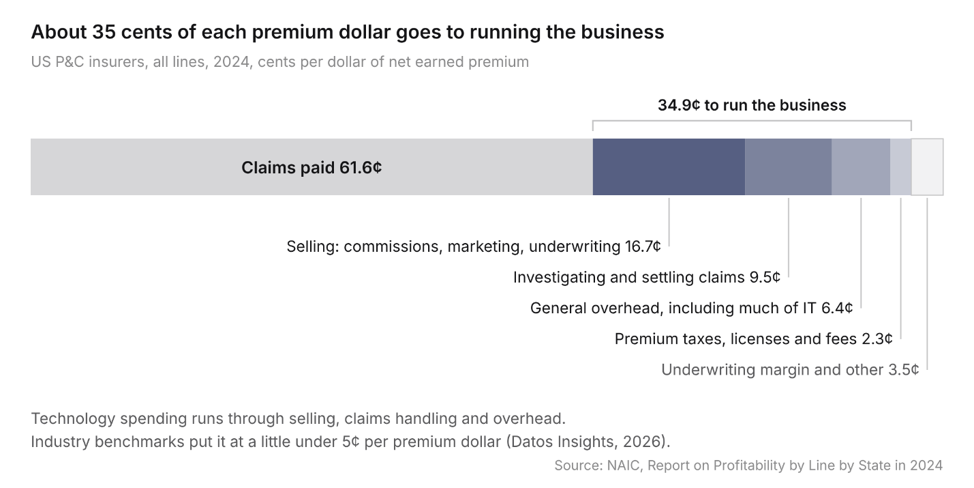
Technology runs through all of these lines, and industry benchmarks put it at a little under five cents of each premium dollar. That deserves careful management. It is also a small slice of the whole, which is why a cost program built mainly around IT leaves most of the opportunity on the table.
IT spending deserves scrutiny
Most carriers have real savings available in technology. Application portfolios have grown through acquisitions and line-of-business silos. Cloud usage often runs ahead of oversight. Tools overlap, and platforms that earlier migrations were meant to retire are still running.
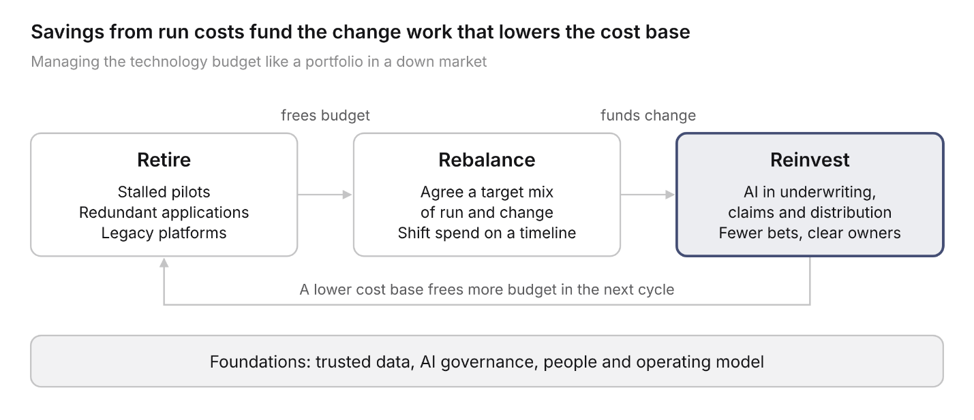
The harder question is how those savings get taken. At most carriers, the bulk of the IT budget goes to keeping existing systems running. A flat cut tends to land on discretionary projects first, including the ones that would eventually bring run costs down. A more durable path is to agree on a target mix of run and change spending, take savings from the run side, and put part of them back into the work that lowers the cost base over time.
Every cost pool has a purpose
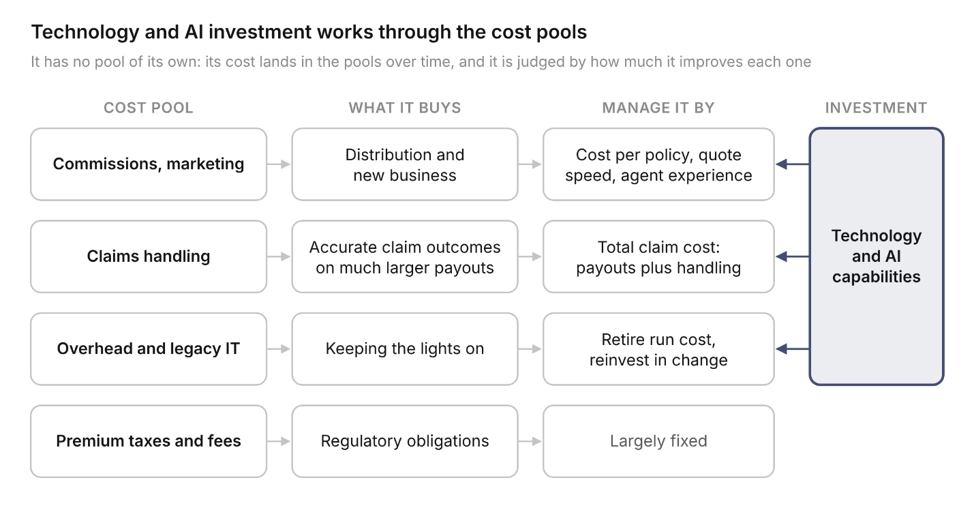
Selling and claims handling are the two highest costs outside of claims payments, and both are large for good reasons.
Commissions buy access to distribution. In a soft market, agents and brokers have more options, and a cut can send business elsewhere quickly. As agency leaders point out, commission reductions are also hard to undo. Direct writers face the same dynamic with marketing.
The better conversation is about productivity: what it costs to bind a policy in each channel, how long it takes an underwriter to turn a submission into a quote, and how easy the carrier is for an agent to work with. Progress on those measures lowers acquisition cost without straining relationships, and AI-assisted intake and triage are already among the more proven tools for it.
Claims handling works the same way. The cost of investigating and settling claims is small next to the claims themselves. Thinning claims staff can trim handling expense while pushing up payouts, litigation and cycle times, and those increases can quickly outweigh the savings. Total claim cost is the number to watch. Better triage, straight-through handling of simple claims, and litigation and recovery analyses can bring both down together.
Overhead and legacy platforms are the cleaner targets. They carry the least growth risk and often the most accumulated waste. The industry has shown the expense ratio can move: it has improved steadily over the past decade, largely through lower overhead, and the gap between the best and weakest performers is still close to 10 points.
The pressure builds as growth slows. When expenses keep rising and premium growth flattens, the ratio creeps up unless someone is actively managing it.
The rebalancing act
Experienced investors use a falling market to exit what isn't working, rebalance, and keep funding what they still believe in. The same approach fits an insurer's operating budget. Retire stalled pilots and redundant applications. Shift technology spending from run toward change on a deliberate timeline. Protect the capabilities that improve underwriting, distribution, and claims outcomes. The goal is a leaner cost base that still supports the growth and loss-ratio work that will matter when the market hardens.
Directing AI investment where it moves the ratios
Most carriers already have plenty of AI activity, and large language models are now in use at nearly every large and midsize insurer. Far fewer are getting value at scale; BCG's research suggests it is fewer than four in 10 P&C carriers.
The carriers that are tend to concentrate on a small number of domains, such as claims intake or commercial submission handling, and redesign the end-to-end process around the new capability. Each effort has a business owner accountable for a measurable result in loss ratio, expense ratio or growth. They invest heavily in the people and operating-model work that turns a model into a lasting change. They address the data foundations the use cases depend on, and they favor proven platforms, saving custom builds for areas where differentiation is real. They put governance in place early, so risk and compliance teams can sign off on production use.
They also decide in advance how savings will be captured. Early gains are easily absorbed by other priorities, or competed away, if they are not written into budgets and staffing plans.
The payoff is material. Forrester expects AI and automation to take about two points off expense ratios at the largest insurers this year, enough to offset much of the margin pressure a soft market brings.
Questions for this planning cycle
Before budgets are finalized, leadership teams may find these questions useful:
- How much of our IT budget goes to running existing systems, and what mix are we aiming for over the next three years?
- For each major cost pool, what does it buy, and how do we know it is working? Cost per bound policy and total claim cost are good places to start.
- Which AI initiatives have a named business owner and a clear financial target? What should happen to the others?
- How will savings from automation show up in budgets and staffing plans?
Carriers that come out of this phase with leaner overhead, healthy distribution relationships and AI working at scale in their core processes will be well placed when pricing turns again. Results across most of the industry are still strong, which makes now the right time to build that position.