Download

3 Sales Myths That Are Killing You (And You Probably Don't Even Know It)

Myths are fiction passing as facts. Clean out the myths and you can refocus your sales efforts.|

You don't have to sell everyone and you don't have to serve everyone. The idea that companies should chase every piece of business out there and that if they don't they're leaving money on the table is antiquated. The negative impact of chasing the wrong prospects and serving the wrong customers is huge. To change your approach you may have to remove the myths that you may believe. Here are three:Myth #1: The Law Of Large Numbers "More means more" is the core of this myth. More prospects means more sales ... The only time that I see this myth become truth is not when you are a salesperson, but when your role is truly just order taking. Order taking means that the purchasing energy is driven by customer demand, not salespeople demonstrating value and securing new customers and contracts. All prospects are not created equal and the most successful salespeople who truly sell are successful in part because they prune their list, reducing the number of prospects regularly.Myth #2: The Funnel (Hotel California) "You can check in any time you like, but you can never leave..." These lyrics from The Eagles song "Hotel California" are just as true for CRM and sales tracking systems. There is a belief that once a prospect has been added to the list of qualified targets that companies should continue to communicate, sell, participate in RFPs and generally pursue those companies. I was in a session recently during which a company's leadership bragged about chasing a deal for a decade. What a waste. Think of it: Ten years of newsletters, trade shows, prospecting campaigns, RFP participation and so on. How much margin would there need to be above regular business margin to pay for the huge investment made? Myth #3: Money Is Money (Even When The Client's A Jerk) Some clients are just not worth having. I see companies clinging to the old idea that "the customer is always right," allowing low-profit and bad-cultural-fit clients to eat away at their businesses. A great quick read is Robert I. Sutton's book, "The No Asshole Rule." It was written about employees but is every bit as true for customers. The negative blast zone in a company that a bad employee or a bad client creates is far more damaging than the revenues they produce. Here are quick reality checks for you to test how your company is doing in regards to these myths:
  • How many prospects in your pipeline have been there longer than 15 months without an order? Fifteen months may be the wrong window, but there is a period after which the prospect is just an expense, not a real opportunity.
  • How many of your clients violate "The No Asshole Rule?" Determine how they became customers and then figure out how to avoid those prospects in the future.
  • Do you have a threshold for your salespeople as to how many prospects they can have active in their pipeline at any one time? Salespeople can be blocking real activity by "claiming" prospects when they haven't made progress after a defined period. They can't land the opportunity and your company is not landing another client either because your salesperson is tied up in a dead pipeline.
Myths are fiction passing as facts. Clean out the myths and you can refocus your sales efforts.

Tom Searcy

Profile picture for user TomSearcy

Tom Searcy

Tom Searcy is a nationally recognized author, speaker, and the foremost expert in large account sales. His methods of unlocking explosive growth were developed through years of real-world success. By the age of 40, Searcy had led four corporations, transforming annual revenues of less than $15 million to more than $100 million in each case.

Data Integrity - Y2K All Over Again?

While it may not be Y2K, the impact of poor data might be greater for Workers' Comp organizations.

Remember Y2K?
"January 1, 2000, that is the day that was to change all of our lives. That was the day that the computers on which we all depended would fail us. That was the day that all of our luxuries of daily life would crumble, and we would be once again forced to live without electricity, running water, heat. The great Y2K scare is what it was called. The scare was that all of our computer systems around the world would cease to function on December 31, 1999."1 They did not.

Drawing A Parallel In Workers' Compensation
The hype and fear of Y2K were paralyzing for some and organizations spent large sums of money to reprogram computers in preparation. Indeed, there is far less anxiety about the veracity of medical provider data in Workers' Comp claims and bill review systems. Yet, medical provider records in Workers' Comp are just as lacking as the year date in systems prior to 2000 and the ramifications could actually be consequential.

Opportunity Cost
The Y2K issue prior to the late 1990's was caused by limited disk space that was conserved by using only two digits for the year. The number of bytes that would fit on a screen and in the memory of the machine was limited. On the other hand, the cause of limited medical provider data is simply a matter of traditionally paying the bill efficiently. Only name, address, and Tax ID is needed. However, inadequate and inaccurate medical provider data is opportunity cost for the industry.

New Applications
No longer is the industry interested in using medical provider information for bill payment only. Provider records in systems are key to evaluating provider performance beyond direct fees for service. Medical providers impact return to work, indemnity costs, claim duration, and other factors. The indicators can be found in the data.

Who Knew?
Medical provider records have recently risen to the level of essential information for quality and cost control. In order to evaluate individual medical providers, medical groups, and facilities, the data in provider records must be non-duplicative, accurate, and complete. Yet, most databases contain multiple records for the same, and presumably the same provider. Moreover, the records are incomplete, especially regarding unique identifiers such as state license numbers or NPI (National Provider Identifier) numbers that distinguish individuals.

Duplicate Provider Records
One of the major problems found in most Workers' Comp data is duplicate medical provider records. Duplicates are a problem because the records for an individual are dispersed over multiple records and can only be evaluated separately rather than collectively. The cumulative data for a provider cannot be assessed until duplicate provider records are merged.

Duplicate provider records occur for many reasons. Some organizations simply add a new provider record to their database when a new bill is received, without checking to see if the provider already exists in the data. This is simple to correct administratively, by requiring data entry persons to check the data for the existing provider. A more reliable solution is to create systems with search and select utilities that limit "add" authority. However, duplicate records occur for other reasons as well.

Duplicate medical provider records can also occur when the same provider is added to the database, but the name is spelled differently, a different suffix is used, and when initials or abbreviations are entered differently. Computer systems read these as different and allow adding the new one. Similar address inconsistency has the same result. Using Ste, Ste., and Suite might result in three separate records for the same person or entity. The solution is using basic record search and select from a drop down list. Moreover, correcting the existing data by scrubbing the database is worth the time and cost.

Optimize Medical Provider Records
Tax ID, so important to paying a bill is nearly useless when evaluating medical provider performance because multiple persons often use the same Tax ID. Establishing a critical mass of data associated with one provider is difficult, and duplicate records simply dilute the information further. Certainty about individual identity is critical and the only way to achieve that is with state license numbers.

License Numbers
Unfortunately, NPI numbers, established by the CMS (Centers for Medicare and Medicaid Services) are abused by some. Notorious medical providers apply for and receive multiple NPI numbers. State license numbers are the most reliable and should be added to provider records in databases to differentiate individuals.

Medical Specialty
Including medical specialty in the provider record increases its value exponentially. The most accurate, fair, and illuminating evaluation is comparing peers. Comparing neurosurgeons to dermatologists on some performance indicators makes little sense. Pain specialists, for instance, usually receive complicated cases late in the game and should be compared to other pain specialists, not those who treat acute injuries. Medical specialties are vital to evaluating performance accurately.

What To Do
While it may not be Y2K, the impact of poor data might be greater for Workers' Comp organizations. Systems should contribute to medical cost management intelligence. However, many cannot because of data quality. Scrub and optimize existing data and establish protocols that prevent continuation of status quo. Outsourcing to a third party specialist is easy and the return on investment certain.

1The Y2K Scare

Healthcare Exchanges: Round 2

The news has been more encouraging than expected, at least by many; however, there are many idiosyncrasies that need to be considered before making a final judgment regarding the Affordable Care Act and the exchanges.

Most of the dust has now settled around the State Exchanges. Last week the New York rates were finalized and with most of the other states, rates came in lower than anticipated. The Department of Health and Human Services (HHS) released an analysis1 suggesting that rates were 18% lower than anticipated. The national press has been in a frenzy as the public is trying to determine what all of this means. This article will discuss several of the issues and try to put them in perspective.

So What Are The Facts?
Are the rates actually lower? The HHS article demonstrates that yes, rates are coming in lower than previously projected rates even by the Congressional Budget Office (CBO). However, the situation is not quite the same as alluded to. For example, the study compared the "lowest rate" with the projected or forecasted rate. In the recently released rates for the State of New York, rates for the silver plan in New York City ranged from a low of about $350 to a high of nearly $700, a wide range. The HHS article compared the lowest rate in a plan type and compared that to the CBO projection. If the low in New York was $350 and the high $700, one might assume an average rate of $525 (i.e., (350 + 750)/2 = $525). Comparing $350 to the projection gets a different answer than comparing $525 to the projection. For example, if $350 is 18% lower than the projection, $525 is 123% of the projection, a much different story than presented.

Why Do The Rates Vary So Much?
Rates are based upon a large number of specific and sometimes hard to define actuarial assumptions. Some of the health plans used different assumptions than others resulting in different rate levels. Some of the key assumptions are:

  • Health care provider discounts and also average cost of those providers in the network
  • Care management approach and effectiveness
  • Required expense and margin loads
  • Assumed health status of population to be covered
  • Assumed health care inflation and/or trend assumption
  • Specific plan design
  • Prior experience with individuals and small groups

There are other assumptions that are included, but the above list describes most of the important ones. If a particular health plan has better than average discounts with providers it is likely that their premium would be lower than a plan with lesser discounts. If the providers included in the network have a lower average cost than a competitor's network, the premium would likely be lower than the competitor. If a health plan had more effective care management practices than their competitor their rates might be lower. The list goes on. In addition to actual measured performance, some of these differences might be based upon perceived value and/or differences.

Although actuarial science is an objective science, different actuaries might have different opinions on the same issue and could apply different judgment when the data is incomplete or questionable. As a result, rate differences might occur as a result of different actuarial opinion.

The nature of a specific health plan can also lead to differences. One example of this is the rate development in one of the states our company was working on. One of the major players in the market attempted to negotiate more favorable contracts with its provider network. The best attempt at negotiating with a highly desirable health system resulted in a contract that paid that provider about 115% of Medicare payment rates, an improvement from their current contract. A competitive health plan in that same marketplace contracting with that same provider was able to negotiate a contract at close to Medicaid rates, considerably less than what the other carrier had achieved. A very surprising result that we had to investigate further to understand.

The first carrier was a major commercial health plan. The second was a health plan that served Medicaid beneficiaries. Their current contract paid close to Medicaid rates, and since the Exchange was going to attract Medicaid-like enrollees they were able to negotiate a rate close to their current rates, but a little higher. The large commercial carrier at the same time was not able to negotiate anywhere near that rate discount but was pleased to be able to get an improvement. This reimbursement difference alone would contribute to at least a 35% - 50% rate differential. Examples such as this have occurred through many of the exchanges and have led to many rate differences.

In addition, some plans have proposed "narrow networks" where providers agreeing to significant discounts and which have demonstrated performance advantage are included in the network. This has resulted in favorable rates in many situations. Some plans have used "broad networks" where almost any provider is included in the network. The exchange has no requirement about breadth of network. Individuals signing up for coverage in the exchange are going to have to carefully assess what providers are included in the networks. The lower premium rates might be the results of narrower networks with limited access.

In summary, the news has been more encouraging than expected, at least by many; however, there are many idiosyncrasies that need to be considered before making a final judgment regarding the Affordable Care Act and the exchanges. Rates will be available October 1, assuming no further delays, and then we will be able to make final assessments.

1 ASPE Issue Brief: Market Competition Works: Proposed Silver Premiums in the 2014 Individual and Small Group Markets Are Nearly 20% Lower than Expected.

Cumulative Trauma (CT) - The "Wearing Out" Disease

Cumulative trauma claims are just another drain on employers and therefore the California economy, and this issue needs to be addressed.

It is time to revisit and re-evaluate the value of this statutory condition (L/C 3208.1), which is rapidly becoming yet another undue burden on both employers as well as the workers' compensation system. Cumulative Trauma claims are currently being used, and in many instances abused, by disgruntled employees who are no longer on the payroll. By filing Post-Termination Cumulative Trauma claims, employees are circumventing the legitimate needs of businesses to make personnel decisions based on the employer's current financial situation and needs.

One need only look at the increase in Cumulative Trauma claims that are being filed after an employee has been laid off. While there has been no specific injury that they can point to, many are now claiming that "work" has worn them out and that they are therefore entitled to even more money than that which was bargained for as a part of their employment agreement.

I would not argue that there are no real and viable events that can lead to a compensable situation. Asbestosis would be the best example of an occupational disease that was unknown to either management or their employees for many years. Litigation over asbestosis has been ongoing since then, and I believe that the compensation awarded to injured workers in such cases is justified.

However, when an employee who is hired to do a job that produces no discernible injuries and who has been laid off for legitimate, non-discriminatory reasons is able to work around the system by claiming a cumulative injury, it is time to reassess the value of that part of the Labor Code. We must decide if both parties to this equation are being properly served. Or, is this an abuse of the system that has been allowed to fester too long?

As a starting point for this discussion, when someone is hired for a job whether it is for either brain or brawn, the employer is taking on the whole person as he/she finds them. When the employee arrives at the jobsite, he/she does not simply place their body in the corner to rest while some mysterious spirit does their job. Employers hire the entire package as he/she finds them and is responsible for same. I would then point out that whether or not we like it, all of us are "wearing-out" as the years pass. The question then is, "Why should an employer be responsible for the normal aging process vs. being responsible for a specific injury?" I argue that they should not.

I therefore offer three possible options for consideration. Any or all of these will allow legitimate cumulative injuries to be raised as part of the work bargain while at the same time making employees responsible for their own "wearing out."

  • Take "cumulative" claims out of L/C [Section 3208.1(b)] so that it reads: "An injury may be either specific or cumulative occurring as the result of one or a series of incidents or exposure which causes disability or the need for medical treatment" and then remove cumulative trauma from L/C 5412 and place it under 5411.

    This will allow employees to file a cumulative trauma claim just as they would a specific injury. This would also place the burden of proof on the employee to show, just as they must now with a specific injury. In other words, what extraordinary events of employment occurred thereby showing how this cumulative trauma is more than just part of the normal "wearing out/aging" process we all face every day.

  • Change the definition of a Cumulative Trauma injury to more closely mirror that of psych/stress claims (L/C 3208.3). In other words, let the employee show how the preponderance of actual work, absent the normal aging process, had caused a "disability" which should be covered.
  • Since the employer is hiring the entire package, we should set up a "depletion" allowance funded by the employee. There should be a percentage taken from each dollar earned which is placed in a fund similar to a 401K. It will belong to the employee and will be portable so that it follows him/her throughout their working career. At the time they become eligible for Social Security, they would have access to this additional fund of dollars. This would result in taking the burden of the normal aging process off the backs of employers.

Regardless of which of these or any others the legislature feels would be the best solution to this growing problem, the real point is that this is currently just another further drain on employers and therefore the California economy and needs to be addressed.

Insurers Should Deploy Predictive Analytics Across The Enterprise

The data miner role is no longer the only one to use predictive analytics in the insurance industry; a new role of data scientist is emerging.

Ovum Publishes Report On Creating An Insurance Predictive Analytics Portfolio
If the past four years are a reliable guide, the insurance industry will face complexity and even chaos in the coming months and years. Insurers need to be concerned about a future which could promise "black swan" events (those that are unpredictable, infrequent, and have a severe effect), the quickening pace of customer-driven commerce, the continuing spread of the digital economy, and the annual occurrence of severe weather events historically forecast to happen only once a century.

Insurers already know that the future holds tightening regulation, demanding customers who expect a better-quality experience, aging populations, and economies still weakened by the financial crisis. Ovum's recently published report Creating an Insurance Predictive Analytics Portfolio discusses the importance of insurers using predictive analytics to prepare for future market challenges and opportunities. We also discuss the types of quantitative professionals that insurers need, data sources and data management issues, and the areas in which insurers should apply predictive analytics.

Many Opportunities Exist For Insurers To Improve Their Competitive Position With Predictive Analytics
Where to use predictive analytics is limited only by the creative imagination of the staff responsible for its application. Ovum suggests that insurers consider creating predictive analytics initiatives in the following areas, to achieve the example objective listed. More objectives and units of analysis for each initiative are detailed in the report.

  • The insurance company itself as the focus of the initiative: To determine which markets to enter or leave.
  • Marketing: To create a portfolio of customized marketing offers.
  • Product development: To create the best product for each channel.
  • Channel management: To determine which insurance agencies to appoint.
  • Customer acquisition/retention: To estimate each customer's lifetime value to shape target market initiatives.
  • Customer services: To estimate retirement income for each life insurance customer.
  • Litigation management: To estimate litigation costs for each claim as it is reported.
  • Claim management: To determine the best way to reduce loss expenses/combined ratio for each line of business and each selling agent or claims adjuster.
  • Risk management: To estimate potential losses for the book of business as each new customer is added.
  • Cost control: To determine how the cost levers might change for different company governance structures.
  • Underwriting management: To estimate how many underwriters of what level of experience by line of business to have on staff.

The Insurance Industry Exists In A World Of Increasingly Rich Data
The insurance industry exists in a world of increasingly rich data. More and more data is available from existing sources (e.g. third-party providers offering information about weather events and forecasts, attributes of geographic locations, and consumer credit behavior), newer sources (e.g. social media), and those that are largely still conceptual (e.g. from machine-to-machine communications, also known as the "Internet of Things" — specifically from vehicle telematics).

In particular, insurers can access (although not necessarily free of charge) a never-ending torrent of (mostly) semi-unstructured and structured data from sources such as:

  • insurance business systems
  • social media
  • embedded sensors (e.g. vehicle telematics)
  • insurance company portals
  • mobile apps
  • location intelligence
  • complementary insurance information (e.g. FICO scores, building repair cost, and business formation data).

The Data Scientist Role Is Emerging As Equally Important As The Data Miner Role In The Insurance Industry
The data miner role is no longer the only one to use predictive analytics in the insurance industry; a new role of data scientist is emerging. A growing number of insurance companies are creating new departments of these types of quantitatively skilled professionals.

A data scientist and a data miner could be the same person. But the two roles should have different perspectives regarding the scope of predictive analytics initiatives and the time horizon of predictive analytical models. Moreover, data scientists may need different skills to fulfill their responsibilities. An insurer should expect a data scientist to approach a predictive analytics initiative by first collecting data — although not necessarily all the data required to complete the initiative — and then investigating the data on an iterative basis until a coherent hypothesis emerges.

Furthermore, Ovum believes that data scientists should be responsible for models that support short, medium, and long-term corporate objectives. Data miners, however, should be primarily involved with predictive analytics initiatives that support short and medium-term corporate objectives.

What Is The Difference Between Intrinsic Value And Market Value Of Insurance Agencies?

If you are a buyer, a brutally honest intrinsic valuation is the best way to manage your risk. Market value should be entirely secondary.

I have been valuing insurance agencies for a long time. I have been valuing them using both the Intrinsic Value and Market Value methods most of the time. For anyone interested in reading a brilliant description of these two methods, I suggest reading the article, "Musings on Markets" (September 7, 2011), by Professor Aswath Damodaran of the NYU Stern School of Business.

Intrinsic value is usually determined using one of several versions of the discounted cash flows method (the exact definition of cash flow varies, but all are intrinsic). This method states a firm's value is determined by the firm's future expected cash flow, discounted for time and risk.

In theory, market value also emphasizes cash flow. However, my experience is that most practitioners, especially when applied by agency owners but also some consultants, so inadequately account for cash flow and the risk that something will go wrong so that for all practical purposes, cash flows are disregarded. This makes market value agency appraisals purely speculative. Sometimes the result is an under valuation. More often the result is a value exceeding reasonability. Sometimes market value and intrinsic value are materially the same. After all, a broken clock is correct twice a day and 730 times a year. Most people would say being right 730 times a year is an awesome record.

A good example is the real estate boom and bust. The intrinsic value of the real estate never supported the market value. Many analysts and promoters became quite innovative in their development of "intrinsic" metrics that supported the market values, but the basic cash flow never supported the market value. The real estate investment only made sense if one could flip the investment at an adequately higher price before the market crashed.

The same force occurred in the market for insurance agencies. Very few agencies have an intrinsic value exceeding two times today or five years ago or ten years ago. If a business appraiser or a business broker sees someone who wants to believe an agency is worth more, the list of rationalizations, justifications, fictitious economies of scale, insightful product diversification strategies, and capital plays (interesting since capital is arguably free in some forms today) are infinite. If someone shoots holes in all these arguments, then ultimately the business broker will play their ultimate card: "We're so much smarter that we can make this work."

The fact is the intrinsic value did not justify the price paid by many agency buyers five years ago. The strategies that caused the buyers to believe the values were justified were mirages of wishful thinking. The market was overheated and for whatever reasons, if buyers wanted to be in it, they had to pay a high price. There is and was nothing else to it.

The fascinating difference between intrinsic and market value for insurance agencies is that the intrinsic value should remain in a rather narrow band because:

1. Profitability in a well-managed agency is stable. By well-managed, I am excluding firms that are 100% or more dependent upon contingencies for their profits. In these agencies, profitability will vary wildly depending on their contingencies. Otherwise, expenses do not vary much year-to-year in well-managed agencies and therefore, profitability is stable.

2. Sustainable growth is humble. When you read about an agency growing 10% to 25% annually, ask, "How many annuals?" In other words, how long have they truly achieved such significant growth? Also, what risks are they taking? The Property & Casualty industry grows at approximately the same rate as the U.S. economy because the Property & Casualty industry insures America's economy. That rate is approximately 3% annually.

The Property & Casualty industry is not a growth industry and it has not been one for decades. To pretend otherwise is like an older model choosing the right makeup, the right lighting, and the optimum angle to look ten years younger. In fact, the evidence is strong that firms who grow multiple times faster than average have a higher than normal probability of cheating. Often the cheating is not malevolent, but it is still cheating.

3. Risk is comparatively moderate. The insurance agency business is one of the least risky businesses. It may feel risky, but compared to most other businesses, it is quite safe.

These three factors combine to create periodic value fluctuations, but within a rather narrow band on an intrinsic basis. This is why owning an agency is a great business in tough times while maybe less appealing in great times. So why is the fluctuation so much more on a market value basis? Speculators. The speculators may be banks, brokers, private equity, other agencies, but they are speculating. This creates some issues because speculators use market value plus twenty percent or so for their values. They have a tendency to build price without adequate regard for supporting cash flow or risk. This is why a boom takes years to build and the resulting bust can take just a few weeks.

The fact that speculators pay too little attention to cash flow and risk has two significant consequences. The first is that speculators value good agencies and bad agencies too similarly. The result is they pay too much for bad agencies and sometimes fail to purchase the best agencies because they're not willing to pay an adequate premium for quality. Now, some really smart speculators have learned that certain kinds of supposedly bad agencies do not actually have post acquisition bad results. One should not confuse these two situations.

The second consequence is when inadequate attention is paid to cash flow and risk upon acquisition, speculators eventually cannot or do not pay enough attention to building the people and systems necessary for organic growth. This is readily apparent in some brokers' results today.

Whether you should or should not emphasize market value over intrinsic value depends on your position and the market cycle. As a seller in good times, the market value will usually be your best deal because this industry has blessed sellers with an infinite supply of irrational buyers. Their numbers grow and constrict with the seasons, but rarely are they in short supply for long. The only exception to this is the really good agency. A market value may rarely adequately capture the true value of these agencies' cash flows and risk. Internal perpetuation is almost always the best course for maximizing their value.

If you are a buyer, a brutally honest intrinsic valuation is the best way to manage your risk. Market value should be entirely secondary. Always remember that no acquisition is better than a bad acquisition and since roughly every study ever done shows that 75% of acquisitions are failures when truly tested, this rule is worth cementing in your brain. The exception is that if the buyer has such a bad situation that a bad acquisition can hide their current dilemma, then maybe make the bad acquisition.

Controlling Workers' Compensation Claim Costs: 3 Things Every Self-Insured Should Know

Understanding and recognizing the importance of three basic claims practices that could result in increasing workers' compensation costs will enable the self-insured to effectively manage the Third Party Administrator to control increasing costs.

The observed increase in workers' compensation claim liabilities and ultimate losses is partially attributable to external factors — those outside the control of risk management, such as medical inflation. Elizabeth Bart's article, Ever-Increasing Unpaid Claim Liabilities: When Does The Growth Stop? explores such external factors.

This article also explores the topic of increasing workers' compensation claim costs, with a focus on how claims practices can influence claims costs and contribute to the increasing liabilities, and discusses what self-insureds can do to better manage practices in an effort to control costs.

The management of a workers' compensation claim incorporates several key areas, all of which interact and combine to influence the claim's outcome (e.g., initial handling, investigation, reserving, medical management, etc.). It can be challenging to understand whether a workers' compensation claim is well-managed and whether optimal outcomes are being achieved. This is particularly true for self-insured entities, which often delegate claims management responsibilities to an outside third-party claims administrator (TPA).

The result of using TPAs for claims administration is that the self-insured entity itself maintains little if any expertise in the area of sound claims management practices. Moreover, the TPA will often delegate certain functions to other vendors such as case management and medical and legal bill review, further removing the oversight of these services from the self-insured's reach. Finally, many self-insured/TPA contracts focus on the quick resolution of a large volume of smaller dollar claims, with little consideration for the efforts and resources needed to resolve large claims. Therefore, the management of larger claims may not be well understood or outlined in these arrangements.

Improving three often misunderstood or underestimated claims handling areas could result in a significant improvement in claims outcomes and have a material impact on liabilities:

  • Initial activities
  • Information and data collection
  • Change in case reserving practices

Basic knowledge of these essential claims handling activities will enable the self-insured to effectively work with its TPA to avoid common pitfalls and to proactively manage the TPA. This, in turn, will mitigate or avoid unnecessary cost increases.

Initial Activities
Activities undertaken by the claims handler immediately after a claim is reported are often thought of as administrative tasks — no more than an intake exercise whereby the handler runs through a checklist of scripted questions. These activities include assessing immediate medical management needs, making three-point contact (i.e., contact with the employer, the injured worker, and the medical provider), assigning to the appropriate adjuster, taking statements, and gathering documents (e.g., medical authorizations, photos, police reports, and wage statements).

And in truth, activities that occur in the early stages of a claim may not be terribly significant for the large number of reported workers' compensation claims that resolve quickly. However, for that small percentage of claims upon which the majority of the costs are ultimately expended, proper claims management from the outset is crucial to achieving optimal claims outcomes.

For example, a claimant who has had previous injuries or prior surgeries, or who otherwise presents with certain characteristics such as chronic pain, is more likely to require medical management from the outset to ensure optimal medical outcomes, which in turn reduces costs. For a small number of high-severity claims, if the medical aspects are not understood and well controlled at the outset, the claimant often does not improve and the claim can adversely develop into a larger-than-anticipated and larger-than-necessary claim — a lifetime pain management claim perhaps involving multiple surgeries, and costing hundreds of thousands or even millions of dollars without optimal medical outcome or endpoint for the claimant.

Thus, it is important upon receipt of a claim to investigate all prior injuries, surgeries, prescriptions, and comorbidities (i.e., health issues that are not work-related but nonetheless could impact the treatment of the injury). In many cases, the best practice of making three-point contact has devolved in practice into two-point contact (the employer and the injured worker) and in some cases even one-point contact (the employer). This can leave basic medical questions unanswered for weeks or months. For a small percentage of claims that have the potential for developing into the highest-severity losses, these delays could be critical.

Another key initial activity is adjuster assignment. Assignment to the appropriate adjuster can be particularly important for some claims — for example, those where the claimant reports injuries to nonspecific or multiple body parts, such as "neck, shoulder, arm." These claims present an element of subjectivity, uncertainty, and potential complexity. It is important that the adjuster thoroughly investigate precisely how the injury occurred and communicate with the medical providers about the types of injuries that can result from that activity.

This means that the adjuster needs to have the proper background and expertise to ask the right questions. If injuries or body parts are reported that are not medically connected to the work-related injury, the adjuster may only have a short period of time within which to deny those unrelated claims. An inexperienced adjuster may not identify or attempt the valid denial, in which case that injury and all subsequent treatment may be deemed accepted for the duration (perhaps for the life of the claimant), with no further opportunity to deny. In a large number of cases, this missed opportunity will not have a significant impact on the outcome, but for that small population of high-severity claims, such an error will be costly.

As a final example, the initial investigation is important to assess the claimant's ability or motivation to return to work based on one or more subtle aspects of the claim, such as educational level, child support status, disability status of the claimant's spouse, ability of the employer to accommodate the claimant's limitations, proximity of claimant's home to job opportunities, or other factors.

It is important for the handler at the outset of the claim to immediately contact the employer, the injured claimant, witnesses, and medical providers to ask pertinent questions. Equally important is the need for the handler to listen carefully to the answers and follow up on unusual or inconsistent information. Inexperienced claim handlers often appear to be following a list of predetermined questions and may hesitate to go "off script." Many times, the claims that adversely develop are those that, in retrospect, could have been controlled had certain information been collected and had the investigation been thoroughly completed and thoughtfully assessed early in the life of the claim.

Information And Data Collection
Increasing claim costs are also associated with the inability to easily locate and evaluate the information gathered on the file. A claim may be assigned to an adjuster with the appropriate level of expertise, and that adjuster may undertake a prompt and thorough investigation. However, the pertinent information emanating from that investigation is not captured in discrete data fields in one location in the file system. Rather, that information is buried throughout the "notes" section of the claim system — along with numerous immaterial or administrative entries. This impedes the ability of the self-insured to easily identify claims that have the potential to be large and work with the TPA to effectively control costs.

For example, a large volume of the "notes" section of a claim file may include entries such as the date of a reserve review, an adjuster's failed attempt to contact a party, the payment of a bill, the date a processing decision was made, the scanning of a document into the file, or the receipt of a police report with no substantive commentary. Even entries related to the status of a claim — one that on its face would appear to be highly relevant and current — are often simply "copy/pasted" from prior status entries.

Thus, including in the claim notes pertinent information vital to making prompt and reasonable strategic decisions can lead to inefficiencies and suboptimal outcomes. The amount of stale, outdated, repetitive, and sometimes misleading information makes it exceedingly difficult to identify and assess the pertinent facts, issues, and activities in the file, and impedes the adjuster's (and supervisor's) ability to make informed decisions. In many claim operations, reviewing the file is so time-consuming and difficult that the supervisor is only able to randomly select a small sample to audit at regular intervals. If that supervisor does not by chance select the "right" files, important issues might not be identified and key strategic opportunities might be missed.

The problem is compounded when information is entered incorrectly. Common errors can lead to costly repercussions. For example, assume that the medical records all clearly identify a right shoulder injury. If the handler inadvertently references the "left shoulder" injury in the claim notes, all subsequent actions might be based upon that. A supervisor or newly assigned adjuster may not have the time, or may believe it is unnecessary, to confirm that information by checking the original medical records. Body parts and treatments could be implicitly accepted and additional costs expended for injuries that are not work-related.

Similar types of errors can be made with wage information or rate calculations, and can go unnoticed for long periods of time, resulting in costlier claims. Finally, as more and more claims departments are outsourcing medical bill review functions to third-party vendors, some of that key medical information is not captured in the claim system at all, which can also distort the true picture of the potential exposure.

Thus, it is important that the self-insured verify that the TPA, or other claims-handling entity, develops a system of meaningful data capture, whereby key pieces of information are systematically downloaded or manually entered into consistent discrete fields in as few screens as possible. Many claims systems already have these capabilities, but handlers are not required to enter the data and the fields remain blank. Such a data capture would allow representatives at the self-insured entity the ability to obtain a current and comprehensive snapshot of the development on the claim. Discrete data fields also ensure consistency, facilitate fact-checking, and support the creation of meaningful metrics and management information reports. Self-insureds should ensure that they have full access to the claims system and that they understand all the features of that system.

Change In Case Reserving Practices
The onset of conservative case reserving practices can lead to unnecessary increases in ultimate losses. This may not be intuitive. Many people may think that inadequate case reserves lead to increasing ultimate losses, because over time the case reserve (which was initially set "too low") needs to increase to cover actual payments. While this is true, the ultimate losses may not be affected by the development of inadequate case reserves, because the actuary may have taken the case reserve practices into account in estimating the actuarial reserve.

Thus, even if the case reserves were "too low," the actuarially estimated additional reserves would have compensated, resulting in a total reserve (case plus actuarial), or "ultimate," of "just right." As case reserves increase, actuarial reserves may decrease (all else being equal), and the ultimate will not change. In that way, inadequate case reserves do not necessarily result in increasing ultimate losses.

An important aside: We must remember that inadequate case reserves are not necessarily the result of poor claims handling or intentionally suppressing case reserves. When we say that case reserves are inadequate, we mean that, despite best efforts to set a case reserve that reflects the ultimate value of the claim at any given point in time, there are a few claims that will develop adversely in unanticipated ways (i.e., in ways that could not be foreseen by the claims handler when the prior case reserve was established). That is in part what the actuarial reserve is intended to estimate — the unanticipated development — and is outside the purview of the claims handler.

Changing case reserving practices by making them "higher" or "more conservative," however, can result in increasing ultimate losses. Consider, hypothetically, a TPA that decides to institute a new practice of establishing a case reserve reflecting the worst case scenario, or adding an arbitrary amount (e.g., 25%) on top of the best estimate of case reserves. That change could result in higher ultimate losses, for two reasons:

  • First, if the actuary is unaware of this change, it will not be incorporated into the actuarial estimates. This could result in higher actuarial estimates. When added to the already increased case reserves, the ultimate losses increase substantially.
  • Second, raising case reserves on a claim can lead to overpayments by the adjuster, a phenomenon commonly referred to as "leakage." In this case, the additional case reserves are believed, either explicitly or subconsciously, to be available to make payments. Efforts to reduce costs and manage the claim to its optimal result may be tempered by the knowledge that there is "extra" money with which to negotiate. This change in case reserving practices can lead to overpayments and rising claims costs.

Conclusion
In this article, we explored a concept mentioned but not developed in Elizabeth Bart's article, Ever-Increasing Unpaid Claim Liabilities: When Does The Growth Stop? Specifically, we discussed three basic claims practices that could result in increasing workers' compensation costs. Understanding and recognizing the importance of these practices will enable the self-insured to effectively manage the TPA to control increasing costs.

Ever-Increasing Unpaid Claim Liabilities: When Does The Growth Stop?

An actuary can't make external trends disappear but can help explain them to executive management and make other suggestions on finding solutions in your data.

Large deductible and self-insured workers' compensation programs often face year-over-year increases in their unpaid claim liabilities, even though they are not suffering from adverse claim development, unexpected large losses, or materially changing their risk profile. Why does this keep happening? The increase is the natural result of several external factors, with the biggest drivers being rising indemnity costs and rising medical costs. Why should program managers expect these increases? And how can the inevitability of these rising costs be conveyed to executive management?

The solution starts with recognizing the nature of liability growth and focusing not solely on liabilities but rather on ultimate losses.

How Actuaries Determine Unpaid Claim Liabilities
Actuaries estimate a program's ultimate losses — the amount that will eventually be paid to close all claims that have occurred under the program. For a review as of December 31, 2012, the ultimate losses include all claim payments, current case reserves, and an incurred but not reported (IBNR) provision for any future case reserve development (including reopened claims) and for claims that have occurred but have not been reported as of December 31.

There is one important (non-numerical!) formula that relates to ultimate losses and the resulting reserves called unpaid claim liabilities. The ultimate losses as described above can be shown as follows:

Ultimate Losses

The actuarial report will estimate the total amount to be paid (i.e., ultimate loss) and we know the total amount paid to date from the claim data. The program's remaining obligation is what is left to be paid: the known case reserves and the additional estimated IBNR provision — that is, the remainder of the ultimate loss amount.

Utilizing the estimated ultimate loss and the actual paid losses, we can arrive at the estimated unpaid claim liability:

Estimated Unpaid Claim Liability

Just as the unpaid claim liability is the ultimate losses minus the paid losses, the change in the unpaid claim liability from one evaluation to the next is the change in ultimate losses minus the change in paid losses. The key to understanding the change in the unpaid claim liabilities is to understand the drivers behind the change in the ultimate losses relative to the change in paid amounts. Because, in an ongoing program, both will theoretically increase at each subsequent evaluation. The amount by which the change in ultimate losses outpaces the change in paid amounts will determine the change in the unpaid claim liability.

When unpaid claim liabilities are increasing, it is really because the ultimate loss estimates for each new accident year are increasing faster than the losses are paid during the calendar year. So what causes the ultimate loss estimates to increase?

Many risk managers are concerned that executive management will perceive increasing ultimate losses and increasing unpaid claim liabilities as a reflection of an underperforming current risk management program as well as claim management practices. However, there are many factors completely unrelated to risk management that influence the unpaid claim liabilities.

Changing risk management practices such as claim reserving methods and claim payment speed, or shifting the type of work performed or injuries incurred, will influence actuarial studies, but we're going to focus on external trends that influence programs and cannot be controlled by risk management. These factors, even with keeping all aspects of the program's risk management consistent from year to year, cause the natural tendency of ultimate losses to grow each year.

An Illustrative Example — Without Trend
While actuaries and risk managers are fluent in the actuarial terms of ultimate losses and unpaid losses as described so far, when describing the cash flows to executive management at a high level it may be easier to think in terms of buying a house and making annual payments on it. If a $250,000 house is purchased, it's clear that ultimately the full $250,000 will be paid. Until then, the remaining unpaid portion is equivalent to the actuarial unpaid claim liability.

Let's say a $250,000 house is purchased and $50,000 payments are made every year for five years to pay it off. An additional house is purchased every year. The first house is purchased in 2012 and, at the end of the year, $50,000 is paid. The unpaid amount is $200,000 ($250,000 - $50,000). In 2013, another house is purchased and a $50,000 payment will be made on each house this year.

At the end of 2013, we know that ultimately $500,000 for both houses is owed and that $50,000 was paid in 2012 for house #1 and $100,000 in 2013 for both houses. The unpaid liability as of December 31, 2013, the remainder left to be paid, is $350,000 ($500,000 - $150,000) — which is an increase of 75% over the prior year end.
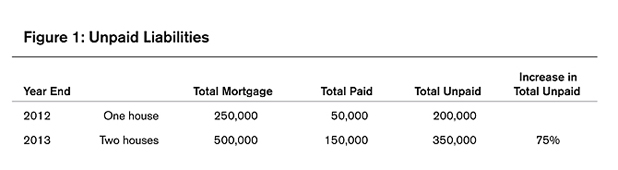
Unpaid Liabilities

If the same thing is done in 2013 as 2012 (buying a $250,000 house and making $50,000 payments on each), why does the liability go up? It's because the change in ultimate losses (another $250,000) is much larger than the additional $100,000 payments in 2013. In 2013, the ultimate increased by $250,000 for the new year's exposure of an additional house and the payments increased by $100,000 for the two $50,000 payments made on the two houses. The prior liability of $200,000 plus the change in ultimate losses of $250,000 minus the change in payments of $100,000 equals a new liability of $350,000 at the end of 2013.

For the next four years, the liabilities will keep increasing. The liability will go unchanged only when the payments made in the calendar year are equal to the new exposure brought on with the purchase of a new house. When five (or more) $250,000 houses are owned, $250,000 in payments will be made each year, offsetting the additional $250,000 in liability picked up with each new house purchased, as shown in Figure 2 below.
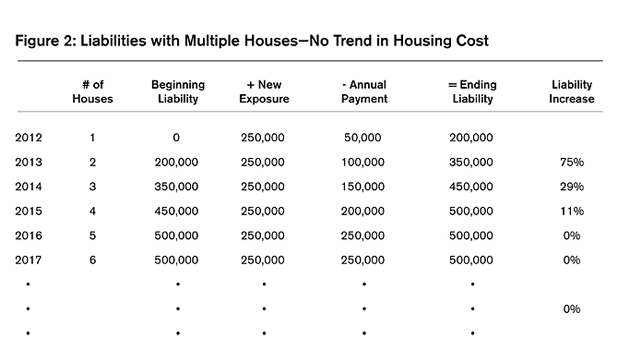
Liabilities with Multiple Houses - No Trend in Housing Cost

Many executive managers (and some risk managers) feel that their programs are in this "steady state" and do not expect to see increases in the liability. However, in the real world of large deductible and self-insured workers' compensation programs, the ultimate losses for each new exposure year are heavily influenced (and increased) by rising medical and indemnity costs. The injuries that cost $250,000 in 2012 dollars will cost more in the future.

An Annual Occurrence?
It is very important that executive management is aware that unpaid workers' compensation claim liabilities are expected to increase each year. And that the increases will be more than inflation (as represented by the consumer price index, or CPI). While other balance sheet items may be subject to inflation only, unpaid claim liabilities are subject to inflation, severity trends, and frequency trends. The 2012 State of the Line annual presentation by the National Council on Compensation Insurance (NCCI) shows a five-year indemnity trend of 2.9% from 2006 to its projection for 2011, with a medical trend of 4.4%, noting that the negative frequency trends that had been offsetting the rising indemnity and medical severity trends are beginning to flatten out.

This means that as business continues into the future, and even if all other variables remain the same, each new year of additional workers' compensation exposure is expected to cost more than the prior year by the aggregate trend. This is analogous to buying the same house every year in a housing market that's rising.

In this next example, the houses bought are 3% more expensive every year. All the houses have similar characteristics from year to year — square footage, tax rates, school districts, etc. — just as from year to year, many companies' workers' compensation exposure stays similar, as far as the number of employees, the mix of NCCI class codes, the location of employees, and the retention limit of the insurance program.

Adding Trend
Continuing from Figures 1 and 2, if a 3% housing increase trend is used, the change in liability will now increase each year and will continue to increase by the 3% trend. In our first example, a constant liability was achieved because the total calendar year payments ($50,000 on each of the five houses with a mortgage at any one time) lowered the liability the same amount as the new house raised the liability each year.

In the 3% trend example below, payments are made on less expensive houses while the incoming houses are the most expensive. In 2018, the first trended house is purchased for $257,500 ($250,000 × 1.03). The first of five payments is made on this house for $51,500. Each of the other four outstanding mortgages is still being paid at $50,000 each, so in 2018 a total of $251,500 is paid. But this is $6,000 short of the $257,500 change made to the ultimates when the new house was purchased.

Recognizing that the majority of payments are being made on mortgages (or claims) in earlier, "cheaper" years, while more expensive, trend-influenced mortgages/claims are being brought onto the program's liabilities, is the key to accepting the natural rise in liabilities over time.
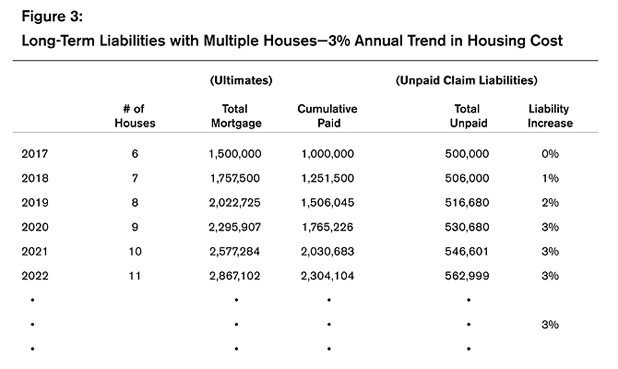
Long-Term Liabilities with Multiple Houses - 3% Annual Trend in Housing Cost

Large deductible and self-insured workers' compensation programs face liability increases that are due to cost trends every year. In order for a program's liabilities to stay at the same level or decrease, the program would have to overcome these trends. But inflation, severity, and frequency trends aren't the only variables out there.

What To Watch For In The Future
As the economy recovers and workforces grow, this will increase the future additional costs applied to the program's liabilities. As a workforce increases by 1%, 3%, or 5%, so too do the anticipated ultimate losses for the next year. It would be comparable to buying a house with 1%, 3%, or 5% more square footage at the same cost per square foot.

Additionally, as the insurance market slowly hardens, programs may begin raising their retention levels. As the retention levels rise, so do the oncoming liabilities. Retention level increases will have a much larger impact than trend increases, as retention levels can increase by substantial amounts. In this example, a workers' compensation retention increase from $250,000 to $500,000 is similar to suddenly buying more expensive houses. While a 3% trend will raise the house price from $250,000 to almost $300,000 over six years (and raise liabilities by 3% each year), a jump to buying $500,000 houses will noticeably increase the liability with the addition of $500,000 mortgages, while most payments on the houses are in the range of $250,000 to $300,000.

In these examples, a very even payment pattern was used, but it is also important to note that the timing of payments influences the unpaid claim liabilities. In real life, workers' compensation payments may not be this regular, and large claims can have sudden payouts due to judgments or settlements.

As shown in the earlier formula, unpaid claim liabilities are equal to the ultimate losses minus the paid amount to date. Let's say that a decision is made to fully pay one of the mortgages on these houses. An additional payment of $250,000 would decrease the liabilities by $250,000. And while this large payment will decrease the liability, it does not have an effect on what is paid in total — the ultimate payments will remain the same — they just have to be paid sooner. And the decrease in the liabilities came from an equal decrease in the assets, which will offset on the financial statements.

Your actuary can explain and quantify the trend effects on your insurance program in detail and how any other changes in your program (to retention levels, employment levels, etc.) will affect the liabilities going forward. Internally, the actuarial report should be reviewed for its information on the change in the program's ultimate losses, which is a better reflection of the program's performance over time than the change in liabilities over time that is due to their sensitivity to payment timing.

Risk managers who need to manage executive management's expectations on unpaid claim liability growth can explain the external factors that play a large role in changing liabilities over time. If liabilities are increasing with the increasing trends, that's to be expected. If liabilities are increasing less than trend, staying flat, or decreasing, that's great. If liabilities are increasing by more than trend, ask your actuary for some suggestions.

A safety analysis can help identify which kinds of injuries make up the majority of the loss dollars, the program's retentions and allocation methodology can be reviewed, or for a thorough review of claims, predictive analysis can zero in on loss drivers.

An actuary can't make external trends disappear but can help explain them to executive management and make other suggestions on finding solutions in your data.


New AMA Classification Of Obesity: How It Affects Workers' Compensation And Mandatory Reporting

Baseline programs such as the EFA-STM ensure that the employee and employer are protected and take the sting out of the new classification by the AMA for obesity.|

On June 16, 2013, the American Medical Association voted to declare obesity a disease rather than a comorbidity factor. This change in classification will affect 78 million American Adults and 12 million children. The new status for obesity means that this is now considered a medical condition that requires treatment. In fact, a recent Duke University / RTI International / Centers for Disease Control and Prevention study estimates 42 percent of U.S. adults will become obese by 2030.

According to the Medical Dictionary, obesity has been defined as a weight at least 20% above the weight corresponding to the lowest death rate for individuals of a specific height, gender, and age (ideal weight). Twenty to forty percent over ideal weight is considered mildly obese; 40-100% over ideal weight is considered moderately obese; and 100% over ideal weight is considered severely, or morbidly, obese. More recent guidelines for obesity use a measurement called BMI (body mass index) which is the individual's weight divided by their height squared times 703. BMI over 30 is considered obese.

The World Health Organization further classifies BMIs of 30.00 or higher into one of three classes of obesity:

  • Obese class I = 30.00 to 34.99
  • Obese class II = 35.00 to 39.99
  • Obese class III = 40.00 or higher

People in obese class III are considered morbidly obese. According to a 2012 Gallup Poll, 3.6% of Americans were morbidly obese in 2012.

The decision to reclassify obesity gives doctors a greater obligation to discuss with patients their weight problem and how it's affecting their health while enabling them to get reimbursed to do so.

According to the Duke University study, obesity increases the healing times of fractures, strains and sprains, and complicates surgery. According to another Duke University study that looked at the records for work-related injuries:

  • Obese workers filed twice as many comp claims.
  • Obese workers had seven times higher medical costs.
  • Obese workers lost 13 times more days of work.
  • Body parts most prone to injury for obese individuals included lower extremities, wrists or hands, and the back. Most common injuries were slips and falls, and lifting.

The U.S. Department of Health and Human Services said the costs to U.S. businesses related to obesity exceed $13 billion each year.

Furthermore, a 2011 Gallup survey found that obese employees account for a disproportionately high number of missed workdays. Also earlier National Council on Compensation Insurance (NCCI) research of workers' compensation claims found that claimants with a comorbidity code indicating obesity experience medical costs that are a multiple of what is observed for comparable non-obese claimants. The NCCI study demonstrated that claimants with a comorbidity factor indicating obesity had five times longer indemnity duration than claimants that were not identified as obese.

Prior to June 16, 2013, the ICD code for comorbidity factors for obesity in workers' was ICD-9 code 278. This is related to obesity-related medical complications, as opposed to the condition of obesity. Now the new ICD codes will indicate a disease, or condition of obesity which needs to be medically addressed. How will this affect work-related injuries?

Instead of obesity being a comorbitity issue, it can now become a secondary claim. If injured workers gain weight due to medications they are placed on as a result of their work-related injury or if an injured worker gains weight since they cannot exercise or keep fit because of their work-related injury and their BMI exceeds 30, they are considered obese and are eligible for medical industrially related treatment. In fact, the American Disability Act Amendment of 2008 allows for a broader scope of protection and the classification of obesity as a disease means that an employer needs to be cognizant that if someone has been treated for this disease for over 6 months then they would be considered protected under the American Disability Act Amendment.

Consider yet another factor: with the advent of Mandatory Reporting (January 1, 2011) by CMS that is triggered by the diagnosis (diagnosis code), the new medical condition of obesity will further make the responsible party liable for this condition and all related conditions for work-related injuries and General Liability claims with no statute of limitations. It is vital to understand that, as of January 1, 2011, Medicare has mandated all work-related and general liability injuries be reported to CMS in an electronic format. This means that CMS has the mechanism to look back and identify work comp related medical care payments made by Medicare. This is a retroactive statute and ultimately, it will be the employer and/or insurance carrier that will be held accountable.

The carrier or employer could pay the future medical cost twice — once to the claimant at settlement and later when Medicare seeks reimbursement of the medical care they paid on behalf of the claimant. This is outside the MSA criteria. The cost of this plus the impact of the workers' compensation costs as well as ADAA issues for reclassification of obesity for an employer and carrier are incalculable.

The solution is baseline testing so that only claims that arise out of the course and scope of employment (AOECOE) are accepted. If a work-related claim is not AOECOE and can be proved by objective medical evidence such as a pre- and post-assessment and there is no change from the baseline, then not only is there no workers' compensation claim, there is no OSHA-recordable claim, and no mandatory reporting issue.

A proven example of a baseline test for musculoskeletal disorders (MSD) cases is the EFA-STM program. EFA-STM Program begins by providing baseline injury testing for existing employees and new hires. The data is only interpreted when and if there is a soft tissue claim. After a claim, the injured worker is required to undergo the post-loss testing. The subsequent comparison objectively demonstrates whether or not an acute injury exists. If there is a change from the baseline site specific treatment, recommendations are made for the AOECOE condition ensuring that the injured worker receives the best care possible.

Baseline programs such as the EFA-STM ensure that the employee and employer are protected and take the sting out of the new classification by the AMA for obesity.

Belief In Your Products And Services Is The Key To The Sale

Until you trust that the product or service that you are trying to sell is the best decision that the buyer is going to make, you will never be in danger of making a sale.

Let me ask you something: Do you believe in the products and services that you are selling? Do your employees believe in the products and services that they are selling? If the answer is "no" to either one of these questions, you are in danger of losing the sale.

I will tell you right now that as a CEO, Founder, and Salesperson, I refuse to sell a product or service in which I do not believe. I refuse to sell a product or service that I am not proud of. Why? Because if you yourself do not believe in a product or service, how do you expect consumers to believe in it? You cannot possibly expect to make a sale if this is the case!

In order to make the sale, you need to 1) develop a belief system; and, 2) coach both yourself and your sales team to believe.

Developing A Belief System
There are two very important things to believe in when trying to successfully sell a product or service. Number one, you must believe in yourself. Number two, you must believe in what you are selling. Having confidence in both areas will work in your favor and it will ultimately shine through to the potential client with whom you are sitting face-to-face. If you truly believe that you are serving the customer the best possible product or service, it will show.

People are not interested in being sold things. Let's face it! People are afraid of salespeople. The reality of the situation is that people want to buy from somebody who is not selling them, but helping them to make an educated buying decision. If you know everything there is to know about what you are selling — and you believe in it — the consumer will trust your judgment. The consumer will see that you have the facts laid out right in front of them. As a professional, it is your duty to develop belief in all areas before you head out and push a product or service on potential buyers. If you have a belief system in place, you can communicate what you are trying to do very effectively.

Coaching Yourself To Believe
If you are not a believer in your own product, you have a whole new set of problems to deal with. As the CEO and Founder of Astonish, I know that our company has the greatest digital marketing system in the world. I know that we sell the best product, have the best technology, the best training and the best digital marketing strategies for local insurance agencies across the country. I am telling you right now: The reason I want to be the best at sales is because I truly believe that at the end of the day, insurance agencies that don't work with Astonish are making the biggest mistake that they have ever made — and I will tell them this! And guess what? They begin to think. They begin to second guess. They can see the passion I have. They can sense that I am genuinely concerned.

If you do not truly believe in your products and services, then what do you do? Whatever it is that you are in doubt of, you need to fix! You need to pinpoint exactly what you do not believe in and improve it — because if you do not believe in it, you will never be in danger of selling it.

It is your ultimate goal to have a client believe you, trust you, and see that this sale is coming from some place much deeper than just the point of making a sale and making money. Once you achieve this, you will absolutely, positively sell more.

Coaching Your Salespeople To Believe
For all the salespeople out there, I say this: If you do not believe in the company for which you are working, leave. If you do not believe in the products or services that you are trying to sell, please just leave! If this is the case for you, sticking with a company in which you do not believe will not do any good for anybody involved — not you, not the company, and certainly not the consumer.

If you are a business owner, it is your responsibility to make sure that you have a team of salespeople who truly believe in what they are selling. How do you do this? You have to coach them. You have to amp them up. You have to prove to them that the product or service that they are selling is literally the greatest product out there.

The first step to coaching your salespeople is to train them on what they are out to sell. They must know the ins and outs and everything in between. It is your job to make sure these people have a full understanding of what their purpose is! You can do this by hands-on training, tutorials, providing manuals, documents, and more. Once they have a grasp on the product or service, you send them off ... and then what? Measure and monitor.

How can you tell if a salesperson is passionate about selling? Numbers, numbers, numbers. Take a look at metrics. By the way — numbers do not lie! If a salesperson is not meeting goals, chances are, he or she is not trying hard enough to push the product. Why? It's a lack of passion. Without the passion or belief behind the product, their sales pitch is merely words. Mindless words with no enthusiasm. Chances are, they are either not cut out for sales or they are not interested in the product or services that they are promoting. If this reads on their face during a meeting with a potential customer, guess who is not going to believe? Bingo.

Do You Believe?
If you are a true believer in the product and services that you are selling, you have every right in the world to look a consumer dead in the eyes and ask for their business. If you would not sell this product to yourself, your friends, or your family, why would you sell it to an important customer? Until you trust that the product or service that you are trying to sell is the best decision that the buyer is going to make — I repeat — you will never be in danger of making a sale.

So let me ask you one last question: Do you believe?