Download

Section 831(b) Captive Insurance Companies And The Tax Preparer Penalty

The hurdles for properly deducting premiums paid to one's own insurance company are both numerous and, to some extent, subjective.

An Actual Scenario: A CPA was preparing the tax return of a longtime client who had purchased three captive insurance companies from a well-known provider of such entities, and had paid $3.3 million in insurance premiums to these companies. The client wished to show that payment as a tax deductible item. The client had $28 million in revenue and paid $92,000 annually for their usual third-party insurance program. The insurance premiums paid to these new captives were for "coverages" that supplemented their existing insurance. What could the CPA do with this request?

Background: Owners of profitable businesses are attracted to the tax and financial planning benefits of forming and owning a captive insurance company that qualifies for the tax benefits of section 831(b) of the Internal Revenue Code (the "Code").

The Code section provides that if an insurance company has no more than $1.2 million in annual premium income, it can elect to exempt that income from taxation. And under a series of judicial decisions and Revenue Rulings, the insured company may be able to fully deduct the premium paid, even if the same person (or persons) owns both the insured and the insurance company.

This concept can be financially powerful, resulting in an immediate reduction in the owner's tax bill, yet virtually all of the funds remain tax free inside a related company. The profits of that company can either be accessed later at capital gains rates or passed to heirs outside of the estate tax regime.

The Problem: The deductibility of the premium is not automatic. The hurdles for properly deducting premiums paid to one's own insurance company are both numerous and, to some extent, subjective. The new insurance company must demonstrate sufficient "risk distribution," the amounts charged by the insurance company as premium for the coverages offered must be "reasonable," and the client must demonstrate an adequate "business purpose" for entering into the transaction, to name just a few of the important hurdles involved. These are each very important requirements that a tax preparer is unlikely to be able to judge with any degree of comfort.

Tax preparers who face the request to sign a return that reflects the deduction of such premiums must be careful not to run afoul of the Return Preparer Penalties of section 6694 of the Code. In addition, the client could face an accuracy-related penalty under section 6662 of the Code equal to 20 percent of the underpaid tax should the deduction ultimately be disallowed.

The standard for avoiding the Return Preparer Penalty is that the preparer held a reasonable belief that the position (the deductibility of the insurance premium) would have a greater than 50 percent likelihood of being sustained on its merits.

One of the factors included in the Regulations covering Section 6662 to determine whether a tax return has been negligently prepared is "failure to reasonably ascertain the correctness of an item that to a reasonably prudent person would appear 'too good to be true' under the circumstances."

In this case, it appeared that a sudden increase in insurance expense from $92,000 to over $3 million might make the deduction of that expense "too good to be true." But how could the preparer "reasonably ascertain" the likelihood of this deduction being upheld in audit?

The third party that the client relied on for advice in this transaction was the captive insurance company provider that sold them the program in the first place. But that party obviously believed that their program was fully compliant and therefore could not deliver a truly objective response to the CPA's concerns.

The client's attorney was not versed in captive insurance companies and could not be helpful without an expensive journey up the learning curve.

Turning to another captive insurance provider for an analysis of the client's situation was an obvious option. But each provider has their own competing program and clearly has an incentive to undermine the competition and encourage the client to switch providers. Certainly this may not always be the case, but it is wise to question the objectivity of the person doing the analysis if that person is a competitor.

The Solution: In this case, the CPA needed two sources of help. First, she needed to find an expert in captive insurance who did not also offer his own competing program. Second, she had to find an independent actuary who was familiar with captive insurance programs and who would be willing to opine as to the "reasonableness" of the premiums being charged by the captives.

Finding these independent advisors required networking with other CPA firms, searching the web for relevant articles and identifying their authors, and locating captive insurance sites and blogs.

The Result: The independent advisor created a report that the CPA could rely on, stating that while the structure of the captive insurance program would likely be compliant, the amounts of the premiums being charged did not appear reasonable, given both the nature of the client's business and relevant premium rates in the third-party market. The CPA then advised the client to hire an independent actuary to perform a rate review. The actuary ultimately opined that the client could reasonably support premiums of about half of the amount originally considered.

The client got a large tax deduction and the preparer had in file objective third-party support for the position ultimately taken on the tax return. While this support does not guarantee a favorable result in the event of audit, it should be very valuable evidence in any such audit and should satisfy the requirements for avoiding the Return Preparer Penalty.


Hiring Your Insurance Advisor

Purchasing insurance is a very serious consideration for the preservation of your business capital and should never be just about price.

Hiring an insurance advisor to handle your insurance is a critical necessity for a business owner. While many business owners know this, unfortunately, others default to a personal friend, a relative in the insurance business or the sales person that is friendly and wants to save you money. While there is not really anything terribly wrong with this (after all, you should work with someone you like), it is often better to work with someone you respect. That respect should be based upon experience and knowledge. The problem with that sentence is that since you do not understand insurance in all of its complicated glory, how do you select your broker?

Well, nothing is a perfect science, but if we put aside personalities for a little bit, there are some basics that you can follow that will help you make an appropriate decision based upon facts and then can factor in the personalities.

Some Basic Truths

First: Interview a prospective insurance agent/broker and qualify them according to your own needs.

Second: Insurance is a large portion of your annual expenses.

Third: You have a significant potential for uncovered losses that can put you out of business or cause you to lose capital and/or assets.

Fourth: All insurance policies are not created equal.

Fifth: There is no such thing as coverage for every type of loss.

Any insurance broker that starts the conversation by offering to reduce your insurance premium should be shown the door — immediately. If that is all they have to offer, move on.

It's All About Price, Right?
Purchasing insurance is a very serious consideration for the preservation of your business capital and should never be just about price. Every agent/broker will attempt to get the lowest possible premium so that they are competitive. Many businesses have purchased insurance only to find out at the time of a loss, that the insurance was inexpensive because it did not provide proper coverage. Although agents and brokers are licensed, there are great differences of education, knowledge and market understanding among them. An insurance advisor that is at the top end of that scale is an invaluable resource to you and your business.

For illustration purposes, here's a classic example: An underground water pipe breaks and the business owner has to remove a significant portion of paving as well as the pipe and replace both. The cost is $500,000. The insurance coverage placed by their insurance broker paid not a dime. Why? Underground pipes and pavement are often excluded types of property. Here's the pitiful part: Coverage can be provided for these items and at no additional premium (the limit of insurance, however, must include these values).

It is important that you understand which losses you are insuring and which losses you are retaining. A knowledgeable insurance advisor will help you identify your normal as well as unique exposures to loss, offer coverage and, most importantly, be able to explain that coverage in terms that make sense to you as a business owner without a lot of insurance techno-babble.

Think about the many complexities of various contracts you enter into. Insurance is another contract that is just as complex and detailed as your other business agreements.

Keep 'Em Honest
If you are sending your insurance out to quote to "keep your insurance agent honest," get another insurance agent because clearly you do not trust your current agent.

You should have a trusted advisor that has demonstrated their skill and depth of knowledge, who understands you and your business by asking for information and providing insurance or other risk guidance to you on an ongoing basis. If your business generates significant premium, interview competing agents and select one in addition to your incumbent agent and obtain a coverage review and quotation every three years.

You should create a Request For Proposal in order to provide the same information about your company to each competing broker. Assign them insurance markets. Allow your current advisor first choice for their top three or four insurance companies and have the competing broker identify the three to four insurance companies they will be using. The competing broker cannot use the same markets as those of your current broker. Your current broker should always bring their proposal to you after the competing broker.

Don't Shoot Yourself In The Foot
Never provide one broker's proposal or reveal information to the other. If the competing broker brings significant coverage issues and solutions to the table that your current advisor has never talked about, then perhaps you need to reevaluate your choice. One of the business practices that is the most aggravating to insurance professionals and is just plain wrong is to send everything that a competing broker has developed as risk exposures and solutions over to the existing broker by the owner. If the exposures are significant and the coverage analysis has been performed and specifics given to you, why would you do this?

Let's see if this makes sense: Give someone else's work to the person that has been mishandling your coverage and tell them to fix it. That is not buying insurance based upon real solutions — that is simply buying insurance either from someone you like or because you think they are the cheapest game in town.

Ask And Tell Policy
The relationship between you and your insurance advisor must be based upon proper communication. Tell your broker everything about your business and ask questions about your insurance program. Never assume that "your agent is handling" it. Ask your insurance advisor to become involved in contract negotiations or buy-sell agreements before you sign them. Their job is critical to your continued viability as a business: standing between you and your loss of capital and assets. As President Reagan famously said: "Trust, but verify."

Important Terms

Agent Places your insurance coverages through an insurance company with which they have a contract (called an agency appointment). An agent legally represents the insurance company to the buying public. Note that in some states, the state regulations use the term "producer" and may encompass both an "agent" and "broker" in a legal capacity.
Independent Insurance Agent Often represent many insurance companies with which they place insurance. Although legally representing the insurance company, they also represent the insurance buyer and have a different status than agents that represent only one company.
Broker Places your insurance coverages with one or more insurance companies. A broker legally represents the insurance buyer to the insurance company and is not required to have a contract with any insurance company. A broker can go directly to certain insurance companies or may access insurance companies through a surplus lines broker.
Surplus Lines Broker Also known as a "wholesaler". This is a company through which difficult lines of insurance are written. State laws control how the insurance delivery scheme is enacted. Your broker goes to the wholesaler who places your coverage through an insurance company. The insurance company could be "admitted" or "non-admitted". You will pay fees to both and these should be completely disclosed to you, in writing. The premium for a non-admitted insurance company does not include taxes and fees; those must be disclosed in writing along with the actual premium.
Insurance Market Access The type of insurance professional that has the widest market access is an independent insurance agent who is also licensed to act as an insurance broker. Although the license name varies by state, the critical question is: Can you only write business through insurance companies with which you have a contract or do you have access to a wide variety of insurance companies directly or through surplus lines brokers? This allows the widest insurance market access to properly transfer your exposures on a competitive basis.
Insurance Consultant / Risk Manager An independent person who works exclusively for the hiring party. This person will provide guidance for managing your risk and will work directly with your agent/broker (or prospective agent/broker) for proper insurance placement. An independent consultant should never actually place your coverage. This person should create insurance specifications that are extensive, provide those to your agent/broker and review the insurance placed and received for conformance. Verify that your consultant does not, in any manner, receive payment or share in the commission from the insurance agent/broker. This creates a conflict of interest and the consultant is no longer acting exclusively for you. A consultant should also never promise to reduce your premium and receive a fee for doing so. This also reduces the altruistic nature of the relationship.

Download an interview sheet that you can use that may be of help to you in this endeavor.

Using Strong Carrots And Sticks To Drive Health Care That Works

Employers are waking up, and are tying stronger incentives to approaches that get results. On the hook for exorbitant health care costs, employers and employees are game to know who delivers value and what works. They want good care for their families without financial peril. And they want help orchestrating that process without financial conflict.

On a recent call with a large manufacturer, my company's team expected to describe how we develop primary care medical homes that become platforms for managing comprehensive health care clinical and financial risk. But the team on the other end of the phone beat us to it. Their remarks — that health care cost is a multi-headed monster that requires a broad array of simultaneously executed approaches — were a breath of fresh air.

They wanted to avoid approaches that don't work or are designed to accrue to a vendor's disproportionate financial advantage and focus instead on mechanisms that measurably improve health and reduce cost. Their conventional current clinic vendor wasn't onboard, philosophically or in terms of capabilities, and so wasn't getting results. They were looking for a replacement vendor that could help them drive more appropriate care, with clear rules for patients and providers.

Often we have to cajole clients into more aggressive actions: restructuring their benefits or their PBM formularies, redirecting care to high performing doctors or hospitals, direct contracting for advanced images or ambulatory surgeries, creating stronger incentives for approaches that are most likely to produce better results. But now we're finding more employers exhausted and eager to pursue out-of-the-box approaches that can drive more appropriate care and cost.

Since the end of World War II, when employers began offering health benefits to recruit and retain better employees, a tug-of-war has been waged over the rules of engagement. Employers want competitively healthy and productive work forces, but see health care as an unpredictable significant cost that must be managed. Employees may bristle at participating in risk assessments, or seeing certain doctors or working toward a healthier lifestyle. These may be seen as brazen invasions of privacy, as work overflowing into personal life, as constraints on patients' abilities to obtain quality care.

Until now, most employers have been reluctant to be too dictatorial. But the financial threats of relentlessly surging cost — 4.5 times general inflation for more than a decade — and overwhelming evidence of industry excess have been impossible to ignore, fueling a focus on using strong carrots and sticks to steer behaviors that follow what works.

This is no small task, because a profiteering health care industry has developed scores of ways to extract more money than it is entitled to. Low primary care reimbursements have translated into rushed visits, driving up specialty referrals, diagnostics, procedures and costs for complicated patients. Egregious unit pricing on drugs, devices and specialty procedures — think stents, advanced images and complex spinal surgeries — encourage delivering more unnecessary products and services. Yellow-pages provider networks give patients "choice" to unwittingly see lousy doctors who consistently produce poorer outcomes at higher episodic cost, or get care in hospitals where there are higher opportunities to experience an error or acquire an infection. Leaving all this to health plans that have, for decades, been unwilling or unable to manage these vectors or control costs is repeating a behavior while hoping for a different result.

Last year, Walmart contracted for heart, spine and transplant surgeries with six Center of Excellence health systems around the country. These organizations use salaried specialists who are more likely to diagnose and treat correctly the first time for lower overall utilization and cost. They use and share evidence-based protocols, share data and coordinate care with local providers. Walmart employees who visit these Centers pay nothing. Many large and mid-sized firms are now pursuing this design.

Jerry Reeves MD, a medical management innovator, structured an alternative health plan design for one of his clients. His plan used rules that strongly encouraged approaches that work. Employees who adhered to the rules paid about one-third less for their coverage. But the program required a commitment. Participants who signed up had to use one of eight primary care medical homes that had been established. They needed to visit within 90 days for an exam, including a biometric profile. If the medical home called to recommend visiting a nurse coach, the patient needed to do that. Patients seeing specialists needed to make sure that the specialist information came to the primary care doctor. The medical homes were structured to accommodate walk-ins, so urgent care visits in Emergency Departments were not covered until after hours. There were other rules as well.

There are rules for doctors and hospitals too. To participate in good standing, they had to develop and sign documented care plans for patients, so patients and physicians could know what to expect. They had to be able to exchange clinical information so care could be better coordinated.

Patients failing to follow any of these rules would receive "strikes," and three strikes would land the patient in health care timeout for a year, back to the original health plan, with more choice but 35 percent more cost.

Dr. Reeves' numbers were striking. 97 percent of the group signed up for the plan, and only one person struck out. Hospital days dropped 55 percent. Advanced images dropped 35 percent. Health improved and costs plummeted.

Employers are waking up, and are tying stronger incentives to approaches that get results. On the hook for exorbitant health care costs, employers and employees are game to know who delivers value and what works. They want good care for their families without financial peril. And they want help orchestrating that process without financial conflict.

More employers are making this shift. Broad-spectrum medical management organizations see this as an opportunity to succeed by bringing health care back into balance.

This article first appeared on Care and Cost.

25 Axioms Of Medical Care In The Workers Compensation System

In this article, William Zachry, the Vice President of Risk Management for Safeway Inc, shares 25 fundamental principles of the real-world workers' compensation system.

  1. The right medical care at the right time is always in the best interest of the injured worker and almost always will result in the lowest claims costs.
  2. The right medical care at the right time will (almost always) result in an earlier return to work with less permanent residual disability.
  3. Evidence-based medicine is the right care for the legitimately injured workers. (There is a hierarchy on how to apply evidence-based medicine).
  4. To control worker's compensation medical costs requires both a fee schedule and an ability to control the frequency and the appropriateness of treatment. One without the others usually results in massive increase in medical costs for the system.
  5. The medical treatment fee schedule should be clear, easy to use, accurate and reflect the latest technology.
  6. A fee-for-service system may result in incentives for physicians to over-treat, inappropriately.
  7. In many jurisdictions Worker's Compensation is generally the last fee-for-service system.
  1. As long as workers compensation uses a fee-for-service system, medical utilization review is needed to make sure that the physicians will treat adhering to evidence-based medicine.
  2. Pharmacy utilization is problematic because of the "Medicalization" of the general population. (Medicalization is the direct advertising of symptoms and diagnoses to the general population by drug manufacturers, resulting in an overuse and/or misuse of some types of drugs and therapies).
  3. There is a significant problem with "off label use" of drugs in the worker's compensation system. (Off Label is the use of a drug for treatment that was not the reason for its approval from the FDA).
  4. Medical decisions should be made by medical professionals. Most Workers' Compensation judges, attorneys, and claims adjusters have little to no formal medical training and are not medical professionals.
  5. Poorly (inappropriate) placed incentives will result in poor medical outcomes. (There are several studies that demonstrate that allowing physicians to do self-referrals or to dispense pharmacy goods from their offices will usually result in a utilization of unnecessary services or inappropriate usage of drugs).
  6. Even if the doctor is not dispensing the drugs, opiates require regular visits to the doctor for renewal of the prescription and also may involve expensive drug testing; so there is a financial interest on the part of some doctors to prescribe opiates.
  7. Some physicians who prescribe opiates do not fully appreciate the addictive power of the drugs that they are using or the difficulty in detoxing the patients.
  8. There are currently enough treating physicians and specialty physicians in most urban areas; however there are not enough physicians (treating, orthopedic or neurosurgeons, etc.) in the rural areas to meet the demand. This problem will only get worse as the population ages and more doctors retire. It will also get worse if physicians leave workers' compensation due to the demand for their services due to the implementation of the federal universal health care programs.
  9. Many surgeons and other physicians want to perform their craft (do surgery, provide injections, etc.). They truly believe that their surgery or injections will work even if the prior treatments have not been successful or if current evidence-based medicine says surgery is not appropriate.
  10. Every patient looks like a good candidate for an MRI when there is an MRI machine in the doctor's office.
  11. Not every person with a surgical or potentially surgical condition is a good surgical candidate. Though pre-surgical psychiatric evaluations are required for spinal cord stimulators (post spine surgery), the same is not true for many other surgeries.
  12. It is difficult for a patient who is in intractable pain to believe that strong medications (including opiates) are not appropriate or are not good.
  13. It is difficult for a patient who is in intractable pain to believe that not having back surgery will have the same ultimate result as having surgery when the surgeon is saying (with confidence) that the surgery will cure all. Even though current evidence-based medicine says differently.
  14. Because "doing something is better than doing nothing" when the patient is in intractable pain, if the surgeon says surgery will not be successful, the injured worker will attempt to find someone who will say that the surgery "will be more successful than not having surgery," and will then attempt to have the surgery.
  15. Patient advocacy is the application of appropriate treatment and patient encouragement that allows the patient to remain as functional and productive as possible.
  16. Patient advocacy does not always mean the pursuit of treatment a patient desires.
  17. Patient advocacy may require the physician to decline to do the treatment sought by the patient when that treatment is inappropriate.
  18. In Workers'Compensation, there are many (known and unknown) underlying non-industrial, psyche/social issues that may hinder or completely stop optimum medical recovery.

Skiing The Slippery Slope Of Employment Practices Liability In The Nonprofit Sector

If unsure about the nature and extent of your Employment Practices Liability coverage, by all means consult with your insurance agent or broker.|

One of your employees has been out on disability with a workers' compensation injury and you have been getting great advice and service from your workers' compensation carrier regarding managing the employee while out on leave. Ultimately, you are advised that it has been determined in the workers' compensation case that the employee has reached maximum medical improvement (known as permanent and stationary in some states) and cannot return to her job due to a permanent disability. With regret, you terminate the employee since she is now receiving workers' compensation vocational rehabilitation benefits and you have heard that workers' compensation is the exclusive legal remedy for employees suffering workplace injuries. Not so fast! If an employer has 15 or more employees, it is subject to the Americans with Disabilities Act (ADA) and/or a state disability accommodation law with a different threshold for applicability. In this instance, even though you acted appropriately in terms of not discriminating based on a work-related injury in violation of workers' compensation law, you have violated the Americans with Disabilities Act for failing to engage in the interactive process to determine if there is any reasonable accommodation that would have allowed the employee to return to work for you — perhaps in a different job. Failing to engage in the interactive process prior to terminating a disabled employee is a violation of the Americans with Disabilities Act and would subject you to legal liability resulting from the termination. Okay, so maybe you knew about that issue. But what about the other employment law moguls out there just waiting for you? Let's explore some of the common — and maybe not so common — employment practices law issues that face nonprofits, how to guard against mistakes, what it can cost if you do err, and how insurance fits into the picture. Timing Really Is Everything Culled from the claims files of the Nonprofits' Insurance Alliance of California (NIAC) and the Alliance of Nonprofits for Insurance (ANI), member companies in the Nonprofits Insurance Alliance Group (NIA Group) that insures over 11,500 nonprofits around the country, here are just a few examples of seemingly appropriate terminations by 501(c)(3) nonprofits that failed to withstand scrutiny because of their timing.
  • A couple of disruptive employees whose paychecks had been withheld for failure to have reports done on time filed a complaint about not being paid and were then terminated. (Two strikes on this one!) First, most states prohibit withholding paychecks just for poor performance. Second, terminating these two employees after they complained resulted in valid claims under the state's "whistleblower" laws.
  • A poorly performing employee complained of sexual harassment. A thorough investigation concluded no harassment had taken place. The employee was then terminated on performance grounds alone. Problem — no contemporaneous documentation of the alleged poor performance existed, so it appeared to the state administrative agency that the termination was a result of the harassment allegation because it followed closely behind the report of it.
  • A long-term employee of an elder daycare facility, who was a "mandatory reporter" under state law, filed a report with the state about inadequate staffing at the facility when an elderly client was left unattended and was found wandering around in traffic. She was terminated for not following "internal reporting procedures" (in this case a warning was the appropriate remedy, not immediate termination).
So What's An Employer To Do? Let's start with the exposures under Employment Practices Liability (EPL) that give rise to liability claims. Both federal — and most state — laws proscribe the most commonly known unfair employment practices of wrongful termination, sexual harassment, discrimination and ADA violations. Embedded in each of those categories, however, are some lesser known prohibitions and strict liabilities. By now most everyone knows that in most jurisdictions you can't terminate someone based on age, race, gender, or sexual preference. But what if a poor performing employee is the only one working for your nonprofit that's in a protected category? Termination here may have the appearance of discrimination sufficient to subject you to administrative or civil exposure. You know that sexual harassment is illegal and that procedures need to be in place to train supervisory and management personnel about its ins and outs. But what if you're in a state that imposes strict liability on an employer, even if the employer didn't know the harassment was occurring? Or what about a delivery person that's been making inappropriate suggestions to your receptionist, or if the delivery person believes that one of your employees has been harassing him or her? That can get you into as much trouble as the typical case. So, what to do? Defense of Employment Practices Liability claims starts with your agency having documented procedures in place that you and your counsel can use to demonstrate to an administrative agency or a court that you intended to be — and were — in compliance. This is best accomplished from the beginning with a robust personnel handbook that includes policy statements and procedures around at least 12 key subjects.
Twelve Components of a Model Personnel Handbook Following are twelve components that we recommend all personnel handbooks contain:
  • Introductory Statements
  • Nondiscrimination and Sexual Harassment
  • Organization and Structure
  • Training and Orientation
  • Employee Classifications and Categories
  • Employment Policies, Including Wage and Hour Regulations
  • Benefits Disclaimer
  • Leaves of Absence and Time Off
  • Standards of Performance
  • Workplace Violence Prevention and Safety
  • Search and Inspection
  • Drug-Free Workplace
At a minimum, the handbook should include statements regarding at-will employment, probationary, introductory or benefit waiting periods, and examples of disciplinary offenses (always prefaced with "including, but not limited to" language). Always have employees sign a written acknowledgment that they have read and understand the policies, or you might as well not have created them in the first place. Next comes training and adherence. Regardless of size, every nonprofit needs to train its management personnel about the employment laws relevant to their jurisdiction and the policies and procedures the agency has adopted. Include here any state mandates such as sexual harassment training for supervisory personnel. Then, walk the talk! Follow those policies and procedures diligently — every day. Oh, and did you remember to include your board members in the training? They are at risk as much as the Executive Director because they are ultimately responsible for the agency's overall management.
The Old "Ounce Of Prevention" The last, and most overlooked, step in Employment Practices Liability claim prevention is checking in with experienced employment counsel before taking a significant personnel action. A poorly drafted employment offer letter can bind you for a lot more than you thought. So can the improperly announced new personnel policy or procedure — even if it's meant to be a "positive" for employees. More than anything else, however, is every Employment Practices Liability defense lawyer's wish that you consult counsel before termination. There would be obvious questions about clear documentation of performance issues, protected classes of employees, and compliance with your own policies and procedures, but some circumstances might require some "drill down" inquiry. Suppose a health issue, disclosed or not, is involved. Is the employee perhaps entitled to an ADA accommodation? What about Family and Medical Leave Act entitlement, or workers' compensation benefits? Always, always, check with counsel experienced in employment law. Some are available on a pro bono basis — check with your local bar association. A number of Directors and Officers and Employment Practices Liability insurance carriers provide this service to their policyholders, although sometimes on a limited basis. So ask them if they do. If they don't, ask them for a referral. At ANI-RRG and NIAC, we feel so strongly about the importance of our members getting good advice before they take an important employment action that we have three experienced labor law attorneys dedicated solely to providing preventative advice on this subject to our member-insureds. And The New "Pound of Flesh" If you haven't heard or read about it, employment practices law is one of the latest and greatest fertile fields for aggressive plaintiff's attorneys. It matters not that you are a charitable nonprofit (particularly if you have good insurance limits). Six-figure jury verdicts have become more frequent, particularly in metropolitan areas where the majority of the nonprofit sector does its work. Need convincing? Think about this data from ten recent years of our closed claim files:
  • One out of every 100 nonprofits (regardless of size) will have an EPL claim this year
  • 97% of all claims against directors' and officers' policies are in the EPL category
  • The average cost to defend when a claim has some merit is $29,000 and the average loss on those claims is $44,000 — a combined average of $73,000
  • 40% of EPL claims have some merit and when they do, one in ten will cost more than $100,000
  • When claims do not have merit, the average cost to defend is only $5,000, thanks to early intervention by our experienced employment defense counsel
  • The two largest claims cost $1 million and $400,000 respectively
Did You Say Something About Insurance? Unless you have tens or even hundreds of thousands of dollars just sitting around, you probably want to think about how your agency can protect itself in this vulnerable area and one other that directors and officers should be concerned about. When Employment Practices Liability claims first came into vogue years ago, the insurance industry's "knee jerk" reaction was to find a way to exclude the exposure. Smarter heads prevailed, fortunately, so that today EPL coverage is readily available. But like many things, it comes in different shapes and sizes, and not always where you think it is. Let's talk first about Employment Practices Liability as a stand-alone coverage. It's available and commonly protects the nonprofit from damages claimed as a result of an adverse employment action. The defense component provides for payment of attorney fees and costs, and the indemnification component provides for payment of actual damages, if any. There are exclusions as discussed below. It is more common, however, to find EPL coverage as either an attachment to, or embedded in, the nonprofit's Directors and Officers (D&O) coverage. The components are generally the same as described above. Key issues to consider are detailed below, but look out for some tricky provisions such as the one that requires your consent before the carrier settles a claim, but makes you responsible for all the ongoing legal expenses if you don't accept the carrier's recommendation. Typical exclusions include fines, penalties and sanctions (these are uninsurable risks), back wages, multiplied damages and plaintiff's attorney's fees. Wage and hour claims are one of the biggest uncovered liabilities that a nonprofit faces. Properly classifying an employee as exempt from the overtime requirements of the Fair Standards Labor Act (or similar state laws) can be tricky business and sometimes requires extra sensory powers of hindsight. To be properly classified as exempt, an employee must make a threshold salary as defined by federal and state law and pass the duties test of either the professional, executive or administrative exemptions. While most insurance policies do not cover payment of back wages and penalties, a few at least provide some defense costs to cover wage and hour claims. So what are the key EPL components of a good D&O policy? At a minimum, expect the following: Adequate policy limits
  • $1 million is generally adequate for small to mid-size nonprofits. Larger agencies should consider higher limits or an umbrella policy.
Broad definition of who is an insured
  • Is the nonprofit agency itself insured in addition to its directors and officers?
  • What about prior directors and officers?
  • Committee members?
  • Employees and volunteers? (Volunteers don't have all the federal or state immunities you may think.)
Broad coverage for employment practices liability
  • Either by endorsement or imbedded in the D&O policy itself
Duty to defend
  • Does it extend to administrative proceedings (where most EPL claims start) or just to suits in civil courts?
Advancing of defense costs
  • The carrier should pay for defense costs as incurred, not after the nonprofit has paid for them and is seeking reimbursement
Anything Else? Make sure that you understand your policy before you need to use it. For example, be sure that you understand when you need to report facts that may result in employment practices liability. For example, you may decide not to report to the insurer an employee grievance filed with your Human Resources Department pertaining to the employee's termination, perhaps thinking that a legal claim may not develop from it. Unbeknownst to you, your policy may require you to report potential claims, including grievances filed with your HR Department. By the time the terminated employee files a legal complaint with the district court, the reporting period has passed and your insurer may deny coverage. Don't be disappointed if your insurance carrier insists on using defense counsel of its own choosing. It has the right to do so and generally has developed over time a panel of attorneys experienced in employment law defense who understand the nonprofit sector better than most. While not directly EPL-related, make sure your Directors & Officers policy also protects you for fiduciary liability claims such as failure to properly account for grant funds. If unsure about the nature and extent of your Employment Practices Liability coverage, by all means consult with your insurance agent or broker. They are usually paid commissions when they place your coverage, and providing appropriate advice is part of what they are paid for — and a service you have a right to expect. Happy skiing!

How Much Does Health Care Cost? More Than You Can - or Want - to Imagine

What will it take to tame the monster? Each of us asking questions, pushing back on the system, objecting to outrageous pricing, and taking care of ourselves. Do your part: feed the Health Care Spending Blob a little less this month.

In my mind’s eye, I’ve started imagining U.S. health care spending as the Blob from the 1950s horror movie of the same name: the monstrous mass at the edge of town, consuming everything in its path. It’s expanding before our eyes, oozing all over the economy, threatening our future, and no one knows exactly how to stop it.

The other reason the Blob is a good analogy is that we no longer find it scary when there are many more modern, realistic threats (aliens, viruses, nuclear and chemical weapons) that worry us. The citizens in the movie weren’t frightened either, until it started eating them. So, after having a laugh and dismissing the Blob as a harmless story, imagine some ominous music in the background and a green, sticky substance oozing under your front door.

The Blob of health care spending continues to grow whether we acknowledge it or not. Despite recent news that our cost trend has slowed somewhat in recent years1 2 and hopes that reform will decrease costs (it won’t; early projections from the exchanges are 25% higher)3, health care spending remains one of the greatest threats to our national security and prosperity.

Unfortunately, there is neither political will nor industry incentive to limit the monster’s appetite. It is up to each of us to stop feeding its seemingly unlimited ability to consume budgets. First, let’s remind ourselves how big this monster has become and examine what we give up as a result.

How Big Is It?
The answer is that health care spending is now bigger than we can comprehend. Literally. The number is three trillion dollars per year4. That’s not a number most of us can grasp. One trillion equals one thousand billion. The idea that we are spending many times that number needs examples to understand.

Try this: if you spent $1 million dollars every single day, it would take you over 8,200 years to spend three trillion. Or, if you and 82 friends each spent $1M per day, it would take you collectively 100 years to spend $3 trillion.

Or try this: 3 trillion seconds won’t tick by for over 950 CENTURIES (95,000 years)!

Or: If we blink once every five seconds, it still would take 6,000 people living to 100 years of age to blink 3 trillion times.

More to the point, $3 trillion is almost $10,000 every year for every man, woman and child in the country.

Perhaps the most daunting part is that we spend that much each and every year, and the annual amount has quadrupled since 19905. Plus, health care now supplies one in nine jobs6. That means eight people do everything else, in every other job, in every other industry, for every one job in health care. The ratio is 8:1. Where will the ratio stop? 7:1? 6:1? Or will the Blob keep growing?

Compared To What?
From another perspective, let’s compare our health care spending with that of other countries. We spend 1.5 to 2 times as much of our Gross Domestic Product (GDP) (almost 18%) on health care than other industrialized nations, which average under 10%7. This means the Blob consumes one in every five dollars we spend on everything; a ratio of 4:1, four on everything else, one on health care. Other countries average 9:1. This means other nations can spend more on important investments, while we feed the monster. Even if we achieve a strong future economy, that disadvantage will be difficult to overcome.

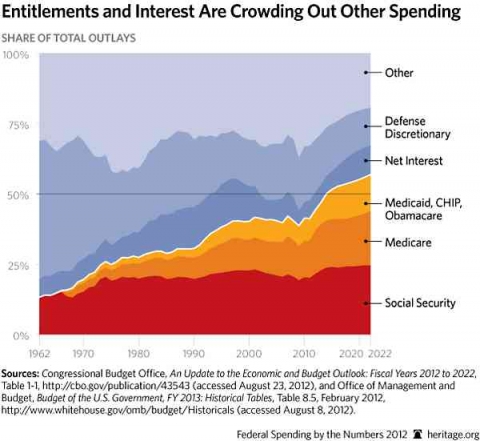
Let’s also compare to spending on other national interests. Public medical spending now exceeds our budget for Social Security or Defense8, despite the amazing fact that the U.S. spends more on defense than the next ten highest-spending countries combined9.

Reading, Writing Or Ritalin®?
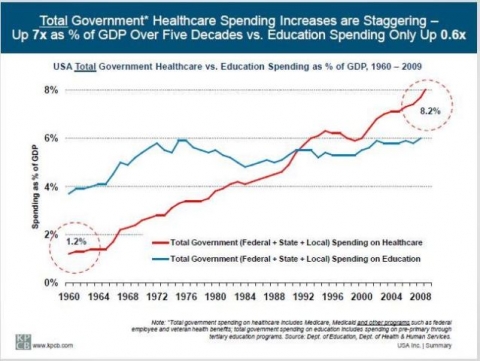
Most disturbing, the amount our government spends on health care has increased eleven times faster than education spending over the last 50 years, and we now spend 33% more on health care than education (8.2% of GDP versus 6%)10. This hasn’t been a conscious choice to put arrhythmia ahead of arithmetic, but that’s how the Blob works ... a slow advance, gobbling up resources. The trade-off may feed the hungry monster today, but at what cost to our global competitiveness in a future labor market? Remember this represents only public spending on health care, ignoring the 40% paid privately.

Entitlements and Interest Are Crowding Out Other Spending

Total Government Healthcare Spending Increases Are Staggering

Each Of Us Feeds The Health Care Blob
Neither government nor medicine will save us from the extreme financial threat of health care. We have to do it ourselves.

Of course medicine (the so-called Medical-Industrial Complex that IS the Blob) will keep telling the public that they need more and better care; another surgery, another medicine, another exam will make us feel better. And of course that message makes us feel cared for and justified in our continued over-use of over-priced services. While someone else pays, we shrug and get another test, just to be on the safe side.

But the battle against the Blob can’t be won by asking the Blob itself to go on a diet, or asking legislators who are sponsored by the Blob to limit its consumption. And, like in the movie, the public doesn’t perceive the magnitude of the threat; until it may be too late.

What will it take to tame the monster? Each of us asking questions, pushing back on the system, objecting to outrageous pricing, and taking care of ourselves. Do your part: feed the Blob a little less this month.

This article was first posted on Altarum.org.

References

1 Ryu AJ, Gibson TB, McKellar MR, Chernew ME. The slowdown in health care spending in 2009-11 reflected factors other than the weak economy and thus may persist. Health Aff (Millwood). 2013;32(5):835-40. Epub 2013/05/08.

2 Cutler DM, Sahni NR. If slow rate of health care spending growth persists, projections may be off by $770 billion. Health Aff (Millwood). 2013;32(5):841-50. Epub 2013/05/08.

3 Hancock J. Maryland Offers Glimpse At Obamacare Insurance Math. Kaiser Health News [Internet]. 2013 May 20, 2013.

4 Munro D. U.S. Healthcare hits $3 trillion. Forbes [Internet]. 2012 May 20, 2013.

5 Hartman M, Martin AB, Benson J, Catlin A. National health spending in 2011: Overall growth remains low, but some payers and services show signs of acceleration. Health Aff (Millwood). 2013;32(1):87-99. Epub 2013/01/09.

6 Altarum Institute. Health Sector Economic Indicator Briefs 2013 May 20, 2013.

7 PBS NewsHour. Health costs: How the U.S. compares with other countries. October 22, 2012.

8 Meeker M. A Basic Summary of America's Financial Statements, February 2011. May 20, 2013.

9 Cory Booker says U.S. military spending is greater than the next 10-12 countries combined. The New Jersey Star-Ledger PolitiFact [Internet]. 2013 May 21, 2013.

10 Meeker M. A Basic Summary of America's Financial Statements, February 2011. May 20, 2013.

Prescription Drug Abuse - Progress In Sacramento

The abuse of high powered prescription pain medication is a public health crisis with workers' compensation implications.

On May 30, the California Senate passed Senate Bill 809 (DeSaulnier) unanimously. This bill has as its primary goal the continued funding of the Controlled Substance Utilization Review and Evaluation System (CURES) in the California Department of Justice. Over the past year, considerable attention has been brought to the issue of abuse of prescription painkillers nationwide and across all benefit systems. Well-publicized research in California by the California Workers' Compensation Institute (CWCI) and multi-state analyses by the National Council on Compensation Insurance, Inc. (NCCI) and the Workers' Compensation Research Institute (WCRI) have quantified the tragic effects of over-prescribing these medications.

SB 809 seeks to do more, however, than simply develop a stable funding source for this program. The recent Senate action, while important, demonstrates that not all issues surrounding the CURES program are likely to be resolved in 2013. As a series of investigative reports done by the Los Angeles Times pointed out, participation in the CURES program by physicians is not mandatory, and there is no adequate mechanism in place to report unusual prescribing patterns by physicians to the Medical Board of California. While the funding legislation for CURES will address the latter problem, there is still no requirement that prescribers access the database before prescribing a Schedule II - IV controlled substance. However, all prescribers and dispensers will be required to register with the CURES system, which in and of itself is an important development for the Department of Justice and the Medical Board in their efforts to identify and investigate abusive prescription patterns and to combat diversion of the medications for illicit purposes.

Also, stripped from the bill was a tax on manufacturers of controlled substances that would have been used for enhanced law enforcement capabilities throughout the state. This was a critical development that policy makers still need to address, either in this legislation or through the budget process.

Even though a targeted tax on manufacturers is not palatable to the Legislature, the need to fund better enforcement of the laws governing illicit sales of prescription drugs remains a high priority. The funding in the current bill will allow the CURES program to be maintained and improved, but law enforcement will still not have what it needs to investigate physicians and pharmacists who are violating the law and bring them to justice.

While California's workers' compensation system does not have the same level of protections against prescription drug abuse as other state workers' compensation systems, there are resources at our disposal to limit the danger of these medications.

The Medical Treatment Utilization Schedule, utilization review, and Independent Medical Review (IMR) recently added by Senate Bill 863 will assist payers in their effort to curb overutilization of these medications while still addressing the very real clinical need for relief from acute pain and management of chronic pain resulting from an occupational injury. The Division of Workers' Compensation is expected to release new guidelines on pain management later this year that should further assist in this process. And the workers' compensation system, like all other healthcare financing programs, will benefit from the enactment of SB 809. It's a good start, but we are a long way away from declaring this problem solved.

The abuse of high powered prescription pain medication is a public health crisis with workers' compensation implications. The path to a solution requires the active participation of the medical and pharmacy communities, drug manufacturers, law enforcement, medical benefit payers — whether public programs, private group health plans or workers' compensation insurers and self-insured employers — and state and federal agencies and boards overseeing the development and use of these medications.

Progress is being made, but more work needs to be done. The goal is not simply for payers to be better able to say "no". The goal is also not simply being able to avoid the costs of these medications and the complications their abuse creates and have those costs be borne somewhere else. The goal is delivering the highest quality treatment for an injured worker. A back injury, for example, doesn't automatically require surgery in all circumstances any more than it requires an injured worker to face the prospect of drug dependency.

If we use the tools at our disposal compassionately and intelligently and if we continue to press policy makers and regulators to take all steps necessary to protect patients from the improper use of these medications, then we will be able to measure success in more than dollars saved. If Governor Brown gets SB 809 on his desk and signs it, it will become effective immediately. That's a good first step, but there will still be much work to do.

Waiver Of Premium: The Unmanaged Liability

Why take the time to discuss waiver of premium liabilities? Because someone has to.

This is Part 1 of a two-part series on waiver of premium. Part 2 can be found here.

Insurance actuaries consider waiver of premium (WOP) a neglected liability — a supplemental benefit rider that has yet to be fully evaluated for risk exposure or cost containment, unknowingly costing individual and group life insurance carriers billions in liability every year.

The problem is that many companies don't have accurate claim management systems capable of reporting what's really happening with the life waiver reserves that are sitting on their books. But with a 44 percent increase in disability claims by people formerly in the workplace1, it's time this largely ignored liability is held up to the light.

Why Companies Need To Pay Attention
Most life insurers aren't fully aware of how much of a liability they're carrying when it comes to their waiver of premium reserves. Moreover, they're even less likely to know critical information such as the number of open life waiver claims, the percentage of approvals and denials, or claims still holding reserves that perhaps maxed out years ago.

Tom Penn-David, Principal of the actuarial consulting firm Ant Re, LLC explains: "There are generally two components to life waiver reserves. The first is active life reserves (for individual insurers only) and the second is disabled life reserves, which is by far the larger of the two. A company that has as few as 1,000 open waiver claims with a face value of $100,000 per policy, may be reserving $25+ million on their balance sheet, depending on the age and terms of the benefits. This is a significant figure when coupled with the fact that many life insurers do not appear to be enforcing their contract provisions and have a higher than necessary claim load. Reserve reductions are both likely and substantial if the proper management systems are in place."

Unfortunately, by not knowing what's broken the situation can't be fixed. Companies need to examine their numbers in order to recognize the level of reserve liability they're carrying, and to see for themselves the significant financial and operational consequences of not paying attention. Furthermore, a company's senior financial management team may be underestimating the actual number of their block of waiver claims, thus downplaying the potential for savings in this area. Typically, the block of existing claims is much larger than new claims added in any given year, and often represents the largest portion of overall liability.

"Life companies are primarily focused on life insurance reserves and not carefully looking at waiver of premium," Oscar Scofield of Factor Re Services U.S. and former CEO of Scottish Re., says. "There could be a significant reserve redundancy or deficiency in disabled life reserves and companies need to pay attention to recognize the impact this has on their bottom line."

To illustrate this point, let's take a quick look at the financial possibilities for a company with even a small block of life waiver claims:

Example - Individual Life Carrier Current Reserve Snapshot With Proactive Management
Number of Open WOP Claims 1,000 1,000
(*) Average Disability Life Reserves (DLR) $19,989,255 $19,989,255
(*) Average Mortality Reserves $3,046,722 $3,046,722
Average Premiums Paid by Carrier on Approved WOP Claims $754,427 $754,427
Average Total Reserve Liabilities $23,790,404 $23,790,404
Claim Approval Percentage 90% 60%
Reserves Based on Approval Percentage $21,411,364 $14,274,242
Potential Reserve Savings $7,137,121

* The above reserve data is based on Statutory Annual Statements.

As you can see, even under the most conservative scenarios, the reserve savings are substantial when a proactive waiver of premium claim management process is put into action.

Industry Challenges
The National Association of Insurance Commissioners (NAIC) requires life companies to report financials that include both the number of policyholders who aren't disabled with life waiver, as well as reserves for those who are currently disabled and utilizing their life waiver benefits. But many items, like the number of new claims or the amount of benefit cost are not reported. Moreover, companies rarely move beyond these life waiver reporting touch-points to effectively monitor their life waiver claim management processes or to identify the impact of contract definitions on their claim costs.

The new and ongoing volume of claim information, manual processing, and the fact that life waiver claims involve months if not years of consistent, close monitoring, is humanly challenging — if not impossible. For example, it's not out of the ordinary to have only a few people assigned to process literally thousands of life waiver claims.

It's unfortunate, but this type of manual claim reporting continues to remain unchanged as claim personnel (working primarily off of three main documents: the attending physician's statement, the employee statement, and the claim form), quickly push claims through the system. The process is such that once these documents are reviewed (and unless there are any questionable red flags), the claim continues to be viewed as eligible, is paid, and then set-up for review another 12-months down the road. As long as the requests continue to come in and the attending physician still classifies the claimant as disabled and incapable of working, there isn't much done to proactively manage and advance the claim investigation.

An equally challenging part of the life waiver claim process is working off the attending physician statement — both when claims are initially processed, as well as when they are recertified. Typically very generic in nature, the statement often only indicates whether or not the claimant is or continues to be unable to work. This problematic approach essentially permits the physician to drive the course of the claim decision away from the management of the insurance company. The insurer, who is now having to rely on the physician's report to fully understand and evaluate the scope of the claimant's medical condition, has little information in which to manage the risk.

For example, did the evaluation accurately assess the claimant's ability to work infrequently or not at all? Are they able to sit, stand, walk, lift, or drive? If so, then what are the specific measurable limitations? Is there potential to transition them back into their previous occupation or into an occupation that requires sedentary or light duty — either now or in the near future? In order for companies to move beyond the face value of what has initially been reported, and to monitor where the claimant is in the process, they need to build better business models.

Closing The Technology Gap
The insurance industry as a whole has always been a slow responder when it comes to technology. But for companies to optimize profitability, closing the gaps in life waiver claim management and operational inefficiencies will require a combination of technology and human intervention. Investing in the right blend of people, processes, and technology with real-time capabilities, can substantially reduce block loads and improve overall risk results.

Constructing a well-defined business model to apply standardized best practices that can support and monitor life waiver claims is critical. The adjudication process must move beyond obvious "low hanging fruit" to consistently evaluate the life of the claim holistically. It means not only examining open claim blocks, but also those that are closed, to better identify learning and coaching opportunities to improve future claim outcomes.

Additionally, segmentation can provide great insight into specific areas within the block, by applying predictive modeling techniques. It can evaluate how claims were originally assessed, the estimated duration, and why a claim has been extended. For example, was there something regarding the claim that occurred to warrant the extension of benefits such as change in diagnosis?

Predictive modeling also looks at how certain diagnoses are trending within the life waiver block, so if anything stands out regarding potential occupational training opportunities, benefit specialists can effectively introduce the appropriate vocational resources at the right time for the insured.

Capabilities to improve outcomes in waiver of premium operations through technology and automation should include these three primary assessments:

  • Financial: Companies need to start looking at waiver of premium differently. They need to continually evaluate the declining profit margins on in-force reserves in order to identify the impact on profits. Even if a waiver of premium reserve block is somewhere between 10 and 200 million dollars, potential savings are likely to be 10 to 20%. Better risk management tools can substantially control internal costs and improve reserve balances.
  • Operational: Current business models have to move beyond the manual process to steer the claim down the right path from start until liability determination. Standardized automation brings together fragmented, disparate information systematically across multiple platforms, essentially unifying communications between the attending physician and the insurance company. This well-managed infrastructure gathers, updates, and integrates relevant data throughout the life of the claim.
  • Availability: A critical way to improve the life waiver claim process is through accurate reporting. By breaking down the silos between the attending physician, case manager, and the insurance company, claim related information can immediately be uploaded and reported in real-time. Proactively enhancing the risk management process to enable companies to consistently receive updated claimant health evaluation and physical limitation reports, is critical for best determining return-to-work employment opportunities.

Three Technology Touch-Points in Waiver of Premium Operations

Front end: Assessment of the initial claim and determining the best possible duration time.

Mid-point: An open claim should be reassessed to determine continued eligibility and to evaluate the direction of the claim if lasting longer than projected-and why.

End-point: The evaluation process continues to ensure claims are being re-evaluated at regular intervals, examining the possibility of getting the claimant back to work.

Why Waiver Of Premium Matters
What's typically happening is that most company's life claim blocks are managed on the same platform and in the same manner as their life claims, so ultimately the life waiver block is improperly managed. Life companies need to recognize that a waiver of premium block is not a life block but a disability block, and needs to be managed differently. For example, older actuarial tables do not reflect the fact that people with disabilities are living longer, potentially leaving companies with under-stated reserve liabilities.

Ultimately, having a good handle on the life waiver block will prove beneficial for both the carrier and the insured.

Part 2 of this series will discuss specifically how the introduction of process and technology into this manual and asynchronous area can deliver substantial benefits to life carriers.

1 Social Security Administration, April 2013.

Insurers Win Big With Social Media

While insurers are off to a great start with social marketing, there is so much more that they can do to leverage the power.

Insurance agents have long understood the need to be social as a part of their sales process: the best agents have always been those who build strong relationships with and educate customers, keep in touch and ask for referrals. But new ways of communicating have resulted in new expectations buyers have, such as being able to Google an agent and check out his or her LinkedIn profile before deciding to proceed. This means that insurers need to rethink the sales process and the tools that they provide to their agents, so agents can take full advantage of the power of social media.

The profile information and status updates that more than one billion people share each day on Facebook, Twitter and LinkedIn offer agents incredible insights into what is happening in the lives of current and potential policyholders. These insights signal to agents what types of insurance are needed by the customer and generally allow the agent to build trust through personal connection and personalized service. As a result, agents can now be smarter about when they contact customers and prospects and more directed in their communications, saving agents time and improving business results. Researching prospects on social media and understanding what's happening in their lives ensures that every call will be warm. In the era of social media, the cold call is dead.

The insurance industry has been an early adopter of social technology. While regulated industries, including financial services and insurance, tend to be cautious because of compliance concerns, a study by International Data Corp. found that the insurance industry has actually blazed the trail with social media. Farmers, Nationwide, Thrivent Financial, Northwestern Mutual and other Fortune 500 insurance organizations have instituted forward-thinking initiatives on Facebook, LinkedIn and Twitter that have demonstrated social success that other industries are attempting to replicate.

But it's time for all insurers to move to the second wave with social. In the first wave, many companies rushed to get as many "likes" as possible on their Facebook pages. But research shows that these "likes" have failed to convert into lasting value and tangible return on investment. In the second wave of social, insurers are realizing that they need to focus on results achieved through true engagement and authentic relationships. Just as it has always been, since long before the digital age, developing long-standing relationships is key to building a successful business in the social era.

For insurers, moving on to the second wave means two main things:

First, insurers need to provide unique and relevant content that agents can use on their Facebook, Twitter and LinkedIn feeds. For an agent, sharing relevant content via social channels builds credibility and helps establish them as a trusted expert that their connections will turn to when they need insurance. Marketing departments already know the type of content that resonates with customers and are typically producing professional content used in other online and offline channels. For example, success stories about the value of insurance or financial planning tools are valuable pieces of content for agents to share socially.

Second, insurers must empower the field. As an example, Thrivent Financial, a Hearsay Social client, has hundreds of agents actively managing their own local Facebook pages. As financial experts, Thrivent Financial representatives share value with their close-knit communities by consistently posting relevant content, like IRA calculators and market analyses. In addition, Thrivent reps share personal updates and plan community events, building an authentic social presence while still appropriately representing brand.

Organizations that empower agents to create their own local social-media presences are many times more effective than when the same messages are shared from a corporate page. While having five million fans wins bragging rights for any brand marketer, from the consumer's perspective, it can be much more powerful to hear the story from a local representative that you know and trust.

A local insurance agent's Facebook page

Savvy chief marketing officers at insurers have done a great job of making a relatively abstract product tangible by creating some of the most interesting and memorable personas in the history of marketing — Mayhem the Allstate villain, Flo the Progressive Girl, Snoopy representing MetLife and the GEICO gecko. For an industry that sells a product you can't hear, see, smell, taste or touch, this is impressive. And the characters can drive social-media strategies, allowing a company to create a social-media asset for a character (e.g., the Facebook page for Mayhem). Getting consumers to "like" the page can provide yet another entry point into the News Feed, increasing engagement for the brand and driving sales. When your local MetLife agent posts a picture of a sleeping Snoopy with the text "TGIF," how can you not click "like"?

While insurers are off to a great start with social marketing, there is so much more that they can do to leverage the power of social media into sales. By coordinating enterprise-wide social selling programs, insurance companies can empower agents to attract more prospects and build stronger relationships, leading the way by selling socially.

Outside Looking In

This article relates four common positions held by agency owners that create immovable and serious roadblocks to their agencies' success.

I found myself arguing an extremely silly point with an agency owner at a conference.  Everyone but the agent saw the silliness of his argument.  I explained the point every way imaginable, to no avail.  I could see from the looks on others’ faces, they were tiring of him not getting the point either.  If he had been one of the audience members watching someone else argue, he probably would have seen the errors in his thinking, too.  But, sometimes you just have to be outside looking in to see a point.

As a consultant, I very often find myself facing this type of situation.  The four points below are the most common positions held by agency owners that create immovable and serious roadblocks to their agencies’ success.  If any of these sound familiar to you, take a step outside of the situation and look back in.  You might see your position in a different light.

1.  We must write small accounts because you never know which one will turn into a large account. This commonly expressed position presumes an inability to identify clients with great potential versus those with no potential.  This means agencies believing in this philosophy should write absolutely as many small accounts as possible. 

An average agency abiding by this philosophy has at least 1,000 small accounts and maybe one, over 10 years has grown big.  But let’s say there are two accounts that grow big.  So out of 10,000 renewals, two get big.  Can the agency write enough large accounts to cover the 1,000+ small accounts that soak up huge amounts of time, effort and expense?  If so, this may be a great strategy.  If not, it is time to rethink the agency’s strategy.

2.  We do not use coverage checklists because we might leave something off.  The belief here is that if you don’t have a list, you can’t leave coverages off.  This presumes nothing is left off when a checklist is not used.  So if an insured does not get the correct coverage because the producer does not use a list and the absence of a list means the coverage wasn’t necessary to offer, then by default, the customer could not have needed the coverage and therefore, the uncovered claim is just a figment of their imagination.  Right?  If you believe this, then keep on going without using coverage checklists.

Another perspective is that if the agent does not use a coverage checklist, there is no need to recommend coverages a customer needs.  In other words, if I don’t know the customer needs a coverage, I don’t have a responsibility to offer the coverage.  For a peddler of insurance, this makes perfect sense because peddlers only take orders.  Why pay commissions to peddlers?  Web sites are quite capable of taking orders and issuing policies.

3.  We do not need to hold our producers accountable.  The reasons given for not holding producers accountable are numerous and include that accountability might make them angry.  What is the price of an angry producer?  In some cases, say $500,000 commission producers, not making them angry might be a good strategy.  But is the price reasonable for not making $100,000 producers angry?  An incompetent producer may leave the agency or become a good producer through accountability.  Either way, the agency may find itself way ahead by enforcing accountability.

Other common reasons given are that they are nice guys and that they have never been held accountable so it is unfair to do so now.  That is fair enough.  But to be really fair, if the producers are not held accountable, why hold anyone accountable?  Why hold the customer service representatives (CSRs) accountable?  Why hold new producers accountable?

Another reason given is that by holding them accountable, the ultimate outcome is that they would be fired and the emotional trauma of firing a producer is too much.  That makes sense.  Of course, if you are not going to fire a producer, how can you fire a CSR?  Is their trauma any less?

Then there are the producers that should hold themselves accountable negating the need for management to do so.  How well is that working in your agency?

4.  All agencies have the same value as a multiple of sales or EBITDA.  I am often asked, “How much are agencies worth today?”  This presumes that all agencies are alike, all agencies are commodities and nothing is special about any agency.  Is this correct?  Is there nothing special about your agency?

Let’s assume some common multiple applied to all agencies.  If one agency is losing 10 percent of its commissions annually and another agency is growing by 10 percent, then they should have the same multiple.  The same goes for the agency that has a 25 percent profit margin versus the agency that has a -5 percent profit margin.  Even the agency that has $1,000,000 of extra cash on its balance sheet versus the agency that has spent $500,000 of trust monies will have the same value. 

The question presupposes such material differences do not exist.  It’s like someone is asking, “What’s the value of a 2005 Ford F-150?”  They expect I can look up the blue book, ask how many miles the agency has on it, the condition of the body, and whether it has any extra features.

Quite often, the agency owners who ask this question have problematic agencies and the reason they ask the question this way is because they do not want their problems taken into consideration in the valuation. 

I do not believe any reader likes the logical result of these incredibly common beliefs and practices.  I’m not going to argue these ideas are wrong.  If you share these beliefs, take a step outside and look back in.  Think through the complete concept and if you still believe in it, then go for it 100 percent!