
One of my favorite movie scenes comes from "Volunteers."
Tom Hanks is trying to negotiate with a local warlord. Standing nearby is the warlord's beautiful bodyguard—whose command of English is somewhere between nonexistent and interpretive dance. Tom flashes a grin that suggests he'd be perfectly happy if she happened to be part of the bargain.
The warlord responds with something to the effect of, "If I say yes… and not no…"
I honestly don't remember exactly how the scene ended. What I remember is what popped into my own head.
I'd settle for not no.
At the time, it was just a funny line. Thirty years later, after more investor meetings than I care to count, I finally understand why it stuck with me.
Founders spend years chasing "yes." Investors rarely give you one. Instead they say…
"Interesting."
"Come back after revenue."
"Let's reconnect in six months."
"We'd like to see your next release."
"Keep us posted."
None of those are yes.
But they aren't no.
If you're building a company, you eventually realize that companies aren't built on yes.
They're built on not no.
The High Wire
Being a founder is the proverbial high-wire act. There's no safety net. No guarantee. No instruction manual.
People love talking about entrepreneurial risk. Let me save you some time. It's all risky.
The right decisions.
The wrong decisions.
The crazy decisions.
Sometimes you don't know which one you made until two years later.
Then there are the mornings.
3 a.m.
Every.
Single.
Morning.
Not because the alarm went off. Because your brain did.
There's always one more investor to research.
One more slide to improve.
One more grant proposal to edit.
One more feature to design.
One more email to send before the day job begins.
People think founders work 80-hour weeks. The truth is… founders never really stop working. The company follows you to bed. It wakes up before you do.
And then there's that feeling. If you've ever built a company, you know exactly what I'm talking about. That knot in the pit of your stomach. It never completely goes away. It's there when you wake up. It's there during investor meetings. It's there while you're brushing your teeth. It whispers the same questions over and over.
What did I forget?
Are we going to make it?
Am I asking my family to believe in something impossible?
Is this the dumbest thing I've ever done… or the smartest?
I've come to think of it as the founder's tax. Nobody talks about it. Everybody pays it. Some people call it stress.
Founders call it Tuesday.
Venture Capitalists and Sea Turtles
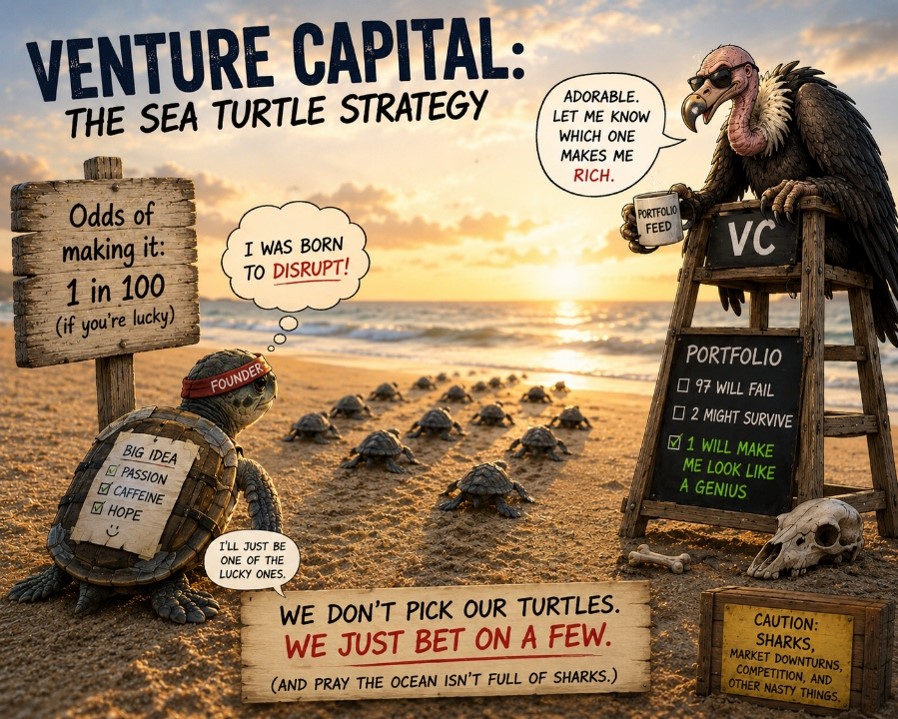
One of my favorite startup metaphors comes from Silicon Valley.
Ron LaFlamme, the eccentric attorney, explains venture capital using sea turtles. Sea turtles lay hundreds of eggs because only one or two eventually make it to the ocean.
"That's what Peter Gregory is doing," Ron explains. "Making sure one or two of his compression plays make it to the sea."
The first time I heard that I remember thinking,
"Why not just pick stronger turtles?"
Of course, that's not how venture capital works. They're playing portfolio math. Fund enough companies and one eventually becomes the next Google.
They're not looking for certainty. They're looking for outliers.
Founders don't have that luxury.
Most of us get one turtle.
One company.
One dream.
One shot.
It's amazing how differently you look at risk when you're carrying your only turtle.
Government Grants: The Ultramarathon
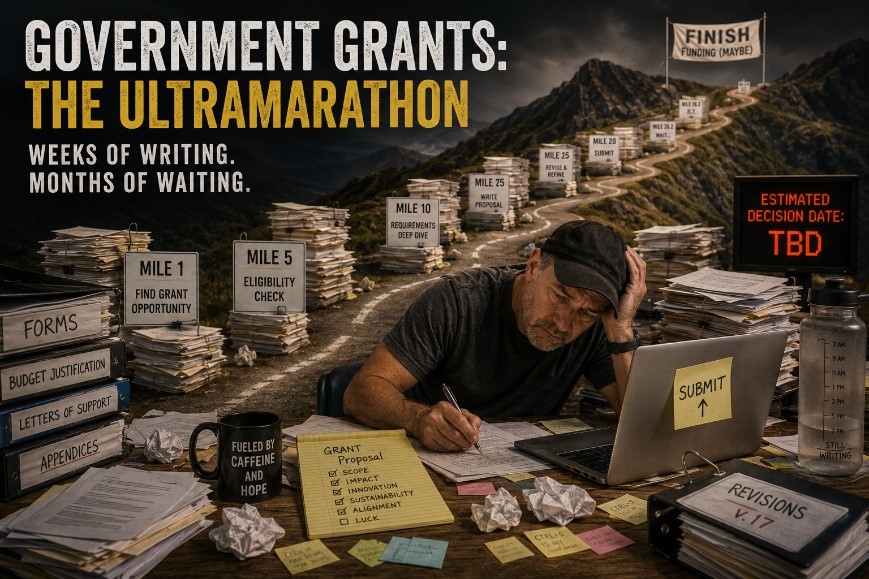
If raising venture capital is a marathon… government grants are an ultramarathon.
Uphill.
Into the wind.
Dragging a filing cabinet behind you.
You spend six weeks writing.
Three weeks editing.
Two weeks wondering whether Requirement 3.2.17(b) means exactly what you think it means.
You finally hit "Submit."
Then… absolutely nothing.
Weeks become months.
Months become more months.
Eventually an email arrives.
Your pulse quickens.
Your palms get sweaty.
You open it.
"Thank you for your interest…"
That's government-speak for, "Better luck next time."
The amazing part?
You immediately start writing the next proposal.
Founders are funny that way.
The government didn't invent persistence.
Entrepreneurs did.
Accelerators

I actually like accelerators.
Some of them.
Many provide genuine value.
They introduce founders to investors.
They surround you with experienced entrepreneurs.
They shorten the learning curve.
Some absolutely earn the equity they receive.
Others…
Well…
Let's just say the first image that came to my mind was a skinny kid explaining proper deadlifting technique to a professional bodybuilder.
It made me laugh.
Mostly because I've been there.
Now before anyone gets offended…
No, I don't know everything.
Far from it.
But this ain't Marine Corps boot camp.
I don't need somebody teaching me how to polish my boots. I've spent decades leading soldiers, briefing executives, running cybersecurity organizations, and solving difficult problems. Teach me something I don't know. Introduce me to someone I couldn't otherwise meet. Open a door that's been closed. Challenge my assumptions.
That's acceleration.
Teaching me how to center a title on a PowerPoint slide? Not so much.
Now, to be fair, accelerators usually introduce you to investors. Of course, they don't do it out of the goodness of their hearts. They generally take a slice of your company.
Sometimes it's a reasonable slice.
Sometimes…
It's a fat butcher's slice.
Every founder has to answer the same question.
Was it worth it?
If the answer is yes… great.
If not… that was one expensive PowerPoint lesson.
The Founder's Retirement Plan
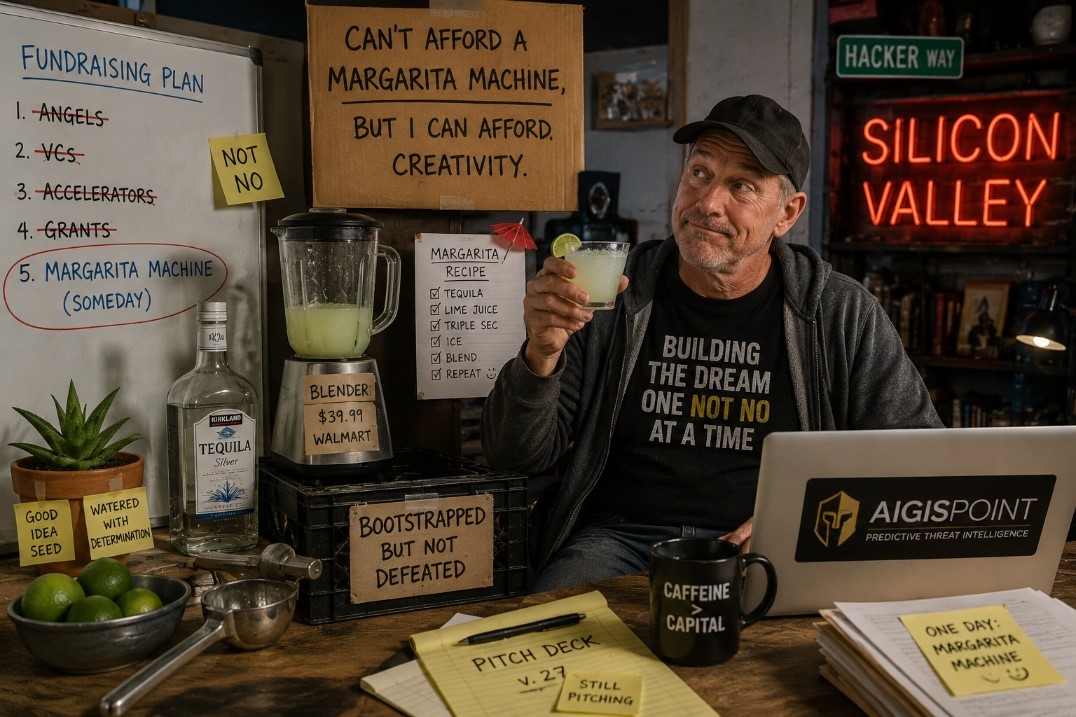
Somewhere along this journey I stopped looking at my investment portfolio as retirement.
I see software development.
Advertising.
Patent attorneys.
Trade shows.
Cloud hosting.
Developers.
My financial advisor sees diversification.
I see operating capital.
Retirement?
I'll think about retirement after Version 5.0 ships.
Every now and then I tell Suzanne we're flying first class to the Maldives for a week of scuba diving.
Just as soon as…
well…
just as soon as we can afford a margarita machine.
Fans of "Silicon Valley" will appreciate that reference.
Everyone else probably thinks I've developed an unhealthy obsession with frozen drinks.
They're not entirely wrong.
The funny thing about founders is that we stop measuring wealth the way everyone else does.
A new car?
That's six months of development.
Kitchen remodel?
Marketing budget.
Vacation?
Another developer.
People ask how founders keep funding their companies.
Simple.
We stop thinking about assets.
We start thinking about runway.
Yin and Yang
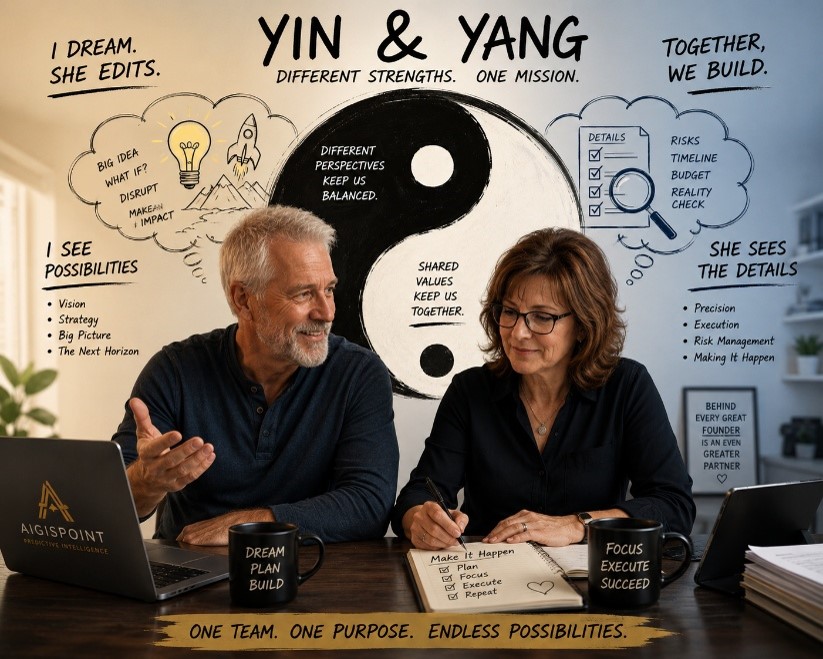
People ask what it's like to build a company with my wife. The answer usually surprises them. We work remarkably well together.
Mostly because we work remarkably well apart.
Ron LaFlamme would probably describe us as yin and yang.
That's us.
I'm the dreamer.
Suzanne is the realist.
I see possibilities.
She sees details.
I chase ideas.
She quietly points out the 17 reasons one of them probably won't work.
She's usually right.
Long before software, we bought a short-term rental.
The number one comment from our guests wasn't the location.
It wasn't the view.
It wasn't the amenities.
It was one word.
"Immaculate."
That's Suzanne.
If NASA hired her, astronauts would dust the launch pad before liftoff.
She has standards that make hotel inspectors nervous.
Thank goodness.
Somebody has to.
Every founder needs someone willing to ask,
"Are you sure?"
Not because they doubt the dream.
Because they want the dream to survive.
People celebrate founders.
They should spend more time celebrating the people who quietly make founders better.
The Turtle on the Fence Post
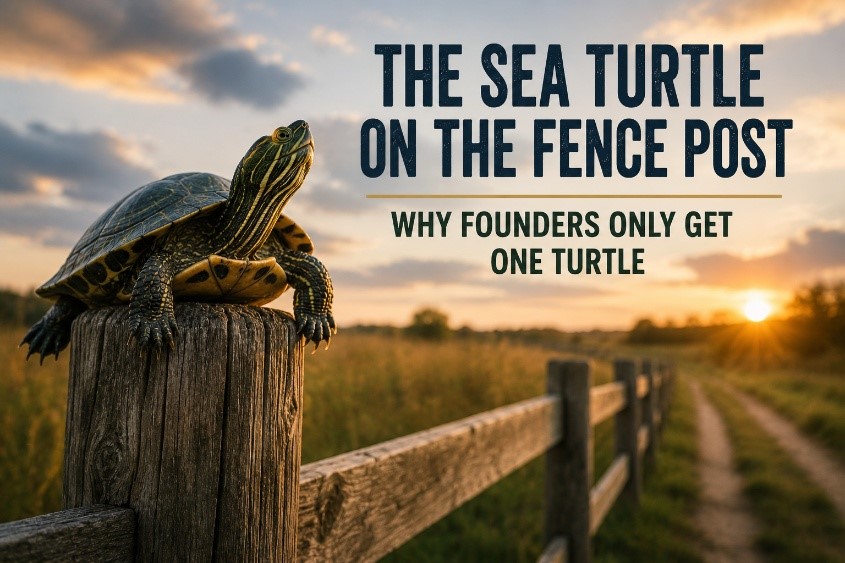
There's an old saying: "If you see a turtle on a fence post, you know it didn't get there by itself."
How he got up there is anybody's guess.
Yes…
I'm mixing metaphors.
It's my article.
Besides, if you've ever started a company, you know reality stopped making sense a long time ago.
You stop measuring life normally.
Your retirement account becomes software development.
Vacation becomes cloud hosting.
Credit cards become temporary venture capital.
Your dog starts recognizing the Amazon delivery driver by first name.
Normal people call this insanity.
Founders call it product-market fit.
The truth is, nobody builds a company alone.
Somebody always believed.
Somebody always introduced you to someone.
Somebody always opened a door.
And if you're lucky enough to succeed… maybe someday you'll become the person holding the door open for the next founder trying to get through.
That's a legacy, too.
Why 66?
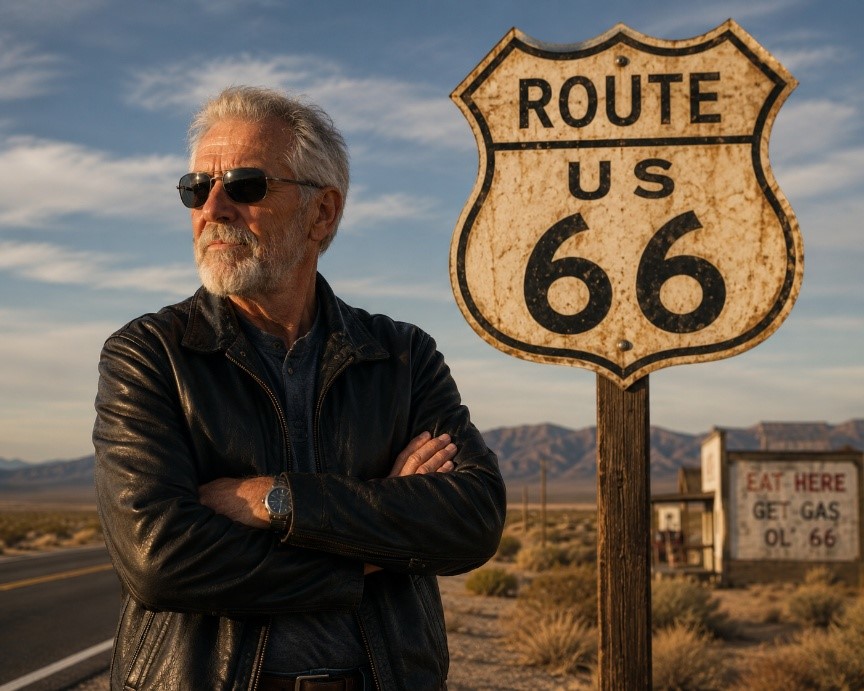
People may someday ask me a simple question.
"Why did it take until you were 66?"
It's a fair question.
The funny thing is…
I don't think I waited until I was 66 to become a founder.
I think I spent 40 years accidentally preparing to become one.
The Army taught me leadership.
It also taught me that no plan survives first contact.
Corporate America taught me patience.
Cybersecurity taught me skepticism.
Attackers adapt.
Technology changes.
Certainty is usually an illusion.
Marriage taught me partnership.
Investors taught me persistence.
Government grants taught me humility.
And rejection…
Rejection taught me that success usually belongs to the person willing to hear "no" one more time than everyone else.
Looking back, every assignment, every promotion, every setback, every impossible deadline, every deployment, every conference room, every board presentation, every sleepless night somehow led here.
Maybe the company wasn't waiting for me.
Maybe I was waiting to become the person capable of building the company.
The Founder Nobody Sees
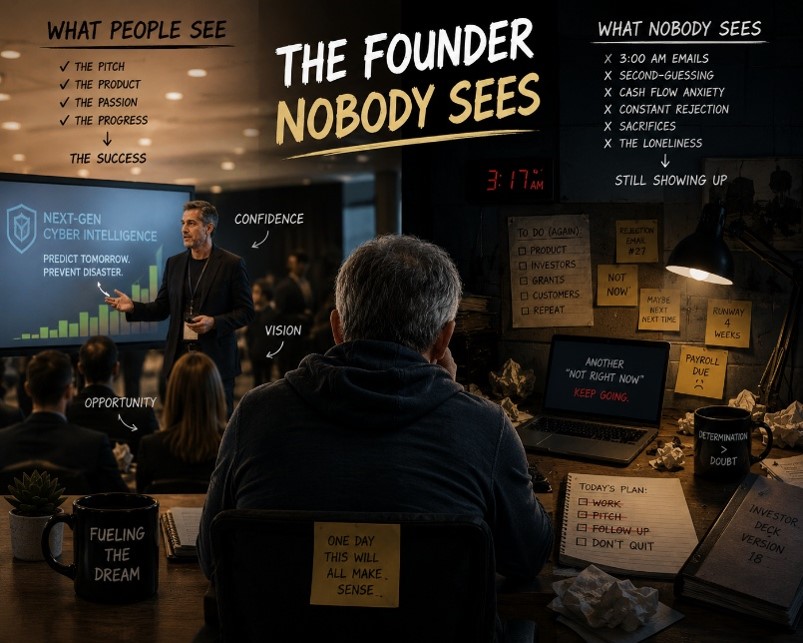
People see the pitch.
They see the product.
They see the trade show booth.
They see the LinkedIn announcement.
What they don't see… is the founder sitting at the kitchen table at 3 a.m. trying to get two hours of work done before heading to the day job.
They don't see weekends disappear.
They don't see vacations turn into strategy sessions.
They don't see the credit card bill arrive.
They don't see another investor politely explaining why your company isn't quite ready.
They don't see the quiet conversations between spouses.
"Can we keep doing this?"
"How much longer?"
"Are we crazy?"
The answer, by the way… is yes.
Founders are a little crazy.
Thankfully.
If they weren't, most companies would never exist.
Looking Forward Instead of Backward
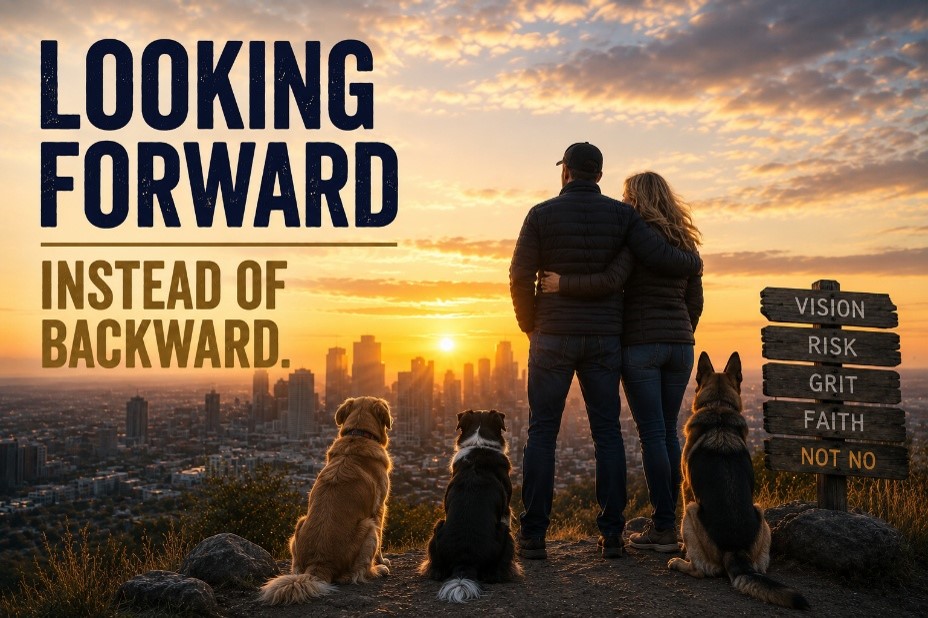
At 66, something changes.
You stop asking,
"How much money can I make?"
You start asking,
"What am I going to leave behind?"
Money is nice.
Don't misunderstand me.
I'd love to stop looking at every block of stock in my retirement account as another software release or another attorney.
I'd love to finally buy that margarita machine.
I'd really love to take Suzanne to the Maldives and spend a week underwater instead of under deadlines.
But that's not why I'm doing this.
If our company succeeds, I hope my legacy isn't the software.
I hope it isn't the patent.
I hope it isn't the valuation.
I hope it's the organization that never became tomorrow's headline because somebody finally started looking through the windshield instead of the rearview mirror.
For decades, cybersecurity has become remarkably good at explaining yesterday.
Yesterday's ransomware.
Yesterday's phishing campaign.
Yesterday's breach.
Yesterday's lessons learned.
Those things matter.
But they're history.
I've always believed we could do more.
What if we could help organizations think about tomorrow?
Not with certainty.
Not with magic.
Not with a crystal ball.
Just disciplined analysis.
Patterns.
Trends.
Probabilities.
Enough information to make one better decision before the next attack arrives.
If we accomplish that… then every sleepless night was worth it.
Every rejection.
Every investor meeting.
Every government grant proposal.
Every conference.
Every dollar we invested instead of spending on ourselves.
Worth it.
The Last Word
The funny thing about entrepreneurship is that people think the story ends when an investor finally says yes.
It doesn't.
That's just the next chapter.
The real story is everything that happened before anyone believed.
The three o'clock mornings.
The knot in your stomach.
The day job that funded the dream.
The spouse who quietly kept believing.
The people who opened doors.
The investors who didn't say yes… but thankfully didn't say no, either.
Today we're still building.
Still pitching.
Still applying.
Still hearing,
"Come back later."
We're still looking at retirement accounts and seeing software development.
We're still laughing about margarita machines.
We're still dreaming about the Maldives.
We're still walking the high wire.
And after all these years…
I'd still settle for…
not no.
Because every once in a while…
…"not no" becomes "yes."
Epilogue
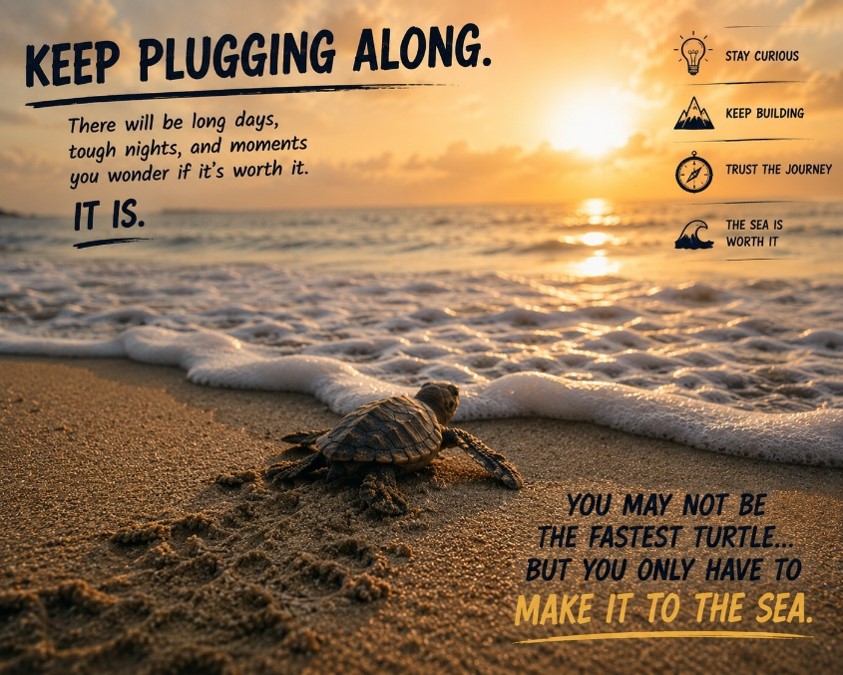
Or maybe just the quiet refusal to quit.
Every founder needs something that carries them through the investor meetings, the rejection emails, the three o'clock mornings, and that knot in the pit of the stomach that never quite goes away.
Keep walking.
Keep building.
Keep believing.
Because every once in a while…
one little turtle actually makes it to the sea.
I'm fortunate.
When I need a reminder to keep going, I don't have to look very far.