

As organizations adopt artificial intelligence (AI) in regulated industries, they face significant risks when validation mechanisms are not built into these systems, leading to compliance, legal, and reputational exposure. Having previously worked in technology for financial services, I can attest that there were many occasions when the technology organization was faced with the dilemma of whether to bring solutions to market quickly or in a manner safe for customers and shareholders. It is critical to establish the right balance to secure governance, while pushing the barriers to AI access in the enterprise. My current role requires me to analyze and deliver a process workflow to preview and validate policy documents.
Industry Context: Why Safe AI Matters
AI enhances productivity, speeds up decision making, and lowers costs. Yet, there are always auditors and governed policies in insurance and banking institutions for every policy document, or every autonomous decision — any deviation from expected outcomes can trigger regulatory scrutiny. Making a mistake is no longer seen solely as a technical problem, but rather as a legal or reputational case, security breaches, or people losing their money. I have observed this in cases where banks and insurers use AI to generate automated outputs, process complex tasks, detect anomalies, and reduce costs. Without proper governance, AI can amplify risks instead of reducing them.
My Approach: Designing Preview Architecture
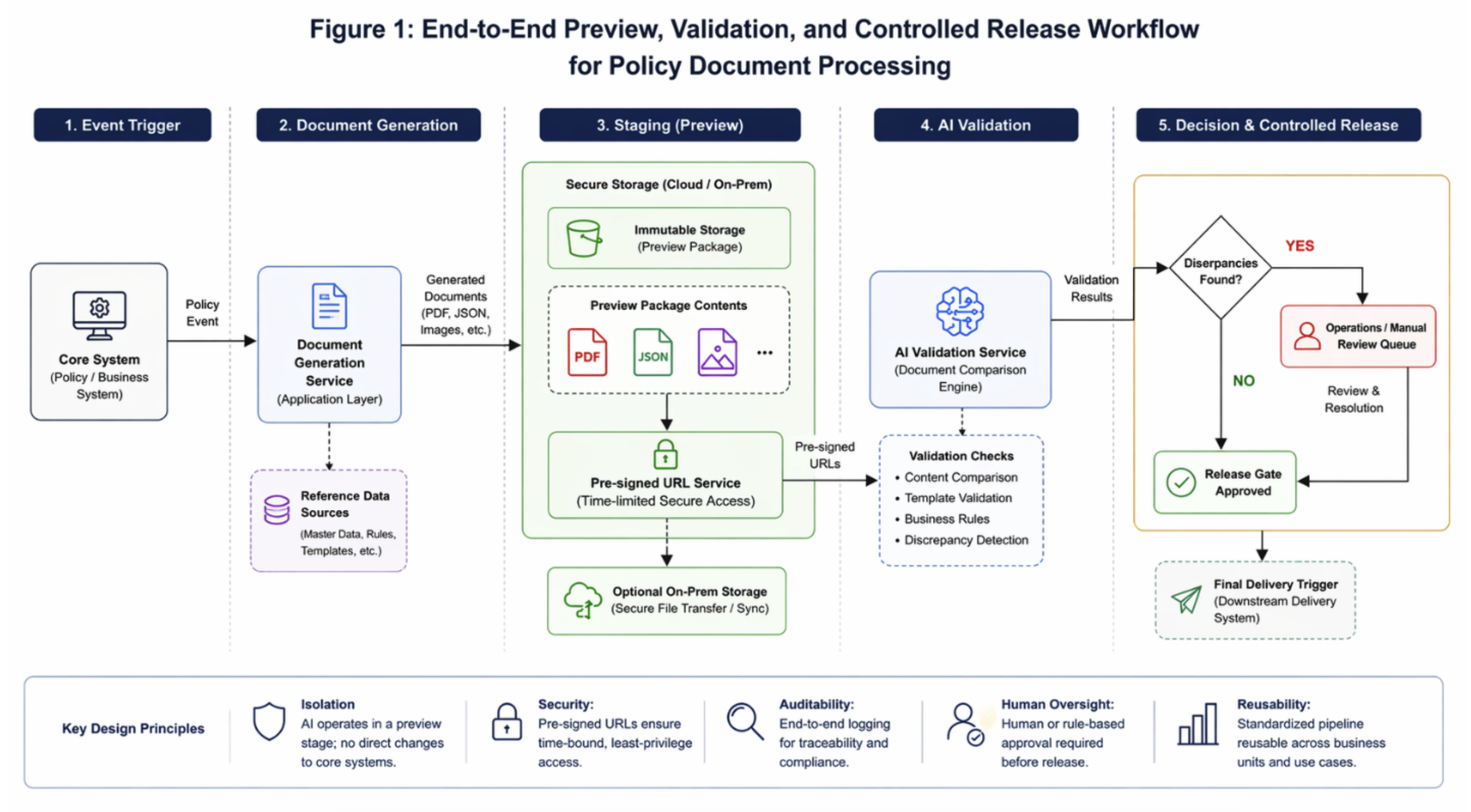
Here is the approach I implemented. My intent was to develop an end-to-end policy documents ecosystem with the ability to AI-preview and AI-validate every incremental change before hitting the "go" button. In practice, I conceptualized the approach as a coherent journey:
- Document Generation: The policy documents are generated by our core systems in various formats (PDF, JSON, image).
- Staging and Preview: The documents are not delivered to the final destination but are first routed to a secure bucket. The documents are staged in a "preview" in which no changes happen to the customer record until validated.
- AI-Driven Validation: We run a comparison model using AI on the documents in the staging area. The model compares any inconsistency between the contents of the new policy and approved templates or data sources.
- Controlled Release: The system only allows final release if everything is checked out. Any discrepancies trigger alerts for manual review.
In this architecture, a separate preview layer is created where AI can operate independently and not interfere with the production servers, and gives the compliance teams the ability to look at every AI finding before changing the modus operandi of the business. This flexible approach supports complicated data environments where data can be captured across many different sources, from cloud software to outdated systems to manual data logging. This workflow ensures that all artifacts are consolidated and validated by AI before release (Figure 1).
Technical Insights and Implementation
The implementation uses cloud-based object storage (such as AWS S3), where each preview package is an immutable artifact. This allows downstream controlled processing exclusively to authenticated content. In practice, orchestration was accomplished using serverless functions (AWS Lambda), and AI-based document comparison runs as a separate service. The choice of a particular AI model architecture — not because of current AI market trends — lets us explain our decisions, as explainability was one of the requirements provided to us in advance by the regulator.
Auditability and logging were present throughout the whole implementation. Events and statistics of every process step are present on our monitoring platform, and metrics such as latency per document, exact detection rate, and percentage of documents sent to human validation are tracked and available for monitoring. One result we obtained from the model after integration was a validation detection rate of about 91% (precision on validation samples); false positives account for less than 10% of total detected discrepancies. This was not a guarantee, but a result of multiple validations in production cases with real samples. These statistical metrics allowed us to create visibility and confidence in the AI layer's reliability.
Most importantly, we also built a safety net: AI does not intervene directly. It detects mistakes but does not take any corrective actions itself. No policy can be modified unilaterally by AI. Our policy management system will always be updated in the traditional way, not via our AI layer. In other words, our AI can identify issues but cannot act on them. Approval and action must always occur in our official system or by an appropriate person permitted to undertake that action. We used this rule-based "exit gate" to convey our low-risk profile to the regulators.
Real-World Observations and Lessons
One of the key learnings from this project was reusability. The preview architecture I had designed for one line of business was abstract enough to fit another line of business. That team also used our architecture for their preview. They simply connected to our staging pipeline, dropped their documents in, and hooked into our AI validation pipeline. All hand-offs were defined (secure SFTP links, bucket triggers). The systems worked seamlessly together. Reusability has a multiplier effect — time and effort saved are multiplied across the enterprise.
One last thing to highlight: metrics are essential for adoption. Beyond the perceived savings in operational cost with the AI-preview system (nearly 60%, going from ~$10 to ~$4.80 per case), approximately $1.1M in annual savings from automating the repetitive task (~500 cases/day), and almost no effect on the manual workforce — since they no longer have to review every page, but just focus on identified failures — those strong results allowed us to get quick buy-in from compliance and management teams and to push the solution forward.
I also learned how to tune AI systems effectively. Initially, the system produced too many false positives. If there was a change in formatting of the document, or a small variation on a standard cover letter, we were triggering an alarm. We improved training data, tuned parameters, and reduced the noise. Another important aspect is that we ensured model behavior remained explainable. When an alarm is raised by the AI, it is possible to generate an explanation that is interpretable from the perspective of the regulator or auditor — in other words, a filtered log with all details and a digest automatically generated per alarm.
AI is ubiquitous today, and organizations are asking themselves, "Can we trust AI decision-making in our use cases?" The trust boundary is in the design. AI should be used as a recommendation engine, with clearly defined boundaries. AI should never play the role of sole decision maker. I had an AI-first architecture mindset when building this as a recommendation engine with guardrails. Architect the pipeline once as an extensible platform. The best lesson I learned is to always think platform first. Rather than trying to solve the AI access problem each time there is a new use case, build a standard reusable pipeline. When we deliver a new service such as AI document analytics, we can leverage the existing infrastructure instead of building the service from scratch. It was designed to hook into the existing document preview layer.
My second principle is to "fail fast but safely." We will never make massive changes, but instead pilot workflows, evaluate the results, and scale incrementally. Stakeholders will always be confident that we will catch any divergences early.
Key Takeaways for Practitioners
- Design for Reuse: Create modular, consistent architecture. A generic preview pipeline can serve multiple teams and use cases, reducing duplication of effort.
- Isolate AI Analysis: Keep AI processing separate from final system actions. Use staging areas or audit logs so that all AI-suggested changes can be reviewed before going live.
- Instrument and Measure: Track accuracy, costs, and impacts. Solid metrics (like processing time or error rates) build confidence with stakeholders and guide improvements.
- Prioritize Explainability: Select models and techniques that let you understand or explain decisions. In regulated settings, a "black box" is too risky.
- Maintain Human Oversight: Automate the heavy lifting but ensure a human or rule-based review gate for any critical change. This balance preserves both efficiency and control.
- Iterate and Improve: Begin with a strong baseline score and then enhance it by incorporating feedback. Use initial outcomes to justify an increase in the number of cases/projects and demonstrate progress.
AI does not have to be flawless to be used in regulated environments, but it must be measurable, verifiable, and governed. It should remain explainable, auditable, and never act without human oversight. A preview-based approach makes this possible by allowing AI to operate within a controlled workflow where outputs are visible and validated before they are committed. Start small, measure the impact, and expand gradually — this is how compliance shifts from a barrier into a competitive advantage.