Despite seeming predictable in hindsight, Black Swans are unexpected or unforeseen events that are highly disruptive and economically damaging. Examples include the 9/11 attacks of 2001 in the U.S., the 2008 global financial crisis, and the COVID-19 pandemic. Allianz Research estimates cumulative global GDP losses from the pandemic between 2020 and 2023 to be in the region of $12 trillion.
In addition to the huge financial and business costs, such events typically have long-lasting implications, resulting in geopolitical and societal shifts that continue many years after the initial event.
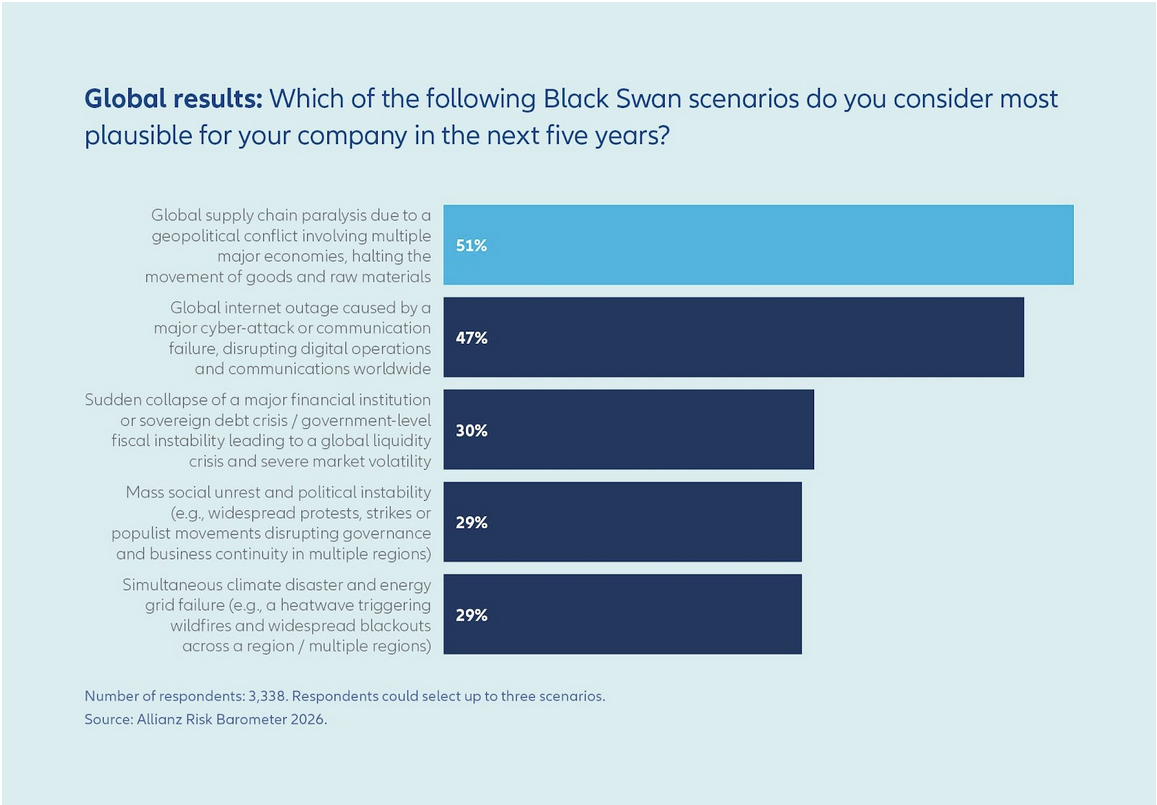
According to new Allianz Risk Barometer analysis, more than half of the 3,000+ respondents (51%) identify a global supply chain paralysis due to a geopolitical conflict as the most plausible Black Swan scenario globally that could affect their company in the next five years. Fear of a global Internet outage ranks second (47%), which reflects the increasing awareness of cyber and artificial intelligence (AI) risks among business leaders.
In the United States, global supply chain paralysis tops the list (52%) followed by global Internet outage (45%) and sudden collapse of a major financial institution (33%).
Geopolitics is a key driver for Black Swans
Given the current geopolitical environment, it is no surprise that supply chain paralysis resulting from a geopolitical conflict is regarded as the most plausible Black Swan scenario. The threats of tariffs, trade wars and protectionism, as well as disruption to supply chains and shipping caused by regional conflicts in the Middle East and Russia/Ukraine are on the top of every board agenda.
Allianz Research estimates that cumulative GDP losses over a two-year horizon triggered by a global supply chain disruption on the scale of the war in Ukraine could total $1.5 trillion. In fact, political-related risks stand out as a leading potential trigger for Black Swan events, according to respondents. Mass social unrest and political instability is regarded as the fourth most plausible scenario globally (29%) and is a top three risk in the Americas (31%) and Africa and the Middle East (41%) regions, as well as in France (42%), for example. A sudden collapse of a major financial institution or a sovereign debt crisis, leading to a global liquidity crisis and severe market volatility ranks third (30%).
Interconnectivity and interdependency of both physical and digital supply chains are potentially increasing vulnerability at a time of geopolitical uncertainty, rapid advances in technology, and climate change. Businesses and global supply chains are also more vulnerable to Black Swan events due to growing concentrations of economic activity reliant on a limited number of critical suppliers and products in areas like AI and digital services, semiconductors, rare earth processors and transition technologies.
Company size influences risk perception
Global supply chain paralysis due to a geopolitical conflict halting the movement of goods and raw materials ranks top for both large (>$500 million annual revenue, 55% of responses) and mid-sized companies ($100 million+ to $500 million, 52%). In contrast, smaller companies (<$100 million) are most concerned about the impact of a global Internet outage (45%), which is the No. 2 scenario for larger and mid-sized businesses.
The third most plausible Black Swan for mid-sized and smaller companies is the sudden collapse of a major financial institution, while larger companies are more concerned about the risk of simultaneous climate disaster and energy grid failure, such as a heatwave triggering wildfires and widespread blackouts.
Multinational enterprises have the advantages of bigger budgets and more diversified portfolios and therefore feel they are better prepared to mitigate the risks of an event such as a major Internet outage than their smaller and medium-sized counterparts.
The top global Black Swan scenarios
Preparing for a Black Swan risk involves bracing for the improbable possibility, necessitating a deep comprehension of the intricate web of interconnected risks, the probabilistic nature of modeling tools, and a touch of imaginative foresight. The future risk environment will continue to evolve, and the organizations best prepared are those that continuously assess, adapt, and embed resilience at every level of their operations.
To read the Allianz Commercial Business Black Swans report, click here.