
For more than a decade, insurers have worked from a shared assumption: Spreadsheets are legacy applications that modernization will eventually solve. Excel was the stepping stone. You were supposed to outgrow it as systems matured.
That assumption is breaking down.
Across carriers accelerating AI adoption, spreadsheet usage isn't declining. It's increasing. Spreadsheets remain central to the insurance value chain from actuarial modeling and rating and pricing, to underwriting, reserving, and financial reporting, especially in specialty lines. Even as AI takes the spotlight with copilots, conversational interfaces, and automated workflows, under the hood, the actual calculations remain in Excel.
Microsoft CEO Satya Nadella has described Excel as effectively Turing complete. It can express complex logic in a way business users, auditors, and regulators already understand. Decades of institutional knowledge are encoded there. When an actuary needs to build, test, and revise pricing logic without involving a dev team, Excel is still the fastest path from idea to production.
None of this is a temporary gap in modernization. AI actually increases the need for deterministic, explainable calculation engines. In insurance, those engines already exist — in spreadsheets.
So the real question for carriers isn't whether Excel will persist. It's whether spreadsheet-based logic can be governed, automated and deployed at the scale AI now demands.
The Compounding Challenge
Large language models (LLMs) can now generate sophisticated spreadsheet models on demand. We saw this firsthand when our head of sales engineering tested ChatGPT to build a term life underwriting rules engine in Excel. It worked surprisingly well.
His reaction: "There are going to be a lot more Excels in the world soon."
But these AI-generated spreadsheets introduce a new kind of opacity.

When an actuary builds a pricing model by hand, they own it in every sense. They can walk you through every assumption and defend every edge case. That model is an extension of their thinking. When AI generates the same model, the formulas might be cleaner, but the reasoning that makes the logic defensible in an audit isn't embedded in the file.
Why AI Acceleration Creates a New Class of Risk
As spreadsheets get wired deeper into AI workflows, a different kind of risk surfaces. One most governance structures were never built to handle.
Consider a common scenario: an AI application calls a rating spreadsheet to generate a quote. But that spreadsheet was updated last week by someone on a regional team, and the production version hasn't formally been approved. Now the AI is using knowledge and logic nobody reviewed and nobody approved.
The gap between the logic you think is in production and the logic that's actually in production widens without anyone noticing. In a regulated industry, that drift has real consequences.
Pricing and underwriting decisions still need to be reproducible, documented, and defensible long after execution. Yet spreadsheet controls at many carriers remain manual and inconsistent. A single "fat-finger" error can misstate a rate, and by the time anyone catches it, the exposure is already on the books.
Without confidence in spreadsheet governance, organizations default to one of three paths. They slow approvals down to reduce risk. They push them through and let risk accumulate unnoticed. Or they treat spreadsheets as the problem itself and launch a costly transformation program, only to find the rebuild consumes years of IT bandwidth while the spreadsheets never quite disappear. Regardless, it's governance that sets the ceiling on AI velocity, not model quality or compute power.
Governing Spreadsheets as Enterprise Infrastructure
The insurers making real progress have accepted that spreadsheets aren't going away. Not in the medium term, and possibly never for some lines and use cases.
Rather than waiting years for a full platform replacement, they've moved to a more strategic question: how do we treat this logic like the infrastructure it actually is?
The urgency is justified. Only about 10% of firms are using AI in any meaningful way, according to a recent U.S. Census Bureau survey, and nearly half of respondents in a UBS survey cited compliance and regulatory concerns as a top barrier.
Governed spreadsheet logic offers a way through.
When an actuary can hand a state regulator an Excel-based rater that's been converted into a governed, callable service, with the AI output and the rater file one-to-one matched and documented, the conversation changes. Regulators get what they need. Domain experts stay in control. And AI adoption gets what it usually lacks: a foundation people will actually stand behind.
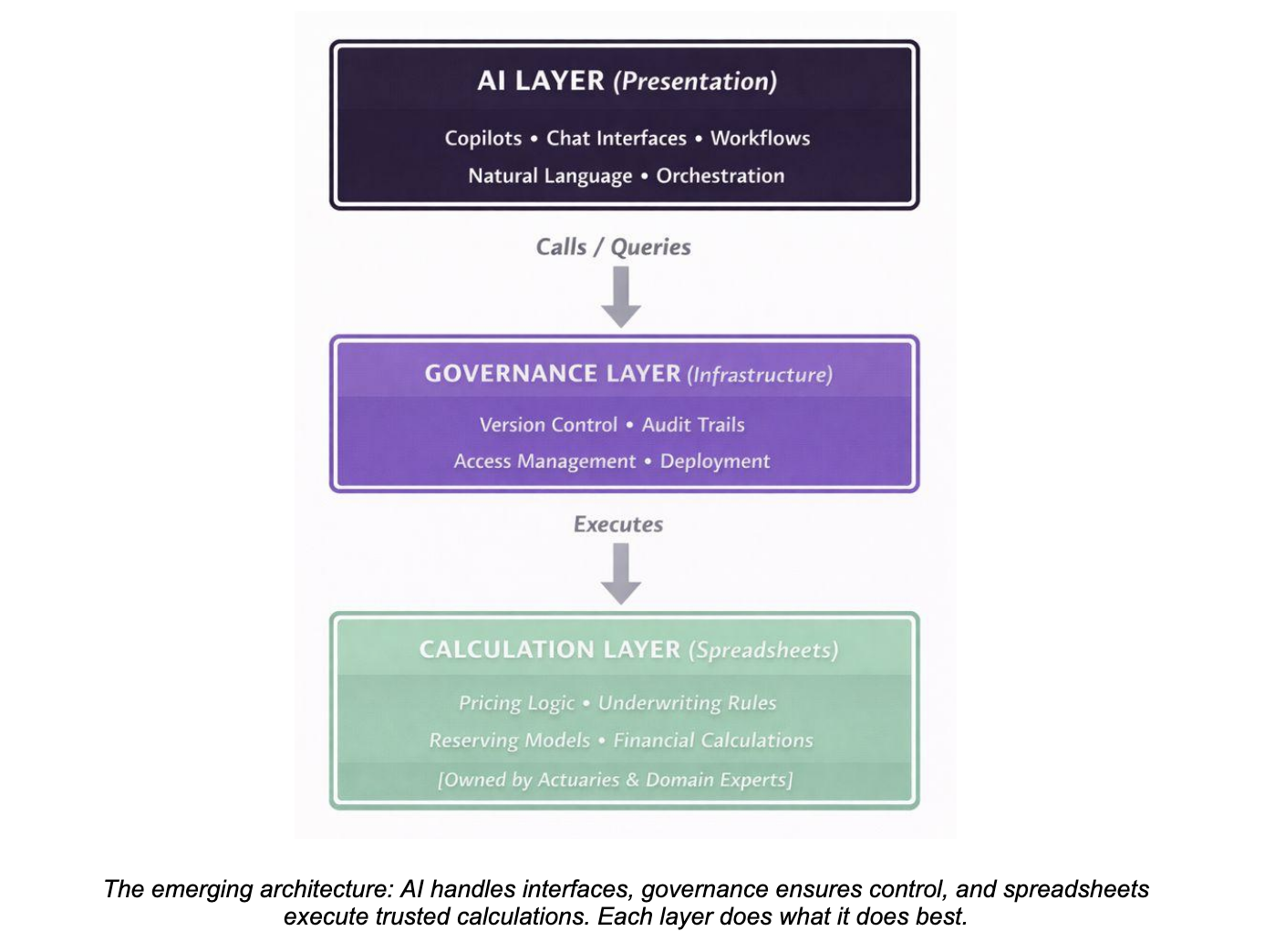
What does that look like in practice?
Versioning, change history, validation evidence, and audit trails get enforced automatically. Spreadsheet calculations get deployed as services that downstream systems, including AI applications, can call directly.
The logic stays in Excel. Governance wraps around it.
Coherent, for example, does exactly this — transforms those spreadsheets into governed, API-driven, enterprise-grade assets, without asking the user to leave Excel.
The Strategic Choice for Insurers
Your pricing logic, your underwriting rules, your reserving models.
That's not technical debt sitting in Excel. That's your IP.
The carriers pulling ahead aren't the ones rebuilding everything in proprietary systems. They're putting governance infrastructure around what already works, so AI initiatives can leverage approved calculations directly, without translation risk or months of development delay.
That's the real divide.
Not between companies that use spreadsheets and companies that have "moved past" them. But between companies that govern their logic as infrastructure and companies that let it sprawl.
AI isn't replacing spreadsheets. It's raising the stakes on every one of them.