Download

Can You Trust the Aflac Duck?

Can simply purchasing disability insurance really lower the cost of workers' compensation claims? Forgive me if I'm skeptical.

I'm always a bit skeptical when companies report the results of self-serving surveys, so let's look at what Aflac -- you know, the duck-spokesman company -- said about a survey that indicated that offering disability insurance coverage to workers could drive workers' compensation claims down considerably. The survey found:

  • 42% of all companies providing voluntary accident and disability insurance report declines in their workers’ comp claims—some of as much as 50%.
  • Roughly 17% of employers offering voluntary accident insurance and 15% of those offering disability saw claims declines of 25% to 49%. The declines were most frequent for large employers, 55% of whom saw workers’ compensation claims drop. Of small- and medium-sized companies, 34% reported the same results.

Is this really true? Can simply purchasing disability insurance really lower the number of workers' compensation claims? Forgive me for immediately thinking that this sounds a bit like the marketing strategy of snake oil salesmen: “Buy one bottle of this magic elixir, and it cures everything from rheumatism to scarlet fever.”

I can think of three reasons why “purchasing disability insurance = lower workers' comp costs” may not be a valid equation.

1. Lower claims may not amount to lower costs.

In the exposure mod rating game, there is no question that lowering the number of claims can reduce the E-Mod and result in lower premiums. However, just because the claims are lower does not automatically mean that the costs are lower.

For example, if the claims reduced by the purchase of disability insurance were small medical-only claims or small lost-time claims, this would reduce the actual number of claims but may not have much of an effect on the E-Mod of a large company that also has more serious injuries. Sure, the number of claims may have gone down, but if Acme Co.’s comp costs stayed the same because of the presence of larger or more serious claims, does that really amount to a substantive benefit?

2. Disability insurance cost may exceed any savings on workers' comp.

What this survey doesn't tell us is how much companies had to spend on disability insurance coverage to realize the savings in workers' comp costs. In other words, did Acme Co. have to spend an additional $100,000 for the disability insurance coverage to save $40,000 in workers' comp costs? If so, that doesn't seem like much of a bargain - - spending $100,000 to save $40,000 (unless we use U.S. federal government math. . . . )

The survey didn’t give us this information probably because the costs to purchase disability insurance coverage would be different for every company surveyed, as would the savings (if any) from the alleged reduction in workers' compensation claims. Nevertheless, I don’t see how we can determine the validity of the “purchasing disability insurance = lower workers comp costs” equation unless we know the ratio of dollars spent on disability insurance vs. the dollars saved in workers comp costs.

3. Why would injured workers leave money on the table?

Let’s assume that Joe Sixpack is injured on the job. If his employer, Acme Co., has both disability insurance and workers' comp coverage, Mr. Sixpack now has a choice of how he seeks payment for medical care and payment of lost wages. The implied argument from the survey is that if Mr. Sixpack has the choice between the two, he will choose disability insurance over workers' comp, thereby reducing the number of comp claims for Acme Co.

But wait…does disability insurance pay for permanent partial disability benefits? Does disability insurance pay for permanent total disability? Does disability insurance pay benefits longer than the term specified in the policy?

Obviously, the answer to these questions could vary. However, in most states, workers' compensation coverage would pay an injured worker a lot more money than the type of disability coverage refererred to in the survey. I’m not attempting to argue that injured workers should choose workers' comp over disability insurance -- but I am pointing out that claimants will typically choose whichever type of benefit will pay them the most money. If that turns out to be workers' comp, then it is doubtful that claimants would be so magnanimous as to choose to file a claim through disability insurance.

Finally, the state where Mr. Sixpack lives may allow him to file a comp claim after he gets benefits through his disability insurance coverage. The presence of disability insurance wouldn’t even amount to a reduction in claims if Mr. Sixpack pursues both avenues.

Bottom line: If you are considering the purchase of disability insurance coverage because it may decrease your workers' comp costs, make sure the math works. Ducks are cute, but I don’t trust their math skills.


Pension Insurance: Just a Stairway to Heaven?

I wondered whether we all have the same requirements when we retire. Or will we eventually expect a degree of customization?|

My eye was caught recently by a small classified ad in the Miami Herald for a care establishment for the elderly called The Door of Heaven. It’s in Fort Lauderdale, if you don’t believe me. The title is a little presumptious and maybe assumes that everyone staying there has pre-qualified for the next (better) life. Less of a care home, more of a departure lounge, with the background music probably falling somewhere between Andy Williams and Doris Day. That same evening, one of the major life insurers ran an ad on TV that took a rather more sophisticated (and expensive) approach. The ad talked about the company's reinvention of its pension products to meet the needs of a changing world. The ad was good brand positioning, even if it didn’t tell me exactly what the company had in mind. But at least they are thinking about the issues. I wondered whether, at the end of the day, we all have the same requirements when we retire. Or will we eventually expect a degree of customization to meet our particular expectations? The recent unforeseen decision by the UK Government to allow policyholders to withdraw their savings as a lump sum in full or part when they retire would seem to provide some new flexibility. In the UK, at least, policyholders can now choose to spend their pension savings on a new sports car, a cruise or even a Gibson Les Paul guitar while they are young enough to enjoy it, rather than save it up for future needs. Sounds like it’s worth thinking about, at least. Ultimately, there are probably limits to the degree of pension options available to us, if not as individuals, then as market segments. Perhaps those customer segments will be based on decade of birth. It seems to me that those born in the era of "flower power" who save their money for future care might have different expectations than do hellraisers of the Led Zeppelin era. Happiness for retired hippies may involve having flowers in now-greying hair. Fans of Zeppelin may demand their carers to provide them with denim-covered Zimmer frames. Dylan fans in their twilight moments as they pass on to the next world will expect to be serenaded by "Knocking on Heaven’s Door." And for those whose faculties aren’t what they used to be, perhaps a touch of the Stones' "I Can’t Get No Satisfaction"…. Personally I’m more of a Who man. When Roger Daltry sang "I hope I die before I get old" in 1965, I don’t suppose he was thinking about the complications of pension schemes. I’m not a fan of old age, but, as they say, it’s better than the alternative.

Tony Boobier

Profile picture for user TonyBoobier

Tony Boobier

Tony Boobier is a former worldwide insurance executive at IBM focusing on analytics and is now operating as an independent writer and consultant. He entered the insurance industry 30 years ago. After working for carriers and intermediaries in customer-facing operational roles, he crossed over to the world of technology in 2006.

Suicide Prevention: Talk About It at Work

Suicide prevention IS a workplace issue, and leaders can create an environment where individuals are more likely to reach out for the help they need.|

Suicide is a serious public health problem -- but is preventable. Suicide has a dramatic impact on the workplace in both human and financial terms. According to the Centers for Disease Control and Prevention, suicide was the 10th-leading cause of death in the U.S. in 2010. There were 38,364 suicides—an average of 105 each day. In addition to the loss of life and suffering of surviving family members, colleagues and friends, the suicides resulted in an estimated $34.6 billion in combined medical and work loss costs. In addition, for every one suicide, there are 25 attempted suicides. An estimated 8.3 million adults (3.7% of the adult U.S. population) reported having suicidal thoughts in the past year. We want business leaders to understand that suicide prevention IS a workplace issue, and that they can create an environment where individuals are more likely to reach out for the help they need. You likely already have employee benefits, such as an employee assistance program (EAP), in place that offer valuable resources for employees and family members in need. Unfortunately, most people who attempt suicide do not reach out to the resources that are available to them. Simply talking can save lives. (Let’s dispel the myth right here – talking about it does not trigger suicidal thoughts or attempts. When the subject of suicide is treated responsibly in a non-sensational manner, discussion can generate increased awareness and understanding, thereby increasing the chance that the person suffering from suicidal thoughts will seek and receive support and help.) When barriers come down and people seek help for mental illness, as many as 90% can significantly reduce their symptoms and improve their quality of life. So, specifically, what can you do? You can begin with a campaign to de-stigmatize mental health issues and to encourage people to seek help. Create a supportive environment where corporate leadership shows that they value physical and emotional health. Convey key messages such as, “It’s a sign of strength to ask for help,” and encourage employees to take talk of suicide seriously, whether in a family member, friend or co-worker. Many employers are beginning to create greater dialogue on this topic. The National Action Alliance for Suicide Prevention is the public-private partnership advancing the National Strategy for Suicide Prevention. The Workplace Task Force of this group, in particular, has developed several public service announcements targeted at employers and organizational leaders. The group has also developed tools to support the workplace in addressing suicide prevention. For more information, including a comprehensive blueprint for a workplace suicide prevention program, visit the National Alliance for Suicide Prevention, Workplace Task Force. For information on an anti-stigma campaign, visit stampoutstigma.com.

Rich Paul

Profile picture for user RichPaul

Rich Paul

As senior vice president and customer and product strategy officer, Paul is responsible for organizing, directing and executing ValueOptions’ product development and market growth strategies supporting sales, new market entry and development, client retention and product innovation and enhancements that support enterprise performance.

The Science (and Art) of Data, Part 1

In essence, business intelligence needs to transcend data, structure and process and be not just a precise science but also a well-integrated art.

Most insurers are inundated with data and have difficulty figuring out what to do with all of it. The key is not just having more data, more number-crunching analysts and more theoretical models, but instead identifying the right data. The best way to do this is via business-savvy analysts who can ask the right strategic questions and develop smart models that combine insights from raw data, behavioral science and unstructured data (from the web, emails, call center recordings, video footage, social media sites, economic reports and so on). In essence, business intelligence needs to transcend data, structure and process and be not just a precise science but also a well-integrated art.

The practitioners of this art are an emerging (and rare) breed: data scientists. A data scientist has extensive and well-integrated insights into human behavior, finance, economics, technology and, of course, sophisticated analytics. As if finding this combination of skills wasn’t difficult enough, a data scientist also needs to have strong communication skills. First and foremost, he must ask the right questions of people and about things to extract the insights that provide leads for where to dig, and then present the resulting insights in a manner that makes sense to a variety of key business audiences. Accordingly, if an organization can find a good data scientist, then it can gain insights that positively shape its strategy and tactics – and gain them more quickly than less-well-prepared competitors.

What it takes to be an effective data scientist

The following table highlights the five key competencies and related skills of a qualified data scientist.

Competencies

Key Skills

Business Impact

1. Business or Domain Expertise

   Deep understanding of:

  • Industry domain, including macro-economic effects and cycles, and key drivers;
  • All aspects of the business (marketing, sales, distribution, operations, pricing, products, finance, risk, etc.).
  • Help determine which questions need answering to make the most appropriate decisions;
  • Effectively articulate insights to help business leadership answer relevant questions in a timely manner.

2. Statistics

  • Expertise in statistical techniques (e.g., regression analysis, cluster analysis and optimization) and the tools and languages used to run the analysis (e.g., SAS or R);
  • Identification and application of relevant statistical techniques for addressing different problems;
  • Mathematical and strategic interpretation of results.
  • Generate insights in such a way that the businesses can clearly understand the quantifiable value;
  • Enable the business to make clear trade-offs between and among choices, with a reasonable view into the most likely outcomes of each.

3. Programming

  • Background in computer science and comfortable in programming in a variety of languages, including Java, Python, C++ or C#;
  • Ability to determine the appropriate software packages or modules to run, and how easily they can be modified.
  • Build a forward-looking perspective on trends, using constantly evolving new computational techniques to solve increasingly complex business problems (e.g., machine learning, natural language processing, graph/social network analysis, neural nets, and simulation modelling);
  • Ability to discern what can be built, bought or obtained free from open source and determine business implications of each.

4. Database Technology Expertise

  Thorough understanding of:

  • External and internal data sources;
  • Data gathering, storing and retrieval methods (Extract-Transform-Load);
  • Accessing data from external sources (through screen scraping and data transfer protocols);
  • Manipulating large big data stores (like Hadoop, Hive, Mahoot and a wide range of emerging big data technologies).
  • Combine the disparate data sources to generate very unique market, industry and customer insights;
  • Understand emerging latent customer needs and provide inputs for high-impact offerings and services;
  • Develop insightful, meaningful connections with customers based on a deep understanding of their needs and wants.

5. Visualization and Communications Expertise

Comfort with visual art and design to:

  • Turn statistical and computational analysis into user-friendly graphs, charts and animation;
  • Create insightful data visualizations (e.g., motion charts, word maps) that highlight trends that may otherwise go unnoticed;
  • Use visual media to deliver key message (e.g., reports, screens – from mobile screens to laptop/desktop screens to HD large visualization walls, interactive programs and, perhaps soon, augmented reality glasses).
  • Enable those who aren’t professional data analysts to effectively interpret data;
  • Engage with senior management by speaking their language and translating data-driven insights into decisions and actions;
  • Develop powerful, convincing messages for key stakeholders that positively influence their course of action.

While it may seem unrealistic to find a single individual with all the skills we've listed, there are some data scientists who do, in fact, fit the profile. They may not be equally skilled in all areas but often have the ability to round out their skills over time. They typically tend to be in high-tech sectors, where they have had the opportunities to develop these abilities as a matter of necessity.

However, because of the increasing demand for data scientists and their scarcity, insurers (and companies in other industries) should consider if they want to build, rent or buy them. Although buying or renting capabilities can be viable options – and do offer the promise of immediate benefits – we believe that building a data science function is the best long-term approach. Moreover, and as we will address in our next post, in light of the shortage of data scientists, a viable approach is creating a data science office of individuals who collectively possess the core competencies of the ideal data scientist.


Anand Rao

Profile picture for user Anand_Rao

Anand Rao

Anand Rao is a principal in PwC’s advisory practice. He leads the insurance analytics practice, is the innovation lead for the U.S. firm’s analytics group and is the co-lead for the Global Project Blue, Future of Insurance research. Before joining PwC, Rao was with Mitchell Madison Group in London.

5 Rules for Hiring Quality Producers

Many agency owners are not good producers, and poor producers typically don't like to hire good ones. Good producers are intimidating, even grating.

A simple and obvious solution to many, likely most, agencies’ growth issues is to hire a quality producer. As proven by the 70%-80% failure rate for such hires, the solution is much easier said than done. However, hiring quality producers is not as hard as it often seems, if agencies follow some rules. (By the way, these rules are based on my clients’ actual, repeatable successes. These rules are not based on theory.)

-- Identify the deadwood.

Quality producers do not want to work with a bunch of retired-in-place producers and owners clipping coupons. Just think about it from their perspective. Can you see a really good producer saying, “I can’t wait to get to work to sell lots of insurance while all my coworkers sit around not making any sales! What an invigorating place! I just love making everyone else rich!”?

Good producers want to work in agencies where everyone is pulling his weight, where other producers are good and generate competition. Good producers want to work in an agency that is growing. Agencies supporting deadwood don’t grow.

-- Eliminate that deadwood and start creating a real sales culture.

Firing deadwood or invigorating them is even more difficult for most agency owners than hiring quality producers. But the agency owner must.

For what it's worth, I have never seen a producer fired who did not benefit. To the best of my knowledge, they all found a better job that fit their personalities, reducing stress and increasing happiness. I have even seen many return to the agency and thank the owner for firing them because they knew they needed to leave but did not have the inner strength to do so.

If an agency owner cannot fire deadwood, she cannot build a true sales culture. Building a sales culture with deadwood producers is like attempting to build a house with twigs as the foundation.

A real sales culture is based on accountability. The producers not only have to make sales but, more importantly, are held accountable for all the activities that eventually lead to sales. A sales culture is built and managed daily rather than just measured once a month or, more honestly, as usually happens, annually. Try it! You’ll like it!

Once you're completed the first two steps -- identifying and eliminating the deadwood and establishing a culture of accountability -- you can begin the search. Don't begin the search first.

-- Test.

The best test for producers is the SPQ Gold test from Behavioral Sciences. It is good on many levels, but what has been interesting to me is the apprehension that flashes across the face of so many agency owners when I describe the test. They know they would fail. They are then caught in an important emotional bind. They have to hire someone who is better than they are at selling.

One of the secrets to why producers fail 70% to 80% of the time is that a large proportion of agency owners are not good producers, and if someone is not a good producer he typically doesn't like to hire good producers. Good producers are intimidating and ego-busting. Good producers can even be grating.

My clients who climb this emotional mountain successfully always do so using the same technique. They separate their emotions from what is best for the agency. Again, easier said than done and likely impossible to do on one’s own. A support system is likely required. Asking for help is actually key to successfully hiring producers. Asking for help is a sign of strength, not a weakness.

-- Don't have owners involved in ANY initial interviews.

When agencies advertise for producers, they try to list all the desired qualities. However, I have never seen an advertisement list the most important quality to owners: that the producer is a good guy (whether male or female).

The search for that quality is a huge reason so many owners fail to find a good producer. Do you want a producer who is a good guy and can’t sell or a producer who may or may not be a good guy but can sell?

Owners have a tendency to fall in love with every producer they interview, so they need to stay out of the process at the start. Let just about anyone else do the initial interviews.

-- Develop and manage.

If you just follow the first four steps, your odds of successfully hiring a quality producer will increase dramatically. But if you really want to maximize your prospects, you must create clear producer-development and -management plans. These are two different plans. Considerable detail is required. If you’ve never done this previously, these plans are nearly impossible to create on your own. Hire specialists.

These are not easy steps. Frankly, most agency owners are not emotionally capable of taking these steps, and many are not emotionally capable of delegating these steps, either.

Having to delegate to people who are better-equipped to hire successfully is often the most painful part of the solution. Delegation feels like abdication of personal responsibilities. Yet delegation is leadership. Being a leader -- and a leader is the decision maker who does what is right for the agency rather than making the emotionally easy choice for the owner -- is what really makes the difference in finding and hiring quality producers.

NOTE:  None of the materials in this article should be construed as offering legal advice, and the specific advice of legal counsel is recommended before acting on any matter discussed in this article. Regulated individuals/entities should also ensure that they comply with all applicable laws, rules and regulations.     

Facebook-Axa: Reimagining Insurance

Most insurers use next-gen technologies to do the same things differently. Axa, with Facebook, will be able to do completely different things.

What a stunner and brilliant outside-in move by AXA – to position itself as a dominant digital insurance company by partnering with Facebook! You baseball fans will know the phrase, “the shot heard 'round the world,” which was said about the game-winning home run by a New York Giants player against the Brooklyn Dodgers in 1951 to win the National League pennant. Just like that home run, this shot is a game-changer for insurance, propelling AXA ahead of the competition and redefining the customer experience.

AXA and Facebook plan to leverage the scale of both businesses via ground-breaking innovation and access to research, training and capabilities, particularly on mobile. The power partnership of the world’s top insurer and the dominant social media company has the potential to completely innovate, transform and redefine AXA’s customer experience, customer engagement, digital presence and growth potential to levels not yet seen in insurance.

AXA’s game-changer move has the potential to establish a new bar for customer excellence, loyalty and engagement that many insurers talk about, but that few have actually taken the bold actions to make happen. This move goes well beyond having a presence on social media, to embracing the power of a social media platform as the foundation of a new customer engagement model.

What is it that makes this so fascinating and game-changing?

Facebook’s mission to give people the power to share and make the world more open and connected – by building a network of more than 1.23 billion (and growing) monthly active users. The influence and pervasiveness of Facebook's platform continues to grow. It is used by 57% of all American adults – and 50% of those adult users have more than 200 friends in their networks, according to the Pew Research Center.

Facebook started 10 years ago on a U.S. college campus, and it expanded across all demographics around the world, creating a powerful network of relationships that influences decisions, other relationships and outcomes. We all have seen or experienced Facebook’s power from making possible the most basic of connections with childhood friends and family to its expansion across the U.S. and the world. Beyond its original purpose of social connection, the platform has grown to have the power to save lives, influence buying behaviors and customer loyalty and motivate social and political change. And it gets more impressive.

In announcing 2013 fourth-quarter financial results, Facebook reported even more milestones that highlight the potential for AXA to turn the insurance model on its head. Consider these:

  • On a daily basis, 757 million people were active users as of December 2013, representing an increase of 22% from the previous year. Even more astounding was that 556 million people were mobile active daily users, an increase of 49% over the previous year.
  • Most impressive was a monthly average of mobile users totaling 945 million, an increase of 39%, and representing nearly 76% of the base.

Facebook’s vision, reflected in its milestones and influence, emphasizes why this partnership opens up a whole new model of customer engagement for insurance:

  • It can create a modern customer experience, like the ones people have every day with companies like Facebook, Amazon or Zappos, where there is a new level of engagement beyond the three common areas of quote and buy, bill payment and claims – the things that are not necessarily delightful! Imagine a new experience where the customer is getting more value through new services, offerings and knowledge sharing with an insurer that is offering a more omnipresent relationship.
  • Customer loyalty – and our typical manner of measuring this through a net promoter score (NPS) – is transformed through a branded customer network of relationships that share experiences, recommendations, costs, product ideas and much more.
  • Imagine leveraging the Facebook platform as a means of managing the customers' portfolios of assets, products and policies, offering life and P&C product recommendations based on their life stage or activities, or helping them during a claim or catastrophic event. Customers can also use mobile technologies in a self-service manner to find assistance with claims or to access information to help protect themselves and their assets.
  • Consider the explosion of new data that will be available and valuable in understanding the customers better so as to personalize their experience, provide insights, uncover new needs and identify new products and services that they may be unaware of.

Most insurers today are using Facebook, mobile and data to just do the same things differently within their operations. This powerful partnership that is leveraging next-gen technologies has the potential to do completely different things– going well beyond what has already been done today, creating a digital strategy and experience that will reinvent AXA and, subsequently, the insurance industry.

Game on! What will your next move be?

Are You Telling a Good Story?

Part of being a successful salesman is doing the legwork, but there is another aspect, too, one that many overlook.

Think back to the last time you listened to a great story. There was a fantastic cast of characters, breathtaking scenery and, of course, a plot line that hooked you. For a brief moment, you were there, right in the middle of it, living the story.

Each time a successful salesman sit downs with a potential customer or client, he weaves together a story in which the product or service has already become an integral part of the listener’s life. The customers, through the picture painted by the salesman’s words, soon realize how beneficial this particular product or service could be and start to wonder how they existed without it for so long.

Does this sound like some sort of trick?    

Does it seem like some sort of mind game played on unsuspecting victims? 

No. By painting a picture with words, by telling a story rich in substance, the insurance professional accomplishes a number of things. First, he helps to develop the conversation with the potential client. By offering details, and making sure that everyone is seeing the same picture, he can see where miscommunication may occur. Also, the potential customer is more likely to think of more detailed questions to ask to help fill out the remaining part of the picture.

Remember that people make the connection with an item or a service not through rational thought but through emotion. Sure, a potential client needs to know the good points, the bad points and the mechanics of how something is going to work, but the final decision is greatly influenced by how he feels about something.

Does your product or service instill confidence? 

Does it feel familiar? 

Does it cause excitement? 

All these feelings and emotions can help make the sales process a success.

So, how do you craft an emotionally engaging story?

First, it is important that you, as the storyteller, believe and are emotionally connected to your story. Remember, a client will hear the sincerity in your voice, or the lack thereof. This is where the knowledge and personal use of your service or product can be so important. By using your own experience, or that of other customers, you can easily convey a believable story that extols the virtues of your product or service.

Second, a great story has structure. We have all heard stories that seemed to go on forever, with no point in sight. We have also all heard stories that jump around so much we tune out because we are lost. There are different ways to structure a story. One is called a “hero’s journey” model. The hero’s journey follows a departure, an initiation and a return.

Steve Jobs was a master storyteller. Watch one of his keynote speeches and observe how he weaves a story throughout his entire presentation. Case in point: his Stanford commencement speech in 2005. (Text is here. Video is here.) His first story connects the dots of his childhood to his success. The second story tells about his loves and losses. The final story is about death. He really gets personal, connecting with his audience on an emotional level. You hear jeers, cheers, laughter, and when the camera pans the audience in the video you see tears. His message is to trust the process, love what you do and don’t settle. Don’t live anyone else’s life. When you listen to this speech, as well as his others… you pay attention, you listen and you feel. You are emotionally connected.

As you formulate your presentation, remember how we, as humans, communicate. Surprisingly, when a person is talking, research shows that most people only give a fraction of their attention (7%) to the words that are being spoken. Over half (55%) is given to the various pictures and images that are created during the conversation. The remaining amount of attention is allotted to the mechanics of speaking itself, such as our mannerisms and body language.

To be an effective sales person, you must engage your potential client and make the entire story memorable. Like an artist, you need to create an emotional picture with your words and bring what you are trying to communicate to life. Don’t be a stick in the mud while talking; use your hands naturally. If you feel enthusiastic about your product or service, don’t be afraid to let those around you know. Chances are the excitement that is coming from you will encourage them to take a second look at what you have.

The art of selling isn’t really about selling at all. It is about sharing a story and bringing your potential client into the creation of the next chapter. By guiding them to a vision where their success and their satisfaction is an integral part of this story, you’ll have a great chance of convincing them of what they truly need.

Are you connecting emotionally to your audience? 

When was the last time you told a good story?

California Bill Could End Use of Temp Workers

This legislation could, effectively, end the staffing agency model by making it difficult for most small businesses to use temporary employees.

The California legislature is considering a bill that could rewrite the relationship between employers and temporary staffing agencies. Assembly Bill 1897 (Hernandez, D-48) would make employers that hire laborers from temporary agencies liable if those agencies fail to provide workers’ compensation insurance, violate wage and hour laws or fail to withhold proper taxes.

This legislation could, effectively, end the staffing agency model by making it difficult for most small businesses to use the services. (The text of the bill is here.)

Employers hiring temporary staffing agencies would be responsible for performing due diligence by checking into the internal practices of the staffing agencies to determine whether agencies are properly funded to comply with labor laws and regulations. The employer, as a client of the agency, would be held responsible if the staffing agency failed to meet these requirements. Under the current version of the bill, it would be impossible to “contract around” this requirement, as a waiver would be deemed to violate public policy.

Promoters of AB 1897, including the California Labor Federation, claim that the bill is designed to protect employees of staffing agencies from wage theft and lack of workers’ compensation coverage. But the goal seems to run deeper. Proponents also hope to address wage disparity between full-time and temporary workers, benefit differences and impediments to collective bargaining by temporary employees. 

According to the California Chamber of Commerce, which opposes the bill, employers that do not have dedicated human resources or legal departments rely on temporary agencies to prescreen employees, to fill seasonal and short-term positions, to provide cover for employees who are absent and to protect the core group of employees from workforce reductions (the use of temporary workers would be reduced during slack times, instead.)

AB 1897 would make life harder for small businesses by holding them responsible for performing due diligence by seeking agency data outside of their purview and making them financially responsible for factors that are beyond their control, including businesses issues that could drive staffing agencies into bankruptcy. While most staffing agencies are properly insured and funded, this bill will cause small businesses anxiety over increased fines and litigation and create a chilling effect throughout the California labor market.

AB 1897 is currently before the Assembly Committee on Labor and Employment.

Risky Spots for EPL Suits

California -- no surprise -- has the highest rate of lawsuits. Illinois, Alabama, Mississippi and the District of Columbia are also high-risk. 

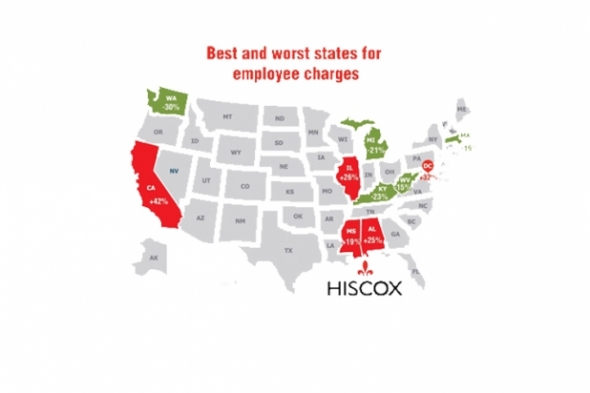
A new study of employment practices litigation (EPL) data by Hiscox found four states -- California, Illinois, Alabama and Mississippi -- along with the District of Columbia, to be the riskiest areas of the U.S. for employee lawsuits. Businesses in these five jurisdictions face a risk that is substantially higher than the national average for being sued by their employees.

According to the study, a U.S.-based business with at least 10 employees has a 12.5% chance each year of having an employment liability charge filed against it. California has the most frequent incidences of EPL charges in the country, with a 42% higher-than-average chance of being sued by an employee. Other high-risk jurisdictions include the District of Columbia (32% above the national average), Illinois (26%), Alabama (25%), Mississippi (19%), Arizona (19%) and Georgia (18%). Lower-risk states for EPL charges include West Virginia, Massachusetts, Michigan, Kentucky and Washington.

Bert Spunberg, a colleague at Hiscox who is a senior vice president and the practice leader for executive risk, says: "Federal level information on employee charges is generally available, but state specific information is more difficult to aggregate. Understanding employee litigation risk at a state level is a crucial step for an organization to establish the processes and protections to effectively manage their risk in this changing legal environment."

State laws can have a significant impact on risk. For example, the employee-friendly nature of California law in the area of disability discrimination may contribute to the high charge frequency in the state. Discrimination cases filed at the state level in California are brought under the Fair Employment and Housing Act (FEHA). FEHA applies to a broader swath of businesses, covering any company with five employees, vs. a 15-employee minimum for cases brought under federal law as outlined in Title VII of the Civil Rights Act.

Mark Ogden, managing partner of Littler Mendelson, the largest employment and labor law firm in the world, says: "Not only are employment lawsuits more likely in those states, but the likelihood of catastrophic verdicts is also significantly higher. Unlike their federal counterparts, where compensatory and punitive damages combined are capped at $300,000, most state employment statutes impose no damages ceilings. Consequently, employers in high-risk states must ensure that their workforces are adequately trained regarding workplace discrimination, harassment and retaliation and that policies forbidding such conduct are strictly enforced.”

For more on the study, click here.

25 Key Slides on Workers' Comp's Future

American industrial might is making a comeback: Is this a golden opportunity for workers' compensation insurers?

The following slides show a promising picture for workers' comp as the economy continues to recover and as certain industries -- such as construction, manufacturing, oil and gas extraction and healthcare-- are poised for growth. At the same time, the industry will have to be prepared for potential disruptions such as those that will come as the workforce ages, such as might occur because of the Affordable Care Act and such as are facing companies because of declining returns on investments. 

The slides were part of a presentation to the AMCOMP Conference for workers' compensation professionals on March 27, 2014. For the full presentation, click here.