However you feel about Tom Brady, the Patriots and football air pressure, today is a learning moment about cell phones and evidence. If you think the NFL had no business demanding the quarterback’s personal cell phone—and, by extension, that your company has no business demanding to see your cell phone—you’re probably wrong. In fact, your company may very well find itself legally obligated to take data from your private cell phone.
New Norm
Welcome to the wacky world of BYOD—bring your own device. The intermingling of personal and work data on devices has created a legal mess for corporations that won’t be cleared up soon. BYOD is a really big deal—nearly three-quarters of all companies now allow workers to connect with private devices, or plan to soon. For now, you should presume that if you use a personal computer or cell phone to access company files or email, that gadget may very well be subject to discovery requirements.
Security & Privacy Weekly News Roundup: Stay informed of key patterns and trends
First, let’s get this out of the way: Anyone who thinks Tom Brady’s alleged destruction of his personal cell phone represents obstruction of justice is falling for the NFL’s misdirection play. That news was obviously leaked on purpose to make folks think Brady is a bad guy. But even he couldn’t be dumb enough to think destruction of a handset was tantamount to destruction of text message evidence. That’s not how things work in the connected world. The messages might persist on the recipients’ phones and on the carriers’ servers, easily accessible with a court order. The leak was just designed to distract people. (And I’m a Giants fan with a fan’s dislike of the Patriots).
But back to the main point: I’ve heard folks say that the NFL had no right to ask Brady to turn over his personal cell phone. “Right” is a vague term here, because we are still really talking about an employment dispute, and I don’t know all the terms of NFL players’ employment contracts. But here’s what you need to know:
Technology and the Law
There’s a pretty well-established set of court rulings that hold that employers facing a civil or criminal case must produce data on employees’ personal computers and gadgets if the employer has good reason to believe there might be relevant work data on them.
Practically speaking, that can mean taking a phone or a computer away from a worker and making an image of it to preserve any evidence that might exist. That doesn’t give the employer carte blanche to examine everything on the phone, but it does create pretty wide latitude to examine anything that might be relevant to a case. For example: In a workplace discrimination case, lawyers might examine (and surrender) text messages, photos, websites visited and so on.
It’s not a right, it’s a duty. In fact, when I first examined this issue for NBCNews, Michael R. Overly, a technology law expert in Los Angeles, told me he knew of a case where a company actually was sanctioned by a court for failing to search devices during discovery.
Work Gets Personal
“People’s lives revolve around their phone, and they are going to become more and more of a target in litigation,” Overly said then. “Employees really do need to understand that.”
There is really only one way to avoid this perilous state of affairs—use two cell phones, and never mix business with personal. Even that is a challenge, as the temptation to check work email with a personal phone is great, particularly when cell phone batteries die so frequently.
The moral of the story: The definition of “personal” is shrinking all the time, even if you don’t believe Tom Brady shrank those footballs.
For further reading: here’s a nice summary of case law.
Get Involved
Our authors are what set Insurance Thought Leadership apart.
DISRUPTION IN THE AUTOMOTIVE ECOSYSTEM: What to Expect, and How to Survive and Win
For the purposes of this paper, and to explain the codependencies and inter-industry impacts, we’ve chosen to define the auto ecosystem as including all business segments affected by the automobile, including: auto manufacturing, auto buyers and drivers; collision repairers; aftermarket suppliers, including parts providers; auto insurance companies and their policyholders; and the deep and extensive claims and services supply chain that supports them, such as the technology and information provider segments. Given the broad scope and complexity of the component topics, we have identified and provided a degree of depth on each one, but by no means should this information be considered exhaustive.
The entire auto ecosystem is in the midst of significant disruption, and the dizzying pace of change will only continue to accelerate. This disruption is the result of the convergence of upstream upheaval in these sub-segments of the auto ecosystem:
• “new consumer” behavior and expectations
• technology evolution, including mobility and the Internet of Things
• the digital data gold rush and the adoption of advanced analytics
• globalization integration, collaboration and supply chain consolidation in the automotive ecosystem
• collision repair industry consolidation
Over the last 30 years, the auto repair and automotive aftermarket segments were part of a steady and inevitable evolution. During this long-term progression, the auto physical damage industry adapted to a myriad of business innovations, technology enablers, program and process changes and product and service introductions. Some resisted these innovations as either real or perceived business disruptions or dis-intermediation while others embraced them as opportunities to be leveraged for business, market and strategic transformation.
The 2007/2008 “Black Swan” event, the U.S. recession, affected our entire economy and loomed large and ominous for a number of years. This became the foundation for today’s unmatched auto physical damage industry transformation. It triggered the start of unprecedented structural change within the U.S. and Canadian auto repair and aftermarket segments. This changing landscape became part of four distinct, yet connected, marketplace phases: contraction, consolidation, convergence and constructive transformation, which continue today.
Additionally, these four phases are being affected by a confluence of numerous, dynamic and impinging forces, which have both disruptive and transformational influences on today’s stakeholders. Some of the more influential external impact factors include:
• globalization
• private equity investment
• accident safety and avoidance technology
• predictive analytics
• telematics and integrated claims process models
• insurer multiple-shop operator, strategic performance-based, direct repair program (DRP) contracts
• new and hybrid direct repair program models
• OEM- certified networks’ influence in the repair process
• morphing demographics
• multi-system operators (MSOs), growing market dominance and insurance carrier acceptance
• repair segmentation
• national technician shortage
• complex vehicle technology and proliferation of advanced materials
• urbanization
• increased complexity in insurance company DRP participation requirements
Consequently, the traditional process of linear thinking, with its straightforward cause-and-effect structure, is giving way to a more realistic and more complex multi-dimensional thinking pattern that heightens the understanding of the frequency, acceleration and degree of change. It is important, in light of this, to build and leverage a strategic alliance ecosystem with customers, suppliers, competitors, investors and business partners to maintain and grow a collaborative brain trust. This shared commitment will help to co-create and foster constructive change within an organization in an attempt to influence its uncertain environment for the mutual benefit of all strategic partners.
Evidence of disruption in the auto insurance industry and its extensive supply chain is plentiful and portends even greater change. Long-standing leaders in the U.S. auto insurance industry have lost significant market share to more innovative consumer-centric carriers. Advanced analytics and telematics technologies have combined to enable new forms of insurance products, including usage-based insurance. The Internet of Things, including the connected car, will amplify this trend going forward and literally change the fundamental nature of insurance and risk management products, solutions and servicing. For example, consumers are now shopping for and purchasing auto insurance, and submitting and receiving claim payments, on their smartphones. Fueled by the entry of large and growing pools of private equity capital, rapid industry consolidation is occurring across several supply chain segments including the once highly fragmented collision repair industry and alternative parts supplier markets.
In this dynamic environment, we believe that the ultimate leaders and winners in 2015 and beyond will be those companies that most successfully focus and execute on the development of compelling personal mobility solutions; transform product development and distribution around the new consumer; leverage data and analytics across the enterprise; think, plan and execute globally; and aggressively collaborate, partner and affiliate as effectively as possible.
The new consumer, mobility and the internet of things
Today’s consumer is totally unlike that of the past, and they have created new challenges and opportunities for all participants in the automotive ecosystem, in particular for auto insurers. This new consumer, epitomized by Millennials, has embraced mobile technologies and the social media they support. This phenomenon has fundamentally changed how insurance is branded, marketed and sold. Moving forward, this same mobility will enable insurers to design completely new types of insurance products and manage risks much more effectively for policyholders and themselves.
The most disruptive group of mobility technologies is the rapidly emerging Internet of Things, much of which is controlled today by industry outsiders. The potential impact on numerous aspects and multiple lines of insurance, as well as on the rest of the auto ecosystem, is enormous.
Of related concern to the insurance industry should be the potential for these outsiders to leverage this valuable information to enter the business and become competitors. Some recent acquisitions include Facebook’s purchase of the fitness and location app Moves, Monsanto’s acquisition of crop insurance and data company Climate Corp. (which was started by former Google executives) and Google’s acquisitions of the connected home devices and security company Nest and the Israeli location-mapping service Waze. Verizon acquired Hughes Telematics in 2012.
The data generated by all of these businesses, which was never before so digitally available, can be combined with advanced analytics to accurately establish and manage individual and property risks. The ability to successfully acquire, control and effectively translate and use all of this data will determine the insurance industry’s digital gold rush winners and losers of the future.
Impact of OEM globalization
The impact of automotive industry globalization is pervasive within the automotive and aftermarket industries. It is one of the more significant continuing influential macro factors within the larger constellation and confluence of simultaneous conditions affecting the auto physical damage landscape. For example, the change caused by how vehicle manufacturers are aggressively re-engineering and consolidating their light vehicle platforms is evident in the worldwide auto manufacturing transformation underway; General Motors is planning to reduce in 10 years its current 26 global production platforms to just four by 2025. This globalization of cars and its many OEM implications will continue to drive significant change throughout the entire property and casualty auto insurance and auto physical damage aftermarket supply chain.
One of the key drivers of this manufacturing transformation is the National Highway Traffic Safety Administration’s CAFE standards, which require average manufacturer fleet fuel consumption to drastically improve from today’s 30.2 miles per gallon to 54.5 miles per gallon by 2025. By the 2016 model year alone, there will be approximately 250 new and different vehicle debuts and redesigns from both U.S. and foreign manufacturers. Ultimately, achieving strategic goals and objectives such as reducing fuel consumption and gas emissions by improving fuel economy and reducing the environment’s carbon footprint reflect the current megatrends end game.
As the OEMs drive to innovate globally, there will be intended and unintended outcomes involving the use of many new materials, engine downsizing, alternative powertrains, advanced integrated electronics, telematics and new repair technologies and processes, and producing light-weight vehicles. These innovations will be seen as a disruption by some, while being embraced by others who seek to leverage these global influences for future growth and competitive advantage.
Other ecosystem and supply chain industry consolidation
Another globalization perspective is being driven by increasing international trade and investment by private equity and strategic buyers involving an explosion in mergers and acquisitions within the property and casualty insurance and auto physical damage industries in the U.S. and throughout the world.
The following is a partial list of some of the more relevant recent M&A activity by U.S. and international companies in this ecosystem:
• CCC Information Services acquires telematics and UBI solutions provider DriveFactor
• Hartford-based Insurity acquires Montreal-based Oceanwide
• Patriot National’s Technology Solutions unit acquires Vikaran Solutions in Pune, India
• Uber acquires control of Metromile (PAYD) insurance, U.S.
• Google acquires CoverHound, an insurance aggregation website, U.S.
• Google’s Nest unit buys Dropcam
• Fosum buys Meadowland, a first-ever acquisition by a Chinese insurer of a U.S. insurer
• Alliant Insurance Services of the U.S. buys the U.S. agency business of Australia’s QBE
• Majesco acquired Cover-All Technologies and Agile Technologies, U.S.
• Symphony Technology Group acquires Aon e-Solutions from Aon (UK)
• ACE (Bahamas) buys Fireman’s Fund U.S. personal lines business
• Vista Equity acquires TIBCO for $4.3 billion, U.S.
• Onex (Canadian private equity firm) acquires York Risk Services for U.S. $1.325 billion, U.S.
• Element Financial (Canada) acquires U.S.-based PH&H fleet management business for U.S. $1.4 billion
• Mapfre Insurance, Spain, acquires Commerce Insurance and MiddleOak personal lines, U.S.
• QBE Insurance, Australia, acquires Balboa Insurance, U.S.• Travelers Insurance, U.S., acquires Dominion Insurance, Canada
• Desjardins Insurance, Canada, acquires State Farm Canada, U.S.
• Boyd Group, Canada, acquirers Gerber Collision and Glass, U.S.
• OMERS, Canada, acquires Caliber Collision Centers, U.S.
• UniSelect, Canada, acquires Finish-Master, U.S.
• Solera, U.S., acquires Velexa Technologies, UK
• Solera, U.S., acquires CAP Automotive, UK
• Belron, South Africa, acquires Safelite Glass, U.S.
• LKQ, U.S., acquires EuroParts, UK
• UBM, UK, acquires Advanstar-Motor Age and Auto Body Repair News ABRN, U.S.
• The Carlyle Group (owners of Axalta and investors in Service King) acquires Nationwide Accident Repair Services of the UK
These acquisitions reflect the growing trend of an increasingly integrated global insurance and automotive economy resulting in an extension of business and market international strategies, introduction of new, innovative and disruptive technologies and processes, and brand expansion while also managing resource and risk diversification.
The digital data gold rush/ advanced analytics
We have entered a “digital Gold Rush” era – a modern version of the California Gold Rush of 1849 – with the gold being digital data, which is beginning to flow in torrents. This has huge implications for the insurance industry, and not least for property and casualty claims. Digitization is already having an impact across the claims technology and services supply chain, forcing supplier consolidation and compressing customer service cycle and response times to near real time. These forces will affect property and casualty claims technology, as well as information and services provider segments, which have historically been highly fragmented and privately owned and operated. National consolidation, volume aggregation and the infusion of sizable technology investments led by professional management teams offer significant medium-term rewards to the participants.
The most potentially disruptive group of digital technologies of all is the rapidly emerging “Internet of Things” or “M2M” (machine-to-machine) technology, with its potential impact across multiple lines of insurance. Of related concern to the industry should be the potential for non-traditional competitors to leverage M2M data and enter their business. An example is Google’s acquisition of the connected home devices and security company Nest Labs. The data acquired in all of these businesses, never before so digitally available, will be combined with advanced analytics to accurately establish and manage individual and property risks.
These powerful forces are all converging to drive mergers and acquisitions activity to unprecedented levels in the property and casualty insurance claims technology ecosystem, attracting increasing numbers of private equity and strategic investors, and providing attractive exit opportunities and strategic alternatives for participants, all while creating exciting new and innovative technology-enabled capabilities for insurers, agents, brokers and consumers.
Private equity and collision repair industry consolidation
The first two phases of the current collision repair industry structural transformation, contraction and consolidation, are part of a four-phase model consisting of contraction, consolidation, convergence and constructive transformation. These first two phases began to emerge and quickly expand after the start of the recession in December 2007. Simultaneously, private equity groups turned their attention to the collision repair industry; they looked under the hood and liked what they saw.
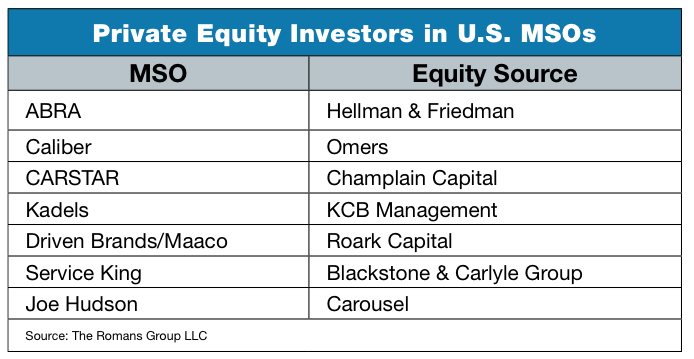
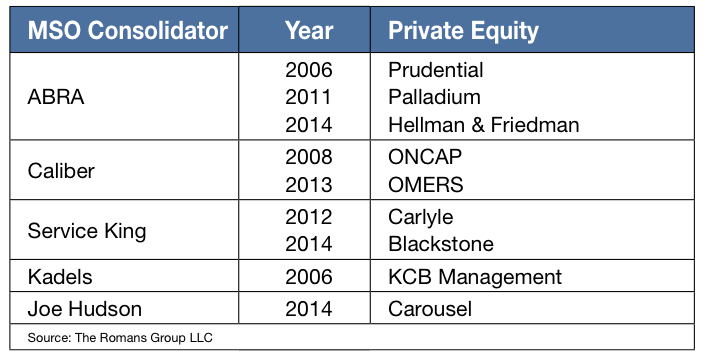
Private equity firms were on the hunt to find alternative investments that could yield comparative or better returns than were currently available during the trough and slow recession recovery between 2007 and today. Additionally, their interest is backed and driven by unprecedented amounts of strategic buyer, private equity and pension fund dry powder/cash-seeking investments that can drive higher valuations and returns on their capital invested. The current private equity investor groups competing in the consolidation of the auto repair industry are identified in the chart below.
There are a number of factors affecting the continued attractiveness of investing in the collision repair industry.
• the collision repair industry’s structural transformation is still early to mid-stage
• the stigma from consolidation’s failed first attempt during the early 2000s is now fully erased
• excess strategic and private equity capital continues to seek high-return, quick-turn investments, which are characterized by recurring revenue, free cash flow and attractive returns on invested capital
• aggressive MSO consolidator and private equity competition
• debt financing is inexpensive and available
• collision repair management teams realize the benefit of strategically partnering with investors to more quickly grow and develop market share
• $32 billion addressable collision repair industry size
• high barriers to new entrants associated with the MSO consolidator model
• business complexity
• mature management teams
• performance-based insurance DRP contract requirements
• brand recognition
• demonstrated economies of scale
• rising operational excellence with lean-based process environment
• replicable acquisition and integration models
• leveraging and expanding technology enablers
• insurance industry strategy aligned with MSO consolidator strategy
As consolidation continues to drive collision repair industry contraction, four MSO consolidators, ABRA, Boyd/ Gerber, Caliber and Service King stand out as the primary buyers or disruptors vying for multi-location and multi-region platform acquisitions. More nascent strategies are focused on market density and coverage through “build outs or tuck-ins,” acquisition of individual shops, constructing "green fields" and "brown fields" and utilizing franchise models in smaller tier markets.
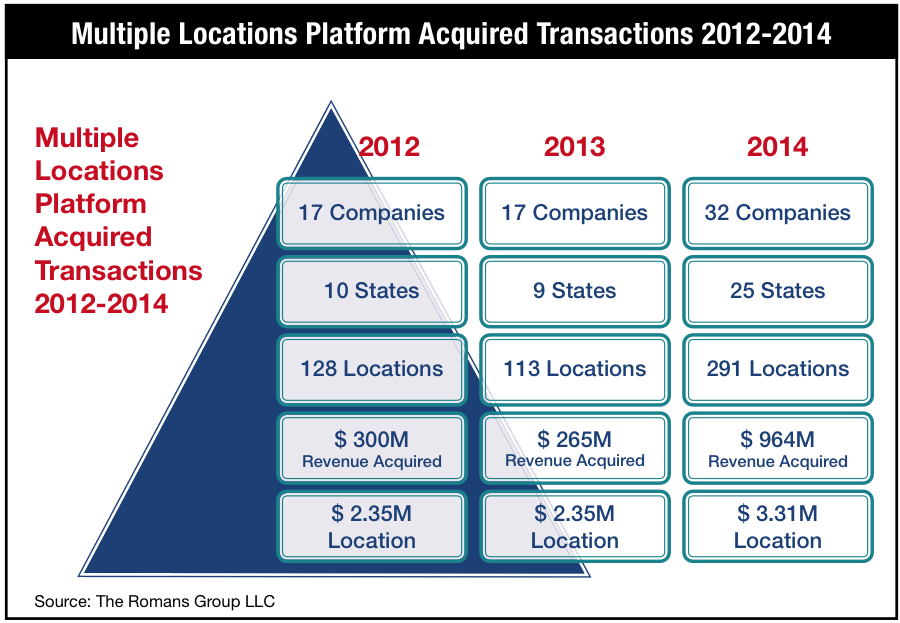
The growth of MSO consolidators associated with these transactions has in all cases had private equity backing. When viewed in the context of an approximate $32 billion auto repair marketplace, there is room for further consolidation in what is still an oversupply of repairers within the approximately 33,000 U.S. auto repair locations.
The transfer of just more than $1.5 billion in multiple-location operator (MLO) platform transaction repair revenue from 2012-2014 excludes three large recapitalizations that included Caliber in 2013 and ABRA and Service King in 2014. If these recapitalizations were included, the total transfer of MSO consolidator revenue would have been slightly more than $3 billion, or approximately 10% of the industry’s annual revenue. Additionally, the MSO segment representing at least $20 million in annual revenue included 80 MSO organizations processing $6.3 billion in annual revenue at year-end 2014. How long private equity continues its aggressive funding of MSO consolidators is uncertain.
Supply chain consolidation in the auto insurance ecosystem
Beyond the collision repair segment, an unprecedented and powerful number of forces are converging to drive mergers and acquisitions activity in the North American property and casualty insurance claims and technology “ecosystem” to historically high levels, including:
• claims supply chain rationalization and consolidation
• rising adoption and deployment of big data and analytics solutions
• insurance product commoditization and the resulting business transformation
• an influx of private equity capital (already raised and seeking to be deployed in the sector)
• expectations of a continuation of a steadily improving economy with the prospect of lingering low interest rates
We expect these forces to amplify competition among well-capitalized strategic players and private equity participants who seek to create scalable and defensible positions in the industry. The implications for smaller, less capitalized, regional or technology- challenged competitors are meaningful.
Claims supply chain consolidation
The area in which we expect the greatest potential for increased activity in 2015 and beyond is within the claims supply chain. The property and casualty insurance claims ecosystem is composed of thousands of small local and independent firms as well as larger regional, national, and global vendors and business partners that provide mission-critical products and services to the claims operations of the property and casualty insurance industry, including:
• insurance technology and IT services, system integrators, core system and claims management software solutions and database and information providers, including communication, repair estimating and body shop management systems
• claims technology vendors (document management, compliance, data quality, payment systems, etc.)
• collision and auto glass repairers
• collision repair parts suppliers
• insurance replacement rental car providers
• third-party administrators and claims business process outsourcing firms
• claim services, including independent auto and property adjusters and appraisers and catastrophe services
• insurance defense attorneys
• auto and casualty claims management solution providers
• salvage vehicle auctioneers and towing services
• insurance staffing firms
• insurance claims investigation firms
One of the subsectors most affected by these factors is the highly fragmented and inefficient collision repair and parts business. Many of these are local, privately owned businesses with limited technology capabilities and management talent. National consolidation, often driven by private equity, can lead to expense rationalization, upgraded information technology systems, improved management and the ability to better respond to upstream customer pressure and improved pricing. By way of example, since its founding in 1998, LKQ (NASDAQ: LKQ) has consolidated the automotive repair alternative parts market in North America and elsewhere to become the largest provider of alternative collision replacement parts and a leading provider of recycled engines and transmissions, with annual revenue approaching $7 billion. In 2014, LKQ acquired Keystone Automotive, a leading distributor of aftermarket parts and equipment.
Additionally, one of the other important trends is the development of an electronic parts procurement and e-commerce solution for the large $15 billion, and still highly fragmented and inefficient, North American auto repair parts supply chain.
For smaller providers in the claims supply chain, now may be the time to consider combining with a larger, better-capitalized player, especially given the trend toward vendor management by insurance companies. A “going it alone” strategy will be increasingly risky as larger, national players will garner more market share by offering better pricing, superior technology solutions and greater geographic coverage than “mom and pop” operations.
Claims information provider expansion and consolidation
North American insurance industry auto and property claims operations, including their auto collision repair and property partners, primarily use the products and services of three claims information providers, each of which has expanded its offerings into automotive claims-related markets.
CCC Information Services: Private equity-backed CCC Information Services (Leonard Green & Partners plus TPG Capital), a database, software, analytics and solutions provider to the auto insurance claims and collision repair markets, recently acquired Auto Injury Solutions, a provider of auto injury medical review solutions. This follows the earlier acquisition of Injury Sciences, which provides insurance carriers with scientifically based analytic tools to help identify fraudulent and exaggerated injury claims associated with automobile accidents. In December 2014, CCC acquired the assets of Actual Systems of America, including its interest in Pinnacle Software, an automotive recycler and yard management system provider, which will enhance its fast-growing TRUE Parts alternative collision repair parts procurement platform. In May 2015, the company further extended its insurance claims solution capabilities by acquiring telematics driving data and analytics provider DriveFactor.
Mitchell International: In 2014, Mitchell International, a provider of technology, connectivity and information solutions to the property and casualty claims and collision repair industries, acquired pharmacy claims management software vendor Cogent Works as well as Fairpay Solutions. Fairpay’s service offering includes workers’ compensation, liability and auto cost containment and payment integrity services. These assets will expand Mitchell’s solution suite of property and casualty insurance-focused bill review and out-of-network negotiation services as it complements its 2012 acquisition of National Health Quest. Mitchell was acquired in 2013 by KKR & Co. (NYSE:KKR).
Solera, Inc.: The breathtaking series of recent U.S. and foreign automotive service industry and data acquisitions in 2014 by Solera (NYSE:SLH) includes the Czech and Slovakian vehicle valuation provider IBS Automotive, the UK vehicle valuation firm CAP Automotive, the insurance and services division of PGW (including LYNX, GTS and Glaxis), the claims-related business of UK-based Sherwood Group (Valexa Technolgies), AutoPoint (U.S.) and AutoSoft (Italy). HyperQuest (U.S.) was acquired in 2013 along with Distribution Services Technologies and Services Repair Solutions (U.S.), Serinfo (Chile), Pusula Otomotiv (Turkey), Ezi- Works/CarQuote (Australia) and APU Solutions in 2012. Since its initial public offering in 2007 (originally backed by private equity firm GTCR), Solera has completed 30 acquisitions globally and grown its revenue to more than $1 billion.
Over the next 12 months, we expect these information providers to expand in several directions through internal product development supplemented by strategic acquisitions. This expansion will likely include:
• deeper integration with claims management core systems
• introduction of new tools and services utilizing advanced analytics for use cases across the entire auto and property claims process
• deeper and wider integration with third-party companies in the auto and property claims supply chain, specifically including collision repair parts procurement
• further development of auto casualty and workers’ compensation medical management networks and services and cost containment solutions.
Predictions for 2015 and beyond
• The macro influencers of contraction, consolidation and convergence, combined with the intensity and high velocity of change among the confluence of simultaneous events, will continue to overlay and affect the structural change and the continuing constructive transformation currently happening within the entire automotive ecosystem.
• Property and casualty insurance carriers will develop new forms of highly customized and contextual insurance coverage tied to policyholders’ real-time needs.
• Property and casualty insurance carriers will sell micro-insurance and risk management services to customers based on digital connections to their bodies, automobiles, homes and other personal property; collectively composing the Internet of Things,
• Insurance carrier supply chain partners will increasingly assume claims servicing and resolution responsibilities and may well assume some or all of the associated risks in exchange for guaranteed transaction volume.
• Direct repair assignments through customer choice among the top 10 property and casualty auto insurers continue to grow, and many now have an assignment conversion rate of more than 50% to their DRP providers
• Analytics will evolve to change every aspect of insurance, including marketing, distribution, underwriting, pricing, claims and billing
• The pace and scope of supply chain consolidation within the auto insurance ecosystem will accelerate sharply in 2015 as existing players move to protect and grow their market shares. New, well-capitalized and more consumer-savvy players will enter the market with an array of powerful digital assets. Investors will continue to gravitate to the space, betting on attractive short-term upsides and adding fuel to the fire.
• MSO consolidators will continue to execute on their platform acquisition growth and development strategies. They will supplement their multi-regional and national growth with a combination of single repair center acquisitions, Brown field and green field build outs and franchise expansion to improve coverage and density in existing major and smaller markets.
• The traditional insurer-repairer business model, which is focused on an estimate exchange process, is likely to be transformed within three years and supplanted by a process driven by mobile technologies coupled with predictive analytics. This will reduce and eventually eliminate the need for repairer-carrier estimate exchanges for an increasingly higher percentage of claims.
Conclusions
• The ultimate leaders and winners in 2015 and beyond will be those companies that most successfully focus and execute upon the new realities identified in this report. They will also leverage a strategic alliance ecosystem in which they team up for success. They will accomplish this with customers, suppliers, competitors, investors and business partners as part of a collaborative brain trust where all are committed to co-create and change their organizations and their uncertain environments to their individual and mutual benefit.
• In this dynamic environment, we believe that the ultimate leaders and winners in 2015 and beyond will be those companies that most successfully focus and execute on the development of compelling personal mobility solutions and transform product development and distribution around the new consumer. They will leverage data and analytics across the enterprise, think, plan and execute globally and aggressively collaborate, partner and affiliate as effectively as possible.
• The auto parts supply chain, one of the most fragmented of all segments in the ecosystem, and until now characterized by numerous competing parts search and procurement platforms, will finally begin to consolidate in the hands of just a few well-capitalized, highly experienced and strategically positioned information and software providers.
• The ability to successfully acquire, control and effectively translate and leverage all of these new streams of data into actionable information and insights will determine the insurance industry’s digital gold rush winners and losers of the future.
• The area in which we expect the greatest potential for increased disruption in 2015 and beyond is within the claims supply chain.
• For smaller providers in the claims supply chain, now may be the time to consider combining with a larger, better-capitalized player, especially given the trend toward vendor management by insurance companies. A “going it alone” strategy will be increasingly risky as larger, national players will garner more market share by offering better pricing, superior technology solutions and greater geographic coverage than “mom and pop” operations.
• Many of the trends associated with the beginning of a slow, long-term, downward slope of future accident frequency such as the proliferation of accident avoidance technology, urbanization, car sharing, Uber, connected vehicles and telematics are already cooked into the expanding equation and future auto insurance and repair model reflecting reduced auto accidents and fewer repairable vehicles with new and hybrid insurance coverage offered by fewer surviving insurers.
This was originally published in the U.S. in ABRN in the July 2015 edition and in Canada in Collision Repair Magazine in the August 2015 edition.
Get Involved
Our authors are what set Insurance Thought Leadership apart.
Stephen Applebaum, managing partner, Insurance Solutions Group, is a subject matter expert and thought leader providing consulting, advisory, research and strategic M&A services to participants across the entire North American property/casualty insurance ecosystem.
Vincent Romans is the founding principal and managing partner of The Romans Group, which was established in 1996 and which leverages four decades of business operator and consulting experience with domestic and global enterprises.
The Romans Group provides business, market, financial and strategic development advisory services to the collision repair, property and casualty auto insurance and the auto physical damage aftermarket ecosystem.
He is a frequent speaker, moderator, panelist and writer on the dynamic and evolving marketplace and industry trends affecting the collision repair, property and casualty auto insurance and numerous other adjacent segments involving the auto physical damage supply chain.
In the not too distant past, consumers went to independent agents for all of their insurance needs – whether simple or complex – because insurance was often an elusive concept to the man on the street. At the same time, insurance coverage was considered something everyone must have, so when insurance-related questions came up, many consumers’ initial instinct was, “I have to talk to my agent.”
Over the past few years, this paradigm has shifted toward consumers being much more willing and able to build an understanding of their needs. This trend is broadly seen across nearly every industry and is accelerating in insurance. While the trusted relationship with an agent is often still crucial, insurance consumers today are researching, purchasing and interacting with the insurance industry in new ways, and increasingly on their own terms. In working with agencies and end consumers around the industry, we think the shifting behavior of consumers can be summarized in two key ways:
The Knowledgeable Consumer
This consumer actively researches insurance online and consults his peer network prior to purchasing policies – either online or in person. How can you quickly and effectively service these consumers before they research other options or take their business elsewhere?
The Always-On Consumer
This consumer wants information anytime, anywhere via any device, be it smartphone, tablet or desktop computer. These consumers don’t want to stop by your office for an auto ID card or certificate of insurance. How can you give them access to their insurance information when and where they want it?
One thing these two types of consumers have in common is the expectation for instant access to information. From an agent’s perspective, providing a mechanism for online service allows for an improved experience by allowing consumers the flexibility to interact with your agency when and how they want. And while there may still be a window of opportunity for this to be considered as a differentiator for the agency, the day is approaching where nearly every consumer will expect and demand it of the agency. Consumers who don’t get this immediate accessibility and flexibility will take their business elsewhere. Further, by pushing common transactions online, agencies can free resources to focus on higher-value service interactions with consumers.
As seen across nearly every industry, advanced technology should be a key element of the agency strategy to meet these business objectives and the evolving expectations of insurance consumers. Agencies and brokerages are able to become more productive with relative ease thanks to enhanced data, mobility, better communication and increased adoption of third-party apps and other tools.
As an agency considers its business strategy, I’ll suggest there are three key considerations when it comes to the role technology solutions can play:
Standardize and Dissect Your Data
Standardized Workflows
To the extent it makes sense for your business, workflow consistency can yield real productivity gains and help capture comprehensive and better customer risk and demographic information your agency can use to better market, account round and engage customers. By leveraging standardized workflows, agency owners are ensuring data entry is consistent across an agency – regardless of location. Additionally, standardized workflows reduce the number of workarounds conducted by staff – increasing productivity at the outset and reducing any potential time spent rectifying workarounds at the back-end. The result will be improved quality and completeness of the underlying data.
Business Intelligence
Over time, agencies and brokerages generate an immense amount of data – yet it can be difficult to access, analyze and understand that data in meaningful ways. Business intelligence (BI) solutions are one way to help turn all of that data into information. For example, principals can identify which producers are using their time most efficiently and driving the most revenue for the business. Principals can also evaluate how effectively their business is cross-selling and quickly identify new market opportunities. While traditional reporting can take hours if not days, BI solutions present your information in immediate and visual ways that drive new insights, enabling you to make more effective decisions to improve productivity and business growth.
Think Easy Access
Mobile Technology
New mobile technology affords producers all of the benefits associated with management system access within an office, without having producers tethered to a desk. This allows them to be more productive and to respond to clients and prospects more quickly and in the manner that current and prospective customers want and expect. For smaller agencies, where employees wear multiple hats within the organization, giving your employees access to tools when they’re away from the office is critical.
Online Access
Consider how your business can leverage the cloud to drive productivity gains. The ability for service staff to work from home via the cloud, when needed, supports work-life balance and allows business to go on regardless of unexpected events.
Time Is Money
Paper No More
Evaluate ways to become an all-digital agency and eliminate paper. Agencies and brokerages should leverage electronic signature and delivery of client documents, which reduces the time and expense of mailing paper copies.
Carrier Information Exchange
Productivity gains have increased over the years as carriers improved their interface and as agencies better understood how and where to enter data in carrier systems. The vast majority of agencies use personal lines policy detail download to reduce rekeying of data, saving, on average, 81 minutes a day per employee. In addition to download, using real-time for service and rating saves agency employees as much as an hour per day. Policy download yields daily time-savings of nearly an hour and a half per department employee for personal lines and nearly an hour for commercial lines. Take the time to automate communications with your carrier on the front end to save more time over the long term.
Online Client Self-Service
As mentioned, today’s insurance consumer increasingly expects information anytime, anywhere. Agencies need to provide clients the ability to access policy and billing information on their terms, which helps strengthen relationships, ensures high retention rates and drives revenue gains. Self-service capability can increase staff productivity and decrease costs in commercial lines, as well as personal.
Technology will allow you to work faster and, in turn, will redefine the products and services you offer to your clients. While working faster is one thing, using technology to provide mobile access, enhanced communication and streamlined procedures to more quickly serve clients will also drive new business and customer retention.
For additional insights on how to use technology to bolster agency productivity, check out our eBook, “Working Smarter: Finding Agency Productivity Gains.”
Get Involved
Our authors are what set Insurance Thought Leadership apart.
Michael Howe is senior vice president, product management, for Applied Systems. Howe is a collaborative leader in enterprise software industry with a unique combination of strategic and operational expertise that spans product management, marketing, corporate strategy, sales, and software engineering.
There once was an immutable law in business: to increase quality, you must increase cost. In other words, to make something better, you must spend more. The principle seems quaint now given the generally held expectation that we should get more and pay less at the same time.
One reason for this change in mindset is a collection of business disciplines often referred to as total quality management. Throughout the 1980s, ’90s, and into the 2000s, businesses across the world introduced techniques such as statistical process control, kaizen, quality circles, employee involvement, the Toyota Way and the teachings of W. Edwards Deming into multiple areas of their business.
What does this have to do with today and with financial services? Businesses everywhere are now challenged with delivering consistent, meaningful innovation to meet customers’ growing expectations. New technologies offer the promise of different business models that simultaneously deliver higher value to both companies and consumers.
Companies making progress with innovation adjust their traditional business processes to include an “innovation perspective.” This is particularly true in the annual planning process used to select which strategic projects will be funded and which will not.
One approach is similar to portfolio management, where a set of choices are profiled according to different factors. The result is then reviewed to determine which factors are overweight, which are under and which are not addressed at all.
The first step is to select 20 to 25 projects considered to be the most important strategic business initiatives in the organization for the coming planning horizon. There is no magic to this number, but there is a practical limit within which choices can be made efficiently.
Second, each project should be reviewed to identify its strategic intent. This is defined as the principal reason that an initiative is undertaken. Many high-profile projects are pursued for a multiple of reasons; however, it is important that one central, driving motivation be chosen for each item.
Next, identify which type of change each project seeks to make. To label these, the company must have agreed-upon definitions for different types of changes. Again, it is important to limit the number of labels. What has proven successful is a three-tiered model of improvement, innovation and disruption.
Once these two dimensions are identified for each project, plot the results on a 2x2 matrix or on a graph showing the intersection of different strategic levers and types of projects. The visual will clearly show where there are clusters of initiatives and where there is no representation at all.
Teams of senior leaders can then challenge their results and ask a number of questions, including:
Given our strategic intent, are our “bets” the right ones?
Are our resources aligned against the right initiatives?
Are we being bold enough regarding innovation?
Are there disruptive technologies that should be tested?
Where are we at risk of losing ground against competitors?
What trade-offs in the portfolio need to be made?
Is the organization ready for the changes required?
Research in insurance has shown a predictable concentration of initiatives that are improvement projects related to the strategic lever of efficiency and expense reduction. Disruptive efforts are not prevalent, but where they are present are usually related to product and market strategies.
This model is not intended to replace current budgeting tools or planning methods used by project management offices or finance teams but is meant to introduce the concept of innovation into the control process. The desired outcome is a plan that considers the impact of more, or less, innovation in an approved project portfolio. As the annual budgeting cycle begins for firms on a calendar-year reporting schedule, companies are encouraged to include an innovation perspective in their deliberations.
Get Involved
Our authors are what set Insurance Thought Leadership apart.
Mike Fitzgerald is a senior analyst with Celent's insurance practice. He has specific expertise in property/casualty automation, operations management and insurance product development. his research focuses on innovation, insurance business processes and operations, social media and distribution management.
The need to improve customers’ experiences in interacting with insurers strikes me as so acute that I’m going to take a shot at the issue here, even though we’ve been hitting it hard in a series of articles from Capgemini and Salesforce over the past month. (The articles are here, here, here and here, and a related white paper is here.)
I want to share what I found to be some keen insights from a webinar I hosted last week with executives from the two companies and with Donna Peeples, a member of our advisory board who was the chief customer experience officer at AIG and who is currently the chief engagement officer at Motivated, a consultancy she founded to help improve experiences.
The basis argument goes like this: Customer ratings of their dealings with insurers are bad and getting worse, putting hundreds of billions of dollars of premiums at risk. Insurers need to solve the problems and even find ways to start delighting customers. Technology must play a huge role.
But a lot lies behind that straightforward argument, and a lot of art, as well as science, needs to be applied to the problem. Thus the insights from the webinar, whose panelists, in addition to Peeples, were Nigel Walsh, vice president, insurance, at CapGemini, and Jeffery To, senior director, insurance, at Salesforce.
The insights are too long to fit on bumper stickers but are still plenty pithy and deserve careful thought.
The Problem
Peeples:
“Let's face facts. Who really gets excited about buying insurance? It's just not that much fun.”
“We think of claims as our product, when in actuality peace of mind is really our product.”
To:
“There's $400 billion in premiums across P&C and life that is at stake. That's because 70% of policyholders are making renewal decisions in the next 12 months.”
“You lose, not just the customer for that one policy, but you lose the lifetime value of that customer.… The second thing that insurers will suffer from when a customer leaves is brand erosion, because in this day and age, with social media and mobile and so forth, bad news travels fast.”
Walsh:
“Insurers get compared to every other retail product or retail approach that consumers make. More often than not, of course, those are retail purchases that you make. They're joyful, they're delightful, they're exciting.”
What Customers Want
Walsh:
“GAFA -- or Google, Amazon, Facebook, Apple: If I could describe the ideal experience every one of us wants, we almost want data like Google have it, supply chain like Amazon have it, a community like Facebook have and a brand like Apple….This whole concept of GAFA to me gives you the ideal framework for what a great experience would look like.”
The Key Words to Focus On
Walsh:
Convenience: “Let me pick on Amazon and Amazon Prime, specifically. I'm still in awe that someone turns up on Sunday morning, first thing, with my package I ordered the day before, and it's just there…. The speed at which they operate and are able to fulfill those things, we need to apply that to a claims scenario or a mid-term adjustment.”
Relevance: “We need to be relevant to customers time and time again, as opposed to approaches that we do once a year or at certain points in the year….Day in, day out. ADT and Nest is an example about how you become relevant to your customer by doing more than just insurance.”
To:
Seamlessness: “Customers are expecting the Apple-like experience….You want to provide that effortless experience to policyholders across all phases in their journey.”
Stickiness: “If you can provide agents and brokers with the latest product updates, support and expertise with the same ease as in a community like Facebook, you're creating loyalty and stickiness.”
Integrated: “Insurers have grown through acquisitions….I've worked with insurers who've got hundreds of different legacy systems, back-office claims, policy billing systems that they have to deal with, and you can't achieve a true single view of a customer without integrating all of these various pieces."
The Solution
Peeples:
“Always start with the people. We have to stop thinking about sorting data, and we have to start thinking about beating hearts.”
“We all talk about busting silos, but silos are like cockroaches. They're going to outlive us all.”
“How do you think about those verticals where we all take such good care of the customer and say we own them, when in fact we're all just caregivers for a certain amount of time along that customer's journey? The elegance, or lack thereof, of those hand-offs is where I would also focus.”
To:
“If I'm a service agent or a sales agent, regardless of what device I'm using, whether it's a desktop or a mobile device, I want a single view of that policyholder that pulls together things like claims history, policy changes, interaction history, and add all of that in addition to policyholder profile information…. If I'm a life provider, it's important for me to know who the spouse and the children are because they could be potential dependents or beneficiaries. Tying all these pieces together requires more than just a unified front-end user experience. You need to actually unify the underlying pieces.”
Walsh:
“[The three most important areas for focus are] connecting elegantly, engaging regularly and seeing completely.”
“Engaging regularly is actually a tough challenge for insurance organizations because ultimately, why would I want to talk to my insurance provider unless it's a time of crisis? …There are some great examples, from the connected car, the connected home, the connected self, where we can actually regularly engage with each of our individuals that we want to market to and talk to. That's really, really key.”
“Millennials want to connect the way that says, “We actually have no clue what we've bought. We're worried about what we've bought. Therefore, can we speak to someone that's going to give me the assurance and confidence and walk me through the process?”
Peeples:
“The call center folks generally, not always, are some of the lowest-compensated. Maybe some of the least-trained. But they still represent the brand every single day as surely as the senior executives when they're speaking on analyst calls or to Wall Street. Those people are really where the rubber hits the road. If you haven't gone out and stood in the retail locations and seen the interactions, if you haven't sat at the caller processing centers… these are the warriors of your brand and of your company.”
“There was a study that was conducted around call centers that found that, in 2013, the average number of screens that a CSR would have to pull up to get to what you and I as a customer would think is a relatively simple answer, was five. That number jumped in 2014 to seven…. I would encourage just a very thoughtful process around connecting those systems.”
“We have to recognize that we no longer have the benefit and control of a monologue at the customers or stakeholders. It's no longer ‘word of mouth’; it's a ‘world of mouth’ out there.”
“We talk a lot about the customer's journey, but there's also equally as important an employee journey that creates this double helix that is the corporate DNA.”
Walsh:
“You can actually break the problem down into some quick hits. We've got some clients that launch products in 30 to 40 days. I say that to most people, and they almost fall of their chair because the usual time for these things is six, 12, 18 months….You need to tweak it, or it's going to fail. But with modern technology at least you can try and prove it and move it into a full rollout or move on to a different thing.”
Peeples:
“We need to listen to our customers, get out of our focus group of one, out of our own head.”
To:
“It simply will not work to turn to the predefined business process maps that you've done in the past. Don't turn to those. Think first about the customer and agent experience, what their goals are, and design the customer experience around those goals. Don't pave the cow path.”
“Rationalize. Make those tough decisions about what systems that you have in your spaghetti factory of legacy systems, which ones of them are strategic and which ones are you going to sunset.”
“Unify. Before you can even take the first few steps toward actually deploying or designing, you need to get basic blocking and tackling stuff done, like governance. Like having a common data model in place so that everyone agrees on what the data is, how it's defined and where it's going to come from. Unify the visions across the various levels in the organization.”
“You want to be able to measure your results. At the end of the development and after we've let it run for a little while, have we met our objectives?”
“Before problems even arise, you want to be so in tune with where that policyholder is in their interactions with you or in their life events that you are able to actually provide value-adding services and information before it even has to be requested.”
Walsh:
“Think big, start small, act quickly.”
“The cross sale, up sale is a constant, constant challenge. Most companies that I work with right now have an average of 1 to 1.1 products per customer. Best in class will tell you that it's probably 3 products per customer. What's the route for 1 or 1.1 to 3?”
Final Words
Walsh:
“Believe me, it's absolutely possible to do some crazy things out there.”
Peeples:
“Let's be honest here, we talk about hearts and minds, but it's really about hearts, minds and wallets.”
“By the numbers, 55% of our customers tell us that they would pay more for guaranteed better service, and 82% of our customers would buy more from us if we just made it easier for them. 89% of our customers said that they would quit doing business with us after a bad experience.”
“Stop thinking about transactions and start thinking about relationships. Whether they're customers or they're employees or they're part of the bigger universe of stakeholders including the intermediaries and the legislators and the regulators, it's about the people.”
“Always keep the people in mind. Be data-informed and technology-enabled, but always think about the people.”
To hear the full webinar, click here. To see the slides, click here. If you want the full transcript, email me at paul@insurancethoughtleadership.com.
Get Involved
Our authors are what set Insurance Thought Leadership apart.
Carroll spent 17 years at the Wall Street Journal as an editor and reporter; he was nominated twice for the Pulitzer Prize. He later was a finalist for a National Magazine Award.
The need to improve customers’ experiences in interacting with insurers strikes me as so acute that I’m going to take a shot at the issue here, even though we’ve been hitting it hard in a series of articles from Capgemini and Salesforce over the past month. (The articles are here, here, here and here, and a related white paper is here.)
I want to share what I found to be some keen insights from a webinar I hosted last week with executives from the two companies and with Donna Peeples, a member of our advisory board who was the chief customer experience officer at AIG and who is currently the chief engagement officer at Motivated, a consultancy she founded to help improve experiences.
The basis argument goes like this: Customer ratings of their dealings with insurers are bad and getting worse, putting hundreds of billions of dollars of premiums at risk. Insurers need to solve the problems and even find ways to start delighting customers. Technology must play a huge role.
But a lot lies behind that straightforward argument, and a lot of art, as well as science, needs to be applied to the problem. Thus the insights from the webinar, whose panelists, in addition to Peeples, were Nigel Walsh, vice president, insurance, at CapGemini, and Jeffery To, senior director, insurance, at Salesforce.
The insights are too long to fit on bumper stickers but are still plenty pithy and deserve careful thought.
The ProblemPeeples:
“Let's face facts. Who really gets excited about buying insurance? It's just not that much fun.”
“We think of claims as our product, when in actuality peace of mind is really our product.”
To:
“There's $400 billion in premiums across P&C and life that is at stake. That's because 70% of policyholders are making renewal decisions in the next 12 months.”
“You lose, not just the customer for that one policy, but you lose the lifetime value of that customer.… The second thing that insurers will suffer from when a customer leaves is brand erosion, because in this day and age, with social media and mobile and so forth, bad news travels fast.”
Walsh:
“Insurers get compared to every other retail product or retail approach that consumers make. More often than not, of course, those are retail purchases that you make. They're joyful, they're delightful, they're exciting.”
What Customers WantWalsh:
“GAFA -- or Google, Amazon, Facebook, Apple: If I could describe the ideal experience every one of us wants, we almost want data like Google have it, supply chain like Amazon have it, a community like Facebook have and a brand like Apple….This whole concept of GAFA to me gives you the ideal framework for what a great experience would look like.”
The Key Words to Focus OnWalsh:Convenience: “Let me pick on Amazon and Amazon Prime, specifically. I'm still in awe that someone turns up on Sunday morning, first thing, with my package I ordered the day before, and it's just there…. The speed at which they operate and are able to fulfill those things, we need to apply that to a claims scenario or a mid-term adjustment.”
Relevance: “We need to be relevant to customers time and time again, as opposed to approaches that we do once a year or at certain points in the year….Day in, day out. ADT and Nest is an example about how you become relevant to your customer by doing more than just insurance.”
To:Seamlessness: “Customers are expecting the Apple-like experience….You want to provide that effortless experience to policyholders across all phases in their journey.”
Stickiness: “If you can provide agents and brokers with the latest product updates, support and expertise with the same ease as in a community like Facebook, you're creating loyalty and stickiness.”
Integrated: “Insurers have grown through acquisitions….I've worked with insurers who've got hundreds of different legacy systems, back-office claims, policy billing systems that they have to deal with, and you can't achieve a true single view of a customer without integrating all of these various pieces."
The SolutionPeeples:
“Always start with the people. We have to stop thinking about sorting data, and we have to start thinking about beating hearts.”
“We all talk about busting silos, but silos are like cockroaches. They're going to outlive us all.”
“How do you think about those verticals where we all take such good care of the customer and say we own them, when in fact we're all just caregivers for a certain amount of time along that customer's journey? The elegance, or lack thereof, of those hand-offs is where I would also focus.”
To:
“If I'm a service agent or a sales agent, regardless of what device I'm using, whether it's a desktop or a mobile device, I want a single view of that policyholder that pulls together things like claims history, policy changes, interaction history, and add all of that in addition to policyholder profile information…. If I'm a life provider, it's important for me to know who the spouse and the children are because they could be potential dependents or beneficiaries. Tying all these pieces together requires more than just a unified front-end user experience. You need to actually unify the underlying pieces.”
Walsh:
“[The three most important areas for focus are] connecting elegantly, engaging regularly and seeing completely.”
“Engaging regularly is actually a tough challenge for insurance organizations because ultimately, why would I want to talk to my insurance provider unless it's a time of crisis? …There are some great examples, from the connected car, the connected home, the connected self, where we can actually regularly engage with each of our individuals that we want to market to and talk to. That's really, really key.”
“Millennials want to connect the way that says, “We actually have no clue what we've bought. We're worried about what we've bought. Therefore, can we speak to someone that's going to give me the assurance and confidence and walk me through the process?”
Peeples:
“The call center folks generally, not always, are some of the lowest-compensated. Maybe some of the least-trained. But they still represent the brand every single day as surely as the senior executives when they're speaking on analyst calls or to Wall Street. Those people are really where the rubber hits the road. If you haven't gone out and stood in the retail locations and seen the interactions, if you haven't sat at the caller processing centers… these are the warriors of your brand and of your company.”
“There was a study that was conducted around call centers that found that, in 2013, the average number of screens that a CSR would have to pull up to get to what you and I as a customer would think is a relatively simple answer, was five. That number jumped in 2014 to seven…. I would encourage just a very thoughtful process around connecting those systems.”
“We have to recognize that we no longer have the benefit and control of a monologue at the customers or stakeholders. It's no longer ‘word of mouth’; it's a ‘world of mouth’ out there.”
“We talk a lot about the customer's journey, but there's also equally as important an employee journey that creates this double helix that is the corporate DNA.”
Walsh:
“You can actually break the problem down into some quick hits. We've got some clients that launch products in 30 to 40 days. I say that to most people, and they almost fall of their chair because the usual time for these things is six, 12, 18 months….You need to tweak it, or it's going to fail. But with modern technology at least you can try and prove it and move it into a full rollout or move on to a different thing.”
Peeples:
“We need to listen to our customers, get out of our focus group of one, out of our own head.”
To:
“It simply will not work to turn to the predefined business process maps that you've done in the past. Don't turn to those. Think first about the customer and agent experience, what their goals are, and design the customer experience around those goals. Don't pave the cow path.”
“Rationalize. Make those tough decisions about what systems that you have in your spaghetti factory of legacy systems, which ones of them are strategic and which ones are you going to sunset.”
“Unify. Before you can even take the first few steps toward actually deploying or designing, you need to get basic blocking and tackling stuff done, like governance. Like having a common data model in place so that everyone agrees on what the data is, how it's defined and where it's going to come from. Unify the visions across the various levels in the organization.”
“You want to be able to measure your results. At the end of the development and after we've let it run for a little while, have we met our objectives?”
“Before problems even arise, you want to be so in tune with where that policyholder is in their interactions with you or in their life events that you are able to actually provide value-adding services and information before it even has to be requested.”
Walsh:
“Think big, start small, act quickly.”
“The cross sale, up sale is a constant, constant challenge. Most companies that I work with right now have an average of 1 to 1.1 products per customer. Best in class will tell you that it's probably 3 products per customer. What's the route for 1 or 1.1 to 3?”
Final WordsWalsh:
“Believe me, it's absolutely possible to do some crazy things out there.”
Peeples:
“Let's be honest here, we talk about hearts and minds, but it's really about hearts, minds and wallets.”
“By the numbers, 55% of our customers tell us that they would pay more for guaranteed better service, and 82% of our customers would buy more from us if we just made it easier for them. 89% of our customers said that they would quit doing business with us after a bad experience.”
“Stop thinking about transactions and start thinking about relationships. Whether they're customers or they're employees or they're part of the bigger universe of stakeholders including the intermediaries and the legislators and the regulators, it's about the people.”
“Always keep the people in mind. Be data-informed and technology-enabled, but always think about the people.”
To hear the full webinar, click here. To see the slides, click here. If you want the full transcript, email me at paul@insurancethoughtleadership.com.
Get Involved
Our authors are what set Insurance Thought Leadership apart.
Carroll spent 17 years at the Wall Street Journal as an editor and reporter; he was nominated twice for the Pulitzer Prize. He later was a finalist for a National Magazine Award.
“Baseball is a game of inches” – Branch Rickey
Property damage because of flooding is quite different from any other catastrophic peril such as hurricane, tornado or earthquake. Unlike with those perils, estimating losses from flood requires a higher level of geospatial exactness. Not only do we need to know precisely where that property is located and the distance to the nearest potential flooding source, but we also need to know the elevation of the property in comparison to its nearby surroundings and the source of flooding. Underwriting flood insurance is a game of inches, not ZIP codes.
With flood, a couple feet can make the difference between being in a flood zone or not, and a few inches of elevation can increase or decrease loss estimates by orders of magnitude. This realization helps explain the current financial mess of the National Flood Insurance Program (NFIP). In hindsight, even if the NFIP had perfect actuarial knowledge about the risk of flood, its destiny was preordained simply because it lacked other necessary tools.
This might make the reader believe that insuring flood is essentially impossible. Until just a few years ago, you’d be right. But, since then, interesting stuff has happened.
In the past decade, technologies like data storage, processing, modeling and remote sensing (i.e. mapping) have improved incredibly. All of a sudden it is possible to measure and store all topographical features of the U.S. -- it has been done. Throw in analytical servers able to process trillions of calculations in seconds, and all of a sudden processing massive amounts of data is relatively easy. Meanwhile, the science around flood modeling, including meteorology, hydrology and topology, has been developed in a way that the new geospatial information and processing power can be used to produce models that have real predictive capabilities. These are not your grandfather’s flood maps. There are now models and analytics that provide estimates for frequency AND severity of flood loss for a specific location, an incredible leap forward from zone or ZIP code averaging. Like baseball, flood insurance is also a game of inches. And now it’s also a game that can be played and profited from by astute insurance professionals.
For the underwriting of insurance, having dependable frequency and severity loss estimates at a location level is gold. There is no single flood model that will provide all the answers, but there is definitely enough data, models and information available to determine frequency and severity metrics for flood to enable underwriters to segment exposure effectively. Low-, moderate- and high-risk exposures can be discerned and segregated, which means risk–based, actuarial pricing can be confidently implemented. The available data and risk models can also drive the design of flood mitigation actions (with accurate credit incentives attached to them) and marketing campaigns.
With the new generation of models, all three types of flooding can be evaluated, either individually or as a composite, and have their risk segmented appropriately. The available geospatial datasets and analytics support estimations of flood levels, flood depths and the likelihood of water entering a property by knowing the elevation of the structure, floors of occupancy and the relationship between the two.
In the old days, if your home was in a FEMA A or V zone but you were possibly safe from their “base flood” (a hypothetical 1% annual probability flood), you’d have to spend hundreds of dollars to get an elevation certificate and then petition the NFIP, at further cost, hoping to get a re-designation of your home. Today, it’s not complicated to place the structure in a geospatial model and estimate flood likelihood and depths in a way that can be integrated with actuarial information to calculate rates – each building getting rated based on where it is, where the water is and the likelihood of the water inundating the building.
In fact, the new models have essentially made the FEMA flood maps irrelevant in flood loss analysis. We don’t need to evaluate what flood zone the property is in. We just need an address. Homeowners don’t need to spend hundreds of dollars for elevation certificates; the models already have that data stored. Indeed, much of the underwriting required to price flood risk can be handled with two to three additional questions on a standard homeowners insurance application, saving the homeowner, agent and carrier time and frustration. The process we envision would create a distinctive competitive advantage for the enterprising carrier and one that would create and capture real value throughout the distribution chain, if done correctly. This is what disruption looks like before it happens.
In summary, the tools are now available to measure and price flood risk. Capital is flooding (sorry, we couldn’t help ourselves) into the insurance sector, seeking opportunities to be put to work. While we understand the skepticism of the industry to handle flood, the risk can be understood well enough to create products that people desperately need. Insuring flood would be a shot in the arm to an industry that has become stale at offering anything new. Billions of dollars of premium are waiting for the industry to capitalize on. One thing the current data and analytics make clear is this: There are high-, medium- and low-risk locations waiting to be insured based on actuarial methods. As long as flood insurance is being rated by zone (whether it is FEMA zone or Zipcode), there is cherry-picking to be done.
Who wants to get their ladder up the cherry tree first? And who will be last?
Get Involved
Our authors are what set Insurance Thought Leadership apart.
Nick Lamparelli is the managing partner of Insurance Nerds and chief program officer for Latin International Reinsurance Group.
He is also CEO of the Insurance Advocacy Forum of Florida.
Lamparelli is a three-decade insurance executive, starting as a local agent and evolving to middle market broker, wholesaler, underwriter and catastrophe insurance expert.
Ivan Maddox is a geospatial engineer who for 20 years has been solving problems with location-based solutions for a variety of industries, including geophysical, governmental, telecommunications, and, now, insurance.
You've heard it before, "It's not the tip of the iceberg that cost you so much; it's what you can't see. It’s what's below the water level that costs you real money." We hear that the total loss to a company from a workers’ comp loss is six to 10 times the value of that work comp loss. But risk managers have neither the right tools to understand and measure the loss, nor the right tools to improve productivity to capture the cash flow that comes from preventing that loss.
During my initial journey into lean sigma consulting, a seasoned Japanese colleague shared an important concept. While this principle was developed to improve the quality and efficiency of output in manufacturing, it has many other applications, including in improving safety and reducing workers’ comp costs. Understanding and applying the rule has improved the profitability of many companies.
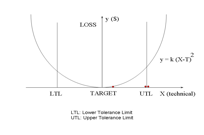
Dr. Genichi Taguchi, a Japanese engineer, theorized (and ultimately proved mathematically) that loss within any process or system develops exponentially–not linearly--as we move away from the ideal customer specification or target value.
An example of Taguchi's Loss Curve is shown below:
Another way to look at it is this: Anything delivered just outside the target, (labeled as LTL and UTL in the diagram above) creates opportunity for exponential financial improvement as we move toward the center of the U-shaped curve. And the farther away from the target we are, the greater the opportunity.
I explain Taguchi's principle using an example from a kaizen event that dramatically improved machine setup times within a CNC shop.
For years, our client assumed it took 46 minutes to set up and change over machinery. After all, for 10 years, it did take 46 minutes. But our kaizen team was hired to challenge this thinking.
If the CEO and his team were right, setup times couldn't be completed any faster. But if setup times could be better, loss had been occurring beneath the water line, which meant the iceberg was growing, but no one knew.
Machine setup time is loss because no value is produced during the setup process. And setup times can represent 35% of the total labor burden, so there's a lot at stake. While employers can compute labor and overhead costs easily, when their assumptions are incorrect about setup times, they're losing big money. But rarely do they know it or how much.
Here's our client’s story:
Our client used people and machinery to produce aircraft parts. Machines were not dedicated to product families or cycle times. In other words, the client could build a Mack Truck or Toyota Corolla on the same machinery. And because setup times were slow, the client built large batches of products. When defects struck, they struck in large quantities, and, financially, it was too late to find causes. The costs were already sunk.
Our client borrowed capital to purchase nine machines, leased the appropriate space to house them and purchased electricity, water, and cutting fluids, as well. Each machine had affiliated tool and dies, and mechanics to service them. In other words, when you own nine machines, you need the gear, people and money required to operate and maintain nine machines. And all of this cost was based on 46-minute setups.
Think about that for a moment.
If the client didn't need nine machines, it wouldn't have had to spend all of that money and for all of those years! And a wrong assumption in setup times could be leading to loss that never appeared on any income statement. What would show would be the known labor, materials, machinery and overhead costs. But what wouldn't show would be what wasn't needed if the team could complete a setup in less than 46 minutes.
After videotaping, collaborating and measuring cycle times on the existing operations and processes, it was evident: The team had ideas that would challenge the 46-minute setups.
After some 5S housekeeping, the team produced a 23-minute setup. One more day of tweaking, and the team got it down to 16. By the last day, the team was consistently producing 10-minute results.
Now let's talk about the impact.
Under the better state, the client could indeed produce parts faster. It also needed far less capital, insurance, labor, gear, electricity, fluids, tooling, floor space, etc. And because our client's customer would now get parts faster, the company would get paid faster.
While banks may not like these facts, clients and employees do. Employees can do their jobs more efficiently, and the company makes more money while borrowing less.
Here's an explanation of the 5S tool the team used to make their setup times faster. This tool–when used properly––not only improves operating efficiency but removes or reduces safety hazards like: tripping, standing, walking, reaching, handling, lifting and searching for lost items.
In addition, the kaizen event itself creates an opportunity for employees to improve their own job conditions and use their curiosity and creativity to solve production-related problems. The event also creates a more engaged employee, one less likely to file future work comp and employment-related claims.
The 5S Process consists of five steps.
Sort the work area out.
Straighten the work area out, putting everything in the right place.
Clean the entire area, scrub floors, create aisle ways with yellow tape, wash walls, paint, etc.
Create standardized, written work processes.
Sustain the process
Using the tools like 5S, I continue to improve my thinking relating to identifying, and managing work comp risks. But during each kaizen event, I also gain perspective about why stakeholders rarely change their ways. What I’ve learned is this: Clients typically need to have one of two conditions met for good change to occur.
They need to have something to motivate them––which often means facing a crisis.
They need to physically see and experience things to believe them.
If you're like me, you probably need proof, too. Here it is: A reduction in setup times from over two and a half hours to just over ten minutes.
What the Lean Assessment Does
The lean assessment helps find improvement opportunities. That’s because assessments study and measure cycle times, customer demand, value-adding and non-value-adding activities. The assessment helps everyone—including the executive team— see how people physically are required to do their work and understand why they are required to do it the way they are.
In the week-long assessment process, we're no longer studying the costs of just safety; we’re studying all of the potential causes that drive productivity and loss away from the nominal value. Safety is not necessarily why we are measuring outcomes. Safety is the benefactor from learning how and why the company adds value, and precisely where it creates loss.
That is the power of good change. And good change comes from the power of lean.
“The best approach is to dig out and eliminate problems where they are assumed not to exist.” – Shigeo Shingo
Get Involved
Our authors are what set Insurance Thought Leadership apart.
Colin Baird provides Kaizen training to improve operational efficiency (lean manufacturing) programs. A speaker as well as a writer, his articles on continuous improvement appear frequently in Chief Executive magazine, CEO.Com, Leadership Excellence and Public Sector Digest.
For those of us wondering what Google plans to do in insurance -- isn't that all of us? -- it's worth looking at the company's Project Sunroof. The project uses exceptionally sophisticated mapping data to determine which homeowners would most benefit from solar panels and, in the process, may provide some insight into how Google is approaching insurance.
To me, there are two key aspects of Project Sunroof. The first is that Google is taking a bottom-up approach that could inform a lot of decisions about insurance (while insurers traditionally go top-down). The second is that Google is being unusually smart about combining layers of information -- some proprietary, some in the public domain; some new, some long-available -- to produce what my frequent co-author Chunka Mui has, with a little help from me, labeled "emergent knowledge." ("Big data" is the term commonly used, but data isn't very interesting, while knowledge is. And the size of the database doesn't matter. What matters is using developments in technology to look in the right places to find the right data to answer the right questions so that revelations emerge.)
Top-down vs. bottom-up
Insurers typically start with pools of risk. They're getting much more sophisticated about subdividing those pools into ever smaller groups, but the thinking is still along the lines of "drivers without moving violations who travel 11,000 to 12,000 miles a year in generally suburban conditions." Insurers will keep getting more and more specific and produce more and smaller pools but are still going from the top down.
Now look at Project Sunroof. Google is modeling the world in three dimensions and using that model to generate information house by house based on totally personalized criteria: on the square footage on the roof that would be available for solar panels, on the amount of cloud cover that is expected to obscure the sun above that house, on the effectiveness of the sunlight that will hit the roof (incorporating calculations based on temperature and on how the angle of the sun changes each day) and on any shade that would be cast on those panels from other structures. Although the article doesn't say so, I assume Google calculates potential savings on solar based on the rates of each local utility. In any case, there are no pools in sight for Google -- unless you want it to tell you about those in the backyards.
That same model of the world could be the basis for a house-by-house, car-by-car, person-by-person approach to insurance for Google. And, if this approach works, Google will gain the sort of information advantage that has proved to be almost impossible to overcome. Even the largest insurers would have a hard time spending the money that Google has to map the U.S. by having cars drive every single street to take pictures and collect data, by making a series of acquisitions of data providers and by employing a small army of people to manually fix errors and update maps -- and Google would still have a years-long head start in developing its model of the world. Microsoft has thrown billions of dollars at search engines, but even Microsoft couldn't overcome the fact that Google's dominant share meant it was always learning and improving faster than Microsoft's Bing. Apple's map services were ridiculed, by comparison with Google's, when Apple launched them in September 2012. Apple is now at least in Google's ballpark on mapping, but no insurer can come close to Apple's resources -- a $646 billion market valuation and $202.8 billion of cash in the bank. That's "billion," with a "b."
Emergent knowledge
Google obviously begins with a huge asset because of its prescient decision years ago to map the entire U.S. and because of the recent work that has made that map 3D. But Google is also taking data wherever it can get it.
I know from some work I did at the Department of Energy in 2010 that national maps of sunlight have been available for years, and they have surely become far more detailed as the interest in solar power has spread, so I assume Google didn't have to generate those maps on its own. Temperature maps are also in the public domain. (Especially high or low temperatures degrade the performance of solar panels.) Those maps will become increasingly granular as they incorporate data from smartphones and other widely used devices that can act as sensors -- temperature will no longer be what the weather station reports from the Detroit airport; temperature will be known house by house. Overhead photos from satellites and, in some cases, drones are widely available, so Google can use those to check square footage of roofs, to see which direction the solar panels would point and so on. Google can collect information on rates from state utility commissions, where utilities have to make regular filings.
It's easy to imagine Google layering similar types of information onto its map of the world for insurance purposes. In response to the federal Data.gov initiative, governments at all levels are making more information available digitally, so Google could incorporate lots of data about where and when accidents occur, where break-ins happen, where and when muggings occur and so on.
Google could incorporate private work that is taking a 3D approach to flood risk (whether your house is three feet higher or lower than the average in a neighborhood can make all the difference) and is being much more discriminating about earthquake risk. Google could add information, from public or private sources, on the age of homes, type of pipes used, appliances, etc. to flesh out its understanding of the risks in homes.
And, of course, Google will have lots of very precise information of its own to add to its model of the world, based on, for instance, what it knows about where your smartphone is and can infer about where you park your car, where and when you drive, etc.
Once you take all this information and map it to such a precise model, there will surely be some non-obvious and highly valuable insights.
WWGD: What Will Google Do?
Looking at Project Sunroof still doesn't say a lot about how Google will attack insurance. Will it just sell increasingly targeted and valuable ads? Will it sell leads? Will it become a broker? Will it do more?
But I think it's safe to say that, whatever Google does, its starting point will the most sophisticated model of the world -- and that model will always be improving.
Get Involved
Our authors are what set Insurance Thought Leadership apart.
Carroll spent 17 years at the Wall Street Journal as an editor and reporter; he was nominated twice for the Pulitzer Prize. He later was a finalist for a National Magazine Award.
Shopping for and eventually purchasing auto insurance is not the most enjoyable experience. It’s difficult because each state varies in terms of which specific types of coverage are required and which are not, i.e. luxury coverage. Even more trying is deciding which type of additional coverage you need. Most auto insurance companies profit from the sheer ignorance of the consumer. If you drive one of the 10 vehicles mentioned below, and you are paying quite a bit more than the upper limits, you have a solid case for changing policies. If you do not drive one of the 10 vehicles and are curious about how much you are paying versus what other auto insurers are willing to charge, compare auto insurance now!
Data is derived from compare.com
Get Involved
Our authors are what set Insurance Thought Leadership apart.
Jaron Clinton is a digital marketing specialist and enjoys spending time in the great Arizona outdoors. He is a graduate from Thunderbird School of Global Management and enjoys traveling, hiking, fishing, camping, and sharing a good laugh with friends.