Download

Job Misery Is a Slow, Steady Killer

Consequences of job misery are weight gain, weakened immune system, loss of sleep, ruined relationships, increased aging and on and on.

George Carlin once said, "Oh, you hate your job? Why didn't you say so? There's a support group for that. It's called everybody, and they meet at the bar."

All Carlinisms aside, job misery is a leading cause of death. That has been studied and reported in Europe over and over. Consequences are weight gain, weakened immune system, loss of sleep, ruined relationships, increased aging and on and on.

If you truly dislike you job, you either need to move on or figure out a way to tolerate it. You owe that to yourself, and your family and friends.


Tom Emerick

Profile picture for user TomEmerick

Tom Emerick

Tom Emerick is president of Emerick Consulting and cofounder of EdisonHealth and Thera Advisors.  Emerick’s years with Wal-Mart Stores, Burger King, British Petroleum and American Fidelity Assurance have provided him with an excellent blend of experience and contacts.

2 Heads Are Better Than 1, Right?

Bringing more people into a decision can help -- or hurt. Groups may not only fail to correct individual biases but may amplify them.

|

Everybody knows that two heads are better than one. We've known it since kindergarten, where we were taught that cooperation, collaboration and teamwork are not just socially desirable behaviors-they also help produce better decisions. And while we all know that two or more people working together are more likely to solve a problem or identify an opportunity better than one person doing it alone, it turns out that's only true sometimes.

Ideally, a group's collective intelligence, its ability to aggregate and interpret information, has the potential to be greater than the sum of the intelligence of the individual group members. In the 4th century B.C., Aristotle, in Book III of his political philosophy treatise Politics, described it this way: "When there are many who contribute to the process of deliberation, each can bring his share of goodness and moral prudence...Some appreciate one part, some another, and all together appreciate all."

But that's not necessarily how it works in all groups, as anyone who has ever served on a committee and witnessed groupthink in action can probably testify.

Groups are as prone to irrational biases as individuals are, and the idea that a group can somehow correct for or cure the individual biases is false, according to Cass Sunstein, Harvard Law School professor and author (with Reid Hastie) of Wiser: Getting Beyond Groupthink to Make Groups Smarter. Interviewed by Sarah Green on the HBR Ideacast in December 2014, Sunstein said that individual biases can lead to mistakes but that "groups are often just as bad as individuals, and sometimes they are even worse."

Biases can get amplified in groups. According to Sunstein, as group members talk with each other "they make themselves more confident and clear-headed in the biases with which they started." The result? Groups can quickly get to a place where they have more confidence and conviction about a position than the individuals within the group do. Groups often lock in on that position and resist contrary information or viewpoints.

Researcher Julie A. Minson, co-author (with Jennifer S. Mueller) of The Cost of Collaboration: Why Joint Decision Making Exacerbates Rejection of Outside Information, agrees, suggesting that people who make decisions by working with others are more confident in those decisions and that the process of making a judgment collaboratively rather than individually contributes to "myopic underweighting of external viewpoints." And even though collaboration can be an expensive, time-consuming process, it is routinely over-utilized in business decision-making simply because many managers believe that if, two heads are better than one, 10 heads must be even better.

Minson disagrees: "Mathematically, you get the biggest bang from the buck going from one decision-maker to two. For each additional person, that benefit drops off in a downward sloping curve."

Of course, group decision-making isn't simply a business challenge--our political and judicial systems rely and depend on groups of people such as elected officials and jurors to deliberate and collaborate and make important decisions. Jack Soll and Richard Larrick, in their Scientific American article You Know More than You Think, observed that while crowds are not always wise, they are more likely to be wise when two principles are followed: "The first principle is that groups should be composed of people with knowledge relevant to a topic. The second principle is that the group needs to hold diverse perspectives and bring different knowledge to bear on a topic."

Cass Sunstein takes it further, saying for a group to operate effectively as a decision-making body (a jury, for instance) it must consist of:

  • A diverse pool of people
  • Who have different life experiences
  • Who are willing to listen to the evidence
  • Who are willing to listen to each other
  • Who act independently
  • Who refuse to be silenced

Does that sound like a typical decision-making group to you? When I heard that description, I immediately thought of Juror 8 (Henry Fonda) in "12 Angry Men"--a principled and courageous character who single-handedly guided his fractious jury to a just verdict. It is much harder for me to imagine our elected officials, or jury pool members, or even the unfortunate folks dragooned into serving on a committee or task force at work, as sharing those same characteristics.

The good news is that two heads are definitely better than one when those heads are equally capable and they communicate freely, at least according to Dr. Bahador Bahrami of the Institute of Cognitive Neuroscience at University College London, author of "Optically Interacting Minds." He observed: "To come to an optimal joint decision, individuals must share information with each other and, importantly, weigh that information by its reliability."

Think of your last group decision. Did the group consist of capable, knowledgeable, eager listeners with diverse viewpoints and life experiences, and a shared commitment to evidence-based decision-making and open communication? Probably not, but sub-optimal group behavior and decisions can occur even in the best of groups. In their Harvard Business Review article "Making Dumb Groups Smarter," Sunstein and Hastie suggest that botched informational signals and reputational pressures are to blame: "Groups err for two main reasons. The first involves informational signals. Naturally enough, people learn from one another; the problem is that groups often go wrong when some members receive incorrect signals from other members. The second involves reputational pressures, which lead people to silence themselves or change their views in order to avoid some penalty-often, merely the disapproval of others. But if those others have special authority or wield power, their disapproval can produce serious personal consequences."

On the topic of "special authority" interfering with optimal decision-making, I recently heard a clever term used to describe a form of influence that is often at work in a decision making group. The HiPPO ("Highest Paid Person's Opinion") effect refers to the unfortunate tendency for lower-paid employees to defer to higher-paid employees in group decision-making situations. Not too surprising, then that the first item on Sunstein and Hastie's list of things to do to make groups wiser is "Silence the Leader."

So exactly how do botched informational signals and reputational pressures lead groups into making poor decisions? Sunstein and Hastie again:

  • Groups do not merely fail to correct the errors of their members; they amplify them.
  • Groups fall victim to cascade effects, as group members follow the statements and actions of those who spoke or acted first.
  • They become polarized, taking up positions more extreme than those they held before deliberations.
  • They focus on what everybody knows already-and thus don't take into account critical information that only one or a few people have.

Next time you are on the verge of convening a roomful of people to make a decision, stop and think about what it takes to position any group to make effective decisions. You might be better off taking Julie Minson's advice, electing to choose just one other person to partner with you to make the decision instead. Seldom Seen Smith, the river guide character in The Monkey Wrench Game by Edward Abbey, was obviously a skeptic when it came to group decision-making, but he may have been on to something when he declared:

"One man alone can be pretty dumb sometimes, but for real bona fide stupidity, there ain't nothin' can beat teamwork."


Dean Harring

Profile picture for user DeanHarring

Dean Harring

Dean K. Harring retired in February 2013 as the executive vice president and chief claims officer at QBE North America in New York. He has more than 40 years experience as a claims senior executive with companies such as Liberty Mutual, Commercial Union, Providence Washington, Zurich North America, GAB Robins and CNA.

Q4 Economic and Investment Outlook

The investment and economic outlook is murky because the long period of low interest rates is painting the Fed into a corner.

|

Although it may not seem like it, in the second quarter of this year the U.S. economy passed into the beginning of its seventh year of expansion. In the 158 years that the National Bureau of Economic Research (the arbiters of "official" U.S. economic cycles) has been keeping records, ours is now the fifth-longest economic cycle, at 75 months. For fun, when did the longest cycles occur, and what circumstances characterized them? Is there anything we can learn from historical perspective about what may lie ahead for the current cycle?

The first cycle longer than the current, by only five months, is the 1938-1945 U.S. economic expansion cycle. Of course, this was the immediate post-Depression recovery cycle. What preceded this cycle, from 1933-1937, was the bulk of FDR's New Deal spending program, a program that certainly rebuilt confidence and paved the way for a U.S. manufacturing boom as war on European and Japanese lands destroyed their respective manufacturing capabilities for a time. More than anything, the war-related destruction of the industrial base of Japan and Europe was the growth accelerant of the post-Depression U.S. economy.

In historically sequential order, the U.S. economy grew for 106 months between 1961 and 1970. What two occurrences surrounded this economic expansion that were unique in the clarity of hindsight? A quick diversion. In 1946, the first bank credit card was issued by the Bank of Brooklyn, called the "Charge-It" card. Much like American Express today, the balance needed to be paid in full monthly. We saw the same thing when the Diners Club Card became popular in the 1950s. But in 1958, both American Express and Bank of America issued credit cards to their customers broadly. We witnessed the beginning of the modern day credit culture in the U.S. economic and financial system. A support to the follow-on 1961-1970 economic expansion? Without question.

Once again in the 1960s, the influence of a major war on the U.S. economy was also apparent. Lyndon Johnson's "guns and butter" program increased federal spending meaningfully, elongating the U.S. expansion of the time.

The remaining two extended historical U.S. economic cycles of magnitude (1982-1990, at 92 months, and 1991-2001, at 120 months) both occurred under the longest bull market cycle for bonds in our lifetime. Of course, a bull market for bonds means interest rates are declining. In November 1982, the 10-year Treasury sported a yield of 10.5%. By November 2001, that number was 4.3%. Declining interest rates from the early 1980s to the present constitute one of the greatest bond bull markets in U.S. history. The "credit cycle" spawned by two decades of continually lower interest rates very much underpinned these elongated growth cycles. The question being, at the generational lows in interest rates that we now see, will this bull run be repeated?

So fast-forward to today. What has been present in the current cycle that is anomalistic? Pretty simple. Never in any U.S. economic cycle has federal debt doubled, but it has in the current cycle. Never before has the Federal Reserve "printed" more than $3.5 trillion and injected it into U.S. financial markets, until the last seven years. Collectively, the U.S. economy and financial markets were treated to more than $11 trillion of additional stimulus, a number that totals more than 70% of current annual U.S. GDP. No wonder the current economic cycle is pushing historical extremes in terms of longevity. But what lies ahead?

As we know, the U.S. Fed has stopped printing money. Maybe not so coincidentally, in recent months macroeconomic indicators have softened noticeably. This is happening across the globe, not just in the U.S. As we look forward, what we believe most important to U.S. economic outcomes is what happens outside of the U.S. proper.

Specifically, China is a key watch point. It is the second-largest economy in the world and is undergoing not only economic slowing, but the very beginning of the free floating of its currency, as we discussed last month. This is causing the relative value of its currency to decline against global currencies. This means China can "buy less" of what the global economy has to sell. For the emerging market countries, China is their largest trading partner. If China slows, they slow. The largest export market for Europe is not the U.S., it's China. As China slows, the Euro economy will feel it. For the U.S., China is also important in being an end market for many companies, crossing industries from Caterpillar to Apple.

In the 2003-2007 cycle, it was the U.S. economy that transmitted weakness to the greater global economy. In the current cycle, it's exactly the opposite. It is weakness from outside the U.S. that is our greatest economic watch point as we move on to the end of the year. You may remember in past editions we have mentioned the Atlanta FED GDP Now model as being quite the good indicator of macroeconomic U.S. tone. For the third quarter, the model recently dropped from 1.7% estimated growth to 0.9%. Why? Weakness in net exports. Is weakness in the non-U.S. global economy the real reason the Fed did not raise interest rates in September?

Interest Rates

As you are fully aware, the Fed again declined to raise interest rates at its meeting last month, making it now 60 Fed meetings in a row since 2009 that the Fed has passed on raising rates. Over the 2009-to-present cycle, the financial markets have responded very positively in post-Fed meeting environments where the Fed has either voted to print money (aka "Quantitative Easing") or voted to keep short-term interest rates near zero. Not this time. Markets swooned with the again seemingly positive news of no rate increases. Very much something completely different in terms of market behavior in the current cycle. Why?

We need to think about the possibility that investors are now seeing the Fed, and really global central bankers, as to a large degree trapped. Trapped in the web of intended and unintended consequences of their actions. As we have argued for the past year, the Fed's greatest single risk is being caught at the zero bound (0% interest rates) when the next U.S./global recession hits. With declining global growth evident as of late, this is a heightened concern, and that specific risk is growing. Is this what the markets are worried about?

It's a very good bet that the Fed is worried about and reacting to the recent economic slowing in China along with Chinese currency weakness relative to the U.S. dollar. Not only are many large U.S. multi-national companies meaningful exporters to China, but a rising dollar relative to the Chinese renminbi is about the last thing these global behemoths want to see. As the dollar rises, all else being equal, it makes U.S. goods "more expensive" in the global marketplace. A poster child for this problem is Caterpillar. Just a few weeks ago, it reported its 33rd straight month of declining world sales. After releasing that report, it announced that 10,000 would be laid off in the next few years.

As we have explained in past writings, if the Fed raises interest rates, it would be the only central bank on Earth to do so. Academically, rising interest rates support a higher currency relative to those countries not raising rates. So the question becomes, if the Fed raises rates will it actually further hurt U.S. economic growth prospects globally by sparking a higher dollar? The folks at Caterpillar may already have the answer.

Finally, we should all be aware that debt burdens globally remain very high. Governments globally have borrowed, and continue to borrow, profusely in the current cycle. U.S. federal debt has more than doubled since 2009, and, again, we will hit yet a U.S. government debt ceiling in December. Do you really think the politicians will actually cap runaway debt growth? We'll answer as soon as we stop laughing. As interest rates ultimately trend up, so will the continuing interest costs of debt-burdened governments globally. The Fed is more than fully aware of this fact.

In conjunction with all of this wonderful news, as we have addressed in prior writings, another pressing issue is the level of dollar-denominated debt that exists outside of the U.S.. As the Fed lowered rates to near zero in 2008, many emerging market countries took advantage of low borrowing costs by borrowing in U.S. dollars. As the dollar now climbs against the respective currencies of these non-dollar entities, their debt burdens grow in absolute terms in tandem with the rise in the dollar. Message being? As the Fed raises rates, it increases the debt burden of all non-U.S. entities that have borrowed in dollars. It is estimated that an additional $7 trillion in new dollar-denominated debt has been borrowed by non-U.S. entities in the last seven years. Fed decisions now affect global borrowers, not just those in the U.S.. So did the Fed pass on raising rates in September out of concern for the U.S. economy, or issues specific to global borrowers and the slowing international economies? For investors, has the Fed introduced a heightened level of uncertainty in their decision-making?

Prior to the recent September Fed meeting, Fed members had been leading investors to believe the process of increasing interest rates in the U.S. was to begin. So in one very real sense, the decision to pass left the investment world confused. Investors covet certainty. Hence a bit of financial market turbulence in the aftermath of the decision. Is the Fed worried about the U.S. economy? The global economy? The impact of a rate decision on relative currency values? Is the Fed worried about the emerging economies and their very high level of dollar-denominated debt? Because Fed members never clearly answer any of these questions, they have now left investors confused and concerned.

What this tells us is that, from a behavioral standpoint, the days of expecting a positive Pavlovian financial market response to the supposedly good news of a U.S. Fed refusing to raise interest rates are over. Keeping rates near zero is no longer good enough to support a positive market sentiment. In contrast, a Fed further refusing to raise interest rates is a concern. Let's face it, there is no easy way out for global central bankers in the aftermath of their unprecedented money printing and interest rate suppression experiment. This, we believe, is exactly what the markets are now trying to discount.

The U.S. Stock Market

We are all fully aware that increased price volatility has characterized the U.S. stock market for the last few months. It should be no surprise as the U.S. equity market had gone close to 4 years without having experienced even a 10% correction, the third-longest period in market history. In one sense, it's simply time, but we believe the key question for equity investors right now is whether the recent noticeable slowing in global economic trajectory ultimately results in recession. Why is this important? According to the playbook of historical experience, stock market corrections that occur in non-recessionary environments tend to be shorter and less violent than corrections that take place within the context of actual economic recession. Corrections in non-recessionary environments have been on average contained to the 10-20% range. Corrective stock price periods associated with recession have been worse, many associated with 30-40% price declines known as bear markets.

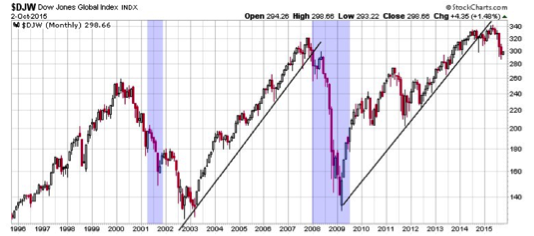
We can see exactly this in the following graph. We are looking at the Dow Jones Global Index. This is a composite of the top 350 companies on planet Earth. If the fortunes of these companies do not represent and reflect the rhythm of the global economy, we do not know what does. The blue bars marked in the chart are the periods covering the last two U.S. recessions, which were accompanied by downturns in major developed economies globally. As we've stated many a time, economies globally are more linked than ever before. We live in an interdependent global world. Let's have a closer look.

If we turn the clock back to late 1997, an emerging markets currency crisis caused a 10%-plus correction in global stock prices but no recession. The markets continued higher after that correction. In late 1998, the blowup at Long Term Capital Management (a hedge fund management firm implosion that caused a $3.6 billion bailout among 16 financial institutions under the supervision of the Fed) really shook the global markets, causing a 20% price correction, but no recession, as the markets continued higher into the early 2000 peak. From the peak of stock prices in early 2000 to the first quarter of 2001, prices corrected just more than 20% but then declined yet another 20% that year as the U.S. did indeed enter recession. The ultimate peak to trough price decline into the 2003 bottom registered 50%, quite the bear market. Again, this correction was accompanied by recession.
graph

The experience from 2003 to early 2008 is similar. We saw 10% corrections in 2004 and 2006, neither of which were accompanied by recession. The markets continued higher after these two corrective interludes. Late 2007 into the first quarter of 2008 witnessed just shy of a 20% correction, but being accompanied by recession meant the peak-to-trough price decline of 2007-2009 totaled considerably more than 50%.

We again see similar activity in the current environment. In 2010, we saw a 10% correction and no recession. In 2011, we experienced a 20% correction. Scary, but no recession meant higher stock prices were to come.

So we now find ourselves at yet another of these corrective junctures, and the key question remains unanswered. Will this corrective period for stock prices be accompanied by recession? We believe this question needs to be answered from the standpoint of the global economy, not the U.S. economy singularly. For now, the jury is out, but we know evidence of economic slowing outside of the U.S. is gathering force.

As you may be aware, another U.S. quarterly earnings reporting season is upon us. Although the earnings results themselves will be important, what will be most meaningful is guidance regarding 2016, as markets look ahead, not backward. We'll especially be interested in what the major multinationals have to say about their respective outlooks, as this will be a key factor in assessing where markets may be moving from here.



Brian Pretti

Profile picture for user BrianPretti

Brian Pretti

Brian Pretti is a partner and chief investment officer at Capital Planning Advisors. He has been an investment management professional for more than three decades. He served as senior vice president and chief investment officer for Mechanics Bank Wealth Management, where he was instrumental in growing assets under management from $150 million to more than $1.4 billion.

Thought Leader in Action: At Walmart

At Walmart, Max Koonce slashed the number of litigation firms he used, carefully picked workers' comp doctors and even set up his own TPA.

|

How do you manage risk when your company is the biggest employer in the U.S. other than the federal government? Very carefully -- and very well, if you're K. Max Koonce II, the senior director of risk management at Walmart, until recently, when he took a senior position at Sedgwick. You do that partly by taking advantage of an extraordinary amount of data to identify potential problems, to use outcomes analysis to greatly shrink the number of litigation firms you use, to be highly selective about doctors used for workers' comp and even to set up a full-sized, in-house third party administrator.

But let's begin at the beginning:

Koonce was born in Mississippi, but his family moved to Bentonville, AR, where he has lived most of his life with his wife and family. He attended Harding University, a private liberal arts university located in Searcy, AR, where he graduated with a BBA in economics. Thinking that economics was not as challenging a career as what he aspired to, Koonce attended the University of Arkansas William Bowen School of Law to obtain his J.D.

He was immediately hired by Walmart upon his graduation in the '90s and was given the responsibility to set up Walmart's internal legal defense system for the roughly 30,000 Walmart employees at the time. He and his in-house team of legal aides handled all of Walmart's workers' comp and ultimately much of its liability claims. The program worked so well that the governor of Arkansas appointed Koonce as an administrative law judge for the state workers' comp commission in 1997, with Walmart's blessing. With Koonce's departure, Walmart eliminated the internal legal program and transferred its litigation to outside legal firms.

koonce K. Max Koonce II

By January 2000, Koonce was appointed by the governor to the Arkansas Court of Appeals. With a vacancy in the State's Supreme Court, Koonce ran for State Supreme Court in a partisan election. During the campaign, he shared fond memories of attending all kinds of civic events, fundraisers and county fairs around the state. When he failed to get elected, Walmart brought him back to head its risk management program that same year. The program grew dramatically with his return.

Apart from the U.S. government, Walmart is the largest employer in North America. Nearly 20 million people shop at Walmart every day, and 90% of the U.S. population lives within 15 minutes of a Walmart. If Walmart were a country, it would be the 26th-largest economy in the world. Walmart manages 11,500 retail units in 28 countries; generates $482 billion in annual sales; and has 2.2 million employees (1.4 million associates in the U.S.). Koonce exclaimed that there was no other retail company to benchmark to, so his risk management department had to make up its own risk benchmarks. Interestingly, with a tightly managed work culture and such huge numbers to work with, Walmart's risk management statistical and actuarial claim calculations have proven to be consistently accurate for many years.

Walmart's risk management department has grown over the years to more than 40 risk management support personnel. Walmart divides its risk portfolio by working with two competing insurance brokers. Koonce said he had an incredibly talented and dedicated team of risk management professionals working at headquarters in Bentonville. "The analytics and metrics achieved by my experts," he said, "were as good as any in the insurance industry." He said that no relevant risk factors in Walmart's operation went unnoticed.

Walmart's workers' comp program is designed to include specific doctors and medical facilities to ensure consistent care of any injured workers. Walmart manages detailed feedback from all of its employees to continue to fine tune its workers' comp program. Koonce stated that risk management has always been a part of the Walmart culture, going back to its founding by Sam Walton in 1962; Walton wanted to help individuals and communities save money while ensuring that the company's operations adhere to ethical decision making, good communication and responsiveness to employees and stakeholder.

Using an "outcomes-based" approach to litigation management, Walmart's team relies on claims data analysis and metrics to choose, evaluate and consolidate the number of workers' comp attorney firms. Max notes: "This approach forms tighter relations with a smaller number of lawyers to create a 'one team' approach to litigation." In California alone, for example, the mega-retailer reduced the number of legal defense firms from more than 20 to three. The outcomes-based litigation strategy relies on a multivariate analysis using Walmart's own claims data. Metrics are used to benchmark attorney performance and align specific lawyers with cases depending on claim facts and knowledge about an attorney's unique skills and experience. At Walmart, claims examiners generally choose specific defense attorneys to maintain a continuing team relationship.

Besides retail store risks, Walmart also manages the largest private trucking firm in the U.S. and delivers more prescriptions than any other retailer. Asked if he had experienced any highly unusual claims during his tenure at Walmart, Koonce said that Walmart is all about awareness, control and consistency and that claims were nearly always within an expected parameter (i.e. slip-and-fall claims) and not horrific, as some employers experience. Each store location, including Sam's Clubs, have conscientious safety response teams that sweep the stores periodically during their shifts and respond immediately to any safety hazards like floor spills.

A unique feature of Walmart is its subsidiary, a third party claims administrator (TPA) called Claims Management Inc. (CMI), at which Koonce served as president. Located in nearby Rogers, AR, CMI administers the casualty claims, including workers' compensation, for all Walmart stores. Although most companies with national operations use insurer claims administrators (for non-self-insured operations), or multiple regional TPAs, Walmart's CMI operation is a sizable TPA of its own with 600 employees. As Koonce explains, "CMI provides the claims oversight the company feels is desirable to maintain good control, communication and consistency."

Unlike most national companies, Walmart has been able to maintain a highly efficient and focused risk management program through a tight-knit organization consisting of mostly local or regional employees who live and work in Benton County, AR (pop. 242, 321). Most of Walmart's managers have been employees who have worked their way up the corporate ladder. Sam Walton once said: "We're all working together; that's the secret."

Koonce left Walmart in September to serve as senior VP of client services for Sedgwick Claims Management Services. He was succeeded by Janice Van Allen, director of risk management at Walmart, who started as a store department manager in 1992. Koonce said he's doing what he loves most at Sedgwick -- helping risk managers achieve success with their internal programs.


Jeff Pettegrew

Profile picture for user JeffPettegrew

Jeff Pettegrew

As a renown workers’ compensation expert and industry thought leader for 40 years, Jeff Pettegrew seeks to promote and improve understanding of the advantages of the unique Texas alternative injury benefit plan through active engagement with industry and news media as well as social media.

How to Manage Claims Across Silos

There is growing interest in taking an integrated approach to casualty claims and benefits programs, breaking down the silos.

The long-minimized and largely untapped synergy between casualty claims and benefit programs may offer opportunities for both industries.

Some argue that these worlds are just too different and distinct to bring together, whether through simple alignment or partial to full integration. Managers are often more comfortable in their own functional areas, and sometimes crossing over can stretch expertise and focus. Fundamentally, however, claims are claims.

There's been a shift in thinking and a growing interest in a more collaborative, aligned and even fully integrated services approach - one that takes many forms but that at its core incorporates a more combined strategy from date of incident through claim closure. The targeted goals for this approach are:

  • Ensuring an appropriate employee experience throughout the life of the claim
  • Targeting and delivering optimal outcomes
  • Minimizing the cost of risk associated with the reasons employees are under medical care or unable to contribute productively to their employer's mission

Shared Goals

On its face, the value of collaboration seems obvious. From both an employee benefits and risk management perspective, providing care for the individual is of the utmost importance. One of the main objectives is ensuring the right outcomes, which includes leveraging the basic skills of investigation, verification, documentation and equitable resolution that are common between these two realms.

The nuances and distinctions that exist between them are not insignificant, but the key goals are the same - caring for people under medically related distress (regardless of source), minimizing disruptions to workforce productivity and closing claims efficiently and effectively with fairness to all parties and their respective goals and objectives.

Although these objectives have varying levels of importance in each field, they are fundamental to process effectiveness in both. This is not to say that there aren't peculiar and unique aspects of each that require certain expertise and skills to achieve specific goals.

However, while blending skill requirements among a common group of claims professionals can be challenging, it is not rocket science. Defining and filling positions to enable successful claims handling in both worlds is eminently doable. The biggest hurdle may in fact be the necessary collaboration between these typically distinct functional areas and their leaders.

Many employers are already effectively managing employee injury and disease exposures. There are discernible trends emerging toward fewer silos and more performance-oriented measurements that are focused on short- and long-term strategies. Those companies taking a more collaborative approach can benefit from key elements such as:

  • Compassionate care that puts employee interests first
  • Integrated reporting and measurement across departments
  • Robust analytics that result in prescriptive actions with impact
  • Innovative tools targeted to specific process opportunity areas
  • A more holistic focus on the care of affected employees
  • The over-arching goal of a healthy, productive workforce

So whether or not you have direct responsibility for both functional areas, I urge you to lead the charge that would leverage this opportunity for the benefit of your organization.


Christopher Mandel

Profile picture for user ChristopherMandel

Christopher Mandel

Christopher E. Mandel is senior vice president of strategic solutions for Sedgwick and director of the Sedgwick Institute. He pioneered the development of integrated risk management at USAA.

A Word With Shefi: Boobier at IBM

IBM's insurance analytics executive says big data can identify correlations that will even help us identify the dreaded "unknown unknowns."

This is part of a series of interviews by Shefi Ben Hutta with insurance practitioners who bring an interesting perspective to their work and to the industry as a whole. Here, she speaks with Tony Boobier, the insurance analytics executive for Europe, the Middle East and Africa at IBM, who says, among other things, that he lies awake nights thinking about cognitive analytics and who believes big data can even help identify "unknown unknowns."

To see more of the "A Word With Shefi" series, visit her thought leader profile. To subscribe to her free newsletter, Insurance Entertainment, click here.

Describe what you do in 50 words or less:

My day job is thinking about insurance analytics on a global basis, especially in the emerging markets. At the moment, I'm spending a lot of time thinking about our business partners, and how they need to transform to become more digital.

You possess a unique combination of qualifications in engineering, insurance and marketing. Do explain:

I originally qualified as a structural engineer but was more interested in why things fell down, which led me to insurance, and my engineering training helped me look at matters including processes forensically. My team collected data in a department nicknamed "The Engine Room," as even then, 15 years ago, we realized that the insights we were getting could "drive" the insurance business forward. Being able to effectively explain and implement change was also a critical success factor, which took me toward marketing, which is the profession of communication. Fortunately, all three UK professional institutions have awarded me fellowships, which is their highest honor.

You've once said, "I lie awake at night thinking about the convergence between insurance and technology." What emerging technology are you most excited about?

It's tricky just to think of one technology, as they are all increasingly converging. The one that most excites me is of course cognitive analytics -- but there are lots of other cool things happening in the disruptive technology space. With insurance being heavily dependent on the topic of location, one of my favorites at the moment is what3words.com -- a company in the location analytics space. I am also particularly interested in behavioral analytics -- why we behave the way we do, and what does it mean for business.

Name a carrier you highly value for its innovative culture:

I'd prefer not to name a single carrier -- but is innovation in insurance such a big deal? It's not like we are astro-geeks discovering a new planet or something. Isn't it as much about looking outside the insurance industry for new ideas and then taking them into our own business world? Our industry is full of innovative individuals who step out of their comfort zones and do new things, and companies that let them. By the way, IE falls into the innovation category, and that's why I've always been a fan.

You've recently published an article on "The Unknowns of the Tianjin Disaster," where you question whether analytics can give insight into the "unknown unknowns." Can big data solve big problems? Or is big data best left for those who need a reminder on how often they should brush their teeth (think: Beam Dental)?

Oh, Shefi, I think you're teasing me! But seriously, overall I think that analytics can reveal "unknown unknowns" by identifying correlations that we hadn't previously detected and that aren't apparent using traditional methods. These correlations will give us new insight, which we hadn't really thought about, and that won't be a bad thing. It will make us think differently about the world and our industry. If our teeth remain healthy as a by-product, well, probably that's not a bad thing either.

When you are not working, you are most likely...

I love the arts, in all its forms, and especially to read, write or just think about writing. Last weekend we saw "Bacharach Revisited," which is a rework of Burt's greatest songbook. Reminded me that even with the rapid changes happening around us, some of the more experienced guys have still got the best tunes if we choose to listen to them. Take time out to read Tom Peters on "Re-Imagine!" -- as fresh as the day it was published in 2003.

You are one of IE's earliest fans. Which other website do you visit to complement your entertaining insurance tidbits?

Like most of us, I'm bombarded with information. We have a very effective internal company insurance community with 12,600 subscribers, which is active and shares all the relevant market news; it's a bit like sharing news across the insurance village. But you know, Shefi, that I only have IE's for you!

Note: Boobier is writing on a personal basis. Opinions are of the interviewee and not of IE.


Shefi Ben Hutta

Profile picture for user ShefiBenHutta

Shefi Ben Hutta

Shefi Ben Hutta is the founder of InsuranceEntertainment.com, a refreshing blog offering insurance news and media that Millennials can relate to. Originally from Israel, she entered the U.S. insurance space in 2007 and since then has gained experience in online rating models.

Beginning of the End for Car Insurance?

sixthings

Volvo's statement last week that it would accept all liability when its cars are in autonomous mode takes the threat to traditional auto insurance to a whole new level. Google and Mercedes have already made similar promises, so we now have three major companies saying they will treat certain car accidents as product liability issues and will take on risk that has historically been the responsibility of individual drivers and auto insurers.

For good measure, Tesla just offered a software download that will let real drivers in real Model S cars operate autonomously on real roads.

The future is upon us.

Obviously, this is just the start. In Churchillian terms, we aren't at the beginning of the end for car insurance, and we aren't even at the end of the beginning; we're at the beginning of the beginning.

For the immediate future, there will be zero effect on auto insurers. Only a small number of drivers will be operating their cars autonomously and only for a portion of their time on the road. Tesla isn't even accepting liability at this point, and auto insurers won't initially even be asked to adjust their rates to reflect the risk that providers of autonomous technology are taking out of the auto policy equation.

thoughtful column by Craig Beattie argues that two significant steps still have to happen before much risk for car accidents moves to the product liability side of the ledger. First, courts must sort out the many issues that will be raised when the first unlucky person dies in an accident where an autonomous vehicle is at fault. Second, he says, autonomous cars must be in operation long enough that lack of maintenance, rather than product design, becomes the issue that has an autonomous car cause an accident. Courts will then have to sort through who bears the responsibility for that lack of maintenance.

Although I agree with the first point, about settling key issues in court, I'm not so sure the second is a huge deal. I think vanishingly few people will own autonomous cars once we get through the hybrid phase that Volvo, Mercedes and Tesla are taking us into now, where people can switch into and out of driverless mode in what are otherwise traditional cars. Today, cars sit idle more than 95% of the time, so it's far more efficient to share cars operated as part of a fleet, rather than pay to have what is usually someone's most expensive asset, or second-most (after a house), just sit there. A study that Chunka Mui and I cited in our book Driverless Cars: Trillions Are Up for Grabs found that a fleet owner could provide cars to people for 90% less than we pay for car transportation now and still make gobs of money. So I believe that fleets, not individuals, will be responsible for maintenance, removing that as an issue that would be in the province of traditional auto insurance.

I also expect the federal government to get involved at some point. If driverless cars can really reduce the number of traffic deaths on U.S. highways (currently roughly 35,000 a year) by tens of thousands and reduce the number injured in accidents (currently about 2.5 million a year) by many hundreds of thousands, then driverless cars create a clear societal good, and their use should be encouraged. Even if the government decided to be revenue-neutral, it could take the money it currently spends through Social Security, Medicare, Medicaid, etc. because of auto accidents and could perhaps cover all the liability for accidents caused by autonomous vehicles -- and have a lot left over, besides.

Politics will rear its ugly head when it comes to deciding what government should do and how quickly it can act, but it's hard to run a campaign in favor of injury and death.

So the issue about traditional auto insurance is much less about if it goes away and much more about when.

"When" is a legitimate question. It takes 15 years or more for the full complement of cars on U.S. roads to be replaced, so you could decide that autonomous-car technology won't really be mature for a few years, then start a clock and count out 15 years to a time when roads will be fully autonomous. That approach takes many people's calculations to 2030 and beyond -- by which time today's C-suite members will be safely retired.

But many autonomous technologies, such as forward collision avoidance systems and automated braking, can be installed as a retrofit -- Autonomoustuff, advised by our friend Guy Fraker, is a notable supplier. And the dynamics of auto accidents and insurance change long before every car becomes autonomous. Many studies say 20% to 25% penetration is plenty to cause major changes.

While I won't venture a precise guess about the fate of car insurance, I'll offer an observation: When Chunka and I wrote about driverless cars 2 1/2 years ago, we staked out what was then an extremely aggressive position about how quickly the transition to autonomous vehicles would happen and about how far the ripples would reach, including for auto insurance -- and we may be turning out to have been too cautious.


Paul Carroll

Profile picture for user PaulCarroll

Paul Carroll

Paul Carroll is the editor-in-chief of Insurance Thought Leadership.

He is also co-author of A Brief History of a Perfect Future: Inventing the Future We Can Proudly Leave Our Kids by 2050 and Billion Dollar Lessons: What You Can Learn From the Most Inexcusable Business Failures of the Last 25 Years and the author of a best-seller on IBM, published in 1993.

Carroll spent 17 years at the Wall Street Journal as an editor and reporter; he was nominated twice for the Pulitzer Prize. He later was a finalist for a National Magazine Award.

Beginning of the End for Car Insurance?

A statement by Volvo -- following actions by Google, Mercedes and now Tesla -- means that the future of car insurance is upon us.

|

Volvo's statement last week that it would accept all liability when its cars are in autonomous mode takes the threat to traditional auto insurance to a whole new level. Google and Mercedes have already made similar promises, so we now have three major companies saying they will treat certain car accidents as product liability issues and will take on risk that has historically been the responsibility of individual drivers and auto insurers.

For good measure, Tesla just offered a software download that will let real drivers in real Model S cars operate autonomously on real roads.

The future is upon us.

Obviously, this is just the start. In Churchillian terms, we aren't at the beginning of the end for car insurance, and we aren't even at the end of the beginning; we're at the beginning of the beginning.

For the immediate future, there will be zero effect on auto insurers. Only a small number of drivers will be operating their cars autonomously and only for a portion of their time on the road. Tesla isn't even accepting liability at this point, and auto insurers won't initially even be asked to adjust their rates to reflect the risk that providers of autonomous technology are taking out of the auto policy equation.

A thoughtful column by Craig Beattie argues that two significant steps still have to happen before much risk for car accidents moves to the product liability side of the ledger. First, courts must sort out the many issues that will be raised when the first unlucky person dies in an accident where an autonomous vehicle is at fault. Second, he says, autonomous cars must be in operation long enough that lack of maintenance, rather than product design, becomes the issue that has an autonomous car cause an accident. Courts will then have to sort through who bears the responsibility for that lack of maintenance.

Although I agree with the first point, about settling key issues in court, I'm not so sure the second is a huge deal. I think vanishingly few people will own autonomous cars once we get through the hybrid phase that Volvo, Mercedes and Tesla are taking us into now, where people can switch into and out of driverless mode in what are otherwise traditional cars. Today, cars sit idle more than 95% of the time, so it's far more efficient to share cars operated as part of a fleet, rather than pay to have what is usually someone's most expensive asset, or second-most (after a house), just sit there. A study that Chunka Mui and I cited in our book Driverless Cars: Trillions Are Up for Grabs found that a fleet owner could provide cars to people for 90% less than we pay for car transportation now and still make gobs of money. So I believe that fleets, not individuals, will be responsible for maintenance, removing that as an issue that would be in the province of traditional auto insurance.

I also expect the federal government to get involved at some point. If driverless cars can really reduce the number of traffic deaths on U.S. highways (currently roughly 35,000 a year) by tens of thousands and reduce the number injured in accidents (currently about 2.5 million a year) by many hundreds of thousands, then driverless cars create a clear societal good, and their use should be encouraged. Even if the government decided to be revenue-neutral, it could take the money it currently spends through Social Security, Medicare, Medicaid, etc. because of auto accidents and could perhaps cover all the liability for accidents caused by autonomous vehicles -- and have a lot left over, besides.

Politics will rear its ugly head when it comes to deciding what government should do and how quickly it can act, but it's hard to run a campaign in favor of injury and death.

So the issue about traditional auto insurance is much less about if it goes away and much more about when.

"When" is a legitimate question. It takes 15 years or more for the full complement of cars on U.S. roads to be replaced, so you could decide that autonomous-car technology won't really be mature for a few years, then start a clock and count out 15 years to a time when roads will be fully autonomous. That approach takes many people's calculations to 2030 and beyond -- by which time today's C-suite members will be safely retired.

But many autonomous technologies, such as forward collision avoidance systems and automated braking, can be installed as a retrofit -- Autonomoustuff, advised by our friend Guy Fraker, is a notable supplier. And the dynamics of auto accidents and insurance change long before every car becomes autonomous. Many studies say 20% to 25% penetration is plenty to cause major changes.

While I won't venture a precise guess about the fate of car insurance, I'll offer an observation: When Chunka and I wrote about driverless cars 2 1/2 years ago, we staked out what was then an extremely aggressive position about how quickly the transition to autonomous vehicles would happen and about how far the ripples would reach, including for auto insurance -- and we may be turning out to have been too cautious.


Paul Carroll

Profile picture for user PaulCarroll

Paul Carroll

Paul Carroll is the editor-in-chief of Insurance Thought Leadership.

He is also co-author of A Brief History of a Perfect Future: Inventing the Future We Can Proudly Leave Our Kids by 2050 and Billion Dollar Lessons: What You Can Learn From the Most Inexcusable Business Failures of the Last 25 Years and the author of a best-seller on IBM, published in 1993.

Carroll spent 17 years at the Wall Street Journal as an editor and reporter; he was nominated twice for the Pulitzer Prize. He later was a finalist for a National Magazine Award.

How to Reengage a Disengaged Spouse

In succession planning for a family-owned business, a spouse is often disengaged and feels disenfranchised. Here is the answer.

My partners and I spend a lot of time writing about how difficult it is to be a family successor to-be or child working for a parent. We also have many articles detailing how business owners can communicate more effectively with employed family members so they can have positive working relationships while protecting their familial relationships. We've explained how important it is to establish boundaries so that work issues stay at the office to provide quality family time at home.

What we haven't spent enough time on is recognizing how tough it is to be the spouse of an ambitious, successful and highly driven business owner. Typically, although not always, these roles are cast stereotypically, with the husband running the business while the wife holds their personal lives steady raising the children and managing the household. For the sake of simplicity, we'll talk in terms of the stereotype, but the description works with the gender roles reversed.

The women are dynamic, intelligent, educated, assertive people - many left rewarding careers to care for their families so their husbands could fully concentrate on building a substantial family business. They have typically not been included in much of the financial and business-related decision making because they were not actively involved in the business. When families are young, this makes a lot of sense as each spouse is fulfilling a necessary role to provide and care for a growing family and business. The wife protects her husband from family distractions and worries so he can concentrate on building a business legacy and their financial security. The husband protects his wife from the day-to-day business challenges, makes sure there is enough money to run the household and generally learns it is easiest not to burden her with worrisome details of how he manages the business checkbook. However, when it comes to making the critical decisions that will provide for the financial stability of your children's future and your financial security, you can bet it is important for both spouses to be involved and participate in the discussion if you want to maintain family harmony and have a smooth transition for the next generation.

The Disenfranchised Spouse

By the time we are engaged to develop and implement a business succession and estate plan, the business owner's children are usually grown, working in the business and building their own families and the wife/mom is busy being a grandparent, participating in all kinds of civic/community/church activities and planning their next vacation trip. The husband/dad is still running the business and making all of the financial and business decisions.

On the surface, the couple is solid, dedicated to supporting each other, and wants to provide for each other in their declining years. But deep down, there is usually a woman who feels disenfranchised and fairly clueless as to how the business will provide for her personal financial security in the event she outlives her husband. When advisers bring documents for her signature, this is her one time to be able to voice her opinion, take a stand and even hold up progress if she feels uncomfortable with any aspect of the process. She is told not to worry, that she will be provided for - but how and who will she have to turn to after he's gone? Her children? The managers? The family attorney? Not likely.

We have seen women known to be gentle, supportive and trusting change when it comes to protecting her financial security and whether she will have to rely on someone else running the business or get her monthly allowance from her children or, even worse, a banker.

me

Re-Engaging Your Spouse

If you haven't both been involved with your estate and succession planning team, it is likely you may be experiencing some challenges -- perhaps your progress has even come to a standstill, and there may need to be some discussion on this topic before you can proceed any further. What are some of the key factors to make sure that when you are ready to begin your estate or succession planning that you will be comfortable with the people and decisions that must be made? Here are some helpful tips to keep in mind:

  • Never think that protecting your spouse from the truth is being helpful. It indicates you don't think she will understand, that she will overreact or that she is weak. None of these assumptions demonstrate an appreciation for her inner strength, intelligence and sensitivity to your concerns. Additionally, it prevents your closest, most trusted ally from being able to be part of the solution.
  • Make sure your spouse knows and appreciates the key players you depend on each day to run and care for the business. If all she ever hears is your grumbling about a family employee's ineptitude, it is highly likely that she will not feel very good about that successor's ability to manage the business in your absence. The same goes for complaints about any other manager or adviser who is critical to your business stability.
  • When putting together your adviser team (estate attorney, accountant, succession planner), make sure you do the choosing and subsequent meetings together. Interview prospective members of this team together -- you both need to feel comfortable with people who are going to help secure your family's legacy and financial future. There is nothing worse than a business owner who says his spouse doesn't need to be included in the discussions because she isn't involved in business operations. It is amazing what kind of insight we get from spouses -- about family, employees and managers, and about how their husbands are being affected.
  • Just because your spouse is not an active employee in the business does not mean she is not your partner in every sense of the word. Every decision you make, every success or failure you experience, is shared by your spouse. When you are stressed, so is she; when you celebrate success, so does she. Why then, wouldn't you consider involving her in decisions that will ultimately affect her, too? You don't need to discuss every operational decision made each day, but it is important to share the strategically important ones that will affect her future, too.

When you reach an agreement that you have the right people facilitating your family's future, certain that you will each will have equal input, be respected and listened to, you will have increased your odds for achieving succession success!


Ricci Victorio

Profile picture for user RicciVictorio

Ricci Victorio

Ricci M. Victorio is the managing partner of the Mosaic Family Business Center. Victorio is a certified succession planner and co-active coach for individuals, family businesses and management teams. She has been providing communication enhancement, leadership and teamwork training programs to Fortune 500 companies across the country since 1984.

8 Opportunities Created

Usage-based insurance (UBI) lets insurers more precisely predict risks, sharpen pricing strategies and provide better value to policyholders.

With competition tightening, insurers are motivated to find ways to more precisely predict risks, sharpen pricing strategies and provide better value to their policyholders. Usage-based insurance (UBI) offers a promising approach. Data obtained from real-world deployments and proof points from industry surveys indicate that the benefits of well-designed UBI programs can justify the investment.

The expansion of UBI programs around the world is proof that insurers are increasingly recognizing that UBI programs can transform business models by delivering both revenue-generating opportunities and cost-saving opportunities by:

  1. Acquiring low-risk drivers: Insurers starting UBI programs often target low-risk drivers first. These drivers welcome the opportunity to demonstrate their safe-driving practices and benefit from lowered premiums.
  1. Increasing customer retention: To combat steep attrition common in the insurance industry, insurers can capitalize on the investment that drivers have made in a UBI program. After demonstrating safe vehicle operation for a period of time and obtaining lower rates, these drivers are less likely to go to another insurer.
  1. Offering personalized, value-added services to customers: Telematics data collection gives insurers a window into driver habits and behavior, providing opportunities for unique, innovative, value-added services.
  1. Reducing the frequency and magnitude of claims: By helping improve driver behavior and awareness, telematics can cut the frequency and magnitude of claims significantly.
  1. Improving accident reconstruction: Data collected using telematics devices can help paint a picture of the conditions and events whenever a driver is involved in an accident. Factors such as location, speed, G-forces and weather can help fill in details that the driver or witnesses may not recall.
  1. Encouraging better driver behavior: Statistical evidence supports the argument that drivers perform better when enrolled in a UBI program, with the understanding that their driving performance is being analyzed for safe driving practices.
  1. Reducing claims processing costs and fulfilling claims promptly: Analytics in support of a UBI program can distinguish between claims that should be processed directly and those that require deeper investigation. By identifying the claims that need not be challenged, carriers can reduce the costs of claims processing and improve efficiency.
  1. Increasing client engagement: Insurers can successfully enhance driver behavior, as has been indicated by a number of surveys, by providing prompt feedback, rewarding safe practices, acknowledging improvements and, in some cases, creating games to let a driver immediately see recommended practices in action, with scores that help reinforce good, safe driving.

As a vehicle for enhancing revenues, reducing costs and nurturing a steadily growing customer base, UBI counters prevailing trends that show increasing customer dissatisfaction with their insurance companies. UBI provides a number of ways to improve the overall customer experience and to expand communication with customers. Accurate telematics data can reduce the frequency and the magnitude of claims, as well as speed up the settlement process, all of which results in cost savings for insurers. Structuring insurance programs around distinct customer personas, behaviors and preferences is a proven path toward building a long-term relationship and boosting customer satisfaction.

We recommend that, before contemplating a UBI program, insurers should be clear about objectives and adopt a strategy well-suited to long-range corporate plans. UBI programs can be effectively mapped to the individual market objectives and mission of each carrier by choosing the segments, product features and data-collection technologies appropriate to each company's long-term strategy.

For more information, download IMS' free white paper on Building a Business Case for UBI.


Brian Halk

Profile picture for user BrianHalk

Brian Halk

Brian Halk is an experienced global marketing and communications leader with significant experience in the high-technology sector with major brands in North America. At Intelligent Mechatronic Systems (IMS), Halk leads all marketing and communication efforts.