Download

Is It Time to End Annual Physicals?

Annual physicals, long taken on faith as valuable, can generate false positives that lead to unnecessary and dangerous treatment.

A good story with the headline, "Do Annual Physicals Do More Harm Than Good?", was posted recently on CCN, written by Nadia Kounang. Click here to read the full article.

This is not a new question about annual physicals. Leading physicians have been asking this question for decades. Yet the public and professional wellness vendors persist in having blind and uninformed faith in what is an expensive and potentially harmful ritual.

Dr. Ateev Mehrotra, an associate professor of healthcare policy and medicine at Harvard Medical School, says, "This specialized visit hasn't proven anything in terms of staying healthful."

He further says annual physicals "...make sense in theory, but it hasn't borne out in reality."

According to the story, "More doctors are saying the annual physical is unnecessary - and can even be harmful."

Personally, in my career running benefit plans for large corporations, I've seen first-hand numerous people seriously harmed by annual physicals, through false positives on unneeded tests that resulted in medical harm to employees. Plus, such false positives cause stunning and unnecessary anxiety, as in "we-said-you-had-cancer-but-oops-my-bad."

This is a good time to take a hard look at this ritual and consider if precious health dollars could be used better elsewhere.

If your wellness vendor is recommending annual physicals for your employees, you should drop that vendor ASAP. Period.


Tom Emerick

Profile picture for user TomEmerick

Tom Emerick

Tom Emerick is president of Emerick Consulting and cofounder of EdisonHealth and Thera Advisors.  Emerick’s years with Wal-Mart Stores, Burger King, British Petroleum and American Fidelity Assurance have provided him with an excellent blend of experience and contacts.

New Wellness Scam: Value on Investment

Now that claims of ROI by wellness vendors have been thoroughly discredited, are they going away? Nope, just inventing a new metric.

|

What do you do if your entire industry has a negative ROI? If your industry and its lack of ROI have been skewered in the media? If even RAND, which is the most neutral, grownup organization in all of healthcare, now says your industry, wellness, produces no savings and no reduction in utilization of healthcare services? If your leadership group accidentally proved their own industry loses money for its customers? If, on this very site, Insurance Thought Leadership, your patron saint, Harvard professor Katherine Baicker, professes to have no interest in wellness any more, now that her work has been eviscerated?

What do you do if there is a proof that saving through wellness is impossible, and another proof that, even if savings were possible, there haven't been any? If these proofs are backed with a $1 million reward for anyone who can disprove them?

Here’s what you do: You change the rules so ROI doesn’t matter any more.

The new mantra is "value on investment," or VOI. The Willis Health and Productivity Survey published this week claims that 64% of employers do wellness for VOI - specifically, "employee morale" and "worksite productivity." (The survey also mentions "workplace safety." I guess the workplace is safer if no one is working because they are all out getting checkups.)

But the darnedest thing is, all the data shows that the best way to really get value on your investment is to cancel your "pry, poke, prod and punish" wellness program.

Employee Morale

Have you ever seen employees demand more blood tests? More Health Risk Assessments (HRAs)? More weigh-ins? Quite the opposite. This shouldn't be a newsflash, but employees hate wellness programs, except for the part where they get to collect employers' money. As a CEO myself (of Quizzify), I pride myself on our corporate culture. The last thing I would do is force my employees into a wellness program. It would destroy the camaraderie we've established.

Obviously, if employees liked wellness, you wouldn't need large and growing incentives/penalties to get people to participate. Employees dislike wellness programs so much that collectively they've forfeited billions of dollars just to avoid these programs.

Anecdotes often speak more loudly than data, and employee morale anecdotes are easy to come by. Simply look at the "comments" on quite literally any article in the lay media involving wellness programs. It's usually about 10-to-1 against wellness, with the "1" being someone who says: "Why should I pay for someone who's fat?" or something similar. Or the positive comment comes from a wellness vendor or consultant. You know an industry is bogus when the only people who defend it are people who profit on it.

The weight-shaming involved in wellness programs is, of course, a huge fallacy. Among other things, except at both extremes, there is only a slight correlation between weight and health expense in the under-65 population -- the problems associated with weight show up later, typically after people leave the workforce. Assuming major differences among employees would lead to underwriting every individual-marathoners who might get injured, women who might get pregnant, etc. Take the fallacy out, and there is nothing that the American public-left, right and center - is more unified on than detesting wellness.

Workplace Productivity

You're already pulling people off the line to do the "pry, poke and prod" programs and send them for checkups that are more likely to harm employees than benefit them. So productivity takes a hit to begin with. Add to that the weight-shaming and ineffectiveness of corporate weight-loss programs.

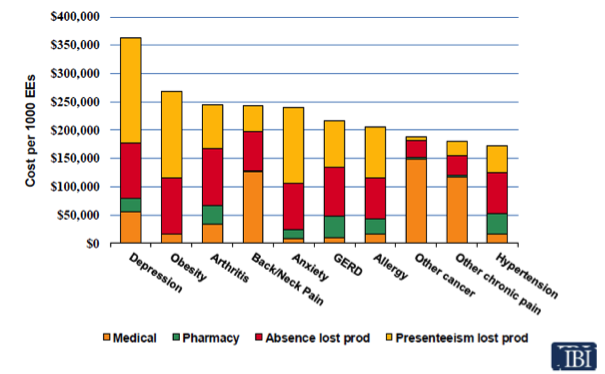
Most importantly, it turns out - according to the Integrated Benefits Institute, a wellness industry association - that the major contributor to low productivity is depression:
chart

Maybe this is just me, but if I were running a company where workers were depressed, I probably wouldn't try to address depression by implementing a program that workers were going to hate, which is sort of a "the beatings will continue until morale improves" approach to management. I'm just sayin'...

The other noteworthy observation? Anxiety has a big impact on productivity. Wellness programs pride themselves on how many diseases they find. This practice is called hyperdiagnosis. The goal is to scare as many employees as possible into thinking they're sick. The C. Everett Koop-award-winning Nebraska state wellness program, for example, bragged about how it found that 40% of employees were at risk. However, the program didn't do anything about the finding, and a year later only 161 employees in the entire state had reduced a risk factor. The vendor, Health Fitness Corporation, also bragged about all the cancer cases it found and all the lives it saved, until admitting the whole thing was made up.

Once again, it's not clear how a wellness program would reduce anxiety and increase productivity. Or maybe I'm wrong. Maybe there's nothing like being told you are at risk of dying to really focus you on clearing your inbox before you croak.

Conclusion

Pretending there is a VOI looks to be even sillier than pretending there is an ROI, because wellness neither increases morale nor improves productivity.

All of this brings us back to what we've been saying for years-especially on this site, which was willing to post our stuff long before it was popular to do so: Do wellness for your employees and not to them.

The latter doesn't work no matter what initials you use. But if you want to improve morale and productivity, up your game for perks, subsidize healthier options for food and maybe even directly subsidize a portion of gym memberships. And maybe teach your employees how to spend their healthcare dollars more wisely. (Disclosure: That is the business we are in.)


What do you do if your entire industry has a negative ROI? If your industry and its lack of ROI have been skewered in the media? If even RAND, which is the most neutral, grownup organization in all of healthcare, now says your industry, wellness, produces no savings and no reduction in utilization of healthcare services? If your leadership group accidentally proved their own industry loses money for its customers? If, on this very site, Insurance Thought Leadership, your patron saint, Harvard professor Katherine Baicker, professes to have no interest in wellness any more, now that her work has been eviscerated?

What do you do if there is a proof that saving through wellness is impossible, and another proof that, even if savings were possible, there haven't been any? If these proofs are backed with a $1 million reward for anyone who can disprove them?

Here's what you do: You change the rules so ROI doesn't matter any more.

The new mantra is "value on investment," or VOI. The Willis Health and Productivity Survey published this week claims that 64% of employers do wellness for VOI - specifically, "employee morale" and "worksite productivity." (The survey also mentions "workplace safety." I guess the workplace is safer if no one is working because they are all out getting checkups.)

But the darnedest thing is, all the data shows that the best way to really get value on your investment is to cancel your "pry, poke, prod and punish" wellness program.

Employee Morale

Have you ever seen employees demand more blood tests? More Health Risk Assessments (HRAs)? More weigh-ins? Quite the opposite. This shouldn't be a newsflash, but employees hate wellness programs, except for the part where they get to collect employers' money. As a CEO myself (of Quizzify), I pride myself on our corporate culture. The last thing I would do is force my employees into a wellness program. It would destroy the camaraderie we've established.

Obviously, if employees liked wellness, you wouldn't need large and growing incentives/penalties to get people to participate. Employees dislike wellness programs so much that collectively they've forfeited billions of dollars just to avoid these programs.

Anecdotes often speak more loudly than data, and employee morale anecdotes are easy to come by. Simply look at the "comments" on quite literally any article in the lay media involving wellness programs. It's usually about 10-to-1 against wellness, with the "1" being someone who says: "Why should I pay for someone who's fat?" or something similar. Or the positive comment comes from a wellness vendor or consultant. You know an industry is bogus when the only people who defend it are people who profit on it.

The weight-shaming involved in wellness programs is, of course, a huge fallacy. Among other things, except at both extremes, there is only a slight correlation between weight and health expense in the under-65 population -- the problems associated with weight show up later, typically after people leave the workforce. Assuming major differences among employees would lead to underwriting every individual-marathoners who might get injured, women who might get pregnant, etc. Take the fallacy out, and there is nothing that the American public-left, right and center - is more unified on than detesting wellness.

Workplace Productivity

You're already pulling people off the line to do the "pry, poke and prod" programs and send them for checkups that are more likely to harm employees than benefit them. So productivity takes a hit to begin with. Add to that the weight-shaming and ineffectiveness of corporate weight-loss programs.

Most importantly, it turns out - according to the Integrated Benefits Institute, a wellness industry association - that the major contributor to low productivity is depression:

chart

Maybe this is just me, but if I were running a company where workers were depressed, I probably wouldn't try to address depression by implementing a program that workers were going to hate, which is sort of a "the beatings will continue until morale improves" approach to management. I'm just sayin'...

The other noteworthy observation? Anxiety has a big impact on productivity. Wellness programs pride themselves on how many diseases they find. This practice is called hyperdiagnosis. The goal is to scare as many employees as possible into thinking they're sick. The C. Everett Koop-award-winning Nebraska state wellness program, for example, bragged about how it found that 40% of employees were at risk. However, the program didn't do anything about the finding, and a year later only 161 employees in the entire state had reduced a risk factor. The vendor, Health Fitness Corporation, also bragged about all the cancer cases it found and all the lives it saved, until admitting the whole thing was made up.

Once again, it's not clear how a wellness program would reduce anxiety and increase productivity. Or maybe I'm wrong. Maybe there's nothing like being told you are at risk of dying to really focus you on clearing your inbox before you croak.

Conclusion

Pretending there is a VOI looks to be even sillier than pretending there is an ROI, because wellness neither increases morale nor improves productivity.

All of this brings us back to what we've been saying for years-especially on this site, which was willing to post our stuff long before it was popular to do so: Do wellness for your employees and not to them.

The latter doesn't work no matter what initials you use. But if you want to improve morale and productivity, up your game for perks, subsidize healthier options for food and maybe even directly subsidize a portion of gym memberships. And maybe teach your employees how to spend their healthcare dollars more wisely. (Disclosure: That is the business we are in.)

Failing ACA Co-Ops? Not a Surprise

The math always wins: Under the ACA, health co-ops only should have been set up in areas where they were the only source of care.

During the congressional deliberations that led to the Patient Protection and Affordable Care Act, strong support emerged for a government-run health plan to compete with private carriers. The "public option" failed but did create political space for the concept of consumer-owned, non-profit, health insurance co-operatives. The co-ops found their way into the ACA, but now, as a group, are in big trouble. Eight of the nation's 23 health co-ops are going out of business, and more may follow.

The Case for Health Co-ops Then-Sen. Kent Conrad championed health co-operatives during the healthcare reform debate. He saw them as health plans owned by local residents and businesses, modeled after the electrical co-ops in his home state of North Dakota. They would receive start-up money from the federal government but otherwise would compete against private carriers on a level playing field.

Co-op advocates hoped they would bring competition to markets dominated by too-few private carriers. Advocates also expected these non-profits to provide individual consumers and small businesses additional affordable health insurance choices. With focus on the first goal, health co-ops might be in a better place today. Unfortunately, too often they sprung up in states where competition was already strong.

The ACA set up a roughly $6 billion fund to help get "consumer-operated and -oriented plans" up and running. The long-term financial viability of health co-ops was to flow from premiums paid by those they insured and the "Three Rs"-programs established by the ACA "to assist insurers through the transition period, and to create a stable, competitive and fair market for health insurance." Specifically these were the ACA's reinsurance, risk adjustment and risk corridor programs.

It's Tough Being New

A (not so) funny thing happened on the way to the health co-ops' solvency. Starting a health insurance plan is difficult and failure always an option. (I know. I was executive vice president at start-up SeeChange Health, an insurer that failed last year.) New carriers, by definition, have no track record and no data concerning pricing, provider reimbursements, claim trends and the like. The first foray into the market is an educated guess. Worse, new plans usually have a small membership base. This provides little cushion against the impact of miscalculations or unwelcome surprises.

A new health plan launching in the midst of the industry's transition to a post-ACA world faced exponentially greater difficulties. In 2013, when most of the health co-ops launched, no one knew what the market would look like in 2014. Exchanges, metallic plan requirements, guarantee issue of individual coverage and more were all happening at once. Were employers going to stop offering coverage? How were competitors going to price their offerings? Would provider networks be broad or narrow? The questions were endless; the answers at the time scarce. In a speech during the lead-up to 2014, I described the situation as carriers "playing chicken on tractors without headlights in a dark cave while blindfolded -- at night."

This is the world into which ACA-seeded health co-ops were born. That they now face serious financial problems should surprise no one. They saw themselves as "low-cost alternatives" in their markets. If they were going to err in setting prices, it was not going to be by setting premiums too high.

Besides, if they priced too low, they were protected by the risk corridor program. As described by the Centers for Medicare & Medicaid Services, which manages the ACA's financial safety net, the "risk corridors program provides payments to insurance companies depending on how closely the premiums they charge cover their consumers' medical costs. Issuers whose premiums exceed claims and other costs by more than a certain amount pay into the program, and insurers whose claims exceed premiums by a certain amount receive payments for their shortfall."

The majority of the nation's health co-operatives saw claims exceeding premiums. With the co-ops on the "shortfall" side of the equation, the government was to come to their rescue like the proverbial cavalry with the money needed to keep them going.

Except the cavalry is a no-show. Too few carriers had too little claims surplus to cover the too large losses of too many health plans. Only 12.6 cents on the dollar due under the risk corridor program is expected to make it to plans on the shortfall side of the equation, the Centers for Medicare and Medicaid Services (CMS) announced on Oct. 1.

The Math Always Wins

Several of the health co-ops were in financial trouble before this news. Losing millions of dollars in expected relief doomed more. As of today, the dollars-and-cents have failed to add up for CoOportunity Health (the co-op in Iowa and Nebraska), the Kentucky Health Cooperative (which also served West Virginians), Louisiana Health Cooperative, Health Republic Insurance of New York, Health Republic Insurance of Oregon, the Nevada Health CO-OP, Community Health Alliance (a Tennessee co-op) and the Colorado HealthOP. Just to use the Colorado situation as an example, the Colorado HealthOp needed $16.2 million; it expects to receive $2 million.

Do these failures mean health insurance co-ops are a bad idea? Not necessarily. What they point to is that health co-ops may have been better off focusing on bringing competition to markets where there were too few plans, not joining a pack where there were enough. Even then, the collapse of the risk corridor program may have doomed them, but they'd have stood a better chance.

As noted above, Sen. Conrad modeled the health co-operatives on electrical co-ops found in some rural communities. Where too few customers make it unprofitable for traditional utilities to invest in the infrastructure required, consumers, seeking electricity, not profits, come together to extend the grid.

Those implementing the ACA should have followed this model. Instead of funding 23 health co-operatives, the administration should have offered seed money to fewer co-ops located where they would be the alternative in the market, not just another one. This may have allowed them to extend financial support long enough to at least partially offset the risk corridor shortfall. Then, just maybe, we could have avoided the "surprise" of failing health co-ops.


Alan Katz

Profile picture for user AlanKatz

Alan Katz

Alan Katz speaks and writes nationally on healthcare reform, technology, sales and business planning. He is author of the award-winning Alan Katz Blog and of <em>Trailblazed: Proven Paths to Sales Success</em>.

It's Time to Toss 'Rank and Yank'

Annual employee rating systems, often known as "rank and yank," don't solve problems; the systems make it hard to develop employees.

When executives don't perform well, sometimes they're fired. But when the company's merit rating system doesn't improve employees, do you fire it, too?

If you're Accenture CEO Pierre Nanterme, you do. That's right, he fired 'rank and yank.'

There will be no more annual performance reviews at Accenture -- a decision that employees wholeheartedly support, according to their responses on Facebook, and the Washington Post, whicho broke the story.

This wasn't the first time in recent memory that rank and yank was given the boot.

Earlier this year, GE and Deloitte largely eliminated their annual review processes, too. They followed Adobe, which blazed the way in March 2012.

If the unintended consequences of annual performance reviews haven't yet hurt your business, consider yourself fortunate. But if your organization is one of the millions of businesses that have not fundamentally improved people -- effectively making employees worse off today than they were when they first came to work for you -- you owe it to yourself and your employees to rethink how you reward and improve people.

The Unintended Consequences

Dr. W. Edwards Deming first suggested eliminating the annual performance review 50 years ago. Deming called it "a disease that annihilated long-term planning, demolished teamwork, left people crushed, bruised and despondent and unable to comprehend why they were inferior."

Today, with fewer than 40% of employees feeling as though they matter at work, is there much data from which to disagree?

Probably not.

While Deming's comments certainly weren't popular with mainstream American leadership, they have resonated loudly with millions of employees.

One thing Deming frequently talked about is systems thinking and how it relates to rank and yank and improving people and their productivity.

Output Equals Input

A Formula One race car running at peak performance maximizes the engine and transmission to generate both horsepower and torque as it speeds along the track. But other components of the system also contribute greatly to the race car's success or demise.

For example, the conditions of the track can vary based on the weather. Heat, cold, humidity, wind and other climatic conditions all affect racing, creating the need for differing types of tire compounds and race car setup. The speed at which a team can change tires also goes into the mix.

So which element is most likely to propel the car to victory?

All of them. None of them stands alone. This is precisely the point behind systems thinking. The sum of the parts is far more important than individual components.

A System of Profound Knowledge (SOPK)

In Deming's System of Profound Knowledge, he promoted the idea that a system of production had four key elements that were necessary to improve and transform an organization.

  1. Appreciation of a system
  2. Knowledge of variation
  3. Theory of knowledge
  4. Psychology

All four elements needed to be thoroughly understood by leadership to materially improve production rates, create greater operating efficiencies and, most importantly, improve people on a continuum.

The Element Of Psychology: Destroying the Entire Herd

The original thinking behind the merit rating system was that ranking employees -- one against another -- would bring the cream to the top, and separate the butterfat from the buttermilk. But the system as we know it has not only spoiled the milk but destroyed the herd used to produce it.

In addition, the merit rating system does little to improve a system's performance. While a handful of employees might "feel" able to produce more goods and services for a few days following favorable performance reviews, the fact is, over the long haul, this isn't true.

The Element of Variation and a Bunch of Red Beads

In his famed red bead experiment, Deming destroyed the fallacy that different people, doing the same thing over and over again in a standardized production process, would yield markedly different results. And the variation in output was predictable to near certainty.

During Deming's experiments, he first established a standardized process. Employees would use the exact same machinery, methods and materials to perform his experiment. The only difference was the person performing the process. Deming, in fact, often used company executives to be production workers for a day.

The goal was to make white beads, of the highest quality and at the fastest rate.

So, pay for performance, maximize output, separate the wheat from the chafe and men from the boys, right?

Wrong!

Mixed within the white beads would be problems, represented by red beads. Executives would reach down inside a container to pull out white beads, and red beads would be mixed in.

Deming compared the white-bead production of each executive, and they were astonished when they couldn't outproduce one another on a meaningful basis, no matter how competitive they were or how much encouragement or punitive action they received from Deming or other team members.They were all impaired by the wasteful red beads that kept popping up.

Deming's simple example of controlled variation showed thousands of executives that merit ratings were ineffective tools at improving human productivity, and improving humans themselves.

To increase production, what was needed was a different way of doing things. A systemically better way. One that used an entire team's talents and knowledge to find the root causes behind production problems. Knowledge and talents that could be used to improve the system while getting to the bottom of the causes of the red beads.

Deming promoted a system of win-win. One that helped any man or woman working within a system get dramatically better psychologically, not intrinsically worse emotionally. A system that avoided using one man's talents to destroy another man's ego -- or perhaps even "annihilate it," as Deming suggested was happening throughout American culture more than 30 years ago.

The Importance of Knowledge

Harvard sociologist Chris Argyris defined learning as "the detection and correction of errors." Deming suggested that man's long-term need to learn -- an intrinsic motivator -- far outweighed the extrinsic rewards and short-term benefits from his financial success.

It was within this context that Deming talked at length about knowledge, psychology, variation and systems thinking and their respective impact on people, productivity and engagement. All aimed directly at improving the conditions in which employees work.

Individuals Vs. Team-Based Merit

Many employees will be happy to see you yank old rank and yank. Especially those who -- according to your merit rating system -- are indispensable performers one year but dispensable slugs the next.

It's time to revisit the ideas behind systems thinking and how it can improve man on a continuum.

I rarely use the word "terminate." But if firing, or simply "laying off" the merit rating system for a while will bring about the good change we need to improve people and profits simultaneously, let's bring about its pink slip.


Colin Baird

Profile picture for user ColinBaird

Colin Baird

Colin Baird provides Kaizen training to improve operational efficiency (lean manufacturing) programs. A speaker as well as a writer, his articles on continuous improvement appear frequently in Chief Executive magazine, CEO.Com, Leadership Excellence and Public Sector Digest.

A Word With Shefi: Polyakov at Livegenic

The CEO of Livegenic says the industry is too slow to adopt innovations -- but that creates opportunities for those nimble enough to seize them.

sixthings

This is part of a series of interviews by Shefi Ben Hutta with insurance practitioners who bring an interesting perspective to their work and to the industry as a whole. Here, she speaks with Alex Polyakov, CEO of Livegenic, which delivers real-time video solutions to help organizations reduce costs, improve customer satisfaction and mitigate risks. His advice: "Never settle for the way things are, and always discover and share a better way, especially when it comes to seeing the customer's point of view. The better we serve the customer, the happier we become."

To see more of the "A Word With Shefi" series, visit her thought leader profile. To subscribe to her free newsletter, Insurance Entertainment, click here.

Describe what you do in 50 words or less:

I run a fast-paced startup that specializes in real-time video solutions in insurance claims.

Name an emerging technology you are most excited about:

There are many technologies that are hot right now like drones, Internet of Things, analytics, etc. However, live video streaming is the technology that I'm most passionate and excited about. Not just because that's our specialty, but because this technology is mature, accessible, with low upfront investment costs and drives incredible value in productivity and customer satisfaction.

What are you most excited about with respect to Livegenic?

We were able to foresee innovation in insurance. We envisioned developing a video platform that would deliver a powerful impact to the insurance market, and we've been recognized for producing the type of innovative solutions this industry needs.

Name a challenge you have faced working in insurance:

While the insurance industry is ripe for innovation in many areas, it adopts innovations slowly. This is one reason why there aren't that many start-ups in insurance compared with other industries. However, this challenge is also an opportunity because the industry is fueled by competition and the need to differentiate.

Your best piece of career advice for the insurance professional:

Never settle for the way things are, and always discover and share a better way, especially when it comes to seeing the customer's point of view. The better we serve the customer, the happier we become.

Your favorite news source:

I follow several sites, such as Insurance Thought Leadership, Insurance Networking News, PropertyCasualty360 and of course Insurance Entertainment. They all share great content, but I must admit that Insurance Entertainment makes me laugh -- always a great way to start the morning.

When you are not working for Livegenic, you are most likely…

I enjoy competitive table tennis, which is like playing chess at 100 miles an hour. It is a great way for me to take my mind off of things and exercise at the same time.

If you weren't working in insurance, what profession would you be in?

I am a product and technology guy at heart, so I guess if I wasn't in insurance, I'd be working in technology in another industry.

Your favorite quote:

"Luck favors the prepared."

Which term best describes you?

  • Driverless or in control? In control
  • Elon Musk (dreamer) or Warren Buffett (doer)? Doer
  • Risk-averse or risk-taker? Risk-taker

To be honest, I wish I could select a term immediately, but I'm very analytical. The best words I would use when I see these questions are "adaptive intelligence." Meaning, the answer depends on a situation because I resemble a little bit of both during different times.


Shefi Ben Hutta

Profile picture for user ShefiBenHutta

Shefi Ben Hutta

Shefi Ben Hutta is the founder of InsuranceEntertainment.com, a refreshing blog offering insurance news and media that Millennials can relate to. Originally from Israel, she entered the U.S. insurance space in 2007 and since then has gained experience in online rating models.

Feeling Like a Keystone Cop

The pace of change suddenly feels like it's picking up. I'm like a Keystone Cop desperately holding on to the back of the car. And I'm not alone.

sixthings

I'm beginning to feel like a Keystone Cop. You know the one; he's the guy hanging on the back of the police car for dear life as the car speeds around the corner in hot pursuit of something.

Let me explain: For most of my professional career I have worked in the insurance industry, and I've diligently tried to keep hold of my personal steering wheel, directing my career toward what I thought might be the right way forward. Along the way, I've tried to keep on top of industry developments, people changes and company news.

But all of a sudden it's beginning to feel harder. I can confidently say that I don't think it's just me. It seems that there's a lot happening at the moment, and it's happening more quickly than ever before. I've just got my head around advanced analytics; now I need to think about cognitive analytics. When I've sorted that one out, I will need to figure out "block chain" -- then "sidechain." By then, well, something else is bound to have come along.

So I'm hanging on like the guy on the back of the Keystone police car. From time to time, I try to convince myself that all of this change is founded on the basic principles of insurance, but I sense that the "rules" of insurance are also being reinvented. Is that a good thing, in an industry that is relatively unchanged for at least three hundred years? Perhaps it's essential?

The danger - if there is a "danger" - is that we run the risk of technologically driven change with disregard to the basic foundations of the industry. Insurance as we know it now, with all its flaws and frustrations, remains as a critical part of society and commerce because we stand on the shoulders of giants. Technology is the great enabler of change, but should it be allowed to displace or threaten the basic tenets of our business - indemnity, utmost good faith and the rest? If we remove these, don't we have something completely different than insurance as we know it?

From a professional point of view, change brings additional challenges. We all work hard to keep ourselves updated and, as a result, to remain relevant. But isn't the speed of change making this harder? Mark Twain once said, "The only people who like change are wet babies." Some of us are perhaps a little more tolerant of doing things differently -- it's in our personal DNA. If as individuals we are prepared to promote change, then we need as individuals to take our own medicine, whatever the consequences.

Continuous professional development has become more essential than ever before. Our ability to promote change, evangelize and manage change remains dependent on our personal ability to cope, and are critical success factors in our ability to remain professionally relevant.

It may feel uncomfortable hanging on to the back of the proverbial Keystone Cops car -- but isn't it better than being left behind?


Tony Boobier

Profile picture for user TonyBoobier

Tony Boobier

Tony Boobier is a former worldwide insurance executive at IBM focusing on analytics and is now operating as an independent writer and consultant. He entered the insurance industry 30 years ago. After working for carriers and intermediaries in customer-facing operational roles, he crossed over to the world of technology in 2006.

Keep Your Eye on the Fourth P

Marketing's fourth P (place) is becoming key. Customers want to buy anywhere, putting new demands on distribution networks.

If you ever took a marketing class, you probably remember the four "P's" - product, price, promotion and place. While attention to all of these is vital to business success (including one or two new ones added over the years), the fourth P, place (which really is about distribution) has been getting a lot of attention lately in the insurance industry. From traditional channels with agents and brokers to new channels like Google, Compare.com, Gobear.com, Walmart and others, the place where prospects and clients meet insurers is worth a fresh look and an open discussion.

Celent recently reported that many insurers are investing in their distribution capabilities to spur growth and retention by adding or expanding channels and markets and optimizing existing channels. Celent predicted a steady market for investment in distribution management systems from 2014-2016 ("Deal Trends and Projections in the Distribution Management Systems Market," September 2015). Gartner has indicated distribution management is one of its hot inquiry topics for 2016.

As I wrote in my last blog, distribution might also be the most tangible touchpoint to customers for product inquiries and purchases, outside of paying bills or making the occasional policy change. Interactions with our distribution channels are key opportunities to create positive customer experiences that lead to loyalty and additional sales down the road. Because only a fraction of our customers will have a claim in any given year, few will have the opportunity to experience the true value of insurance. That places the "burden of value proof" upon insurers, to continually reinforce protective messages, supplement with preventive knowledge and reiterate the comfort customers can have in knowing they are insured.

Distribution has always been the prime communicator of these messages and an extremely important part of the insurance value chain. Channels we use have evolved over the centuries, as insurance itself has evolved. (See the recent report from III, "Buying Insurance: Evolving Distribution Channels," for a good history lesson). But numerous forces inside and outside of our industry have been rapidly transforming this important element of the insurance business model. As an industry, we can't afford to think about distribution in the "usual" old ways.

Traditional channels are still vitally important, but having a broad array of distribution options is even more important in today's marketplace. With consumers' shopping/buying preferences and behaviors changing based on more progressive industries and companies, options and alternatives are critically important to capture and retain customers. While the digital revolution and fast-emerging technologies are intensifying this change, they have not replaced traditional agent channels, despite the predicted demise of the agent channel a few years ago.

Instead, consumers are using multiple channels (traditional and non-traditional) for shopping, buying and policyholding processes. In many cases, it comes down to whichever channel is easiest or whichever channel seems to fit the moment when the individual is ready to transact. This echoes a trend within all industries. For example, research by Deloitte reported by Business Insider found that consumers shop for groceries on average across five different types of stores, no longer needing a traditional grocery store when one is not convenient. Consumers are now buying groceries at warehouse clubs and super-stores like Costco and Walmart, where one-stop-shopping can save time (CBS Moneywatch). For retail suppliers, this means courting any and all potential distribution outlets.

Likewise, insurance needs to expand distribution channels beyond the traditional channel silos of direct mail, captive agent and independent agents to a new model, an omni-channel ecosystem that seamlessly interacts with and meets customers' ever-expanding expectations. This doesn't mean that insurers should rush out and go on a channel shopping spree. It does mean insurers must build a strategic action plan for their unique channel ecosystem using relevant channels, partners and capabilities that work cohesively together to optimize the customer relationship. The irony of this is that while insurers are doing this to make things easier for their customers, it can make things a lot more complex for insurers. Enter the growing need for effective distribution management, and systems that improve carriers' capabilities to manage multiple channels and multiple factors. These factors include:

Compliance: Automation of key producer lifecycle processes, data capture and reporting saves time and ensures accuracy and timeliness.

Compensation: Moving from reliance on core systems and manual tracking and calculations in spreadsheets doesn't just save time and increase accuracy, it also enables more targeted and creative programs to drive performance of your channels.

Performance: In addition to influencing producer behaviors, the right distribution management system makes available the volume and granularity of data you need to enable flexible reporting, as well as more advanced analytics like segmentation and predictive modeling. Majesco's recent research report, "A Path to Insurance Distribution Leadership: New Channels and New Data for Innovative Outcomes," provides some useful insights into how companies are using data to improve the performance of their distribution channels.

Self-Service: Portals for your producers and channel partners give them the transparency that's vital for trusted, mutually beneficial relationships. Developing e-service capabilities for customers and agents was a high priority among insurers Majesco surveyed for the recent research report, "Digital Readiness in Insurance."

You can have the best insurance products, pricing and advertising to build your market presence, but if you don't have a distribution ecosystem underpinned by a robust distribution management system to optimize and maximize these channels, your customer growth and retention potential will remain limited. If it is difficult to effectively optimize compliance, compensation and performance of your channels, you could end up losing to competitors that can. Distribution management systems are no longer considered back-office systems; they are front-office enablers in today's radically changing marketplace. That brings us back to the concept of place. Just like long-established retailers will remodel every couple of years, the place you meet your customers can't remain untouched without your organization and its products losing their feeling of value.

Are you developing a distribution ecosystem? Do you have the right distribution management solution to optimize your established and newly developed channels to help you grow? Celent and Gartner are telling the industry that your competitors are considering and implementing modern distribution management systems. If you haven't been considering distribution management modernization, now is the time to begin the conversation.


Denise Garth

Profile picture for user DeniseGarth

Denise Garth

Denise Garth is senior vice president, strategic marketing, responsible for leading marketing, industry relations and innovation in support of Majesco's client-centric strategy.

Healthcare Exchanges: Math Doesn't Work

We've seen this movie before: Healthcare exchanges won't reduce costs for employees and will increase them for employers.

Employers of all sizes are rushing into healthcare exchanges these days -- often after heavy prompting by their consulting firm or broker. Part of the expectation is that employers can cap their future health plan costs while giving active employees more options. Sounds great, doesn't it?

The problem is the math doesn't work. In addition, this approach has been tried before and flopped miserably.

The previous iteration of healthcare exchanges was in the early '90s and was called "cafeteria" plans. The same claims were made: "No longer will your costs be at the mercy of healthcare inflationary trends. You can control how much you want to increase your subsidy each year - that is, if you want to increase it at all." This failed because the math worked against the strategy then, too.

Let's take a steely-eyed look at the numbers. If a company puts employees into an exchange because it wants to cap its costs going forward, that creates a reverse leveraging effect on employee payroll deductions.

Here's an example: Assume premiums (or self-insured budget dollars) are $10,000 per employee per year and the company contributes 75%. The company pays $7,500 per employee per year (PEPY), and the employee pays $2,500. If plan costs increase 10%, and the company's contribution stays flat, the employee cost will increase by $1,000 per year ($10,000 x 10%). That means the employee payroll deductions will go from $2,500 to $3,500, or an increase of 40%!

If costs go up another 10% in the next year or two, and the company contribution remains flat, the employee payroll deduction will increase another $1,100, for a total of $4,600, or a total increase of nearly 85% over a few years.

What employers quickly realized in the '90s was that, if they didn't keep increasing their subsidy level at a market rate, the cost to employees became intolerable. This reality led to the demise of so-called cafeteria plans.

If that is not enough, consider this. Some benefit managers hope exchanges will lead employees to choose less costly plans, ones with even higher deductibles. However, in an era in which 80% of plan dollars are being spent by 6% to 8% of plan members (called outliers), that notion is flawed. Why? The 92% who aren't spending much may choose plans with higher deductibles and copays, but the outliers won’t. Period. The result is having about the same claim dollars as before but collecting less in employee contributions, an unsustainable proposition for employers.

Further, some outlier spending is deferrable. An outlier-to-be in a high-deductible plan can switch to a low-deductible plan in the following year, have an expensive surgery and then switch back. That, of course, is the definition of adverse selection.

A private exchange may look like a good fit for your situation, but beware. If your consulting firm owns an exchange, really beware.

Alas, considering the rush into exchanges today, it looks like history is doomed to repeat itself.


Tom Emerick

Profile picture for user TomEmerick

Tom Emerick

Tom Emerick is president of Emerick Consulting and cofounder of EdisonHealth and Thera Advisors.  Emerick’s years with Wal-Mart Stores, Burger King, British Petroleum and American Fidelity Assurance have provided him with an excellent blend of experience and contacts.

Can Insurers Move at the Speed of Change?

As most of us enter the annual budgeting season, here are four principles to ensure we are focusing on transformation at speed.

Chances are you are currently or soon to be engaged in the annual planning cycle, taking stock of the year and anticipating your goals and targets for 2016.

Annual planning feels anachronistic in a world where businesses survive only by operating at least at the speed of change, and where constant iteration is the order of the day. But annual planning does at least provide the opportunity to take stock and set early New Year's resolutions. It's useful to hit the "pause button" and remove yourselves from daily operational tactics to reflect on business aspirations and how to make them real.

The fact is, more and more top talent in the start-up and technology sectors is taking aim at the insurance sector, and sees it as ripe for disruption. This is obvious in one-to-one conversations I have had recently with senior executives, at incubator demo days and at investor pitch presentations. It's apparent in the intensity of interest in driverless cars, the advances in the sharing economy, the number (and quality) of new entrants who are providing friendlier and more transparent access to insurance quotes than ever and in the sheer volume of well-funded, highly valued fintech products being developed for the under-40 crowd.

That the insurance sector has a metaphorical bull's-eye on its back should come as no surprise. An outsider not steeped in status quo belief systems about how insurance products are created, how distribution works, how commissions are paid and how clients are served can easily recognize that as a whole the industry is out of step with consumer wants and needs, the massive shift underway in who controls the economy (hint: it's not the Boomers) and the bigger and newer opportunities technology makes possible. While there are certainly outliers at both ends of the spectrum, and an apparent pick-up in tech investment and experimentation among traditional players, there is considerable room to accelerate digital transformation in 2016. It's an imperative.

So here's the question: Are you positioned to make meaningful progress? Here are four principles essential to digital transformation and performance against which to answer that question:

  • The insurance business is about people, not policies. Digital transformation is grounded in client-centricity. Is that emphasis a "check the box" or do you really practice it? Language is a mirror of a culture and belief system, and so it is when it comes to a company's culture, as well. It's hard to imagine that any insurance business referring to its clients - the people who keep you in business - as "policies," "lives" or "gross premium dollars" can claim to be client-centric. What language are you speaking?
  • Time is the most valuable currency. The return on time is compounded or devalued by speed of execution. So, what's your sense of urgency? I was speaking with a fintech founder recently about the company's branding strategy, and on seeing his disbelieving look as I shared that it can take six months or a year to develop and launch a brand in a legacy business environment, we cut the cycle for this start-up's brand development effort down to a couple of months. And we were left with a high-quality, thorough method. The absence of bureaucracy, the sheer will to win and the focus on getting things done quickly and with quality is an asset whose absence cannot be rationalized away by those who plan to thrive in the new economy.
  • Self-awareness is step one to transformation. Do the insurance leaders you know really get what their position is in a morphing marketplace? As an independent adviser, consultant and angel investor, I see a good swath of start-ups and thought leaders whose ambitions and actions form a mosaic of trends and oncoming disruptions. An organization lacking collective knowledge and understanding of the insurance sector, including new and non-obvious entrants, will have a tough time redefining its direction. And is the internal response, "Oh, the regulators will never go for that"? Or are you anticipating the reality of disruptive change that is already spreading across insurance verticals from P&C to health, life, retirement and commercial products?
  • What gets measured gets done. And the wrong metrics will suffocate new business opportunities and misdirect resources. Have you challenged the measures of digital success? It's also true that the wrong timing to read what may well be the right metrics will also stifle new business opportunities. If you are not revisiting your traditional scorecards, and paying real-time attention to the business model drivers you want to achieve -- vs. merely monitoring and managing to the monthly bottom-line results -- the benefits of digital transformation will elude you.

At any given hour, "now" will never feel like the best time to step out of the complexity of daily operations so you can re-frame your business strategy and make digital transformation happen. Aligning people, process, technology and investment dollars is where the re-framing should manifest itself. And now is a great time, and an urgent time, as you begin to anticipate 2016.

The clock is ticking. And the broader digital ecosystem is expanding, faster and faster.


Amy Radin

Profile picture for user AmyRadin

Amy Radin

Amy Radin is a strategic advisor, keynote speaker, and Columbia University lecturer focused on why transformation succeeds or stalls in large, complex organizations. 

Drawing on senior leadership roles at Citi, American Express, and AXA, including one of the world’s first corporate chief innovation officer roles, she helps leaders build the capabilities required to absorb, scale, and sustain change.

Learn more at amyradin.com.


Cyber Risk: The Expanding Threat

Interest in cyber has grown beyond expectations -- and maybe has outstripped the ability of private insurers to underwrite the risk.

Summary

-- Interest in cyber insurance and risk has grown beyond expectations in 2014 and 2015 as a result of high-profile data breaches, including a massive data breach at health insurer Anthem that exposed data on 78.8 million customers and employees and another at Premera Blue Cross that compromised the records of 11 million customers. The U.S. government has also been targeted by hackers in two separate attacks in May 2015 that compromised personnel records on as many as 14 million current and former civilian government employees. A state-sponsored attack against Sony Pictures Entertainment, allegedly by North Korea, made headlines in late 2014.

-- Cyber attacks and breaches have grown in frequency, and loss costs are on the rise. In 2014, the number of U.S. data breaches tracked hit a record 783, with 85.6 million records exposed. In the first half of 2015, some 400 data breach events have been publicly disclosed as of June 30, with 117.6 million records exposed. These figures do not include the many attacks that go unreported. In addition, many attacks go undetected. Despite conflicting analyses, the costs associated with these losses are increasing. McAfee and CSIS estimated the likely cost to the global economy from cyber crime is $445 billion a year, with a range of between $375 billion and $575 billion.

--Insurers are issuing an increasing number of cyber insurance policies and becoming more skilled and experienced at underwriting and pricing this rapidly evolving risk. More than 60 carriers now offer stand-alone cyber insurance policies and insurance broker Marsh estimates the U.S. cyber insurance market was worth more than $2 billion in gross written premiums in 2014, with some estimates suggesting it has the potential to grow to $5 billion by 2018 and $7.5 billion by 2020. Industry experts indicate rates are rising, especially in business segments hit hard by breaches over the past two years.

-- Some observers believe that cyber exposure is greater than the insurance industry's ability to adequately underwrite the risk. Cyberattacks have the potential to be massive and wide-ranging because of the connected nature of this risk, which can make it difficult for insurers to assess the likely severity. Several insurers have warned that the scope of the exposures is too broad to be covered by the private sector alone, and a few observers see a need for government coverage akin to the terrorism risk insurance programs in place in several countries.

See the full white paper here.


Robert Hartwig

Profile picture for user RobertHartwig

Robert Hartwig

Robert P. Hartwig is president of the Insurance Information Institute. Since joining the I.I.I. in 1998 as an economist and becoming chief economist in 1999, Dr. Hartwig has focused his work on improving understanding of key insurance issues across all industry stakeholders including media, consumers, insurers, producers, regulators, legislators and investors.