Download

Labor Dispute Drags at West Coast Ports: 3 Ways to Respond

12.5% of U.S. GDP passes through the ports, and the labor dispute could get worse.

|
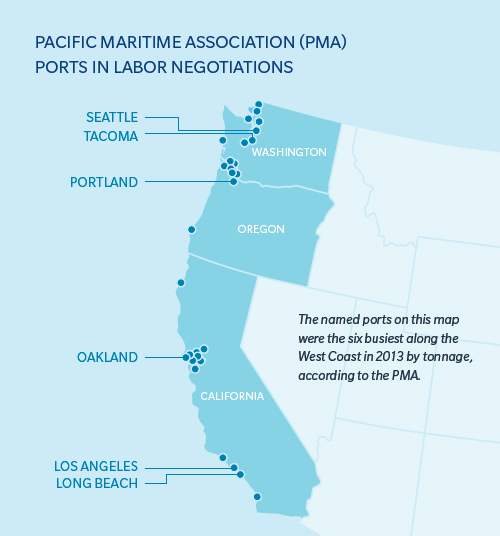
With spring fast approaching, the continuing labor dispute at 29 West Coast ports could affect the ability of suppliers and retailers to stock seasonal merchandise. The backlog of ships at these ports — exacerbated in some instances by work slowdowns and closures — has delayed deliveries of agricultural and manufactured inputs and goods, depleted inventories and potentially harmed businesses across several industries. This situation has resulted from a seven-month impasse between the International Longshore and Warehouse Union and the Pacific Maritime Association, which represents shipping lines and port terminal operators, following the expiration of their labor contract. The White House dispatched Labor Secretary Thomas Perez to San Francisco to reinvigorate negotiations, which resumed on Feb. 17. Previous talks had stalled over the process for arbitrating allegations of work slowdowns, discrimination and other issues. The economic damage from port disruptions could be significant. According to the National Retail Federation, cargo moving through the 29 involved ports represents 12.5% of U.S. gross domestic product. In recent earnings calls, several publicly traded retailers have identified the labor impasse as a potential risk, noting the possible impact on seasonal merchandise. Food and beverage distributors, meanwhile, have reported that port delays have led to spoilage of perishables. And parts shortages attributed to congestion at West Coast ports have led some auto manufacturers to announce plans to halt or cut back production. Although the reinvigorated talks have brought some hope for a quick resolution, retailers and other affected businesses should still consider taking steps to mitigate potential losses from continued disruptions and future work slowdowns, stoppages, or strikes. Specifically, you should:
  1. Diversify your supply chain. The work slowdowns and port closures, coupled with the potential for a strike, have led many businesses to diversify their ports of entry, turn to domestic suppliers or make raw material and finished product substitutions as necessary. Although such actions may bring financial and other costs, they may enable your company to remain competitive until the dispute is resolved. If you have identified alternate suppliers or workaround procedures, consider implementing those strategies and engaging additional or alternate resources now. If you have not identified such resources, now is the time to do so.
  2. Develop crisis management and business continuity strategies. If they are not already significant, the business implications for your organization may soon become so. Consider activating your crisis management and other business incident response teams. Your teams should think about the immediate impacts and workarounds from the current situation and forecast potential impacts should these interruptions continue or a strike occur, allowing a strategy to be developed and executed.
  3. Review your insurance coverage. Some insurance coverage — such as marine cargo and property damage policies with extensions for business interruption (BI) and contingent business interruption (CBI) — may only respond in the event of a strike or port disruption where there is also actual physical damage to insured cargo or property. Your organization should review whether it has or consider obtaining the following additional coverage options:
  • Voyage frustration endorsements to marine cargo policies, which can provide coverage for ground transportation costs and other extra expenses in the event that a shipment is diverted to an alternative port. Such endorsements do not typically provide indemnity for lost sales, contractual penalties or other financial losses.
  • “Seasonal merchantability” coverage, which can sometimes be added to marine cargo policies. This coverage provides indemnification for actual loss in sales as a result of a delay in arrival of goods but may not respond in the event of a strike and usually comes with a lengthy waiting period.
  • Trade disruption insurance (TDI), supply chain insurance and specialty BI insurance policies, which can protect against supply chain disruptions resulting from a variety of causes, including embargoes, acts of terrorism, windstorms and other natural catastrophes, supplier bankruptcy and other events.

For more information, read West Coast Port Disruptions: Insurance and Risk Management Implications.

Tracy Knippenburg Gillis

Profile picture for user TracyKnippenburg

Tracy Knippenburg Gillis

Tracy Knippenburg Gillis leads Marsh Risk Consulting’s reputational risk and crisis management, resiliency and response practice. She provides clients with tailored solutions to protect their organizations from the effects of crises and other adverse events such as reputational risks, business disruptions and emergencies.

How to Defend Against Auto Fraud

Untruths cost car insurers $13 billion a year -- but technology is making it easier to deter auto fraud and greatly reduce leakage of premiums.

Personal auto insurance fraud is a problem. According to Verisk Analytics, it’s a problem on the rise. Between 2008 and 2011, the National Insurance Crime Bureau saw a 34% increase in questionable claims. Auto fraud is also an expensive problem. Industry estimates show that soft fraud accounts for about 10% of paid losses and loss adjustment expenses a year. In 2011 alone, the total amounted to well over $13 billion. The problem, it seems, is that many Americans don’t consider small mistruths to be fraud. They seem to think it’s OK to slightly change the facts if it saves them money! False garaging addresses and mileage estimates One of the most common types of soft fraud, lying about where the car is garaged to receive auto insurance rates for a more affordable ZIP code, has traditionally been a tricky one to track. But with the data that smartphone apps for usage-based insurance (UBI) are designed to collect, it’s much easier to compare the reported garaging address with the actual garaging address. The same is true regarding the estimation of annual mileage. While untruths about garaging and mileage may seem harmless, they add up to big profit loss. In fact, insurancefraud.org reports that premium rating errors account for nearly 10% of the $161.7 billion in personal auto premiums written. The group found that drivers are five times more likely to report midterm mileage changes that reduce premiums than they are to report changes that may increase premiums. The website quotes a 2010 Quality Planning study that found that vehicle-garaging rating errors account for more than $2 billion in annual premium leakage. How to step up your defense against soft fraud Verisk puts it this way: “Basically, carriers need to step up their game in a big way. They’ve made large investments deploying technology and data to improve the customer and agent experience. But they’re falling behind in the race to identify fraud and rate evasion -- a race they can’t afford to lose.” While most auto insurers think of UBI as a strategy to improve customer attraction, retention, pricing and loss ratios, it might be time to expand UBI thinking to include the objective of fraud deterrence. When you add in the potential savings of eliminating even 10% of premium leakage from auto insurance soft fraud, the ROI for UBI becomes even more compelling.

Jake Diner

Profile picture for user JakeDiner

Jake Diner

Jake Diner is the co-founder and CEO of Driveway Software. Driveway is a robust, smartphone-deployed, cloud-based technology that provides auto insurers with comprehensive insured driving data for better pricing intelligence - maximizing the opportunity for loss ratios and higher profits.

End the Dysfunction in Functional Exams

Fee-squeezing has killed quality. Have your workers' comp cases ever been determined by the results of functional exams?

Functional capacity exams (FCEs) are in dire need of quality standards. Employers who want better workers' compensation claim results must take the lead. The FCE is intended to objectively test a patient's thresholds of pain, strength and movement. An FCE should play a major role in things like qualifying a claimant to return to work, ascribing reasonable permanency awards, calculating objective settlement valuations, indicating malingerers, providing defense evidence and essentially helping you close cases. As I see it, the FCE has been under a quality assault because of fee-squeezing managed care schemes. Managed care means only steering work to those "in-network," which emphasizes use of the lowest-fee providers. The overriding value premise of “managed care” is fee reduction, not quality assurance. As such, the peripheral specialty of functional exams has gone unchecked. They have become a perfunctory step in a chain of litigation activities, conveniently extending an adjuster’s diary with the appearance of action. When was the last time your WC case turned on FCE results? When was the last time your defense counsel’s essential witness or deposition list included the FCE provider? The answer may escape you, just as has the missed opportunity to leverage and move churning cases. Quick Tip: Demand Quality FCE Standards and Expect Actionable FCE Results Institute FCE standards in your claim account service instructions. Craft them from the checklist to follow. Require that you or your WC coordinator pre-approve FCE referrals to ensure quality in the application and outcome expectations. Along with selecting a quality provider, you need to provide adequate medical history and other background while asking specific questions. When it comes to provider selection, apply this quality-question checklist: Who is performing the test and what is her certification? Demand licensed physical therapists, optimally with enhanced related certifications. Do not accept PT assistants, sports trainers, vocational counselors or others who are less qualified. Is modern computerized instrumentation used for validity? Do not accept manual systems, which involve subjectivity and simple gauge reading. For example: A manual hand-squeeze test shows pounds of squeeze strength, while modern testing measures isometric contraction and provides an actual “force curve” indicating effort, true point of muscle fatigue and pain. Simply stated, modern computerized systems can indicate real physical capacity while pointing out faking subjects. Will raw data be fed into appropriate computer applications for reliable objective results? Functional exams need to process individual body-part tests and things like coefficient of variance formulas to ascertain whole-body determinations such as “lifting capacity” or other job-specific activities. Calculating these aspects by hand, based on assumptions, is not reliable, and the results may crumble under legal cross-examination. Will heart rate and blood pressure be monitored during testing? This is essential to establishing consistency and overall patient effort. Will the process measure distracted testing? This is a specific technique whereby one test is cross-checked by the appearance of a separate test. For example, back-bending angles are first tested; later, a “straight leg raise” test is performed, which actually re-creates the back bending angles and can be compared with the thresholds of prior back-angle results. This is a critical part of establishing patient credibility. Will the results be admissible as strong evidence? Adherence to aforementioned aspects combined with early communication and input from defense counsel will strengthen evidence. In conclusion, employers must confront a status-quo claims service process to demand FCE standards. Agree to pay for higher-priced FCE providers if you can establish the appropriate quality level. Pick your cases wisely and use detailed oversight. The power of a good FCE will help you move cases.

Barry Thompson

Profile picture for user BarryThompson

Barry Thompson

Barry Thompson is a 35-year-plus industry veteran. He founded Risk Acuity in 2002 as an independent consultancy focused on workers’ compensation. His expert perspective transcends status quo to build highly effective employer-centered programs.

Healthcare Metrics: Driving Standards?

One hospital provides a sterling example of competing on healthcare metrics for quality, not on billboards showing smiling nurses.

|
It’s a new day when healthcare providers choose to compete on quality metrics instead of their new edifices and images of smiling nurses on billboards. I ran into a sterling example of competing on value when the Orthopedic & Sports Institute (OSI) in Appleton, WI, was pitching employers on its bundled prices and its quality. OSI offers all-in prices from pre-op to surgery to rehabilitation. That is the ultimate of transparency -- a pre-set price for the whole episode of care. No bills with a multitude of line items; no incomprehensible codes; no separate bills for radiology, anesthesiology or rehab. Just one fixed price. OSI offers employers a fixed pricing menu for a range of orthopedic procedures. So confident about its outcomes is OSI that it includes a 90-day warranty on its surgeries. Readmissions are on the house, as they should be. OSI is not alone. The Orthopedic Hospital of Wisconsin (OHOW) in Glendale offers similar deals to corporate payers. Employers/payers in the private sector and local government are looking for that kind of value proposition, especially when coupled with the best healthcare metrics on quality. OSI President Curt Kubiak led his presentation with the clinic’s .3% infection rate in 2013, a very low number on a life-and-death metric. (Bloodstream infections, known as sepsis, kill more than 200,000 Americans per year in hospitals.) Also in good shape at OSI were these three measures for 2013:  Readmission rate of .8% (vs. a national average of 4%).  Patient “fall” rate of only 3.9%.  Pain management rate (5 or less on scale of 1 to 10) of 17.8% vs. a normal range of 40% to 60%. Kubiak added that OSI’s goal is to get surgery patients back to work or to their lifestyles in an average of 20 days faster than other providers. OSI is winning direct but non-exclusive contracts from employers as far away as Eau Claire. It believes that, if it does a great job, it doesn’t need to lock companies into exclusive contracts. They will return willingly. Sounds like a bit of a marketplace for healthcare, doesn’t it? OSI executives remain somewhat frustrated at the slow pace of adoption of new pricing and delivery models. But they are winning business, and 10 years ago there was nothing like this model around. The train is moving pretty quickly down the tracks, at least by the standards of the enormous healthcare industry. For the record, I have no connection to OSI, other than to steer Serigraph employees to what we call “centers of value” like OSI and OHOW. We believe that steering employees to such centers with financial incentives is not only the smart thing to do from a cost perspective; We believe it is the ethical thing to do. Don’t employers have a moral obligation to help their people find the best medical outcomes?

Should You Offshore Your Analytics?

The author accessed Indian analysts at a fraction of UK wages but ran into problems and eventually ended the analytics pilot.

|
There has been much on LinkedIn and Twitter in recent years about the shortfall in analytical resource, for the U.S. and UK especially. Several years ago, I had the learning experience of attempting to offshore part of my analytics function to India, Bangalore to be precise. It was all very exciting at first, traveling out there and working with the team as they spent some time in the UK. Plus, on paper, offshoring looked like a good idea, to address the peaks and troughs of demand for analysis and modeling. The offshoring pitch successfully communicated the ease of accessing highly trained Indian graduates at a fraction of UK wages. However, as with all software demos, the experience after purchase was a little different. I always expected the model to take a while to bed down, and you expect to give any new analysts time to get up to speed with our ways of working. However, after a few months, the cracks began to show. Analysts in India were failing to understand what was required unless individual pieces of work were managed like mini-projects and requirements specified in great detail. There also appeared to be little ability to improvise or deal with "dirty data," so significant data preparation was still required by my UK team (who were beginning to question the benefit). Once propensity modeling was attempted, a few months later, it became even more apparent that lack of domain knowledge and rote learning from textbooks caused problems in the real world. Several remedies were tried. Further visits to the UK, upgrading the members of the team to even more qualified analysts (we started with graduates but were now working solely with those who held masters degrees and in some cases PhDs). Even after this, none of my Bangalore team were as able to "think on their feet," like any of my less qualified analysts in the UK, and there were still not any signs that domain knowledge (about insurance, our business, our customer types, previous insight learned, etc) was being retained. After 18 months, with a heavy heart (as all those I had worked with in Bangalore sincerely wanted to do the best job they could), I ended this pilot and instead recruited a few more analysts in the UK. Several factors drove the final decision, including:
  1. Erosion on labor arbitrage (the most highly skilled cost more);
  2. Inefficiency (i.e. need for prep and guidance) affecting the UK team;
  3. Cost and effort to comply with data security requirements.
Since that time, I have had a few customer insight leaders suggest that it is worth trying again (nowadays with China, Eastern Europe or South Africa), but I am not convinced. On reflection, my biggest concerns are around the importance of analysts understanding their domain (business/customers) and doing their own data preparation (as so much is learned from exploratory data analysis phase). The "project-ization" of analysis requests does not suit this craft. So, for me, the answer is no. Do you have any experience of trying this?

Paul Laughlin

Profile picture for user PaulLaughlin

Paul Laughlin

Paul Laughlin is the founder of Laughlin Consultancy, which helps companies generate sustainable value from their customer insight. This includes growing their bottom line, improving customer retention and demonstrating to regulators that they treat customers fairly.

Duke Ellington and 'Insurance of Things'

If the tire pressure of a vehicle is a safety hazard, might the engine be immobilized after due warning is given to the driver?

|
I’m thinking more about the "Insurance of Things." I’m not alone. There’s an increasing amount of speculation about the "Internet of Things," and I’m wondering how this will apply to insurance. With an estimated 15 billion networked devices by 2015 and fridges that can already tell me they have ran out of eggs, it seems like it’s not a matter of "if," but "when." And a natural extension of that question is, "what does it mean for the insurance industry?" It’s a difficult topic to comprehend. As an industry, we have few, if any, reference points on which to form a judgment. In fact, outside the insurance sector, we don’t have too many reference points, either. So we may have to start using our imagination. The natural and easy place to start is in the auto industry, where geospatial devices embedded into vehicles will automatically notify insurers of driver behavior and impacts. (Incidentally, I think this is much more likely than driverless cars, except in theme parks.) The natural extension is into personal devices, and I was intrigued by the announcement by Michael Kors that it will release a range of jewelry with embedded devices. (Have they thought of the effect on infidelity investigators?) In commercial insurance, which is often heavily dependent on warrantees, won’t devices help insurers to see that a warrantee has been complied with? On industrial premises, the "system" will know if fire doors were closed out of working hours, or the sprinkler system tested regularly. But shouldn’t we be bolder in our thinking? Insurers have traditionally thought about moving from being reactive to being proactive. Will the Insurance of Things allow them to undertake that transformation? Will the proliferation of devices eventually allow insurers to move into becoming virtual risk managers, by automatically monitoring the condition of the vehicle, person or property and then "pushing" alerts to the policyholder to take action (or be in breach of the policy conditions)? And perhaps, with the right permissions in place, might one device "talk" to another and take "active intervention?" If the tire pressure of the vehicle is a safety hazard, might the engine be immobilized after due warning is given to the driver? How much will the "Insurance of Things" change the traditional insurance model? Who knows, but the good news is that at least we will have some music to play while it all happens. As Duke Ellington put it, "Things ain’t what they used to be." His style of music might not suit everyone, but he got the title right, at least.

Tony Boobier

Profile picture for user TonyBoobier

Tony Boobier

Tony Boobier is a former worldwide insurance executive at IBM focusing on analytics and is now operating as an independent writer and consultant. He entered the insurance industry 30 years ago. After working for carriers and intermediaries in customer-facing operational roles, he crossed over to the world of technology in 2006.

Screening: More Does NOT Equal Better

It isn't just diseases that cause epidemics. There can be an epidemic of diagnosis, too -- screening can do more harm than good.

In an important op-ed piece in the New York Times, "An Epidemic of Thyroid Cancer?", Dr. H. Gilbert Welch from Dartmouth University wrote that he and his team of researchers found that the rate of thyroid cancer in South Korea has increased 15-fold! 15X! How can this be?! Were South Koreans exposed to massive amounts of radiation? Did South Koreans start using some dangerous skin product? No. And no. South Korean doctors and the South Korean government encouraged increased cancer screening. More screening must be better, right? No. Not at all… This is an important concept for employee benefits professionals to understand: More screening is not necessarily better. What happened in South Korea is that the thyroid cancer had been there all along, just undetected. The most common type of thyroid cancer -- papillary thyroid cancer -- is usually very slow-growing, and people with this cancer never know it is there. It does not affect their health, and it does not kill them. According to the article, it is estimated that 1/3 of ALL ADULTS have thyroid cancer. Thyroid cancer screening is performed by an ultrasound of the neck. It is an un-invasive, painless, fairly simple test. So what happened in South Korea was not an epidemic of thyroid cancer but, as the article puts it, “an epidemic of diagnosis.” There is potential harm in treating a cancer that will likely not cause you any problems. Two out of every 1,000 thyroid surgeries result in death. Removal of the thyroid means a person will have to take thyroid replacement medication for the rest of her life. This medication can be hard to adjust, leading to problems with metabolism, such as weight gain or low energy. In the U.S., there are many screenings that the U.S. Preventive Services Task Force has deemed "unproven" for application across entire populations of asymptomatic individuals. For example:
  • Screening the skin for skin cancer
  • Screening the carotid arteries (neck blood vessels) for narrowing
It is important to address the converse. Increased screening that has been shown to reduce morbidity and mortality is a good thing. Screening for high blood pressure is a good thing. Screening for diabetes is a good thing. Screening for certain types of cancers is a good thing. What does this mean for the employee benefits professionals and the healthcare consumer?
  • Beware of "blanket" statements that more screening is better or of companies that are offering screenings that are not vetted.
  • Know that screening can actually cause harm because of side effects or complications of treatment for a "disease" that is really not a problem.
  • As you set up prevention programs for your employees, ensure that those programs are based on scientific evidence.

Eric Bricker

Profile picture for user EricBricker

Eric Bricker

Eric Bricker, MD, a board-certified internal medicine physician, serves as the chief medical officer for Compass Professional Health Services. He co-founded Compass with Scott Schoenvogel and Cliff Sentell in 2005 to help change how healthcare is delivered to improve employee health and lower healthcare costs.

Will Workers' Comp Kill Uber, Lyft, Etc.?

Two lawsuits would require Uber et al. to treat drivers as employees, not contractors, and provide full benefits -- ending a major innovation.

Two lawsuits seeking to define drivers as employees rather than independent contractors could end up forcing ride sharing services like Uber and Lyft to start providing workers’ compensation and other employment benefits to their drivers around the country. Separate lawsuits (filed by the same attorneys) in U.S. district court in San Francisco are seeking class action status to represent Uber and Lyft drivers nationwide. The suits are using California's labor law, because both Uber and Lyft refer to that state's laws in their driver contracts. Both cases have already earned class action status but only for representing California drivers. Attorneys involved vow an appeal on that decision. If either suit succeeds, it could be very expensive for the companies targeted. It is hard to tell if the drivers will actually see a benefit. The way class action suits go, drivers could end up reclassified as employees, with a host of new benefits, or the attorneys might take millions while every driver gets a free air freshener; we just won’t know until the suits have played out. One plaintiff attorney accuses Uber and Lyft of shifting costs, such as fuel and auto insurance, to drivers by classifying them as contractors. If those drivers were employees, Uber and Lyft would have to pay those costs and also provide workers' comp and other benefits as mandated by law. The math makes a loss in court look downright disastrous for Uber.  It would instantly shift them overnight from a software company coordinating independent commerce to one of the nation's largest employers. According to Uber, more than 162,000 drivers completed four or more trips using the service in December. That is 162,000 people who will suddenly have their fuel costs and insurance paid for (both Uber and Lyft currently offer umbrella liability insurance for their drivers) and will need to be offered workers’ comp. That comp won’t be cheap. These guys aren’t exactly desk jockeys. I’m not even getting into payroll taxes, unemployment or the like. Obviously, a win by the lawyers here would dramatically reshape, and likely end, the budding ride-share revolution. People on the payroll will need to drive far more than four trips in a month, so immediate consolidation will probably ensure a vast swath of that 162,000 will find they no longer drive for Uber. That will result in less availability and slower ride response. In fact, the entire ride-share phenomenon, one based in pure capitalism that brought road warriors clean cars, friendly drivers and prompt service, will be on the edge of extinction. Those cars will be on the same monopolistic path that brought us every rattling, vomit-encrusted cab in America. Oh joy. From my experience with Uber, the drivers seem to meet the criteria of true independent contractors. They are their own business. They use their own cars and work when they want to. No central dispatcher directs them to any pick up, and they appear to work for no one except themselves. They do use a central software system that puts them in direct contact with potential customers, but in the end they have complete discretion to accept or decline an available ride request. Uber and Lyft get a percentage of the fare for facilitating the transaction. In the interest of full disclosure: I have a severe bias against class action suits, which I largely view as nothing more than a wealth redistribution vehicle designed for the enrichment of attorneys. Over the years, I have become party to a few of these, not by anything of my doing other than playing the part of consumer somewhere in America. One such suit, against my beloved Southwest Airlines, apparently determined that Southwest had violated my rights by an improper roll out of expiration dates on free drink coupons. The result was that, if I would declare that I had flown on a Business Select ticket before a certain date, the settlement entitled me to (wait for it) one free drink coupon. (I didn’t bother, and I didn’t care.) The attorneys who brought the suit were seeking $7 million for their efforts. In another suit, related to the purchase system set up over the then-new domain extension ”.biz,” attorneys took $2.75 million of the $3 million made available for a settlement in what was determined to be an illegal lottery. My company, which originally spent about $300 for the “chance” to buy WorkersCompensation.biz (we won), didn’t bother filling out the paperwork for our piece of the action, mostly because our time was more valuable than the $3 or so we would have been paid. If attorneys succeed in having Uber and Lyft drivers declared to be employees, with all the associated rights and entitlements associated therein, they will have killed off one of the most revolutionary and entrepreneurial creations we have seen in the world of ground transportation since, well, the invention of ground transportation. Workers’ comp would, indeed, kill Uber or, at the very least, the independent spirit with which it sprang to life.

Bob Wilson

Profile picture for user BobWilson

Bob Wilson

Bob Wilson is a founding partner, president and CEO of WorkersCompensation.com, based in Sarasota, Fla. He has presented at seminars and conferences on a variety of topics, related to both technology within the workers' compensation industry and bettering the workers' comp system through improved employee/employer relations and claims management techniques.

OSHA Should Help on Infectious Diseases

Current treatment guidelines protect patients from infectious diseases -- but not healthcare workers like those who recently contracted Ebola.

OSHA’s promulgation of an infectious disease rule/standard to protect healthcare workers and employees in healthcare facilities from microorganisms that cause illness and infection would be a welcome expansion of the work OSHA has already done related to bloodborne pathogens. A standard of national caliber would not apply any more pressure to healthcare employers than they already place on themselves to protect the patients and healthcare workers they serve. On the contrary, a rule would highlight the importance of the safety and health of healthcare workers. However, just when we, as a nation, are designing programs to protect healthcare workers from exposure to emerging infectious diseases, like Ebola virus, small businesses say, “No thanks, OSHA, we’re all good.” Just recently, the Small Business Advocacy Review (SBAR) Panel issued a report to OSHA Assistant Secretary Dr. David Michaels that said small healthcare businesses (to include ambulatory surgery, doctors' offices, dental offices, specialty clinics and dialysis centers, to name only a few) weren’t interested in better protections for their workforce. Small entity representatives (SERs) decided that the guidance that is already in place is good enough and that OSHA would just be adding more requirements. The SBAR report stated: Many SERs felt that this rule would overlap with and/or duplicate other relevant guidelines and regulations, including, for example, materials issued by the Centers for Medicare and Medicaid Services (CMS), the Joint Commission and other voluntary accrediting organizations, and state accrediting boards. SBAR has a point: Guidance is in place from CMS, the Joint and others, like CDC. But the guidance is almost completely to protect the patient, not the worker. The American Public Health Association (APHA) disagrees with the SBAR panel and firmly believes that an OSHA standard should be fast tracked to protect the working public. The APHA issued a national policy statement just last month. We learned from the Ebola exposures in Dallas that those infected after exposure were the healthcare workers, not other patients. If a patient enters an emergency department feeling generally ill, it is not typically the other patients who are potentially exposed to a yet-to-be-identified pathogen; rather, it is the string of healthcare workers with whom the patient comes into contact. Those include workers who examine the patient, take vitals, take blood or other specimens, assess, diagnosis and eventually treat. In the case of the Dallas Ebola victim, that was dozens of healthcare workers both in and outside of the hospital over more than a week’s time. The population of healthcare workers that a standard like OSHA’s infectious disease standard could protect is vast. It is typically in smaller healthcare settings that greater protections are needed, as these operations often intersect more closely with the community and have lesser controls in place compared with hospitals or larger health systems. In fact, nearly 10% of the U.S. working population is employed in healthcare settings of all sizes, and healthcare will generate millions of new jobs through the next decade (Bureau of Labor Statistics 2013). This sector of the workforce represents the largest segment of employment growth in the U.S. and serves the largest proportions of Americans, ensuring proper and timely diagnosis, treatment and care. Healthcare employment is marked as the industry sector with the largest growth (2.4%). Better controls to protect our most important healthcare assets -- its workers -- are needed now. OSHA’s bloodborne pathogens standard (BPS) alone will not address these important and constantly emerging occupational risks associated with hazards that are not often visible to the naked eye.  Promulgating an infectious disease role nationally, much like CalOSHA did with its aerosol transmissible diseases standard (ATD, §5199), would provide OSHA the opportunity to work with healthcare facilities and providers of care to develop standards that protect their employees from not just physical or chemical hazards, but biologic ones. Healthcare facilities would have the ability to control the environment of patient care and make it safer for all who enter: patients, family, friends, volunteers, contractors and caregivers alike. This standard, if done right, has the potential to provide the following benefits: -       Prevent transmission of microorganisms that cause illness and infection -       Improve safety for healthcare workers -       Make care for patients safer -       Increase the viability of the healthcare work force and the healthcare economy -       Reduce costs associated with workers' compensation, time away from work, staff turnover -       Provide a collaborative, bridge-building role with other U.S. agencies like CMS, CDC and the Food and Drug Administration (FDA) -       Serve as a model for other countries OSHA’s continued journey down the path of promulgating an infectious disease standard illustrates the role that it can play in bridging the gap between infectious disease and occupational safety and health experts.

Amber Mitchell

Profile picture for user AmberMitchell

Amber Mitchell

Dr. Amber Mitchell is the International Safety Center's president and executive director. Her career has been focused on public health and occupational safety and health related to infectious disease. She has worked in the public, private and academic sectors.

Insurance and the Internet of Things

Insurers could be quick to adopt the Internet of Things and deepen interactions with customers but must avoid three potential problems.

||
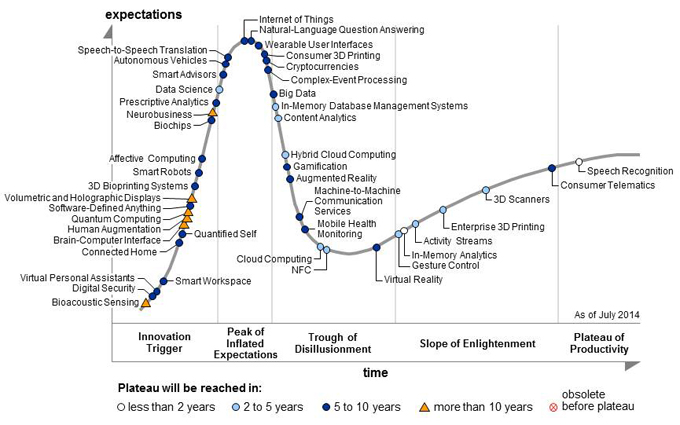
Depending on the day of the week, one of three buzz words seems to fill every column inch, to be used in the marketing of every new product or service and to be cited in every press release. To me, these are, digital (insert anything here), big data and the Internet of Things (IoT). It’s no surprise that the IoT is at the peak of Inflated Expectations in Gartner’s Hype Cycle. AAEAAQAAAAAAAACZAAAAJDUwZjAzMmZlLTQ5NzUtNDI4Yy04ZmFiLTVhZGRlYjI4NzA0Yg In this post, I want to explore IoT a little further, specifically with the insurance world in mind. Like any self-respecting early adopter (technology geek/gadget magpie), I personally see the IoT as a game-changing disruptor, regardless of industry. My kids won’t know a world without almost every conceivable thing being connected to the Internet. Depending on which report you read, there will be anything from 100 to 500 sensors in every home and a market for the IoT worth $7.1 trillion by 2020 (IDC), with more than 4.9 billion connected things by 2015 (Gartner). Very few of the technology giants are not investing heavily in this secto. The IoT is not a fad. So what is the IoT? It’s simply the ability to interact with a network of physical objects that feature an IP address (directly or indirectly) and can connect device to device or device to human. Today, you can connect lots of things to the Internet, some of which you would never expect. Examples include:
  • Homes and commercial buildings -- Smart buildings with smart sensors and smart utilities, security systems, environment monitoring, smart carpet, etc.
  • Automobiles -- tracking when, how and where you drive. Transport vehicles of any kind, including driverless cars, could be connected, as could individual items/packages on a cargo ship.
  • Livestock -- WiFi sheep; see here from the BBC on why sheep are being fitted with WiFi sensors,
  • Human beings -- the latest in wearables allows companies such as Vitality Health Insurance to reward healthy behavior, reducing your premium for the more active and healthy you are.
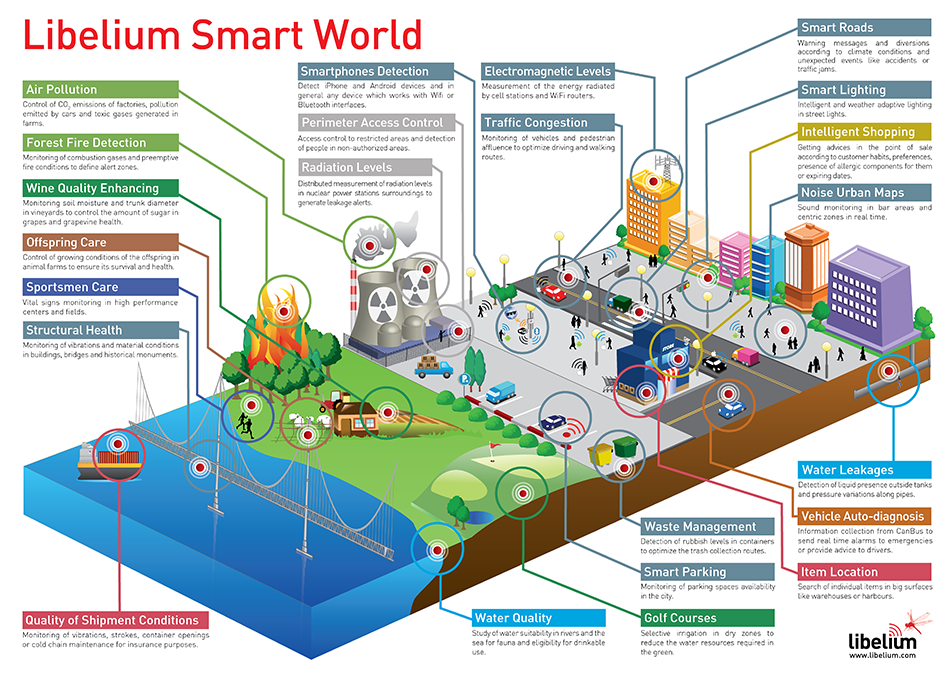
  • Smart cities -- where everything is truly connected. Libelium has 50 great examples here. Have you walked down Regent Street in London recently? It’s an interesting experience. We live in a truly context-aware world.
As Ben Evans said in his great piece, "Mobile is Eating the World," "Sensors profoundly change what a computer can know." Perhaps an easier question to ask is: What can you not connect to the Internet these days? This is a rapidly diminishing list. Look back 12 months or so to the Top 25 weird things to connect to the Internet; all of a sudden they don’t seem so weird. What will happen in the next 12 months? For fans of contactless payment cards, how do you feel when you can’t use it, as a retailer hasn’t yet adopted the technology? Inconvenienced? These are the sorts of simple things that give me time back and are simple and convenient. Ultimately, it’s all about automated data collection from the source itself. As insurers, our success depends on this. It’s what drives our very industry, right from the very first research, through to quote, bind and every event thereafter that drives our risk, pricing and actuarial teams. Getting this data and monitoring this directly from its source has huge potential in today’s traditional insurance business model. Another example of positive uses is from Uber, whose data is now supporting city planners with urban transport. As insurers, we could use the same data to avoid accident black spots, congestion and much more. Traffic systems would be linked directly to the flow, density, type and vehicles themselves. Basic data such as time of day, postal code or gender is simply not enough anymore. IoT connected services can change everything. Opportunities
 The cost of connecting things today has becoming almost insignificant, and, importantly, the desire for things that are not connected is diminishing at a greater pace. Ten years ago, you would test drive a car and, nine times out of 10, focus on the driving experience. The first thing people do today is check the "infotainment," how your smart phone can connect, what you can control via an app. It’s not just cars; I recently moved house and, when looking at new house alarms, a key consideration was what can I control and monitor via my phone or an app. Manufacturers are quick to jump on the bandwagon. Have a look at ADT Pulse (unfortunately not yet available in the UK, but many others are). It seems there are lots of options, but they are still working on old-fashioned business models. When will alarm monitoring be undertaken by your crowd sourced/handpicked local community as opposed to the centralized service center, which then calls the police? With IoT, who needs middlemen? The first notice of loss (FNOL) or claim process becomes automated (we have talked about this for years). The level of fraud can be dramatically reduced. Everything you can interact with or monitor, you can now predict better than ever. How does the IoT affect the carrier, agent or broker? Have a look at the infographic below -- which of these "things" did you expect to monitor? (The site for the infographic is here.) As the local city administration, can you reduce accidents or claims from understanding smart roads, pothole damage and more? Reduce health costs by understanding pollution? libelium_smart_world_infographic_950px We as insurers typically struggle because customers rarely want to speak to their insurers. In the new economy, we have the opportunity to be connected all the time to each other. This brings a vast number of possibilities and new potential business models to us, based on this new wealth of data. Insurers now have the ability to know in advance of an event, ultimately improving their customers' and potential customers' experience, security and well-being. With everything connected, what could go wrong? However, the IoT has to come with a health warning, too. For me, three of the key things to consider here as insurance organization are:
  1. You are now really competing on data, nothing more. We never produced any products, anyway; now it’s even more transparent. Make sure you know your data, can process it efficiently and effectively, understand it and most importantly use it. How we use information to enrich our world will be key. Don’t drown; the volume is about to explode. As an example, every minute, OCTO stores more than 118.000 data points from drivers around the world. How will you stand out from the crowd? I wrote recently here on how brand will be critical. Ownership of the data will also be key. BMW recently announced that it would not share any of its connected car data. It does, however, have a significant partnership with a large global insurer already.
  2. Another key risk is from cyber security. There are already stories of usage-based insurance (UBI) car devices potentially being hacked. What happens if your driverless car gets hacked and then crashes, causing serious damage or, worse, a fatality? Who will carry the risk?
  3. You must see how the IoT can drive new business models, based on customer demand. Ray Wang recently said that we are now supporting mass personalization for a market segment of one. What can you now insure that you never could previously for individuals and organizations? New business models don’t mean we have to go alone, either. New partnerships will drive innovation and, importantly, convenience for the end user. Be careful not to miss out on the output, as British Gas has with Hive and nPower has with Nest. Ignore the Hive and Nest connected devices; the data they collect is what matters.
For once, the insurance industry could be as quick to adopt as everyone else to adopt, or ahead. We are on the forefront of data enrichment and much more. We can better price, engage and interact with our customers and prospects. We can interact with each and every stage of the insurance life cycle; we can join and automate the dots faster and better than ever before. It’s an exciting time, and while it may be a while before the legacy oil tanker turns, we had better be ready and at the wheel if we are to own the opportunity.  

Nigel Walsh

Profile picture for user NigelWalsh

Nigel Walsh

Nigel Walsh is a partner at Deloitte and host of the InsurTech Insider podcast. He is on a mission to make insurance lovable.

He spends his days:

Supporting startups. Creating communities. Building MGAs. Scouting new startups. Writing papers. Creating partnerships. Understanding the future of insurance. Deploying robots. Co-hosting podcasts. Creating propositions. Connecting people. Supporting projects in London, New York and Dublin. Building a global team.