Download

Should Bad Faith Matter in Work Comp?

States are evenly split on whether to allow "bad faith" lawsuits against insurers and third-party administrators. Who's right?

Here's a sensitive question for the workers' compensation community: Should workers' compensation insurance companies and third-party administrators be subject to civil "bad faith" lawsuits?

Or should a state's workers' compensation system remain an exclusive remedy, even if a claims payer intentionally commits egregious acts such as denying benefits that it knows are due?

WorkCompCentral Legal Editor Sherri Okamoto reports that about half of the states have done away with any civil bad faith remedy either through legislative or judicial actions, and that the other half retain that remedy.

The contrasts are stark.

Okamoto cites an Iowa jury award an earlier this month of $25 million in punitive damages, along with $284,000 in damages, payable by the former employer's workers' compensation carrier for its bad-faith handling of his claim. The offense was failure to pay permanent total disability benefits after a 2009 accident left the worker with catastrophic injuries.

Other states where there is no civil remedy rely on administrative penalties and administrative judicial enforcement, but those policies, in states such as California, have been criticized for not sufficiently deterring bad behavior such as wrongfully denying medical care to the critically injured.

Okamoto notes that the states that do allow for civil remedies vary widely in the standards and definitions for reprehensible conduct.

Alaska and Arizona, for example, define "bad faith" as a refusal to pay a claim without any arguably reasonable basis. In contrast, Arkansas requires a showing of "affirmative misconduct" or “dishonest purpose” to avoid liability.

Colorado, Maine and Michigan make a carrier's failure to act in good faith a breach-of-contract claim. Hawaii and Mississippi make carrier misconduct redressable in tort.

Texas used to permit bad faith actions until the Supreme Court's decision in Texas Mutual Insurance Co. v. Ruttiger, which held there was no common-law bad-faith action in the Lone Star State for workers' compensation claims handling.

Likewise, two months after Ruttiger came out, the New Jersey Supreme Court held that the state's injured workers do not have a common-law right of action for pain and suffering caused by an insurer's administration of a workers' compensation claim in Stancil v. Ace USA.

The North Carolina Court of Appeals ruled recently that an injured worker cannot bring a tort action to recover damages from an insurance carrier for its alleged bad-faith claims handling.

The split surely raises the passions in people: Civil remedies fly in the face of the concept of administrative expediency that underlies workers' compensation; yet, administrative enforcement needs sufficient "teeth" to encourage compliance and deter bad behavior.

What do you think?

David DePaolo

Profile picture for user DavidDePaolo

David DePaolo

David DePaolo is the president and CEO of WorkCompCentral, a workers' compensation industry specialty news and education publication he founded in 1999. DePaolo directs a staff of 30 in the daily publication of industry news across the country, including politics, legal decisions, medical information and business news.

The Flaw in How Risks Are Framed

The problem: There is no such thing as a one-cause event. Nor are there one-consequence events. But many organizations act as if there are.

One of the things that I’ve been tossing around is how we frame a risk. Risks are events. But when it comes to putting together risk statements, often organizations will put a cause and a consequence as well as the risk all into one statement.

I’ll give you an example: "Significant delays in retrieving records due to current tools for data storage and retrieval practices may leave the department unable to adequately respond to freedom of information requests." Now, I’m not even sure what that’s saying, but here's another one: "A department may not have a business process in place to adequately manage the programs, which may lead to weakened results."

Now, given what I’ve talked about on other blogs, I wouldn’t even see those as risk statements. However, what we’ve got there is: We’re trying to put a cause and an event and a consequence into one risk statement. The problem is that there is no such thing as a one-cause event, nor is there any such thing as a one-consequence event. If you identify an event, a risk, you will find that there are a range of causes. It’s a system breakdown.

And even if a risk results in injury or death, there are other consequences, such as harm to reputation, perhaps issues with the regulators and maybe legal action taken against us.

So, if we put our statements together such that we put a cause and a consequence in with the risk, we’re limiting our ability to treat that risk properly. We haven’t identified all the causes. We haven’t identified all of the consequences. And it’s only through identifying all the causes that you can truly start to identify whether you have adequate controls already in place or whether you need additional ones.

When you look at your risk statements, identify what the event is, but then go though and list all the causes and all the consequences, plus the controls and their effectiveness. This is when you have a statement able to be managed effectively.

As always, let’s be careful out there.


Rod Farrar

Profile picture for user RodFarrar

Rod Farrar

Rod Farrar is an accomplished risk consultant. His knowledge of the risk management domain was initially informed through his 20 years of service as an army officer in varying project, security and operational roles. Subsequent to that, he has spent eight years as a professional risk manager and trainer.

How to Vastly Improve Catastrophe Modeling

An open-source catastrophe modeling toolkit is developing that can aggregate all of humanity's scientific knowledge at all points in time.

The OASIS loss modeling framework is an important initiative for the humans standing last in the global queue. To see why, look at the problem that all we humans face: At a global level, the ideal catastrophe modeling process should leverage all the scientific knowledge available to humanity at all points of time to come up with the best estimate of a probability distribution of losses for various horizons of locations and time so that humans and groups can make better choices. The actions of some humans are changing the Earth and its environment (through global warming, climate change, et al.) at a much more rapid rate than before. Along with other natural changes, these human-triggered changes and the increasing knowledge of humanity result in changes in the estimated distribution over time. The insurance industry uses catastrophe models provided by an oligopoly of closed source private providers, causing the following problems:
  • The cost of catastrophe modeling is higher than it would be if there were no oligopoly.
  • The opaqueness of the models prevents transparent evaluation/comparison/regulation.
  • Vested interests may manipulate models and (thereby) choices made by humans and groups.
  • The oligopoly makes it difficult to leverage all scientific knowledge in estimating distributions.Because all humans live on the same Earth, and actions of some empire-building humans are changing the loss distribution for other humans without the latter being aware, it is necessary to make information about the global loss distribution as widely available as possible, so that maximum humans or their representatives can transparently make better choices for themselves (including preventing actions by the empire-builders). As the pace of change of the distribution accelerates, this is becoming more and more urgent.
Unfortunately, humans and groups who stand last in the global queue, as usual, are most vulnerable to impacts of actions by those ahead of them in the global queue. They are usually least aware of this distribution and risk making poorer choices than others. Why don't property insurers share the distribution of potential losses at home location with property owners periodically? Why don't property surveys commissioned by property owners provide the distribution of potential losses at property locations? Why should property owners not be able to understand how specific new local actions by local people, firms and governments affect their loss distributions over various time horizons (thereby affecting property values)? Why don't property insurers provide complimentary/paid information services about the risk (overall or event-specific) to the properties? Property owners/managers, their creditors and their investors would all be interested in such services, because they have a financial stake in the properties. The high cost of catastrophe modeling has been a constraint. But as OASIS reduces this constraint, we should see such services. After all, insurers are in the business of helping their customers manage risk rather than the business of selling insurance policies. (See my other blog post on this.) Empire-building humans always seek to manipulate public perceptions about the true consequences of their actions (product/services) over distant time and space horizons. As scale and complexity of technology has grown, the impact for humanity has become difficult to decipher and control. But the need to generate a common understanding of these outcomes has become more critical, because the impact continues to intensify. As a result, there are two imperatives: 1. The transparency of the catastrophe modeling process is very important to prevent empire-builders from manipulating models partly or fully to promote a wrong understanding of the potential outcomes for humanity. 2. Reducing entry barriers for model providers to provide ever better models to the catastrophe modeling process is very important to ensure that global understanding of potential outcomes for humanity is based on up-to-date scientific knowledge. I have written separately on my other blog about why humanity needs to manage intellectual property that is significant for its future differently from mundane intellectual property. The public or private ownership of intellectual property in the catastrophe modeling domain needs to be managed very carefully. While we need to retain the incentive for private model builders to build ever better models, we need to find a mechanism that does not jeopardize the transparency or build entry barriers for newer models. It is in this context that OASIS (an open-source catastrophe modeling toolkit and marketplace) provides the right combination of public and private ownership to evolve the ideal global catastrophe modeling process. Choosing OASIS over other private options is important for your children and their children. I see OASIS as a genuine oasis in this desert where selfish actions of some humans are risking our shared future. If OASIS succeeds in breaking the oligopoly, making it easier to evolve the ideal catastrophe modeling process, I expect the speed of developing global consensus to put the right and tight leashes on empire builders. I strongly endorse OASIS and wish it luck. I plan to do all I can to ensure its success. I hope you will join me, too.

Pratap Tambay

Profile picture for user PratapTambay

Pratap Tambay

Pratap Tambay has 20 years of experience in solving problems for global customers in financial services, insurance retail and telecommunication. He is currently focused developing new business opportunities in the commercial insurance industry. Tambay has a bachelor’s degree in computer science from IIT Bombay and a master’s degree in management from IISc Bangalore"

Why Medical Records Are Easy to Hack

Medical records have made their way online, opening them to security leaks -- and can be 50 times more lucrative than financial data for thieves.

If hacked credit and debit card account numbers are like gold in the cyber underground, then stolen healthcare records, containing patient information, are like diamonds.

Private details such as Social Security numbers, birth dates, physical descriptions and patient account numbers historically have been recorded on paper and stashed away in physical file folders and cabinets.

But the Internet all too rapidly has become our hub of commerce and social interaction. And that shift has included a mandate by the federal government to go paperless. The result: Healthcare records now exist in digital form, stored in ways that make them easy to hack.

Infographic: The ripple effect of medical identity theft

The criminal opportunities have not escaped organized cyber crime gangs that are stepping up hacking and stealing.

The Ponenom Institute found that many healthcare organizations get attacked multiple times each year, suffering losses ranging from several thousands of dollars to more than $1 million per incident. The total loss to the industry can be as much as $5.6 billion annually.

“In the dark Internet, there seems to be more activity around the theft of medical information, not just to commit medical identity fraud, but to farm that data for a very long time (for other purposes),” says Larry Ponemon, chairman of Ponemon Institute, which has been conducting medical identity theft research since 2010.

More: Protecting your digital footprint in the post privacy era

Stolen healthcare data can be worth 10 to 50 times more than payment card data in the cyber underground. Electronic health records fetch around $50 per record, according to the FBI. Some experts put that number as high as $500 for some type of medical records.

Credit and debit card numbers, by contrast, can sell for as little as $1 to $2 per account number.

“There’s an enormous online marketplace for these records,” says Kurt Stammberger, senior vice president of marketing at Norse, a security company that monitors malicious and criminal Internet traffic. “It’s like eBay — people bid, and there’s a ‘buy now’ price.’ ”

Costly exposures

Healthcare companies are taking major financial hits—and writing off this exposure as an extraordinary cost of doing business. Details on the pain level for breached companies are surfacing, thanks to data breach disclosure rules under the Healthcare Insurance Portability and Accountability Act (HIPAA.) For instance:

  • WellPoint, a managed-care company, settled a case with the U.S. Department of Health and Human Services for $1.7 million last year. WellPoint allegedly left electronic records of more than 600,000 people accessible over the Internet because of a security weakness.
  • New York and Presbyterian Hospital and Columbia University agreed to a $4.8 million settlement earlier this year after substandard security led to 6,800 patient records becoming accessible by search engines online.
  • Individual consumers are getting harmed financially, as well, to the tune of $12.3 billion last year. Ponemon’s 2013 Survey on Medical Identity Theft found that more than one third of victims paid an average of $18,660 out of pocket to recover from data theft. That included being compelled to reimburse healthcare providers for services supplied to an impersonator.

    Prevention hurdles

    Healthcare experts, privacy advocates and law enforcement officials acknowledge that the fundamental problem is mushrooming and won’t be easy to stabilize.

    Part of the challenge is financial. The Affordable Care Act mandates that providers expend 80% to 85% of premiums on quality care—and that doesn’t include any provisions to prevent services from going to an identity thief.

    According to Forrester Research, only 18% of healthcare organizations’ tech spending budget goes to security, compared with 21% across all sectors. And most providers plan a minimal or zero increase in budget.

    More: 3 steps for figuring out if your business is secure

    “The mission of healthcare providers is to take care of patients, and anything that can interfere with patient care takes a back seat,” says Paul Asadoorian, product-marketing manager at vulnerability management vendor Tenable Network Security. “Security is one of those things.”

    Meanwhile, individual victims of healthcare data theft can be left twisting in the wind.

    The financial services industry maintains a central database where stolen identities can be flagged; the healthcare industry has nothing of that sort. In fact, it even lacks a simple standard for authenticating the identity of anyone who steps forward to request patient care.

    There is no standardized practice for assuring the identity of a patient via an insurance ID card combined with another form of ID, observes Ann Patterson, senior vice president and program director for Medical Identity Fraud Alliance (MIFA). “That poses challenges for healthcare providers, when their main concern is quality of care,” Patterson says.

How to Find Patterns in Workers' Comp Claims

Spotting patterns in workers' comp claims starts with identifying the factors that contribute to accidents. The list is longer than you think.

Workers’ compensation claims cost employers, their insurers and government agencies billions of dollars every year. While employee safety should be every employer’s first priority, the desire to reduce the costs of compensation claims can add to that emphasis.

So, how can you reduce the cost of workplace accidents?

One of the most effective and efficient ways is to look for patterns in workers' comp claims. By identifying their patterns, employers can address the workplace issues that most frequently lead to the most expensive claims.

Using Patterns to Identify Workplace Risks

Spotting a pattern to workers’ compensation claims starts with identifying the factors that contribute to accidents in your business. The list may be longer than you think. Consider the following:

  • Company morale
  • Employee experience and training
  • Employee physical and mental health
  • Employee socioeconomic status
  • Facility architecture, age and repair
  • Geographic location
  • Quality, age and repair of equipment, machinery and tools
  • Weather patterns
  • Workplace conditions

While not all of these will be relevant to all employers, they are still all factors that can affect the likelihood of a workplace injury. More importantly, they are factors that employers can address  to mitigate both injury risk and the cost of valid claims.

Reducing Risk of Injury

Of course, the most effective way to reduce the cost of workers’ compensation claims is to avoid them in the first place. While going 100% claim-free may be unrealistic, there are certain measures that can be taken to reduce the likelihood and frequency of injuries on the job.

Reducing risk starts with the hiring process. Careful, targeted pre-employment screening and interviews can help employers identify high-risk individuals. Here, “high-risk” can mean a number of different things: inexperienced, lacking proper training, suffering from problems with drugs or alcohol or even a history of worker’s compensation claims. For existing employees, employers can re-assess records from the hiring process to identify patterns among injured workers. This information can then be fed in to the new-hire process.

Pattern evaluation can be used to identify other areas for improvement, as well. Are injuries more common at a specific location? At a specific time of day? Is a recurring mistake the cause of frequent injuries?

Once identified, these are all issues that can be addressed to reduce the risk of future injuries.

Reducing the Cost of Valid Claims

Pattern analysis can also aid employers and their insurers in avoiding overpayment on valid claims. Understanding what questions to ask and what to look for during the investigation allows companies to pinpoint the relevant issues and tailor the adjustment process accordingly. The more data you have at your disposal, the better able you will be to thoroughly and accurately assess workers’ compensation claims as they arise.

Using Patterns to Spot Fraudulent Claims

Finally, looking for patterns is an effective measure for combating the rising cost of fraudulent claims. Fraud can occur at both the employee and health-care provider levels and, by some measures, accounts for anywhere from 5% to 20% of all compensated claims. While clearly not conclusive, the following are examples of factors that may indicate a fraudulent claim:

  • Refusal to submit to diagnostic testing
  • Inability to provide details about the accident
  • Delayed submission of the injury report (all injuries should be reported immediately)
  • Lack of witnesses to corroborate the claimant’s story
  • Healthcare costs that far exceed what would be expected for the alleged workplace injury

Harness the Power of Data to Manage Your Workers’ Compensation Costs

Understanding the factors that contribute to workers’ compensation claims is the first step toward mitigating the costs of workplace injuries. By identifying patterns before, during and after the claim process, employers and their insurers can improve workplace safety while also benefiting the bottom line.


Kurt Smith

Profile picture for user KurtSmith

Kurt Smith

Kurt Smith is an entrepreneur and marketing consultant. He contributes to many law and insurance blogs.

Buckle Up: Monetary Events Are Speeding

A fundamental shift in central banks' monetary policies suggests that corporate debt and even "overvalued" stocks may be the right bet.

||

Just when you thought the world could not spin much faster, global monetary events in 2015 have picked up speed. Buckle up.

A key macro theme of ours for some time now has been the increasing importance of relative global currency movements in financial market outcomes. And what have we experienced in this very short year-to-date period so far? After years of jawboning, the European Central Bank has finally announced a $60 billion monthly quantitative easing exercise to begin in March. Switzerland “de- linked” its currency from the euro. China has lowered the official renminbi/U.S. dollar trading band (devalued the currency). China lowered its banking system required reserve ratio. The Turkish and Ukrainian currencies saw double-digit declines. And interest-rate cuts have been announced in Canada, Singapore, Denmark (four times in three weeks), India, Australia and Russia (after raising rates meaningfully in December to defend the ruble). All of the above occurred within five weeks.

What do all of these actions have in common? They are meant to influence relative global currency values. The common denominator under all of these actions was a desire to lower the relative value of each country's or area’s currency against global competitors. As a result, foreign currency volatility has risen more than noticeably in 2015, necessarily begetting heightened volatility in global equity and fixed income markets.

If we step back and think about how individual central banks and country-specific economies responded to changes in the real global economy historically, it was through the interest-rate mechanism. Individual central banks could raise and lower short-term interest rates to stimulate or cool specific economies as they experienced the positive or negative influence of global economic change. Country-specific interest-rate differentials acted as pressure relief valves. Global short-term interest-rate differentials acted as a supposed relative equalization mechanism. But in today’s world of largely 0% interest rates, the interest-rate “pressure relief valve” is gone. The new pressure relief valve has become relative currency movements. This is just one reality of the historically unprecedented global grand central banking monetary experiments of the last six years. At this point, the experiment is neither good nor bad; it is simply the environment in which we find ourselves. And so we deal with this reality in investment decision making.

There has been one other event of note in early 2015 that directly relates to the potential for further heightened currency volatility. That event is the recent Greek elections. We all know that Greece has been in trouble for some time. Quite simply, the country has borrowed more money than it is able to pay back under current debt-repayment schedules. The New York consulting/ banking firm Lazard recently put out a report suggesting Greek debt requires a 50% “haircut” (default) for Greece to remain fiscally viable. The European Central Bank (ECB), largely prompted by Germany, is demanding 100% payback. Herein lies the key tension that must be resolved in some manner by the end of February, when a meaningful Greek debt payment is due.

Of course, the problem with a needed “haircut” in Greek debt is that major Euro banks holding Greek debt have not yet marked this debt to “market value” on their balance sheets. In one sense, saving Greece is as much about saving the Euro banks as anything. If there is a “haircut” agreement, a number of Euro banks will feel the immediate pain of asset write-offs. Moreover, if Greece receives favorable debt restructuring/haircut treatment, then what about Italy? What about Spain, etc? This is the dilemma of the European Central Bank, and ultimately the euro itself as a currency. This forced choice is exactly what the ECB has been trying to avoid for years. Politicians in the new Greek government have so far been committing a key sin in the eyes of the ECB – they have been telling the truth about fiscal/financial realities.

So, to the point: What does this set of uncharted waters mean for investment decision making? It means we need to be very open and flexible. We need to be prepared for possible financial market outcomes that in no way fit within the confines of a historical or academic playbook experience.

Having said this, a unique occurrence took place in Euro debt markets in early February: Nestle ́ shorter-term corporate debt actually traded with a negative yield. Think about this. Investors were willing to lose a little bit of money (-20 basis points, or -.2%) for the “safety” of essentially being able to park their capital in Nestle’s balance sheet. This is a very loud statement. Academically, we all know that corporate debt is “riskier” than government debt (which is considered “risk-free”). But the markets are telling us that may not be the case at the current time, when looking at Nestle ́ bonds as a proxy for top-quality corporate balance sheets. Could it be that the balance sheets of global sovereigns (governments) are actually riskier? If so, is global capital finally starting to recognize and price in this fact? After all, negative Nestle ́ corporate yields were seen right alongside Greece's raising its hand, suggesting Euro area bank and government balance sheets may not be the pristine repositories for capital many have come to blindly accept. This Nestle ́ bond trade may be one of the most important market signals in years.

As we have stated in our writings many a time, one of the most important disciplines in the investment management process is to remain flexible and open in thinking. Dogmatic adherence to preconceived notions can be very dangerous, especially in the current cycle. As such, we cannot look at global capital flows and investment asset class price reactions in isolation. This may indeed be one of the greatest investment challenges of the moment, but one whose understanding is crucial to successful navigation ahead. In isolation, who would be crazy enough to buy short-term Nestle ́ debt where the result is a guaranteed loss of capital in a bond held to maturity? No one. But within the context of deteriorating global government balance sheets, all of a sudden it is not so crazy an occurrence. It makes complete sense within the context of global capital seeking out investment venues of safety beyond what may have been considered “risk-free” government balance sheets, all within the context of a negative yield environment. Certainly for the buyer of Nestle ́ debt with a negative yield, motivation is not the return on capital, but the return of capital.

This leads us to equities and, again, this very important concept of being flexible in thinking and behavior. Historically, valuation metrics have been very important in stock investing. Not just levels of earnings and cash-flow growth, but the multiple of earnings and cash-flow growth that investors have been willing to pay to own individual stocks. This has been expressed in valuation metrics such as price-to-earnings, price relative to book value, cash flow, etc. To the point, in the current market environment, common stock valuation metrics are stretched relative to historical context.

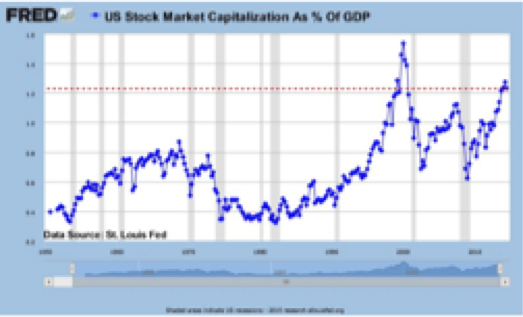
In the past, we have looked at indicators like total stock market capitalization relative to GDP. The market capitalization of a stock is nothing more than its shares outstanding multiplied by its current price. The indicator essentially shows us the value of stock market assets relative to the real economy. Warren Buffett has called this his favorite stock market indicator.

Untitled
The message is clear. By this valuation metric, only the year 2000 saw a higher valuation than the current. For a while now, a number of market pundits have suggested the U.S. stock market is at risk of a crash based on these numbers.

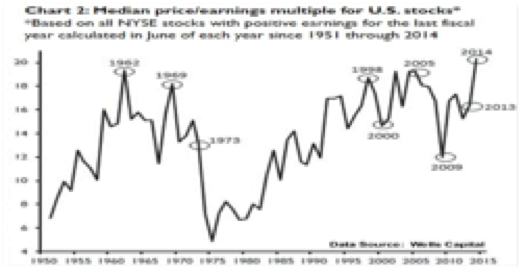
Wells Capital Management recently developed data for the median historical price-to-earnings multiple of the NYSE (using the data for only those New York Stock Exchange companies with positive earnings). What this data tells us is that the current NYSE median PE multiple is the highest ever seen. Not exactly wildly heartwarming for anyone with a sense of stock market valuation history.

Untitled

It is data like this that has prompted a number of market commentators to issue warnings: The big bad stock market wolf isn’t coming; he’s here!

In thinking about these numbers and these dire warnings from a number on Wall Street, we again need to step back and put the current cycle into context. We need to put individual asset class movements into context.

In isolation, current stock market valuations should be very concerning (and they are). In isolation, these types of valuation metrics do not make a lot of sense set against historical precedent. But the negative yield on Nestle corporate debt make littles to no common sense, either...unless it is looked at as an alternative to deteriorating government balance sheets and government debt markets.

Trust us, the LAST thing we are trying to do is be stock market cheerleaders. We’ll leave that to the carnival barkers at CNBC, with its historically low viewer ratings. What we are trying to do is “see” where the current set of global financial market, economic and currency circumstances will lead global capital as we move throughout 2015.

Heightened global currency volatility means an increasing amount of global capital at the margin is seeking principal safety. The recent Greek election results are now forcing into the mainstream commentary the issue of Euro bank and government fiscal integrity, let alone solvency. We believe the negative yield on the Nestle ́ corporate bond is an important marker that global capital is now looking at the private (corporate) sector as a potential repository for safety. The Nestle ́ bond is an investment that has nothing to do with yield and everything to do with capital preservation. Nestle ́ has one of the more pristine corporate balance sheets on Earth. We need to remember that equities represent a claim on not only future cash flows of a corporation but also on its real assets and balance sheet wherewithal.

We need to be open to the possibility that, despite very high-valuation metrics, a weak global economy and accelerating global currency movements that are sure to play a bit of havoc with reported corporate earnings, the equity asset class may increasingly be seen as a global capital repository for safety in a world where global government balance sheets have become ever more precarious over the last half decade. The investor who survives long-term is the one with a plan of action for all potential market outcomes. Avoid the tendency to cry wolf, but, of course, also keep in mind that even the boy who cried wolf was ultimately correct.

It’s all in the rhythm and pacing of each unique financial and economic cycle. Having a disciplined risk management process is the key to being able to remain flexible in investment thinking and action.


Brian Pretti

Profile picture for user BrianPretti

Brian Pretti

Brian Pretti is a partner and chief investment officer at Capital Planning Advisors. He has been an investment management professional for more than three decades. He served as senior vice president and chief investment officer for Mechanics Bank Wealth Management, where he was instrumental in growing assets under management from $150 million to more than $1.4 billion.

How to Enable the Next-Gen Insurer

The pace of change demands that companies try to become a Next-Gen Insurer, but research shows that very few are moving fast enough.

|

Innovation continues to be a key topic within the industry, attracting greater attention in the last few years because companies like Google, Walmart, Apple and others have raised the bar with strong innovation cultures that are challenging existing companies and industries, including insurance, in a multitude of ways. Their commitment to create, nurture and inspire a culture that mobilizes their creativity and resources is breathtaking and is also backed by the commitment of top leadership to ensure innovation is seen, heard and acted upon each and every day.

In this rapidly changing marketplace, innovation is no longer a nice-to-have initiative. It is a must-have, strategic business capability and core mandate that is defining a new era of market leaders across all industries, including insurance. The change and disruption are not from any one influencer, but rather a combination of influencers that together are creating a seismic shift in business models, customer expectations, products and services and infrastructure. As result, companies are increasingly embracing innovation to address the challenges and opportunities of this disruption … and insurers must, too.

Many insurers are on the journey to becoming a Next-Gen Insurer by reinventing the business of insurance. Unfortunately, too many are only retooling their traditional business elements such as products, services and processes. These varied approaches expose a wide and dangerous gap in the levels of innovation maturity. Based on our research results, only 13% have a strong innovation culture, 35% have a formal innovation team, 26% have formal innovation processes and 36% are using collaboration tools. The diversity and small amount of engagement in these four critical areas suggests that only about a quarter of insurers would likely have the necessary foundation in place to achieve mover or market leader status, leaving the majority of insurers at the laggard or "mainstreamer" level.

What does this reveal? Insurers appear to be significantly behind -- especially when compared with new challengers that are moving at a high pace and level, with innovations and capabilities emerging regularly through their own development, acquisitions or partnerships. The new challengers are transforming other industries, and the insurance industry is being threatened, both directly and indirectly. Retail with Amazon, taxi service with Uber, banking with Lending Club, venture capital funding with Kickstarter, automotive with Google and insurance with Google all illustrate ways that innovative capabilities are being introduced and that industry boundaries are being eliminated. A commitment to innovation is at the heart of growth and success.

The implications for insurance are vast. If insurers fail to achieve a robust level of innovation maturity, they will increasingly fall behind and risk becoming irrelevant in a changing marketplace, just like Kodak, RadioShack, Borders and others. But those that embrace the inevitable nature of the seismic shifts that will affect almost every line of business and every product within the insurance industry’s portfolio will be well-positioned to lead their organizations’ innovation initiatives beyond traditional comfort zones.

This report provides a framework to help insurers assess their current innovation maturity level compared with where they want to be. By doing so, they can best determine strategies to establish innovation as a core business capability to help win in today’s world.

In a world of rapid change, new competitors, emerging technologies, advancing innovation and fading industry boundaries are intensifying the challenge to traditional insurance business assumptions. How insurers respond to these changes – with a fresh set of views that combine both inside-the-industry and outside-the-industry perspectives within a robust innovation process – will very likely influence their future.

So how should insurers respond?

  • Insurers must assess their current innovation maturity level, define the desired maturity and formulate a plan to move the organization forward on their journey as a Next-Gen Insurer. Evaluate your current state across key elements and provide executives a baseline from which to define and develop mature innovation capabilities necessary to compete today and in the future.
  • Insurers should establish an innovation mandate and business capability by leveraging best-practice methodologies, like the SMA innovation framework, to guide and implement the desired innovation maturity level within the organization. Ensure that innovation becomes a sustainable and robust capability similar to other core capabilities like program management, financial management or product management.
  • An organization must focus on the level of strategic and organizational commitment, on tracking and assessing inside and outside industry trends, on being willing to embrace open innovation and an ecosystem, on the ability to develop long-term scenarios and on investment of resources. They will define the level of innovation maturity and determine future success.
  • Insurers must create and participate in robust ecosystems of internal and external resources to gain insights.
  • The commitment to innovation should be viewed no differently than the organizational and financial commitments needed for any strategic initiative, new market entry or new business. Market leaders are embracing innovation as a requirement for fueling the organizations’ potential and securing their market leadership.

Innovation is a must, and time is of the essence. Leading futurists, including David Smith and Erik Qualman, suggest that 40% of the Fortune 500 companies won’t exist in 10 years. It is reasonable to expect a similar ripple effect through all companies. It is imperative that insurers assess their current state of innovation maturity and commit to a future state that is fully capable of fulfilling their vision for a viable future. Those that embrace innovation and capitalize on the disruption and influencers stand to make the biggest gains and remain relevant in the future. But those that hesitate will fall short in both competitive position and financial stability. What is your next move?

Click here to learn more about SMA’s research.


Denise Garth

Profile picture for user DeniseGarth

Denise Garth

Denise Garth is senior vice president, strategic marketing, responsible for leading marketing, industry relations and innovation in support of Majesco's client-centric strategy.

Options in Work Comp Making Progress

Working with ARAWC, Tennessee has introduced a bill to increase "opt-out" options in work comp -- and more states may soon follow.

Last year, I highlighted the mission and objectives of the newly minted Association for Responsible Alternatives to Workers’ Compensation (ARAWC) organization that was established by a collaborative group of employers and their provider partners. With Sedgwick as a founding member of this organization, I can report that we moved quickly to stand up the association, hiring experienced staff, lobbyists and others with expertise in passing legislation. We are putting in so much effort on behalf of U.S. employers to ensure this organization stays focused and delivers on its mission. Before I give you the really good news, here is a recap of the central issue on options in work comp. Workers' compensation is dictated by separate statutes in every state. Only Texas and Oklahoma offer the freedom to “opt out” of the statute, and, in each case, the way this is practiced is quite different. In the case of Texas, opting out is known as “nonsubscription” and has been around for more than 100 years. Practitioners have achieved dramatic costs savings and better outcomes for many claims. Over time, nonsubscribers also often experience significant reductions in frequency and length of disability. All of these outcomes are what we work hard to help our clients achieve, but we are often frustrated by the statutory requirements of many states that bring bureaucracy and controversy to the resolution of many claims. Back in 2013, Oklahoma enacted new workers’ compensation legislation in SB 1062, which allows any employer to exit, or opt out of, the state’s statutory workers’ compensation system. While not exactly like  “nonsubscription” in Texas, this new statute is a significant move forward in giving employers more options in how they respond to and finance employee injuries and related benefits. Regardless of the mechanical operations in the free market alternatives to WC, the key focus is ensuring injured employees are treated respectfully and compensated fairly in the aftermath of on-the-job injury. Just as there are significant differences between what Oklahoma has done and what has been in place in Texas for more than 100 years, there are state-specific opportunities to improve the financing for and response to employee injuries in many other states. Where Oklahoma’s SB 1062 offers Oklahoma employers that choose to opt out of the state system the opportunity to substantially reduce work-injury costs and avoid both the statutory system’s extensive regulation and litigation risk, similar goals for other states are being established by the leaders of ARAWC for the benefit of both employers and employees. Two key statistics reflect a clear basis for why Oklahoma changed and improved their approach to employee injuries:
  • Oklahoma employers cited that WC cost was the # 1 reason they were either leaving the state or adding jobs at facilities located in other states such as Texas
  • 2012 NCCI statistic’s showed Oklahoma loss costs to be 225% higher neighboring states.
Currently, all but these two states effectively mandate workers’ compensation insurance as the sole option for employers to cover employee injuries. ARAWC’s mission is to expand the delivery of better medical outcomes to injured workers by expanding employer choice in other states. Experience under these alternative employee injury benefit platforms has proven to dramatically reduce employee injury costs, while achieving higher employee satisfaction and substantial economic development. Over the past two decades Texas nonsubscribers have achieved better medical outcomes for hundreds of thousands of injured workers, and saved billions of dollars on occupational injury costs. While ARAWC is not necessarily taking the Texas model forward into other states, it will leverage the learnings from over 100 years of having options in Texas and what emerges from the changes from Oklahoma’s new statute, to drive a strategy for process improvements and lower costs in selected states where change is overdue. The key core benefits that ARAWC is seeking in these states include but won’t necessarily be limited to:
  • Delivering better medical outcomes and higher process satisfaction for injured workers without the cost and burden of traditional workers’ compensation.
  • Driving state economic development through the attraction of employer savings.
Providing employers more choice in financing and responding to employee injuries can positively impact employees, employers and health care providers. Experience supports that competition to traditional workers’ compensation insurance can reduce premium rates and improve services. Enabling choice of program design increases employers participation into the process which allows them to hold all service providers accountable for results and outcomes. It also enables employees to access medical providers that do not accept workers’ compensation clients because of low fee schedules and paperwork required. In the absence of statutory mandates, responsible employers create high quality benefit plans for occupational injuries, enabling improved access to better medical talent leading to higher employee satisfaction, better medical outcomes, and lower cost claims. The member companies of ARAWC aspire to refocus state-based mandates in response to growing gaps in quality medical care, efficient risk financing, effective return-to-work and other areas in many current systems. Some of the other expected benefits of ARAWC’s strategy are expected to be:
  • Improved workplace safety and training supporting injury prevention
  • Expanded access to quality medical providers providing exceptional care
  • Opportunity for expanded benefits through custom designed plans
  • Opportunity for reduced waiting periods for wage replacement with greater benefits
  • More expedient medical treatment and more immediate referral to specialized medical treatment to enhance recovery
  • Early identification of potentially complicating medical conditions and securing appropriate medical treatment to aid recovery
  • Improved communications with injured workers to address benefit questions and assist early return-to-work
I am happy to bring further news that the strategic plan is moving along nicely, including the identification of the first two target states for option legislation. In fact, on Feb. 12, a bill was introduced in the Tennessee legislature by Sen. Mark Green that will bring a version of the option to Tennessee employers soon, if passed by the legislature and signed by the governor. If achieved this year, the speed of change will have accelerated dramatically because it took approximately four years to move similar legislation in Oklahoma. Several other states are continuing to be vetted for prioritized change efforts. Even better, we have assisted in drafting legislation in the first state, secured a highly respected bill sponsor, gained the endorsing support of major employers in the state and begun the formal process of socializing and educating key stakeholders instrumental to passing legislation in the state. While this state’s legislative session is relatively short, things are moving quickly enough to believe that there is a good chance of getting some form of this bill passed this year. This would be an amazing result. As you can see, ARAWC is already fulfilling its mission funded by its current members. Active membership recruitment remains a priority as the nature of this beast is that it will take some time to achieve WC legislative change in the many states that will clearly benefit from giving employers an option that can hope to achieve the type of results seen in Texas and hoped for in Oklahoma. More to come soon.

Christopher Mandel

Profile picture for user ChristopherMandel

Christopher Mandel

Christopher E. Mandel is senior vice president of strategic solutions for Sedgwick and director of the Sedgwick Institute. He pioneered the development of integrated risk management at USAA.

Why Pilot Projects Can Be Catastrophic

Pilot projects lull firms into thinking they're being nimble, but a more radical approach is needed -- as Pixar shows in a fascinating video.

Many companies think they are staying nimble during product innovation by setting up pilot projects to validate concepts before they’re rolled out at scale. But pilots aren’t the answer, either, at least not on their own. Once something gets anointed as a “pilot,” it’s no longer an option—it’s the destination. There are typically no graceful ways to kill a pilot, and even course corrections are too hard to make. Systems such as software have all been done at the production level, with the assumption that the pilot will work and will need to be quickly rolled out at scale. Changes are seen as a sign of defeat, and digging into production code can be complicated. Besides, problems at the pilot stage often get hidden. A pilot is very public, and some senior people have a strong interest in success, so they may work behind the scenes and use their connections to make it successful. I once watched a client be all over a pilot in a single state, so thoroughly covering the pilot with senior-management attention that the client learned little before initiating a national roll-out. The executives knew what they were doing, but they couldn’t help themselves. They were so invested in the success of the pilot. The solution is to rephrase the issue. There needs to be less planning and more testing. The only way to accomplish that is to defer the pilot stage and stay in the prototyping phase much longer than most companies do. The difference between a prototype and a pilot is that there’s no possibility or expectation that a prototype will turn into the final version of the product or service. Prototypes are just tests to explore key questions, such as whether the technology will work, whether the product concept will meet customer needs or whether customers will prefer it over the competitive alternatives. The early prototypes should be all chewing gum and baling wire. They shouldn’t have hardened processes or the people required to go live. Yet they should provide real insight that informs further development. Each stage of prototyping should minimize costs and maximize flexibility. To borrow a term from computer programming, new products and services should be explored using “late binding”; they should take final form as late as possible, based on the most up-to-date learnings that can be generated. Pixar has made a religion of prototyping through what the company calls “story reels.” The company doesn’t just write a script; it creates storyboards that provide a sort of comic-book version of a prospective movie, then adds dialogue and music. The story reels cost almost nothing, compared with the fully animated versions of Pixar’s movies, yet provide a great sense of how a story will flow and allow for problems to be spotted. The story reels can also be changed easily. Here’s a fascinating video in which the creators of Toy Story describe their storyboarding process: https://www.youtube.com/watch?v=QOeaC8kcxH0#action=share Every regular review of progress on the prototypes should begin with a demo, much like what Pixar does with its storyboards. My old friend Gordon Bell, who designed the first minicomputer while at Digital Equipment, likes to say that “one demo is worth a thousand pages of a business plan,” and that notion applies to every stage of prototyping. It’s easy to get lost in talk of value propositions, competencies and market segments. A demo makes an idea tangible in a way that no business plan ever will. At Charles Schwab, in the lead-in to the company’s great, early successes with the Internet, executives talked about a hamster on a wheel. Schwab would test potential services by having people working behind the scenes answering questions, looking up information, and so on, running just as fast as their little (metaphorical) legs could go. Anything that didn’t work or didn’t resonate with customers was easily set aside. Only once Schwab had a sense of what customers truly wanted would it start building the capabilities into software. Prototypes and demos are part of what has made Apple products so successful. Steve Jobs always used prototypes of products to drive his thinking. For example, early in the process of figuring out the right screen size for the iPad, Jobs had Jonathan Ive make 20 models in slightly varying sizes. These were laid out on a table in Ive’s design studio, and the two men and their fellow designers would play with the models. “That’s how we nailed what the screen size was,” Ive told Walter Isaacson in his biography of Jobs. Admittedly, it helps when you have a genius like Jobs playing with the devices, but even he couldn’t envision everything. He needed many alternatives of something tangible. As Isaacson quoted him as saying, “You have to show me some stuff, and I’ll know it when I see it.” If Steve Jobs thought it was critical to prototype, shouldn’t you?

The Mental Health Disorder Employers Need to Recognize

Wellness programs focus on physical health but also must confront eating disorders.

|

As many employers offer wellness programs, they focus on increasing their employees’ physical health but often neglect to offer any mental health component to their wellness programs. If employers do offer a mental health component to their wellness programs, the focus is usually on depression, the most common mental health issue. Yet, there is a prevalent mental health disorder that affects 30 million Americans and often goes untreated – eating disorders. Employers that provide incentives for weight loss programs without a mental health component are putting themselves at risk by not being able to detect employees who develop unhealthy eating and exercise habits. Twenty million women and 10 million men will be affected by an eating disorder at some point in their lifetime, according to the National Eating Disorder Association (NEDA).  Research shows that 35% of normal dieters progress to pathological dieting and, of those, 20% to 25% develop partial or full eating disorders. There is a common misperception that eating disorders are simply an obsession with eating or dieting. Eating disorders are serious mental health disorders that have the highest mortality rate of any mental health disorder. Individuals with anorexia nervosa are eight times more likely to attempt suicide than the general population, and suicide is the leading cause of death for those with this disorder. Eating disorders also often occur along with other mental illnesses, and approximately 50% to 75% of those with an eating disorder also suffer from major depressive disorder. However, because of the stigma surrounding eating disorders and mental health, only one in 10 will seek treatment. Mental health disorders, such as eating disorders, need to be viewed and treated like physical illnesses. As with most illnesses, early intervention and detection are the keys to recovery. How Employers Can Help

  1. Learn the signs and symptoms of eating disorders:
  • Constant adherence to increasingly strict diets, regardless of weight
  • Habitual trips to the bathroom immediately after eating
  • Secretly bingeing on large amounts of food
  • Hoarding large amounts of food
  • Exercising compulsively, often several hours per day
  • Avoidance of meals or situations where food may be present
  • Preoccupation with weight, body size and shape, or specific aspects of one's appearance
  • Obsessing over calorie intake and calories burned via exercise, even as one may be losing significant amounts of weight

The National Eating Disorder Association provides more information on the types of eating disorders and signs and symptoms.  Learn the signs and symptoms of suicide:

  • Talking about wanting to die or to kill themselves
  • Talking about feeling hopeless or having no reason to live
  • Talking about feeling trapped or in unbearable pain
  • Talking about being a burden to others
  • Increasing the use of alcohol or drugs
  • Acting anxious or agitated; behaving recklessly
  • Withdrawing or isolating themselves
  • Showing rage or talking about seeking revenge
  • Displaying extreme mood swings

Stopasuicide.org provides more information on the signs and symptoms of suicide and how to help. Provide employees tools to check in on their mental health:

  • Online screenings are a great first step toward treatment and offer employees an anonymous, confidential way to learn if they have signs or symptoms of an eating disorder or other mental health disorder.
  •  Online screenings consist of a series of questions designed to indicate whether symptoms of an eating disorder are present. The screenings also includes a question about suicide. If an individual provides a positive answer during this question, a pop-up message appears that provides the individual with emergency resources such as 911 or the National Suicide Prevention Helpline, if needed.
  • After completing the screening, participants receive immediate feedback and referral information to local resources for further information or treatment.

Connect with resources

  • The Workplace Task Force, a component of the National Action Alliance for Suicide Prevention, provides support for employers and works with them to implement a comprehensive, public health approach to employee wellness.

The best way to address employee mental health is to ensure it is a key component of any employee wellness program. In addition, employers that publicly show a commitment to employee mental health help to reduce the stigma surrounding mental health disorders and increase help-seeking among those suffering. National Eating Disorder Awareness Week is Feb, 22-28, providing employers with a great opportunity to increase awareness of eating disorders among their employees. Screening for Mental Health in partnership with the National Eating Disorder Association provides anonymous online mental health screenings at http://mybodyscreening.org/.


Candice Porter

Profile picture for user CandicePorter

Candice Porter

Candice Porter is executive director of screening for Mental Health. She is a licensed independent clinical social worker and has more than a decade of experience working in public and private settings. She also serves on the Workplace Taskforce under the National Action Alliance for Suicide Prevention.