Download

Hide and Seek With Healthcare Profits

To maintain healthcare profits, key players resist transformational change and use the power of political lobbying, fear and confusion.

Little did I know that the children’s game of Hide and Seek would provide valuable lessons for a life in business. But success requires trying new strategies, moving in different directions and venturing away from the illusion of comfort that home base appears to provide. To win at Hide and Seek, you had to be flexible in your thinking to find great hiding spots, had to make a decision while the countdown was ticking and had to move fast if you wanted to win. Managing healthcare profits in a post-ACA world works the same way. Hide and Seek is a business strategy used in healthcare like no other industry. The key players resist transformational change and use the power of political lobbying, fear, confusion and an almost unbelievable – you can’t make this stuff up – kind of limited transparency. By lack of transparency, I mean like playing Hide and Seek with no moon in the sky and wearing all black. There’s no way you were going to find my hiding place! Fully insured health insurance companies and HMOs are exceptional at playing Hide and Seek, with profit margins hidden in the premiums. Besides the Affordable Care Act and its new extra charges and taxes, you have to look really hard to find out where the contingency margins are hiding in the premium calculations – especially when you consider that there is very limited transparency in the actual healthcare renewal calculations. Ask yourself – did your employees’ good health and low healthcare utilization inure to your corporate bottom line or to the insurance companies?
So, where are the good profit margin hiding places in the fully insured premiums? Let’s take a peek at the ones hiding inside the employer-paid healthcare premiums? For starters, try looking at the pooling charges, medical claims trend factors, demographic load factors, pharmacy claims trend factors or the capitation trend factors. Of course, there are more profit margin hiding places in the retention factors, IBNR reserve, claim stabilization reserve, pending claim reserve and the earned interest rate assumptions built into reserves.
Don’t limit yourself playing Hide and Seek with your local fully insured health insurance company or HMO, because the game is rigged against you as long as there's no financial transparency, profits can be hidden, your company’s good claims subsidize bad risks and you have no way of being rewarded for good claims.
The situation reminds me of the poor kid who always lost at “Bubble gum bubble gum in a dish” or “Engine, engine #9 going down Chicago line” to pick who was going to be "it" first. He didn’t know he was playing a rigged numbers game. The answer was hiding in plain sight... and no one told him. And, now you know!

Craig Lack

Profile picture for user CraigLack

Craig Lack

Craig Lack is "the most effective consultant you've never heard of," according to Inc. magazine. He consults nationwide with C-suites and independent healthcare broker consultants to eliminate employee out-of-pocket expenses, predictably lower healthcare claims and drive substantial revenue.

7 Common Issues on Property Claims

With property claims, the assumption is: Submit your invoices, and your insurer sends you a check. If only the process were that simple.

||

When a property claim occurs, with or without business interruption, it is very common to assume that it will be straightforward. Just submit your invoices, and your insurer sends you a check. You may think, "We can do it ourselves," or, "We have it under control." If this has been your approach, you need to read on.

There are many potential issues when preparing a property claim that are commonly overlooked or misunderstood. The challenge is even greater if there is a business interruption component to your claim.

From experience, my partners and I have identified the most common property claim issues that can slow down the claim process and have an adverse affect on recovery.

  1. Repair vs. Replacement

Repair vs. replacement comes up in almost every significant property claim. The issue arises when it becomes a battle of opinions and assumptions. We all know the humor on opinions and assumptions -- but your property damage claim is no laughing matter, so let's explore what can happen.

If you have a replacement policy, you have the option to repair or replace. If it makes more sense to replace with a new and improved item, then you should do what's best for your business. However, if repairs are possible and at a lower cost, the adjuster will undoubtedly dispute the claim, and you'll be debating a matter of opinion. When the adjuster's experts recommend repairs that you know are not guaranteed to work, especially long-term, you face a challenge. As a business, you cannot afford to risk a failed repair, so you elect to go with new equipment with a warranty. The repair option will now be a theoretical scenario that your insurer can leverage to adjust your claim payment. Regardless of the adjuster's position, you did what was best for your business, but there's a way to neutralize this potential adjustment.

  • First, the worst thing you can do is proceed on a plan without sharing your logic with the adjuster. Include the adjuster in the initial assessment and decision-making process. While you have the right to do what is best for your business, the adjuster's involvement and buy-in early on will make her part of the decision and can help to avoid an issue down the road.
  • Next, get several (at least three) independent quotes to repair or replace the equipment -- these quotes should include the time, expense and predicted reliability of the repair. If you only get a quote from the original manufacturer, there could be a perception that it has an ulterior motive. Armed with data, you will have an easier time justifying your decision. For example, the repair option may be cheaper, but if it takes longer to complete, it will add to your business interruption claim and ultimately cost more.
  • Finally, perform a realistic analysis of various failed repairs scenarios and the potential impact on timing and costs. Discuss your findings with the adjuster to ensure any subsequent repairs and resulting business interruption would be covered as part of this claim and not a separate occurrence. After all, everything is technically repairable -- it is just a matter of determining the most practical solution given all the circumstances.
  1. Betterments

Losses often present opportunities to make useful changes and improvements to operations. Adjusters anticipate this and will be prepared with reasons to limit recovery by labeling certain repairs, reconfigurations, and replacements as betterments. Most of the time, newer is better, and that is why you pay for a replacement policy. However, just because something is better does not mean you should not get full replacement value.

Let's say you are replacing a piece of production equipment that was damaged as part of your loss. In searching for a replacement, you find that the as-was capacity replacement for your equipment is no longer available and that the alternative equipment has a 10% greater production capacity than the damaged property. In this case, the adjuster may argue for a credit for the increased capacity. Though the new equipment is clearly a benefit to your business, because the exact model that is being replaced is no longer available, you don't have an equivalent alternative. If required to justify and validate your decision, simply compare the cost/time differential between your decision and a custom order built to spec. In cases like this, you should not be penalized for the betterment.

There are valid adjustments for betterments, but it's important to understand the difference between a betterment and your rights to a replacement of like kind and quality.

  1. Property Damage vs. Extra Expense

From a policyholder perspective, the types of expenses related to the claim do not really matter because they are necessary to get back in business. The insurance company, however, needs to see expenses segregated into their proper insurance claim buckets. To ensure a smooth claim process, knowing how best to account for expenses is critical to the outcome of your claim. Let's say you have payroll expenses for cleanup and remediation. If you consider that property and extra expense are subject to different limits and deductibles, it makes good sense to claim them according to your coverage limits. As a rule of thumb, look at the property bucket first for expenses related to cleanup and repair of the property because the extra-expense bucket will offset business interruption, thus allowing you to operate as normally as possible during the indemnity period.

As an example, assume you have production labor working overtime to keep production going and to clean up and repair damage from the loss. This time should be separated as normal labor, property damage cleanup and repair and extra expense. To complicate things further, both normal rates and overtime rates need to be factored into each calculation. Finally, you have to keep detailed records that document the who, what, when and where that is involved in the work being done.

Remember, when appropriate, it's best to claim expenses as property damage, provided the costs can be documented. It is a more tangible approach and will avoid conflicting with the business interruption calculations for extra expense and inefficiencies, which are based on assumptions and subject to debate.

  1. Actual Cash Value

Immediately after a loss, you are entitled to recover the documented actual cash value (ACV) of your damaged property. You may claim ACV as the amount you are due before exploring replacement options. This is a good tactic if you want to get the cash flowing early in the process while the replacement values are being determined and decisions on replacement are made. However, accurately determining ACV can be challenging.

Typically, the starting point is the asset ledger that shows a depreciated value of the asset. However, this number is usually used for tax purposes and may not represent the actual value of the asset. Other options to value the asset include pricing based on what a willing buyer would pay or replacement less physical depreciation based on the actual life of the asset. These methods vary state by state. Do your research to value the asset appropriately under the circumstances and know that there is not one right answer.

Additionally, some policies allow you to recover full replacement value for assets even if you do not replace them. The policies usually require that you spend the money on a capital project that was not approved at the time of the loss. The capital improvement does not necessarily have to replace capability of the lost assets. If this is of interest, check with your broker about adding this option to your program.

  1. Period of Indemnity Impact

In general, the period of indemnity is the length of time it takes (or should take) to make property repairs. Once repairs are complete or should have been complete, the period of indemnity terminates. While you can, and should, attempt to settle portions of the property claim as you go, any agreements related to the property side of your claim can have a costly impact on the indemnity period for the time-element portion of the claim. It is critically important to address property issues in tandem with time element, to avoid unnecessary recovery issues.

This can be a little confusing. As an example, let's assume you have a total loss to a piece of equipment, and the replacement cost is known. It would be reasonable to settle for the replacement cost of that equipment. However, the adjuster assumes an aggressive timeline to order and install the equipment, not considering how installation might affect continuing production. When this happens, make sure the timeline and assumptions for installation are clear and acceptable before settling on the cost to replace the equipment. Otherwise, you might get what you want on the property settlement and then lose on the time element.

If you have a separate team working on the property and time-element claims, collaboration is essential to avoid assumption-based adjustments, This becomes especially important when repairs are theoretical, as this will be the basis for the time-element recovery. Always remember to consider all assumptions needed for time-element claims as part of any property settlement.

  1. Residual Value Adjustment

If you have a significant property claim, you may need to purchase equipment or supplies on a temporary basis. The validity of these purchases is not in question, but their use once permanent repairs are made is. For items such as this, the adjuster may look to take a residual value credit. Essentially, the adjuster agrees that you needed that item, but when the permanent repairs are made (and paid for), you will no longer need it. This may be true, but this does not always mean you should not get full value for the item.

For example, you have an electrical loss that will keep you out of business for an extended period. You purchase a generator to provide basic power to areas of your business. When repairs are complete and power is restored, you no longer need the generator but still have the unit. Because you still have it, the adjuster takes a residual value credit. Is that fair?

The first question you need to ask is whether you want to keep the generator. If there is some value to you, a fair credit can be negotiated with the insurance company. If you do not want to keep the item or do not feel the credit is reasonable, you can have the insurance company take possession -- after all, the insurer paid for it. If the insurance company thinks it can get value from the generator by taking possession and selling it, the company will probably take you up on this. More often than not, this is not cost-effective, and you can minimize or eliminate the residual value credit.

  1. Documentation

If you have never been through a significant property claim, you might not appreciate the level of detail that is required to document your claim. The general perception is that you gather some invoices and quotes on a sample basis, and that should be enough. Unfortunately, the requirements for an insurance claim are more detailed than most capital projects and audits. Quotes and estimates need to be extremely detailed, and proof of payment needs to be documented almost entirely -- if you cannot properly document a claim, it will likely not be paid. It may not be acceptable to the insurance company to use a dollar threshold for charges because the company will insist on auditing 100% of the charges.

To demonstrate the level of scrutiny that claims come under, I refer to an experience I had on one of the largest claims I worked on. The property portion of the claim was close to $200 million. Months of work and tons (literally) of paper were presented to support this claim. During a meeting between the accountants and engineers, one of the engineers made copies for everyone of one invoice presented for payment. He adamantly pointed out that the invoice had been duplicated in our claim submission. It was for one $5 roll of duct tape.

The point is that handling and organizing all the documentation required to support your claim can be daunting. To avoid mistakes, it is advisable to assign a dedicated person or team to locate, scan, print and manage all the support documentation. Bringing in an expert forensic accountant is always a good option to consider, especially for larger, complicated claims or just to relieve your team from these tedious and burdensome tasks. Forensic accountants that specialize in claim preparation may be covered in your policy to work on your behalf. Though you will still have some work to do, your claim will go more smoothly, with fewer pitfalls.

Now you know why property claims are not as easy and straightforward as you might expect. After decades of preparing claims for policyholders, we can attest that what you don't know comes at a cost in both time and money. We hope the information above can help you prepare for at least some of the issues you might encounter should you have a future property damage claim.



Christopher Hess

Profile picture for user ChristopherHess

Christopher Hess

Christopher B. Hess is a partner in the Pittsburgh office of RWH Myers, specializing in the preparation and settlement of large and complex property and business interruption insurance claims for companies in the chemical, mining, manufacturing, communications, financial services, health care, hospitality and retail industries.

Succeeding in the Digital Revolution

In the digital revolution, insurers must recognize that a one-size-fits-all channel model is obsolete and must find new ways to touch customers.

History has seen different technology revolutions: the industrial revolution in the late 1700s, the information and telecommunications revolution in the mid 1900s and the digital revolution of the present. Each revolution has taken advantage of the new technologies of its day, creating disruption, innovation and business transformation. Businesses have either grown or died based on how they adapted to and innovated with the new technology and responded to customers’ reactions and expectations. Today is no different. But it is much more intense. The digital revolution is being powered by today’s hyper-connected world and the convergence of multiple influencers -- maturing technologies, emerging technologies, the shared economy and demographic trends, to name just a few. And the revolution is creating experiences, products and services, new outcomes and new business and revenue models. It is generating an explosion of data from new and emerging technologies such as mobile, social media and the Internet of Things. The combination of these factors is transforming existing businesses and creating new ones within insurance. From managing value chains to managing ecosystems, the business transformation is powered by the fusion of technology and data. At the same time, these factors and the pervasive use of technology are lowering the entry barriers for disruptors and competitors from other industries, changing the competitive landscape for insurance in profound ways. In today’s new world, Next-Gen insurers must be digital insurers. They must reimagine themselves and embrace the full breadth and depth of the mature and emerging technologies that are changing customer engagement, transforming products and services, redefining business and revenue models and breaking down the barriers to new entrants, as discussed in SMA’s "The Next-Gen Insurer: Fueled by Innovation" research report. Insurers must embrace digitalization to reshape the way their businesses approach value creation and offer a compelling customer experience. In today’s world, insurers must move from managing value chains to managing ecosystems to power their businesses as digital companies. Many insurers indicate that they are on the strategic journey toward becoming a digital insurer. They are making investments in digital initiatives and technologies, often in a tactical and reactionary approach that is reflected in fragmented strategies and investments in technologies. Forays into new websites, smart-phone apps, agent portals, customer portals, collaboration, connected environments and social media are a start, but these can result in an inconsistent and incomplete customer experience. More importantly, they may delay the establishment of a competitive digital business model foundation with technology embedded. The issue is that these silo-based approaches lack a strategic framework that cohesively brings together the unified digital strategy that will become the driver of market differentiation, business growth, innovation, collaboration and profitability. A unified digital strategy recognizes that all business strategies and technologies touch the customer in some way and that a one-size-fits-all channel model is obsolete. In today’s digital world, this means making a serious commitment to provide real ease-of-doing-business based on customer expectations for every type of interaction through any channel, via any device, to win and retain customers. The strategic components of a unified digital strategy will connect the right people, processes, and technologies. The unified digital strategy is multi-dimensional and brings together areas of business strategy to drive design and develop efficiency and consistency, while providing the foundation for unified experiences across all the customer touch points, now and in the future. Each of these business strategies reflect existing, new and emerging aspects based on the influence of demographics, behaviors and technologies. The strategies include the brand strategy, marketing communication strategy, customer relationship strategy, web strategy, mobile strategy, IoT/connected strategy, social strategy, collaboration strategy and intranet strategy. Today’s and tomorrow’s insurance customers are looking for much more than interacting online. They are looking for choice, engagement, social alignment and more. Some insurers have begun or are well along on the digital transformation journey. But becoming a Next-Gen Insurer that will be recognized as a digital leader demands both technology and leadership dimensions that move the company forward in a coordinated and effective way. From a technology perspective, the digital insurer business architecture framework provides a transformation road map to assess and define a path that helps guide the organizational change, leveraging a wide-array of technologies from core business solutions to emerging technologies like mobile, the Internet of Things, collaboration and analytics. In the leadership dimension, digital leaders seek capabilities that envision and drive the transformation across the organization in a coordinated, consistent manner. These digital leaders work across the traditional departments and silos of an organization to ensure that the strategies are cohesive and working toward the common vision to shape a new future brought about and inspired by technology change. Becoming a digital insurer demands leadership from the top and leadership to drive the digital transformation. This requires a unified digital strategy fortified by existing, new and emerging technologies. So embrace the digital world. Re-envision yourself as a digital business. See the possibilities. Define a unified digital strategy that brings the business strategies and technologies together to cohesively guide your transformation. Make it happen, because the digital future is already well upon us.

Denise Garth

Profile picture for user DeniseGarth

Denise Garth

Denise Garth is senior vice president, strategic marketing, responsible for leading marketing, industry relations and innovation in support of Majesco's client-centric strategy.

A SWOT Analysis of SWOT Analysis

Looking at SWOT (strengths, weaknesses, opportunities and threats) can be a great start but must move to a deeper level of sophistication.

|
A classic SWOT (strengths, weaknesses, opportunities and threats analysis) is usually considered as a good start for strategic planning efforts and further analysis. A disruptive and cascading SWOT can re-position the whole strategic plan to seriously pursue disruptive innovation. A great strategic plan should not just be about beating the competition at their game, but about redefining the game as no one has done before you. The hyper-connected and cascading behavior of global risks The World Economic Forum (WEF) has published a global risk report since 2006. The WEF pleads the case that the more connected our world becomes via a globalized economy, social media, the Internet, etc, the more vulnerable the whole world is to any weak links in the system. The reports include constant references to the connected risks that can cause global system breakdowns. The descriptions of the potential threats include combinations of slow-building and creeping risks that are hyper-connected, capable of linking to create unforeseen and high-energy cascade effects that can create tipping points into a perfect storms with high local and even global fallout. The hyper-connected and cascading behavior of internal risks My independent research into the causes of historical disasters, which started in 2004, has identified certain cascading principles and mechanisms of how the combined effects of underestimated internal risks can wreak havoc and self-destruction even without the help of external forces. If your SWOT ignores the cascading and hyper-connected nature of internal and external risks, your efforts could be futile. Too often, risks are assumed to approach from over the horizon from the outside. This mindset ignores the fact that most organizational failures stem from internal risks and a dysfunctional work culture. The triggers of such havoc can emanate from the top of the organization and quietly ripple through the organizational cascades to create undesirable events. A SWOT analysis on the SWOT analysis A SWOT analysis is a mini-risk assessment and mitigation brainstorm tool.  However, its strengths will become weaknesses if the assessments are superficial. If the SWOT is reconfigured to meet the realities of a hyper-connected and cascading world, this tool can be very insightful. What follows is a short SWOT analysis on the SWOT analysis tool to assess its capabilities to pursue true disruptive innovation. This exercise can be viewed as a self-diagnostic of a SWOT: Strengths:
  • Simple and easy to understand
  • Helps you identify and understand challenges and opportunities
  • Can be used to develop a robust action plan
  • Concentrates on the most important factors
Weaknesses:
  • Its simplicity will not always prompt its users to go deep enough to make its analysis meaningful
  • It does not prompt its users to investigate hyper-connected risks that can cascade and ripple through an organization in a destructive manner
  • It does not prompt its users to investigate slow-burn/slow failures (aka creeping risks) that can build up over time and create tipping points that produce a perfect storm of unintended consequences
  • It does not prompt its users to solicit true and candid cultural perceptions and threats for all employee levels
  • It will not lead to disruptive innovation in its basic form
Opportunities:
  • Invigorate the classic SWOT into a cascading SWOT to match the way in which the world and modern organizations actually operate
  • Identify hidden threats and uncomfortable and unspoken talk rules
  • Include assessment of internal leadership gaps
  • Include factual assessments of cultural health of the organization
  • Include assessments of internal process inefficiencies and risks in key business processes
  • Assess the quality of your business metrics
  • Assess the organization's responses to critical situations
  • Assess how your organization learns from its mistakes and makes the necessary changes
  • Assess the internal and external customer satisfaction levels
  • Include a "points of pain" assessment as perceived for various levels of employees
Threats:
  • The assumption that SWOT-KISS (keep it simple, stupid) is the right approach may not fit well in the complex and cascading world in which we live
  • It can misdiagnose luck as skill; the organization will be ill-prepared for adverse events
  • It assumes that, if you ask fellow employees for inputs, they will tell you the whole truth, without fear of punishment
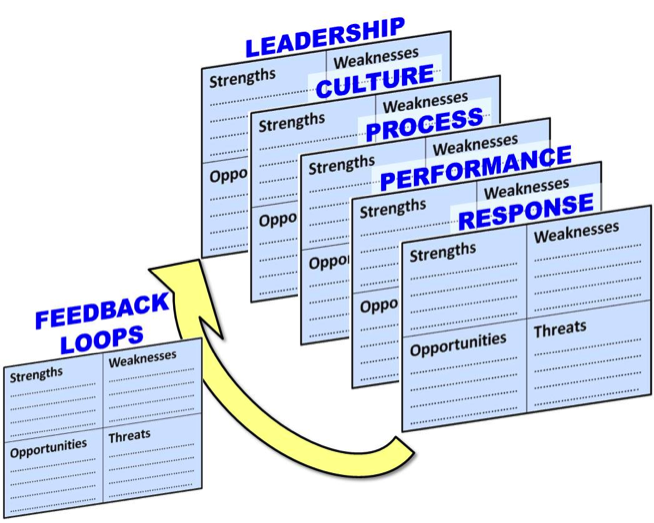
Summary of the SWOT analysis on the SWOT analysis A good SWOT should be provocative and assess the sensibility on your own strategies, track your efforts to solicit and address internal taboo talk rules, monitor employee frustration levels and assess your internal culture's momentum toward success or failure. Most importantly, do not forget to gather multiple perceptions on the above opinions from leadership, mid-management and non-management employees. If the perceptions are vastly different, determine why the same people under the same roof are describing the same company in very different manners. Transforming the SWOT into the foundation for disruptive innovation It must be stressed that an energized SWOT is only the foundation of a good strategic plan. It is not the final analysis or strategic planning tool. The annual corporate strategic planning cycle is usually time-consuming and interactive and must get off to a good start with the right tone if anything of value is to be expected. SWOT expansion to include internal cascading risks The biggest opportunities to achieving strategic objectives lie in the ability of leadership to identify, assess and manage the internal cascading connections and cause-and-effect relationships that exist. The main areas of internal, hyper-connected top-to-bottom cascading elements and loops include:
  • Leadership strategies, attitudes and behaviors
  • Cultural behavior
  • Process efficiency
  • Performance outcomes
  • Responses to shortfalls in performance metrics
  • Feedback loops to leadership that either incorporate lessons learned or ignore such lessons, offering the next cycle of adverse events the opportunity to sink the ship
Each of the above mentioned elements of internal cascades should be SWOT-ed separately with candid and honest inputs from all levels of employees (See graphic below). Embracing such logic allows leaders to create a cascading strategic plan that can energize the organization instead of just addressing the symptoms of issues with sugar-coated Power Point slides or adding a fresh coat of paint to the Titanic while it is sinking. Untitled Figure 1. Each element of internal cascades should be SWOT-ed separately with candid and honest inputs from all levels of employees SWOT expansion to include external cascading risk assessments External risks need to be listed, rated for connectedness and assessed for their impact and likelihood of affecting the business. This offers a good start for subsequent strategic risk management efforts. The World Economic Forum's annual Global Risk Report offers a good reference to use as a starting point for possible risks to consider. Separate SWOT analysis should be carried out for the six main areas of global risks:
  • Economic
  • Environmental
  • Geopolitical
  • Societal
  • Technological
  • Real-time feedback loops to leadership on the status and changes in global risks
Conclusion Organizations and the world are hyper-connected communities that are exposed to threatening invisible cascade, ripple and domino effects. Today's risks can easily leap past national borders, firewalls and other security safeguards and trigger very unexpected circumstances that can threaten the reputation and existence of the business. Modern applications of the SWOT analysis should consider this complex and cascading nature in which the world now operates. A thorough SWOT analysis can be a good start for any level of strategic planning, including the ultimate wish of any organization, which is to create disruptive innovation and value that will ignite the passions of its employees and customers.

David Patrishkoff

Profile picture for user davidpatrishkoff

David Patrishkoff

David Patrishkoff is president of E3 (Extreme Enterprise Efficiency) and the founder of the Institute for Cascade Effect Research. He is a Lean Six Sigma Master Black Belt and the inventor of a cascading risk management methodology that has patent pending status.

Breaking the Silence on Mental Health

Suicide and mental health need to be openly discussed in the workplace so that we can destigmatize the issues and prevent tragedies.

|
Shh, it's time for another round of “let’s discuss depression or suicide in the workplace." That’s right, shh. After all, we aren't supposed to discuss these issues. If we do, someone else may try to commit suicide. If we hush up the problem, maybe it will go away. So, help me to understand why we tolerate this silence with mental illness and not with any other medical condition. I think it is because mental health is a bit more mysterious and scarier than most other conditions. But mental health does account for a large percentage of the costs related to lost productivity ($51 billion). It generates direct costs of treatment of $26 billion a year[1] -- and “absence, disability and lost productivity related to mental illness cost employers more than four times the cost of employee medical treatment.”[2] We need to get over our fear and get the discussions out in the open. Only then will we have a chance to break the cycle. The goal of breaking the silence is already occurring on the high school level and is showing results. I realize that this is a different population, teen-agers, but talking about it really does matter in prevention. This most recently occurred in a high school in Crystal Lake, Ill., after two teen-age friends took their lives. The school and community leaders made a point of getting information to other students about the warning signs so that they could possibly identify those in danger and encouraged parents to talk with their teens about their grief. Leaders also provided grief counselors onsite and gave the students different options for grieving, which included holding vigils, providing groups and allowing for other forums of expression. This is an excellent model that can be adapted for the workplace in partnership with your employee assistance program (EAP). Here are some things employers can do for their workplaces after a suicide:
  • Openly discuss suicide and offer grief groups to anyone directly or indirectly involved with the people who took their lives. Make it okay to talk about the suicide. For more information on steps employers might take, go to “A Manager’s Guide to Suicide Postvention in the Workplace.”
  • Provide information about the warning signs so that employees can help identify others who might be at risk. Make sure that employees and their family members get information about resources that they can access for themselves, their family members or other co-workers. And stress the confidential nature of these sources. A great first step is the National Suicide Prevention Lifeline (800-273-TALK (8255)).
The best defense, however, is a good offense. To encourage prevention, I suggest the following:
  • Create a “mental health/wellness” friendly workplace that involves openly discussing mental health and stress and making sure that employees know that there is confidential help available.
  • Provide employees and managers with training on signs of depression, anxiety, etc. and encourage them to seek help if they or a colleague is showing any of these signs.
  • Have your EAP visible through consistent promotional efforts using print, email and social media.
  • Make sure that the company’s benefits plans have good mental health coverage.
I have been lucky enough to have spent the last 36 years in the field helping individuals and organizations become more open to dealing with psychological issues that may interfere with their professional or personal growth. And I have been amazed at how successful treatment can be when the issue is confronted head-on. As leaders in the insurance industry, those of you who subscribe to this blog are trusted advisers to the leadership and decision makers in organizations of all kinds. I therefore implore you to use these relationships to encourage them to face mental health in an open and forthright manner. Only when people are able to openly seek out help for mental health related concerns in the same manner that they seek out medical treatment for other issues will we be successful. [1] Managed Care Magazine (2006, Spring) Depression in the Workplace Cost Employers Billions Each Year: Employers Take Lead in Fighting Depression. [2] Partnership for Workplace Mental Health, A Mentally Healthy Workforce—It’s Good for Business, (2006), www.workplacementalhealth.org.

Bernard Dyme

Profile picture for user BernardDyme

Bernard Dyme

Bernie Dyme, a licensed clinical social worker, founded Perspectives, which provides workplace resource services to organizations internationally, including employee assistance programs (EAP), managed behavioral healthcare, organizational consulting, work/life and wellness.

If the Regulations Don't Fit, You Must…

The OECD is taking a shortsighted approach to consumer protection by recommending one-size-fits-all regulations across the globe.

International regulatory bodies like the G20 and the Organization for Economic Cooperation and Development (OECD) are still pining for recommendations for regulators on how to avoid another financial crisis like the one that engulfed the global economy in 2008. The groups are increasingly leaning toward stronger consumer regulations to prevent another catastrophe, just like sophisticated regulators in the U.S. and other countries across the globe. The OECD, unfortunately, is taking a shortsighted approach to its consumer protection recommendations by suggesting one-size-fits-all regulatory standards will work for every regulator across the globe. The OECD’s consumer protection recommendations won’t be issued, or received, lightly. And suggesting misguided regulations is dangerous. The guidelines will be (rightly) considered by regulators in nearly every country, despite their very different levels of sophistication concerning financial markets and consumer awareness. We’ve seen movement on one-size-fits-all policies in this area for years, most recently with Solvency II and capital standard policies under consideration in Brussels. The latest version we struggle with is a recommendation for regulators on how to consider the OECD’s High-level Principles on Financial Consumer Protection. The principles are focused on the following areas:
  • Legal, regulatory and supervisory framework
  • Role of oversight bodies
  • Equitable and fair treatment of consumers
  • Protection of consumer assets against fraud and misuse
  • Protection of consumer data and privacy
  • Competition.
And the OECD recently issued draft guidance (framed as a “toolkit”) to address how best to approach the recommendations. Of course, each principle offers broad recommendations on how to manage issues affecting intermediaries. These could ultimately hit broker remuneration, transparency requirements, cooperation among supervisors and the like. And if the draft recommendations gain momentum, our ability to educate our regulators and shape sound consumer protection policies could be diminished. That’s why the World Federation of Insurance Intermediaries (WFII) has been following the proposed “toolkit” closely. The federation issued a strong response to the OECD’s suggestions, rightly calling out the organization’s shortsighted approach and its assumption that regulators should approach with the same vigor businesses large and small and products designed for individuals, multinational corporations and companies located anywhere in the world. The comments filed with the OECD by WFII rightly stated: “the pure fact that an effective approach has been developed in a range of jurisdictions is, in our view, not an indication in itself that it is indeed an ‘effective’ approach. We believe that sound research, an impact assessment and a cost/benefit analysis should be undertaken each time by the regulator/supervisor of the particular jurisdiction before any of these so-called effective approaches summed up in this draft, regardless of them being categorized as a ‘common,’ ‘innovative’ or ‘emerging’ approach. We urge the drafting team to clearly include this need for sound research, an impact assessment and a cost/benefit analysis in the introduction.” The federation went on to suggest that applying the same guidelines to multiple industries can be dangerous, and it suggested to the drafters that the language clearly define when various sectors should be considered equally and when they should be treated differently. Perhaps the most relevant comment to our market is the federation’s position on regulating companies of widely disparate sizes and revenue models. The federation told the OECD that “proportionality is a fundamental principle that should be taken into account by all regulators and supervisors every time they consider imposing requirements on the financial sector. Given the importance of this principle, we believe requirements imposed on the financial sector should be proportional to the size of the market player and the complexity of its service.” The federation concluded its comments by suggesting regulators should engage market players and industry representatives with direct knowledge of the market practices as key rules are written. This point is particularly important for emerging regulators to consider, as their markets are among the fastest-growing in the world. A thoughtful and democratic approach to market guidelines ought to be encouraged to ensure their continued strength. Nearly every developed economy continues to struggle with how to avoid another economic collapse, and the OECD has a strong role to play by issuing sound recommendations. It’s our sincere hope the suggestions to scale back its one-size-fits-all approach are heard loud and clear. This article first appeared in Leader's Edge magazine.

Joel Kopperud

Profile picture for user JoelKopperud

Joel Kopperud

Joel Kopperud is the Council of Insurance Agents & Brokers’ vice president of government affairs. He focuses on legislative and regulatory activity affecting employer-provided benefits, property/casualty insurance regulation and federal natural catastrophe policies. He is a regular contributor to Leader’s Edge magazine.

How Medicare Can Heal Workers' Comp

Many problems begin in the "bizarro-world" of workers' comp medical care, but they can be resolved through a radical approach to Medicare.

Workers’ comp in every state should carve out its medical line and relinquish it to Medicare. The respective statutory systems for indemnity benefits would remain. This scenario, albeit challenging in execution, would correct the cause of many systemic workers' comp ills. First, we must admit that the root of most WC problems lies in the delivery of medical care. Workers’ compensation medicine inhabits its own “bizzaro-world,” often lacking both clinical science and common sense. This is not the fault of most medical practitioners themselves, but more because of the pervasive manipulations, exaggerations and legal stretching of sensibilities that defy the clinical standards used in other venues. The ubiquitous, counter-intuitive flaw is that WC medicine often is used to expand a claim rather than provide a cure. Anyone in the WC business can agree to the following truths as just a sample of medically related frustrations: – Most any study performed shows higher costs and worse outcomes in WC medicine than in other settings. Common injuries take longer to heal when they are WC claims. – Hearing judges regularly disregard clinical opinions in favor of subjective evidence. A common judicial outcome is to award illogical progressions, allowing diagnoses to expand as problems progress through various body parts. – Causal relationship has an extremely low and speculative threshold when injuries are combined with chronic overlays and co-morbidities. – Chronic conditions are accepted as arising out of incredibly specious initial traumas. – Multiple surgeries and lifetime narcotic regimes are embraced in the face of perpetual and repeated failures to cure, all to the general detriment of claimants' health. – Various entities have profit streams directly related to churning medical care. – Most of the pendulum-swinging effort in statutory legal reform amounts to limited attempts to control medical systems already tainted by legal gamesmanship. Therefore, the results don’t always support optimal clinical perspectives or patient well-being. WC professionals may have a jaded viewpoint and accept this nonsense as part of the game. I ask you to consider a world where WC medical care was a non-issue. How much conflict and cost could be taken out of the system? Let’s take it another step and consider ridding the current system of Medicare Set Asides (MSAs). We all know MSAs and their surrounding requirements increase cost, require added resources and waste temporary total disability (TTD) money in process delays. MSAs are a hijacking of any given state’s ability to allow compromise settlements over unproven causal relationships. In effect, when no one has determined direct causal relationship, MSAs simply decree all future care be paid, in advance, as an addendum to a settlement. Another terrible dynamic of this hijacking is how Medicare profits from the wild abandon in WC medicine, as a litany of future responsibilities can be attached to a claim absent a clinical “reasonable and customary” test by which Medicare itself might never accept such treatment requirements. Through the MSA process, Medicare enjoys an exceptionally advantageous position with respect to WC. However, the playing field can be leveled by giving Medicare every claim from day one. There should certainly be a direct reimbursement requirement from WC claim payers to Medicare for related care provided. I argue that this scenario would be much less costly and more efficient and fair than the current big-picture scheme that is WC medicine. Here are a few practical thoughts in application that require no big changes: -Medicare uses its current rules for “reasonable and necessary” to approve all care and to formally conclude treatment. Disputes can be handled via existing channels available through Medicare. – Medicare uses its current fee schedules. – Medicare uses its current rules for determining “chronic” conditions as opposed to curative treatment. This is the arbiter for otherwise obstinate, litigated maximum medical improvement (MMI) arguments and sets the bar for drawing down the WC reimbursement requirement and transferring a case to group health if continuing care is necessary. Here are additional suggested changes to support the concept: – Questionable causation or responsibility for migrating diagnosis could be given a percentage likelihood that would be applied to Medicare reimbursements. Independent physicians from opposing sides could put forth opinions, and a review process could establish the percentage applied to the life of the medical case. For example, a clinical consensus decrees that aggravated shoulder pain is 25% likely as due to job-related issues, and therefore future Medicare reimbursements from WC are 25% of cost. – Extent of disability and permanency could still be determined by state-sanctioned independent medical exams (IMEs) and litigation process. The difference would be limits on the opportunity to exploit medical opinion, as Medicare would refer for these opinions, and aspects of Medicare’s rules and controls and requisite threat of sanctions would govern the providers. – Medicare would need to categorize WC-preferred providers with appropriate qualification in occupationally related medicine. – The ability to actually settle medical costs would no longer exist in any state. – New employer insurance products or funding mechanisms could be invented to cover “Continuing Medicare Reimbursements” on certain classes of long-term claims where indemnity is fully closed, as well as the sporadic one-off future claims that might arise as allegedly part of an initial WC claim, with a “claims made” type of trigger. No more MSAs. In conclusion, this concept would profoundly improve WC in four ways: 1) It provides a nationally accepted level of care to injured workers. 2) It brings clinical common sense to an otherwise specious and manipulated system. 3) It ends the oppressive impact of MSAs. 4) It saves an incredible amount of direct costs, frictional costs and resources while reducing litigation. This idea is radical, but, among the calls to revise the grand bargain, it does not totally explode the current state system. I say, let the debate begin!

Barry Thompson

Profile picture for user BarryThompson

Barry Thompson

Barry Thompson is a 35-year-plus industry veteran. He founded Risk Acuity in 2002 as an independent consultancy focused on workers’ compensation. His expert perspective transcends status quo to build highly effective employer-centered programs.

Work Comp: Simpler Can Be More Effective

Work comp began life as a Hyundai but has evolved into a fully loaded Mercedes. Comp is no longer simple -- and simpler would be much better.

I was only home from WCRI's annual conference a little more than a day when I saw a reminder that "simpler" systems often offer more effective solutions than more complex ones that are supposed to make our lives better. It was a lesson that overlays easily on the world of work comp with its all-too-complex and rigid structures. My wife and I were returning home from breakfast at a local restaurant Sunday morning when we stopped by a grocery store for a quick errand. We had taken my wife's car, and as we stopped she took the opportunity to try to reset the auto's clock, because Daylight Savings Time had "sprung us forward" an hour the night before. My wife drives a 2013 Mercedes Benz. It is by no means a top-of-the-line Mercedes, but it still has a plethora of electronic systems and services customary in a luxury car of this day. The car must be stationary to access the clock controls and other system features, so this was a good time to tackle this task. I watched as she scrolled through the menus on her digital display behind the steering wheel, looking for the correct one. After a few moments, she remembered that her previous car, also a Mercedes, controlled the clock via the main instrument display gauge. The clock control on this Mercedes, on the other hand, was to be found via a large knob on the center console. That knob controls a variety of commands on the audio and information center display to the right of the instrument panel. She decided very quickly that trying to find the clock control was a hassle and that she would just "get it later." Juxtapose this scenario with my car, a 2009 Hyundai Santa Fe. To reset the clock for springtime DST on my unassumingly low-tech ride I simply need to press a button. Once. The clock in my car, near the top center of the dashboard, has three buttons next to it. One resets the clock to the next increment hour. The other two handle both hours and minutes on the clock. Pushing either adjusts the appropriate time segment with ease. Apparently, the Koreans who engineered my car, and the Alabamians who built it, are not as concerned with my safety as those overprotective Germans. I can change the clock whether the car is moving or not. I could be careening down the interstate at 90mph, cellphone wedged between my ear and my shoulder (no Bluetooth) and holding a doughnut firmly clenched in my left hand. A quick reach and push of a simple button still accomplishes on my humble Hyundai what others can only dream of -- an automobile clock set at the correct time. Admittedly, fall is more difficult, as I have to hold that button a few seconds while it scrolls forward 11 digits to actually set the clock back one hour. No AM or PM in my car, baby. The Koreans know I can tell the difference. Metaphorically, the workers' compensation industry, born of the grand bargain in 1911, started life as a Hyundai but has since evolved into a Mercedes. Nothing in comp is simple anymore. At the Workers' Compensation Research Institute Annual Conference, attendees were treated to a myriad of statistics and analysis related to a variety of topics in workers' comp. We learned that despite complex legislative efforts to control outrageous abuses by physicians who dispensed their own drugs, doctors in Illinois simply changed the dosages to bypass the law. We learned that states that set low fee schedules see increased costs because of more expensive office visit codes as well as an increase in doctors office visits. There were many similar topics and discussions, from California's independent medical review (IMR) process to Florida's exclusive remedy challenges. The entire conference highlighted the complexities of managing a process-intensive system that still at times manages to lose people through a somewhat tangled safety net. It is another perfect example of how complexity and process can eventually stumble and collapse under their own weight, and every attempt to fix the previous crisis simply adds more layers of complication, furthering the potential for failure and disappointment. Sometimes, simple is better. Pay doctors a fair wage, and reward the ones who perform the best by using them more often. This would stop much of the gamesmanship we see in the pricing of medical services today. Improve and facilitate communications between the employer and the injured worker. Better communication between these primary parties can reduce lost time and litigation. Train adjusters well, keep their workload reasonable and let them actually manage a claim. This would minimize dependency on a plethora of specialty firms, each performing specific tasks that empowered adjusters of yore used to handle. Streamline regulation, making the care of the injured the most important task rather than focusing on useless and resource-sucking paperwork. A simpler, focused effort in these areas would fairly quickly see improved results for all the players in comp that really matter. I can speak personally of the benefits of simplification. The car I owned prior to my Hyundai was a BMW Z4 Roadster, with sequential manual gearbox transmission. While it was an incredibly fun car to drive, I never could change the stupid clock. Setting it in that car was not dissimilar to following a pre-flight checklist for the space shuttle. It was much easier to leave it alone and let it only be right for 1/2 of the year. But while getting it right half the time may be acceptable for the clock in your car, it is an abysmal concept where injured human beings are concerned.

Bob Wilson

Profile picture for user BobWilson

Bob Wilson

Bob Wilson is a founding partner, president and CEO of WorkersCompensation.com, based in Sarasota, Fla. He has presented at seminars and conferences on a variety of topics, related to both technology within the workers' compensation industry and bettering the workers' comp system through improved employee/employer relations and claims management techniques.

Creating a Customer-Insight Strategy

While strategies supposedly begin with customers' desires, they mostly don't. A real customer-insight strategy needs to begin with three steps.

Too few companies have a customer strategy, let alone a customer-insight (CI) strategy. At least, that's my experience. In fact, many business strategies that I've seen, which seek to pepper their presentation with customer language, are really channel strategies or product strategies that reflect the silos in that business. This is unfortunate, as most CEOs would acknowledge the critical importance of having their business understand, acquire, satisfy and retain customers (ideally, converting them into advocates). But perhaps the lack of customer insight in strategies reflects that may boardrooms have not had an empowered and articulate customer leader (or, better still, CI leader) to identify the need and drive the change. As a small contribution to fill this gap, let me share a few reflections on what I have found helpful to consider when creating a customer-insight strategy. At its simplest, strategy is just a series of decisions about "what you are going to do." This mindset can help avoid too much theorizing with pretty diagrams and ensure your strategy leads to an implementation plan that can be executved. As a simple framework, it can help to consider three overlapping sets that you need to consider for a CI strategy: Strategic Alignment: Although a CI strategy can inform and guide business and marketing strategies (from an understanding of consumers, your target market, their perceptions, unmet needs and channel usage), normally those exist prior to creating a CI strategy. So, a first priority is to ensure alignment. How can customer insight help achieve the goals of the business strategy? What does the business need to understand better to deliver the marketing strategy? How can the work that aligns best with top strategic priorities be prioritized for the CI function. Is there other work that the CI function is doing that can be stopped or reduced given its low alignment with strategic priorities? All these elements should be thought through to decide what is included within CI strategy. Your business and marketing strategy have likely been shaped, at least in early stages by PEST (political, economic, socio-cultural and technological), SWOT (strengths, weaknesses, opportunities and and threats) and other tools to analyze internal and external factors. Similarly, in summarizing what the CI strategy should be (aligned to business and marketing strategies) it is useful to see what use of CI is working for others businesses (here, lessons can often by learned outside your sector) and summarize what CI work has been most effective previously for you (on the basis of commercial return and improved customer feedback). Both of these approaches should help identify priority work areas where CI can make a difference and help deliver the business and marketing strategies. Operational Effectiveness: This is all about organization and processes. How does the CI function operate? Once again, it is useful to both look internally, capturing what has really happened already, and externally (this time for best practice models). Given the relative immaturity of CI in academic terms and lack of common language or focus from "marketing experts,"' it can be hard to find the textbook answer for the customer insight best practice model. However, I have found a few of the benchmarking models used by technology research companies and marketing professional bodies useful and have produced my own (on the basis of 13 years experience in creating and leading such functions). However you come by a best practice model with which you are comfortable, your next step should be the familiar approach for gap analysis. Summarize your current practice, compare and contrast with the best-practice model and then prioritize the gaps you find. Prioritization here needs to be informed by what you will be using your CI function to achieve (as summarized in the strategic alignment section). This review and gap analysis should consider not just the processes for getting different items of work delivered but also the organizational structure of the team. Despite some leaders claiming the structure does not matter if you have a unifying vision and the right attitude, all my experience teaches me that it does. Human beings are inherently tribal, and the quality of CI output is strongly affected by inter-disciplinary cooperation. People Leadership: That mention of departmental structure brings us neatly onto focusing on the people in your CI team(s). Too often, strategy documents, even if they manage to translate the conceptual into the practical, fail to then consider the people side of change. To deliver the priorities identified in your strategic alignment review requires not just appropriate structures and effective processes but also the right people and culture. A good place to start can be a review of the current people in roles, comparing them with the ideal roles and skills required to deliver the work needed. Such a review should seek to consider people's generic competencies and wider skills than they may be asked to use in current roles, as well as critically assess their attitude and fit with the team. But beyond just the right individuals, success will depend on those people coming together to form effective teams, and that is more about culture than what is written down. I like to think of culture as "what happens 'round here when people aren't being watched." Various approaches have been tried to impose or encourage the culture wanted in a team, but I've found little works as well as empowering the people themselves to create the culture in which they want to work. An effective people leader is needed, who can communicate a clear vision and make decisions, but the leader will often be most successful when working with suitably skilled individuals to together define the team culture they want and how that can be encouraged. Truly listening to the wisdom of those doing the work, recognizing and rewarding the behavior sought and giving time to developing people and fixing environmental irritants will all encourage this. None of this is easy. But being in a position to articulate to your team and your boss and the board a coherent customer-insight strategy (which explains how it enables business objectives, operates effectively and gets the best out of the people in the function) can be powerful.

Paul Laughlin

Profile picture for user PaulLaughlin

Paul Laughlin

Paul Laughlin is the founder of Laughlin Consultancy, which helps companies generate sustainable value from their customer insight. This includes growing their bottom line, improving customer retention and demonstrating to regulators that they treat customers fairly.

The Insurance Agent of the Future?

Maybe homeowners will immediately adapt to apps that reduce risks, but big data may create a role for the insurance agent of the future.

|

Recently, my 80-something mother bought an iPad to replace one of the first models, which is now obsolete (can’t upgrade the iOS!). So, though she is an always-with-some-trepidation user, she’s no Luddite. After her second day with the new device, she called me with some alarm to say that someone named Siri was trying to hack into her iPad. This got me thinking about big data and the role of the insurance agent in the future. My thinking goes something like this…

Insurance Agent of the Future

Insurance of the future will be beyond indemnification for losses (at an actuarially fair price, of course) and will include loss reduction in some way, whether through direct action or indirect advice.

Let’s think about home automation and monitoring systems, a.k.a., the connected home, or "telematics for the home," delivered through companies such as Keen, SNUPI and Revolv. Think thermostats, video cams, carbon monoxide and fire/smoke detectors, storm shutter and roof single sensors, refrigerator and freezer sensors, door lock sensors, etc.

The capabilities are going to be integrated and will involve big (data). Some company – maybe insurance companies, maybe those giant B2C companies like Google and Amazon, maybe some others – will take all that data and present it back to the consumer in an intelligent manner.

Here is where loss reduction becomes very interesting. Companies could take direct action through automated activation of alarms and shutdown of systems when storms are approaching. Indirect advice might mean notifying a homeowner of unlocked doors, foot traffic in the house and refrigerator doors opening and closing.

Where does the agent come in? Maybe Google or Amazon and ADT will just get this all to simply work: Download the app, and it tells you what to do. But maybe the consumer will want some help with all this data and all this activity: what filters to tighten, what sensors to de-activate and what data is needed to get the right coverage at the right price. Maybe the Geek Squad needs to morph to the Home Monitoring Squad. And the Home Monitoring Squad sure sounds like the possible insurance agent of the future – tech-savvy, risk-savvy and comfortable conversing with 80-year-olds.


Steve Kronsnoble

Profile picture for user SteveKronsnoble

Steve Kronsnoble

Steve Kronsnoble is Wipfli’s insurance industry practice leader, helping companies gain actionable insight from data, understand and serve their customers, react quickly to economic and competitive changes and modernize technology to support their business objectives.