Download

10 Commandments for Young Professionals

Young professionals in insurance need to find the right mentor, make the right friends, network with the right people and...well, read the list.

  1. Thou shalt start working on CPCU right away, and join the society.
  2. Thou shalt network often both in the company and in the industry.
  3. Thou shalt seek at least one mentor.
  4. Thou shalt never think of thyself as an hourly employee; for young professionals, that is merely a temporary condition.
  5. Thou shalt honor traditions while always challenging the status quo.
  6. Thou shalt make friends in IT and claims and with the admins of the leaders you admire.
  7. Thou shalt always keep an up-to-date LinkedIn profile.
  8. Thou shalt read the Insurance Journal, PC360, National Underwriter, Insurance Thought Leadership and a trade journal for your corner of the industry.
  9. Thou shalt never bad mouth insurance in public.
  10. Thou shalt encourage other talented people to join our industry.
  11. A bonus one: Thou shalt follow Tony Canas on TwitterFacebook and LinkedIn!

Special thanks to Carly Burnham, CPCU, Avolyn FisherTaylor ReedAndrew Holland, CPCU and Andrew Cross, who helped edit this list.


Tony Canas

Profile picture for user TonyCanas

Tony Canas

Tony Canas is a young insurance nerd, blogger and speaker. Canas has been very involved in the industry's effort to recruit and retain Millennials and has hosted his session, "Recruiting and Retaining Millennials," at both the 2014 CPCU Society Leadership Conference in Phoenix and the 2014 Annual Meeting in Anaheim.

The Dangers of Public Segmentations

Public segmentations can lead to insights into groups like Millennials but can lead to overgeneralizations and can be manipulated.

Recently, it seems that developing public segmentations of your customers or citizens and then sharing it for all to see is becoming fashionable.

In part, this is to be applauded and welcomed.,/p>

The trend highlights a key tool within the customer insight toolkit, encourages greater focus on understanding people and embraces the need for greater transparency. However, there is also an inherent risk, that readers fail to understand the purpose, design and limitations of such segmentations and thus unwittingly apply them where they will not help.

This reminds me of a time many years ago when psychometric segmentations were very popular in business circles. Myers Briggs (MBTI) and many other profiles were enthusiastically applied and team members categorized into their "type." Sadly, all too often, this perception about some important differences between team members was filed away following the team-building exercise and never used again. Screening interview candidates via psychometric segments was also "flavor of the month" at one stage, although I hear it being much more rarely used now (or only as part of a mix of "facts" to be considered).

Perhaps part of the problem can be a misunderstanding of the role of segmentation. As posted previously, segmentation is just one of a number of statistical tools available, and each segmentation will be designed to achieve a particular purpose. For this reason, more than one segmentation of customers may be entirely appropriate and insightful for a business that is able to handle such complexity (though most business leaders dislike this idea).

But let's return to reviewing some of those recently published public segmentations. The first one I want to consider is the Consumer Spotlight segmentation published by the FCA.

While this appears a useful segmentation to help the FCA understand and focus on more vulnerable segmentation with regard to financial understanding or access, it is also important to recognize its limitations. A 10-segment model will only ever be appropriate for understand macro attitudes and behaviors. My own experience of segmenting consumers within different product markets tells me that both attitudes and behaviors can vary widely once you drill down to specific needs or products. So, it's important to realize that this segmentation has been designed to focus on dimensions like vulnerability, detriment and financial risk. Thus it is most relevant for the FCA itself, to help target communications.

A second example is a commercial business taking such a public approach to sharing a segmentation. It is the Centre for the Modern Family segmentation funded by Scottish Widows.

This is another interesting segmentation, as it seeks to highlight and track changing social attitudes, family structures and pressures on modern families of many different types. However, once again it is important to realize the limitations of this survey. It is an attitudinal segmentation, constructed from a combination of "qual and quant" survey results, interpreted by an expert panel drawn from academia, social care and commerce. As such, this is a subjective perspective evidenced by self-reported attitudes and behaviors. Although such an understanding can be very rich, the inability to overlay this segmentation onto customer databases means that actual behavior cannot be verified or targeted actions or communications executed (often a drawback of attitudinal segments).

My final example is from the UK government. There are two I could have chosen here, as they have also recently published a segmentation on "climate change and transport choices," but I've chosen to highlight the segmentation exercise published in regard to the problem of digital exclusion.

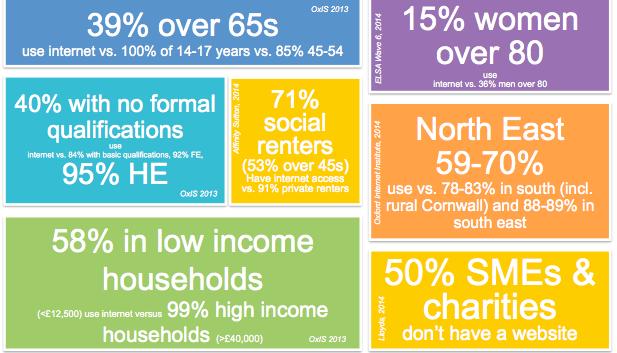
Once again, it's encouraging to see this segmentation exercise being undertaken and the transparency regarding approach and progress. However, it does also appear to run the risk of a number of other "hybrid segmentations." That is the risk that certain differences highlighted in various research studies or other sources are "cherry picked" to construct a patchwork quilt of apparently rich understanding that is not evidenced on a consistent basis. This can be seen in the infographic embedded in the above article. Even constructing a behavioral/demographic framework for a segmentation on that basis and then consistently surveying each segment runs the risk of masking important differences because of the averaging effect of artificially constructed segments. It will be interesting to see how government advisers and agencies avoid those risks.

I hope you found that interesting and are also engaged with the level of focus on segmentation in today's government and media. If these are approached carefully and interpreted appropriately, they should be another driver of greater influence and seniority for customer insight leaders. That is our cause celebre.


Paul Laughlin

Profile picture for user PaulLaughlin

Paul Laughlin

Paul Laughlin is the founder of Laughlin Consultancy, which helps companies generate sustainable value from their customer insight. This includes growing their bottom line, improving customer retention and demonstrating to regulators that they treat customers fairly.

Managed Care Isn't Managed or Care

Managed care started out as a straightforward concept but has mutated into shadowy deals that cost employers. It's time to get angry.

It is time to get angry. I plead with you all to recognize the king’s new clothes as he stands indignantly naked between the 300-pound gorilla and the elephant in this room called workers' compensation. I am hereby calling out an industry that has turned "managed care" into "manipulated cost," with a shameful lack of transparency and a churning mass of workers' compensation claims.

Decades ago, the cottage industry of bill review provided a legitimate and needed service directly between healthcare provider and payer. Fast forward to the scheme that has evolved, with some healthcare networks and other consortiums that purchase services conspiring with some insurers and third-party administrators (TPAs). These arrangements may set up shadowy deals where medical goods and services are marked up by intermediary agents and where perpetrators split the profits -- at the expense of unknowing employers.

Sadly, there is little outrage from employers. Perhaps the amounts seem negligible while the methods seem to be an acceptable cost of doing business. Risk managers have so much else to think about. Maybe managed care is considered to be essential, so no one in their right mind would question it.

I believe the employer-buyer holds a false sense of security that we need to get beyond. The drip-drip-drip of money siphoned from actual employee care needs to finally strike a collective nerve so that real change can happen. To that end, I want to list some considerations that I hope will spark outrage and lead to change.

Quick Tip: Managed Care Food for Thought; Indigestion Guaranteed:

Cognitive Dissonance: Claims providers justify bill-review fee schemes based on the notion that there are no controls from provider-sources… but wait a minute… they also take network fees because they apparently can control bills from provider sources! Anyone feel mildly conflicted trying to reconcile this logic? How can both facts exist?

Deliberate Mystery: Bill review as founded decades ago should no longer be necessary. Today's technology obviates the premise that all WC bills need to be hand-checked against a fee schedule or that licenses for CD-ROMs holding schedules or “reasonable and customary” data are valuable. When it comes to group health, providers make it their business to know what deductibles and reimbursements apply while you stand at the window. Why is WC a deliberate mystery?

Technology Hypocrisy: The WC claims industry purports to have data and IT capability that can predict and fast-track claims, allowing ever higher (arguably untenable) adjuster caseloads, yet when it comes to monitoring fees pretends we are still in the 1990s. I submit that today's technology can lock healthcare providers into correct billing. Aggregate provider monitoring/auditing by the adjusting entity can support accuracy. High automation and negligible cost should make fee oversight an included aspect of claim service, with network affiliation requiring providers to contribute to the technology. As our national provider base moves into more hospital-centered conglomerates, there are far more IT resources available on the provider end.

Core Responsibility: TPAs and insurers are paid to adjust benefits per state statutes. But charging a percentage of savings for medical care in a state with a fee schedule is as ridiculous as would be charging a percentage of "savings" for reducing an average weekly wage to the statutory comp-rate. What is the difference when it comes to core claim adjusting obligations?

No Repeat Value Added: We can agree that complicated in-patient bills are worthy of review and that fees for that review are justified. But there routinely are recurring bills from the same providers on the same file. After the initial adjustment, why should claim payers charge a fee for adjusting the exact same bill repetitive times? Seriously… there is no value added in charging for a task already performed. Here is an exercise: Look at your claim payment register to see the same $1.15 bill review fee and $5.32 network fee charged on the same $48 physical therapy bill over and over and over. Maddening, isn't it?

How Would You Feel?: Let's make it personal. What if your homeowners or auto insurer mandated your use of a repair-provider-network? Your damaged car gets fixed, and you are presented with a bill marked up by the network -- not knowing what the actual body shop charged. You pay your deductible, leaving "profit" for your insurer and network to split… Hmm…

Low-Quality Reality: Network discounts have come to roost, leaving healthcare provider frustration high and quality of care low. I submit that higher quality deserves higher fees.

New Network Charge: Efforts to define, seek and sustain quality should be at the forefront of network effort. Can you imagine providers competing based on quality to join exclusive, well-paying networks? Astute, unbundled and self-administered employers that seek medical quality often pay more with confidence and get better results. Today's bundled programs beget providers willing to work cheap and approach profit on a volume-of-treatment basis. More visits means more weeks/months/years open equals more money for the entities otherwise trusted to resolve claims. Isn't this reality the opposite of what should be managed care?

Employers… Get angry: Start asking questions and making demands. Let's start with disclosure of end-provider fees. Ask your legislators to crack this issue open and make corrections accordingly. I call upon some major broker to take the lead and create a "Managed Care Bill Of Rights." Wouldn’t that be a great distinction?

Bottom Line: The insurance/claims/managed care industry cannot beg for the trust of those served while skimming treatment dollars. Fix the problem.


Barry Thompson

Profile picture for user BarryThompson

Barry Thompson

Barry Thompson is a 35-year-plus industry veteran. He founded Risk Acuity in 2002 as an independent consultancy focused on workers’ compensation. His expert perspective transcends status quo to build highly effective employer-centered programs.

3 Main Mistakes in Change Management

When it comes to transforming core systems, change management can play a crucial role -- but only if you avoid some common errors.

In my last blog, my engineer self admitted that the root causes for why core systems replacement projects don't hit the mark in the business case are more likely related to people, not the technology. I stated that the business only changes when individual contributors each do their jobs differently. Now let’s take a more detailed look. There are many models out there that provide a framework for understanding change. One that we use frequently at Wipfli is the Prosci model, which is focused on understanding change at the individual level. Boiling it down to its simplest form, this model says the change must progress for each individual from awareness to desire to knowledge to ability to reinforcement. Understanding that, Mistake #1 to avoid is measuring the need for change management based on executives’ paths, not their people’s. The executives responsible for the program and ultimately for the change management strategy, approach and investment are by definition the leaders furthest down their own change paths. That is, they are, in all probability, way beyond the awareness and desire stages. (Hint, hint: That’s why this core systems project is underway). And, not uncommonly, because of where they are, they may not understand the need to make a significant investment in change management. Once you embrace the need for change management, there are an array of tools and techniques at your disposal. These include communications, sponsorship, coaching, training and resistance management. Mistake #2 to avoid is loading everything into communications as a one-and-done approach. In fact, I would guess that when most of us hear the term change management, we immediately think of communication. That’s good because change starts with awareness. But did you know that it takes something like five to seven communications for a message to be truly heard and understood by all? Remember that perfect project kickoff email you sent last week that summarized everything perfectly? Yeah – maybe 20% of your audience remembers it today. So communication must be multiple messages using multiple channels coming from multiple stakeholders. Multiple studies over the years have reaffirmed the significant correlation between a project’s success and change management’s impact and, more specifically, the importance of the project sponsor's role in both. Succinctly, the earlier the project sponsor is engaged in the project and the earlier the project sponsor embraces change management, the better the chance for success. Mistake #3 concerns the project sponsor and her change management role. Just because you have a smart and engaged leader as your sponsor, don’t assume she knows what’s supposed to be done every week in a transformational core systems project if she hasn’t played that role before. For example, does the project sponsor know to build a coalition among the key managers and supervisors whom the affected employees will most want to hear from? At the end of the day, the employee will turn to his immediate boss and not the project sponsor to really get the WIIFM (what’s-in-it-for-me). You get the idea. As much as agile project management and delivery approaches and methodologies have been embraced, used and hardened over the past 10 years, we need to do the same for change management.

Steve Kronsnoble

Profile picture for user SteveKronsnoble

Steve Kronsnoble

Steve Kronsnoble is Wipfli’s insurance industry practice leader, helping companies gain actionable insight from data, understand and serve their customers, react quickly to economic and competitive changes and modernize technology to support their business objectives.

The Power of the Right Prototype

There's that moment during a prototype presentation when everything in the room changes. Eyes light up. People lean forward in their chairs.

|

I'm a long-time advocate for leveraging prototypes and demos in the enterprise to explore ideas and emerging technologies. And, there's a particular reason. It's that precise moment during a prototype presentation when everything in the room changes. Eyes light up. People sit forward in their chairs. The conversation shifts from potential problems to possibilities. Executives become transfixed with ideas of transformation. The power of prototypes to persuade is undeniable.

The practice of prototyping has typically been isolated in certain pockets of the organization. However, as technology purchasing is distributed across the company, more executives can benefit from the prototype's ability to put an idea or technology into the context of the business. Through a prototype, a technology once considered the latest consumer fad turns into a vehicle to advance enterprise innovation. Prototypes make a big, amorphous idea personal, relatable and feasible.

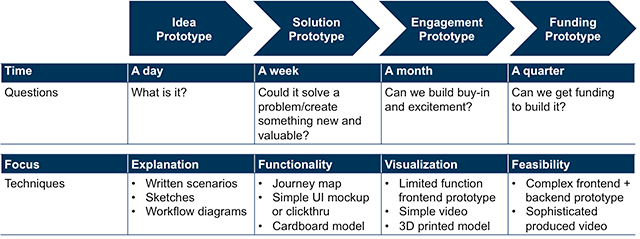
I was recently onsite with a client who was keen on prototyping, and the first question I asked was: Why? Not because I was skeptical that prototyping would work. Understanding the why behind a prototype is imperative for picking the right prototype for your project. Different business drivers demand different types of prototypes, and prototypes often need to evolve as the lifecycle of the idea or technology matures. Prototypes are more than rough first productions of an object. Prototypes span the dimensions of physical, high-technology and digital and can take various forms; even a workflow diagram can be considered an early prototype.

Prototype-table

For example, PwC used digital story telling via video to communicate our vision of the future of shopping as well as to portend the potential impact of wearables on the insurance industry. In this case, video was the most effective prototyping medium because the technology is already available in the marketplace. The impetus was more on inspiring executives to realize what is possible vs. testing the technology's capability or feasibility. By contrast, when a client asked us to explore the use of sensors for increasing business intelligence, we built a smart refrigerator to test the feasibility and usability of the technological components in physical form, given that the Internet of Things is a nascent technology. A particular area of focus was exploring the transmission of data via the cloud.

Challenges With Getting Started

As businesses expand their prototyping programs, they will face challenges. Here are some of the obstacles they will need to scale.

1) New Skills. Prototyping requires a combination of creative design skills and rapid iterative development skills. Most companies have yet to cultivate these skills. Our 6th annual Digital IQ survey of nearly 1,500 business and technology executives found that only 19% of respondents rated the IT's prototyping skills as "excellent."

2) New Prototyping Processes. Traditional business processes like building a business case and determining an ROI don't apply to prototyping. Businesses must find new ways to plan, fund and evaluate prototyping initiatives, such as the ability to identify the next new opportunity for growth, efficiency and effectiveness. How many ideas were generated, how many advanced to the next stage and how many ideas were taken to market?

3) A New Understanding. Executives need to understand why prototyping is vital in today's fast-paced business climate, and the word needs to spread like wildfire across the enterprise. The good news is that it only takes one prototype presentation to turn someone into a believer.

Technology is touching every aspect of our lives, and businesses must constantly explore ways to better engage customers, employees and suppliers. Technology is moving too fast for companies to wait until a vendor hands them the next version of their product or service. Prototyping is no longer reserved for a handful of companies that are considered the kings of creativity. It’s necessary for all companies.


Chris Curran

Profile picture for user ChrisCurran

Chris Curran

Chris Curran is a principal and chief technologist for PwC's advisory practice in the U.S. Curran advises senior executives on their most complex and strategic technology issues and has global experience in designing and implementing high-value technology initiatives across industries.

3 Steps Toward Better Meetings

How often did you attend a meeting in the last week without knowing why you were even there? Better meetings are possible -- and necessary.

How many meetings did you attend last week that lacked a specific agenda, started late and then ended late? How often did you attend a meeting without knowing why you were even there? How many meetings actually resulted in a new idea or significant decision?

With about 11 million business meetings occurring each day, one thing is clear: Meetings are a mainstay of business culture. When they are conducted effectively, they inspire and ignite innovation and lead to higher-performing teams and a stronger bottom line. When they are ineffective and irrelevant, they plague all of us with the notion that this time together was wasteful, costly and inefficient.

Too many meetings fail to generate any meaningful return on the investment of our time and energy. And they undermine our productivity. Our meeting-intensive culture forces people to complete their work in the margins of their day-early in the morning and late at night-hurting their health, motivation and work-life balance.

Something has to give.

It is time for better meetings. It is time for a meeting revolution.

Start the revolution by questioning the value of each meeting you attend, by preparing for your meetings and by ensuring that the right people, and only the right people, are invited.

1. QUESTION THE VALUE OF EACH AND EVERY MEETING YOU ATTEND

Instead of automatically accepting the next meeting request, pause and consider the meeting's return on investment for you. Ask yourself:

  • Will this meeting assist me in achieving my goals?
  • How does the purpose of the meeting align with the company's strategic priorities?
  • What contribution can I make in the meeting?
  • Will anyone even notice if I'm not present?
  • Will this meeting be energizing, or will it suck the life right out of me?
  • Will this meeting be a rehash of the last five meetings I attended?
  • Is attending this meeting the highest and best use of my time right now?
  • Remember, every time you say yes to one thing, you are saying no to something else.

2. SUCCESS AND EFFECTIVENESS DEPEND ON YOUR PLANNING

As you prepare for your next meeting, ask yourself the following questions:

  • Why do we need to meet?
  • What is the purpose of the meeting?
  • Is this an informational, decision-making, problem-solving, brainstorming, team-building or instructional/skill-building meeting? Or a combination of a few of these?
  • What is the outcome I want to achieve as a result of this meeting?
  • Is there an alternative format I can use to achieve the outcome?
  • If a meeting is essential, what is the ideal meeting format to achieve the meeting outcomes-an in-person meeting, a virtual meeting or a combination of the two?
  • Who needs to attend the meeting?
  • What information do I need from the attendees?
  • What do the attendees need to know or complete in advance of the meeting to achieve the outcome?
  • What expectations do I have for the meeting attendees regarding preparation and participation? How will I communicate these expectations?
  • What is the ideal length of the meeting to accomplish the stated purpose of the meeting?

Use your answers to guide you in planning and preparing to have better meetings.

3. INVITE THE RIGHT PEOPLE AND ONLY THE RIGHT PEOPLE

To think about who to invite to your meeting, start by recognizing that there are four types of meeting attendees: the decision maker, the influencer, the resource person and the executer.

  • The decision maker is the primary authority.
  • The influencer has the pull and network within the organization to advocate and popularize meeting decisions and initiatives.
  • The resource person has specific knowledge, skills and expertise needed to inform the decisions and create plans for executing those decisions.
  • The executer has the knowledge, skills, resources and authority to successfully complete the work resulting from the meeting.

An ideal meeting has each of these types in attendance. Of course, one person can represent multiple roles, and more than one representative of a specific role may be required. For example, you may need three executers to complete a complex project discussed during the meeting.

To determine who really needs to attend the meeting, ask yourself:

  • What is the meeting outcome?
  • Who in the organization must be present to achieve the outcome?
  • Who is the decision maker?
  • Who is the influencer?
  • Who is the resource person?
  • Who is the executer?
  • If there are people who will not be invited to the meeting but who have been invited to similar meetings in the past, how will I communicate my rationale for excluding them?

Without the right people in the meeting, nothing will be accomplished, and everyone's time will be wasted. To have better meetings, invite the right people and only the right people.

A decision maker is not necessary to start a meeting revolution. A meeting revolution starts with one person choosing to do something differently and then communicating with colleagues about why she has chosen a different approach.

Thirty-seven percent of employee time is spent in meetings. So, when you choose to lead a meeting revolution, you are not only ensuring that this investment of time and energy generates a significant return on investment, you're also giving your team time back to do the work they're good at, the work they're hired to do and the work that will grow the business.

What can do you right now?

  • Here's a game-changing question for you: Are you a planner, prioritizer, arranger or visualizer? Find out your productivity style in less than 10 minutes; take my free productivity style assessment.
  • Want to take it to the next level? Share the assessment with your team, then start a conversation about your respective productivity styles and what you each need to work well.

Share your thoughts on how these strategies worked for you! Please leave a comment on this post.

This article originally appeared on fast company.com.


Carson Tate

Profile picture for user CarsonTate

Carson Tate

Carson Tate is a productivity consultant and the founder of Working Simply. She is the author of <em>Work Simply: Embracing the Power of Your Personal Productivity Style.</em> She serves as a coach, trainer and consultant to executives at Fortune 500 companies, including AbbVie, Deloitte, Wells Fargo and United Technologies.

How Big Data Can Transform Auto

Big data can already tell you: if you need more staff in the field, what historical repair costs are by year, make and model -- and more.

Big data is everywhere and is becoming more powerful in every aspect of our daily lives. The hunger, and ability, to parse and analyze diverse data sets goes to the highest levels of our government, large corporations and even start-ups, which are finding ways to add immense value. Although we in the claims industry are not involved in international intrigue or attempting to create a surveillance network, we can harness data to effectively influence our decisions. This will ultimately achieve better outcomes by putting specific files in the most skilled hands, streamlining processes and eliminating unnecessary touch-points. As technology continues to advance exponentially, the auto claims process can be radically improved. For many years, auto insurance claims departments squelched innovative thinking, in favor of tired cost-cutting measures. The departments would look at cycle time, average appraisal cost, repair cost, parts usage and total loss option documentation, but these data points are only a small portion of the picture and don't fully address or reveal the root causes. To get to that, we need to dig a bit deeper. Today, so much more data can be effectively captured and analyzed that a  claims manager could nearly predict outcomes and channel resources for the best results. Need more staffing in the field? What are the historical repair costs of a certain year, make and model with a matching impact location? Where are higher labor rates going to result in more total losses? Which companies allow their policyholders excessive rental on subrogation demands? Here are a few examples of how auto claims technology and resulting data can be channeled to improve workflows, eliminate unnecessary touch points and create a more efficient process.
  1. Predictive Dispatching. Imagine putting the right claims into the right hands every time. Through predictive modeling based on a series of data points, the likely repairability of a vehicle can be ascertained to a solid degree from first notice of loss. Combine that with a robust dispatching solution, and the right field representative could be sourced based on factors such as; closest location, past performance, experience levels, historical cycle time results, CSI ratings, estimating software platform, workload volume, current volume for the day and comparisons with other representatives. Algorithms can instantly give the file to the person who is most likely to provide the best outcome. Should the file qualify for a self-service type claim or even trigger a potential total loss, the appropriate resources can be called into action, thus saving money and wasted time.
  1. Subrogation Demand Analysis. Why do some insurers focus intently on the front end of a claim to ensure accuracy yet will accept subrogation demands from carriers without the same scrutiny? Sure, much of the disconnect may be because of the compartmentalization between various departments within a claims organization, but, with data analysis, subrogation reviews can be parsed, reviewed and stored to track trends. Which companies overpay their insureds for rental when the repair is minor? Do a large number of your files end up in arbitration? If so, what are the triggers? Data can even catch potential fraud if, say, a VIN has been reported multiple times for the same damage.
  1. Where and when? For quite a while now, most digital cameras have had information embedded in each photograph. With the spread of smartphones and tablets, geocode location data can also be included. What does this mean? If detailed photo information is needed, oftentimes exchangeable image format (EXIF) data can document what brand of camera took the photo, the time it was taken and the exact coordinates. This means a field representative's day can be reconstructed or a re-inspection date can be confirmed to ensure the condition of a vehicle at a specific point in time. While it’s never guaranteed that every phone or camera will provide the exact EXIF information, adjusters will find that, in most situations, a lot of valuable information can be gleaned.
  1. Claim delay analysis. In auto claims, the standard cycle time for a vehicle damage inspection is 48 hours. Can this always be achieved? If each step of the appraisal process is documented from assignment to completion, any issues and resulting data points along the way can lead to a treasure trove of information. You might discover that an incorrect phone number or vehicle location leads to 25% of all delayed files. This would be a valuable training tool to discuss with adjusters, stressing the importance of documenting accurate information before a dispatch. On the other hand, data may show that a certain percentage of files are delayed because an appraiser is overloaded. This could lead to an immediate focus on better allocating field resources. Capturing and recording specific data points along the way can serve as a tool to detect bottlenecks, inefficiencies and areas for process improvement.
  1. Location volume analysis. Do you need to increase your field staff? Just think if you could pull up a map at a moment's notice and track volume in a certain location. You could track average repair costs in various zip codes, cities and states and break the information down to an even more granular level. Detailed data can be run over time and compared with newly written policies to predict staffing needs in certain areas before the losses even occur. Think about doing this in real time without needless Excel files and manual processes. This can help in forecasting and budgeting for future years, enabling efficient management and allocation of expenses.
Data, when simplified and made usable, is incredibly powerful. Nary a one of us leaves the house today without a smartphone in his pocket packed with valuable data: phone contacts, mapping directions, family photos, etc. In the claims industry, we must likewise surround ourselves with data, innovating and developing in ways that will let claims leaders manage from quantifiable data instead of basing decisions on emotion and misperceptions.

Ernie Bray

Profile picture for user ErnieBray

Ernie Bray

Ernie Bray, chairman and CEO of ACD, has more than 20 years of experience in the insurance and automobile claims industry. Bray is a dynamic force in driving innovation and technology to transform the auto claims industry and connect a highly fragmented business sector.

3 Ways to Fix Operations Reports

Operations reports are a paradox: Business users ask for information, but what they need is advice. Here is how to help.

In a prior life, I worked as a business systems analyst for a global hard drive manufacturer. After successfully navigating the Y2K crisis, we found ourselves inundated with custom report requests. We did an analysis and found that our enterprise system had more than 2,000 custom-coded operations reports, only 70 of which had been run in the last 90 days. Of course, the actively used operations reports were the source of endless user complaints and enhancement requests. That's how we knew we had a good report: Complaints signaled actual use. Perhaps you've heard this broken record before; it happens everywhere.

It's not hard to understand how this happens. A business person is trying to make a decision. Do I have enough resources? Are there bottlenecks I need to address? Was the process change I made last month effective? To guide the decision, she needs information, so she asks for a report. In the change request, she identifies data fields and recommends an output format. If the report is done well, it helps her make her decision. But that's not the end of the story. Once the decision is made, the business person needs to make the next decision. Now that I know I need more resources, where should I position them? Last month's process change wasn't effective, so what can I do now? The old report becomes obsolete. The person needs another report (or an enhancement of the one requested). Rinse and repeat 20 times for 100 business users, and you get what we had: roughly 100 active reports and 1,900 inactive ones.

Let's face it, operational reporting is like fighting a land war in Asia. There are no winners; there are only casualties. Although some reporting is unavoidable, there are three things you can do to drive improved business impact:

Get closer to the decision: Business users may request information, but they're looking for advice. Put the effort into understanding the decisions they are trying to make. It will affect how you conceive your solution.

Apply the 20/80 rule: Providing information is an infinite and unending task. Put 20% of the effort to get 80% of the business value. Then take your savings and…

Invest in innovation: Stop reinforcing outdated paradigms. Columns and rows are food for machines, not humans. Data visualization, advanced analytics, social media and external data sources – the opportunities abound. Save some capacity to pursue them.

Operational reporting is a paradox: Business users sometimes get what they ask for, but they never get what they need. What they ask for is information; what they need is advice. The historical paradigm for reporting is primarily financial: a statement of fact, in a standard format, used by external parties to judge the quality of the company. A financial report has no associated internal decisions – the only purpose of a financial report is to state unadulterated fact. Operational reporting, on the other hand, is fundamentally about advice. A business person needs to make a decision to influence the financial outcomes. The facts are simply just a pit-stop on the journey toward a decision.


Eugene Lee

Profile picture for user EugeneLee

Eugene Lee

Eugene Lee is vice president of data and analytics at Guidewire Software, serving as the business leader for Guidewire’s analytics solutions. He uses internal and external data sources to lead innovation and deliver analytical insight to improve the quality of business decision-making across the property and casualty insurance industry lifecycle.

Best Practices for Predictive Models

With predictive models, many think the sole issue is picking the right technology, but the details of implementation are crucial.

|

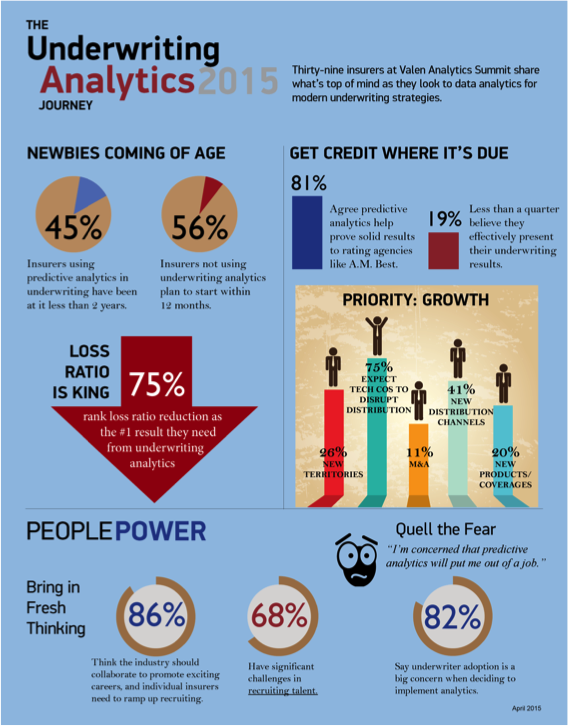
There's little doubt about the proven value in using predictive analytics for risk selection and pricing in P/C insurance. In fact, 56% of insurers at this year's Valen Analytics Summit that are not currently using predictive analytics in underwriting plan to start within a year. However, many insurers haven't spent enough energy planning exactly how they can implement analytics to get the results they want. It's a common misconception that competitive advantage is won by simply picking the right model.

In reality, the model itself is just a small part of a much larger process that touches nearly every part of the insurance organization. Embracing predictive analytics is like recruiting a star quarterback; alone, he's not enough to guarantee a win. He both requires a solid team and a good playbook to achieve his full potential.

The economic crash of 2008 emphasized the importance of predictive modeling as a means to replace dwindling investment income with underwriting gains. However, insurance companies today are looking at a more diverse and segmented market than pre-2008, which makes the "old way of doing things" no longer applicable. The insurance industry is increasing in complexity, and with so many insurers successfully implementing predictive analytics, greater precision in underwriting is becoming the "new normal." In fact, a recent A.M. Best study shows that P/C insurers are facing more aggressive pricing competition than any other insurance sector.

Additionally, new competitors like Google, which have deep reservoirs of data and an established rapport and trust with the Millennial generation, means that traditional insurers must react to technologies faster than ever. Implementing predictive analytics is the logical place to start.

The most important first step in predictive modeling is making sure all relevant stakeholders understand the business goals and organizational commitment. The number one cause of failure in predictive modeling initiatives isn't a technical or data problem, but instead a lack of clarity on the business objective combined with a defect in the implementation plan (or lack thereof).
red

ASSESSMENT OF ORGANIZATIONAL READINESS

If internal conversations are focused solely on the technical details of building and implementing a predictive model, it's important to take a step back and make sure there's support and awareness across the organization.

Senior-Level Commitment - Decide on the metrics that management will use to measure the impact of the model. What problems are you trying to solve, and how will you define success? Common choices include loss ratio improvement, pricing competitiveness and top-line premium growth. Consider the risk appetite for this initiative and the assumptions and sensitivities in your model that could affect projected results.

Organizational Buy-In - What kind of predictive model will work for your culture? Will this be a tool to aid in the underwriting process or part of a system to automate straight-through processing? Consider the level of transparency appropriate for the predictive model. It's usually best to avoid making the model a "black box" if underwriters need to be able to interact with model scores on their way to making the final decisions on a policy.

Data Assets - Does your organization plan to build a predictive model internally, with a consultant or a vendor that builds predictive models on industry-wide data? How will you evaluate the amount of data you need to build a predictive model, and what external data sources do you plan to use in addition to your internal data? Are there resources available on the data side to provide support to the modeling team?

MODEL IMPLEMENTATION,/p>

After getting buy-in from around the organization, the next step is to lay out how you intend to achieve your business goals. If it can be measured, it can be managed. This step is necessary to gauge the success or failure post-implementation. Once you've set the goals for assessment, business and IT executives should convene and detail a plan for implementation, including responsibilities and a rollout timeline.

Unless you're lucky enough to work with an entire group of like-minded individuals, this step must be taken with all players involved, including underwriting, actuarial, training and executive roles. Once you've identified the business case and produced the model and implementation plan, make sure all expected results are matched up with the planned deliverables. Once everything is up and running, it is imperative to monitor the adoption in real-time to ensure that the results are matching the initial model goals put in place.,/p>

UNDERWRITING TRAINING

A very important but often overlooked step is making sure that underwriters understand why the model is being implemented, what the desired outcomes are and what their role is in implementing it. If the information is presented correctly, underwriters understand that predictive modeling is a tool that can improve their pricing and risk selection as opposed to undermining the underwriters. But there are still some who rely solely on their own experience and knowledge who may feel threatened by a data-driven underwriting process. In fact, nearly half of the attending carriers at the 2015 Valen Summit cited lack of underwriting adoption as one of the primary risks in a predictive analytics initiative.

Insurers that have found the most success with predictive modeling are those that create a specific set of underwriting rules and showcase how predictive analytics are another tool to enhance their performance, rather than something that will replace them entirely. Not stressing this point can result in resistance from underwriters, and it is essential to have their buy-in. At the same time, it is also important to monitor the implementation of underwriting guidelines, ensuring that they are being followed appropriately.

KEEPING THE END IN MIND,/p>

Many of the challenges and complexities in the P/C marketplace are out of an individual insurer's control. One of the few things insurers can control is their use of predictive modeling to know what they insure. It's one of the best ways an insurer is able to protect its business from new competitors and maintain consistent profit margins.

Using data and analytics to evaluate your options allows you to test and learn, select the best approach and deliver results that make the greatest strategic impact.

While beginning a predictive analytics journey can be difficult and confusing at first glance, following these best practices will increase your chances of getting it right on the first try and ensuring your business goals will be met.



Bret Shroyer

Profile picture for user bretshroyer

Bret Shroyer

Bret Shroyer is the solutions architect at Valen Analytics, a provider of proprietary data, analytics and predictive modeling to help all insurance carriers manage and drive underwriting profitability. Bret identifies practical solutions for client success, identifying opportunities to bring tangible benefits from technical modeling.

Stop Overpaying for Pharmaceuticals

Studies show huge overpayments for pharmaceuticals, but claims administrators have simple ways to end the problem.

Legislators in all jurisdictions have attempted to rein in the cost of pharmaceuticals in workers' compensation in an effort to reduce insured employers' workers' compensation premiums.

California, in particular, passed legislation between 2002 and 2007 to reduce pharmaceutical costs, yet expected reductions have not been forthcoming. Attention needs to focus on whether claims administrators have taken full advantage of this legislation and whether they could be doing more to help reduce the cost of pharmaceuticals.

A recent Workers Compensation Research Institute (WCRI) study titled "Are Physician Dispensing Reforms Sustainable?" found that the average price paid in California for 5mg and 10mg Cyclobenzaprine, a muscle relaxant, ranged from $0.35 to $0.70 per tablet (from the first quarter of 2010 through the first quarter of 2013). An independent study of Medi-Cal pharmaceutical prices used for California Workers' Compensation found, however, that since 2009, 10mg Cyclobenzaprine has been priced at $0.10 per tablet and as low as $0.05, while 5mg Cyclobenzaprine has been priced at $0.16 per tablet and has also been as low as $0.05. The comparison suggests that claims administrators have overpaid.

The 2006 California Commission on Health and Safety and Workers' Compensation (CHSWC) study titled "Impact of Physician-Dispensing of Repackaged Drugs on California Workers' Compensation, Employers Cost, and Workers' Access to Quality Care" also showed significant cost differences. For example, an insured employer's estimated total cost for each tablet dispensed at the correct Medi-Cal price of $0.10 was $0.29 per tablet. For each tablet dispensed at a price of $0.35, estimated total costs increased by between $0.70 and $0.99. When dispensed at $0.70 per tablet, estimated total costs increased by between $1.69 and $1.98 per tablet. This significant increase is directly caused by claims administrators paying far more than the published Medi-Cal price.

What can claims administrators do to ensure they do not overpay for medications?

First: Monitor medications dispensed. Second: Ensure that no more than the legislated maximum price is paid.

The California Department of Industrial Relations (DIR) website provides a medication pricing inquiry screen requiring entry of a National Drug Code (NDC) and other details taking approximately 10 seconds to obtain the price of a medication on the date it was dispensed. In addition, current pharmaceutical pricing data is available that can be loaded into a claims administrator's computer system or program, such as a spreadsheet. To complement the DIR's offerings, the U.S. Food and Drug Administration (FDA) website also provides NDC inquiry and download facilities, plus a downloadable file of suppliers of medications showing their labeler code(s) along with their company name. The labeler code is the first of three parts associated with the NDC identifying the supplier of the medication. For claims administrators wanting to know more about medications, the FDA offers the "Orange Book" for download, listing all FDA-approved medications along with therapeutic equivalence evaluations. With all this free information, California workers' compensation claims administrators have no excuse for overpaying.

For jurisdictions that utilize the average wholesale price (AWP) to set their maximum price for a medication, claims administrators will need to license pricing information from sources such as Medi-Span (Wolters Kluwer Health) or Red Book (Truven Health Analytics). Both offer extensive pharmaceutical information for download into a claims administrator's computer system or, alternatively, use of the vendor's inquiry facilities.

The passing of legislation in California that set the same prices for medications regardless of dispenser (i.e. pharmacy, mail order/PBM or physician) has provided opportunities for medications to be dispensed by a physician without paying a higher price and for more accurate and timely details relating to medications being available to claims administrators.

The invoice a physician submits (either paper or electronic), includes services rendered at the person's medical appointment with a report outlining their current medical conditions and other pertinent information, including the date of their next medical appointment. Receiving billing details on the same invoice for medications dispensed, which would include the NDCs, quantities dispensed and prices charged, provides the claims administrator with an excellent opportunity to review the appropriateness of the medication against the diagnosis and treatment plan as well as the prices charged, all in one step. In addition, there is the opportunity to review any physician treatments that differ from the norm (i.e. guidelines), which may be necessary so as not to interfere with any non-work-related treatments under the control of the person's own physicians.

In cases of pain management and where step-therapy is used, the claims administrator can ensure that physician-dispensed medication quantities are limited to the next medical appointment and assist in determining when the person may be able to either return to work or stay at work during their recovery. In many cases, acute pain is treated with acetaminophen (aka paracetamol) and nonsteroidal anti-inflammatories (NSAIDs), allowing a person to either stay at work or return to work earlier. At times, however, narcotic analgesics may be required to control pain that blocks pain receptors to the brain, slowing the person's cognitive function and reaction times, possibly restricting their ability to either stay at work or return to work early.

Claims administrators also have the opportunity to monitor a physician's pharmacy formulary to ensure they are dispensing medications from suppliers with the lowest or the average lowest price for a medication. Claims administrators should never have to pay the "no substitution" price for a physician-dispensed medication. For some medications, the Medi-Cal "no substitution" price can be much higher than the regular price.

Considering that claims administrators currently perform some form of medical bill review, to include pharmacy price and utilization verification would add minimal additional effort to the overall medical bill payment process, regardless of whether the physician's invoice is received on paper or electronically.

Claims administrators with computer systems that monitor medications through the NDC have the opportunity through physician dispensing to invoke timely automated processes based on the NDCs shown on the physician's invoice. For example, if claims administrators use an adaptation of the biopsychosocial and shared-decision making frameworks (i.e. collaboration) to address a stay at work (SAW) or early return to work (ERTW), a more empathetic approach to claims handling is required. This SAW/ERTW approach can be enhanced through invoking processes based on the physician's submitted NDCs, which may include: a pre-defined questionnaire associated with distress and risk, focusing on somatic and emotional symptoms: a pre-existing anti-depressant medications questionnaire that establishes whether the person is already taking anti-depressants' as well as a cultural sensitivity questionnaire relating to a person's religious or spiritual beliefs and their cultural and language preferences. The results from these questionnaires can directly influence the medical treatment pre-authorized by the claims administrator as well as assist in determining when the person is likely to return to "normality." All this information directly influences the cost of the claim, which in turn determines the future premiums paid by the insured employer. For claims administrators who do not have capabilities such as these in their computer systems, there are systems available.

Having physician-dispensed medications billed in a timely way on the same invoice as other medical services improves both transparency and accountability. This recent WCRI study has highlighted that insured employers in California may have paid higher premiums for policy periods from 2011 through 2014, caused by claims administrators overpaying for the 5mg and 10mg Cyclobenzaprine medications, which was only brought to the attention of the workers' compensation community in 2015.

Considering that expected savings from the enacted California legislation relating to pharmaceuticals have not been forthcoming, it is only a matter of time before insured employers conduct their own studies investigating how much has been overpaid for dispensed medications and how much this overpayment may have increased their premiums since 2007. Depending on the findings from this type of study, a possible outcome could result in California workers’ compensation insurers being forced to restate their claims costs associated with pharmaceuticals and all pharmaceutical overpayments by their claims administrators to be treated as an expense outside of their workers’ compensation insurance portfolio.


John Bobik

Profile picture for user johnbobik

John Bobik

John Bobik has actively participated in establishing disability insurance operations during an insurance career spanning 35 years, with emphasis on workers' compensation in the U.S., Argentina, Hong Kong, Australia and New Zealand.