Download

'Phone Spoofing' – Yes, It Can Happen to You

A new cyber threat: In "phone spoofing," people fake the originator of a call to avoid Do Not Call laws or to try to work a scam.

Not so long ago, a senior executive at Insurance Thought Leadership received a phone call on his smartphone in which the caller claimed to be returning a call.  The ITL executive politely let the caller know that he hadn’t called. Then came another "returned" call… and another. Each caller said he had received a call from the ITL executive's mobile number and that the caller hadn’t left a message. All told, the ITL executive received about a call a day for about a week. Naturally, he called his mobile provider to find out what was going on. The provider said it sounded like "phone spoofing." How It Works Spoofing is effectively falsifying a piece of identifying information, like a return email address. “Phone spoofing” relates to the number that shows up on caller ID -- someone appears to be calling from that number but doesn't own that number and is really calling from somewhere else.  Spoofing is used to trick people into picking up calls they otherwise wouldn’t (and get around the National Do Not Call Registry). For a shady caller from outside the area – and often the country – a local number is less likely to raise suspicion. The real target of the scam is the person on the receiving end of the spoofed call. In the past year, attorneys general in Arkansas, Ohio, Pennsylvania and Rhode Island (among others) have all issued warnings related to phone spoofing scams. If the recipients do answer the calls, they’re treated to a lovely conversation with ethically challenged telemarketers, debt collectors or scammers. And, as with most sketchy callers, they don’t leave a message if the target doesn't answer. If the recipients are curious about who called, all they have to go on is the spoofed (false) number that appeared in their caller ID. The result: numerous angry “return” calls to the wrong person. In effect, the real owner of the spoofed number is collateral damage. Spoofing technology is unfortunately cheap and widely available. As a result, anyone with a smartphone can be a victim -- though the scam works just as well on landlines. What to Do to Protect Yourself The Truth in Caller ID Act of 2009 prohibits anyone in the U.S. from “knowingly transmit[ting] misleading or inaccurate caller identification information with the intent to defraud, cause harm or wrongfully obtain anything of value….” The act also includes penalties of as much as $10,000 per violation, and related FCC rules note that telemarketers are supposed to display an accurate phone number that can be called during regular business hours. That all sounds good, but… there are a couple of problems with this scenario as it plays out in the real world. The nature of phone spoofing can make it tricky to figure out who actually made the call in the first place. Moreover, many of the perpetrators are based outside the U.S., effectively placing them beyond the reach of the law. While there has been an attempt to enact an updated version that expands the law’s reach to include calls made to recipients in the U.S. from outside the U.S., it’s naturally moving at the speed of Congress. And, of course, enforcement of that law against telemarketers, etc. based overseas will present an additional hurdle. Another issue to consider: The FCC tends to view the recipient of the call as the primary victim of a phone spoofing scam. Consequently, “the intent to defraud, cause harm, or wrongfully obtain anything of value” noted in the Truth in Caller ID Act focuses on actions taken against the recipient of the call (as opposed to real owner of the number in question). In a somewhat related matter, in late 2013 the Federal Trade Commission (FTC) decided not to amend its Telemarketing Sales Rule to address caller ID spoofing because it didn’t believe that the proposed changes would have any effect on the problem. As you may have guessed by now, stopping this isn’t easy. It’s fairly difficult – if not impossible – to completely eliminate the risk of having your number used in a caller ID spoofing scam. One step you can take to decrease the likelihood is to reduce the number of places in which your phone number can be found online. In effect, don’t give out your number unless you have to. This includes web contests and other online forms. And if it is required for an online purchase, don’t save that information for next time. That way it – and your credit card details – won’t be there to steal if an intruder subsequently breaks into the retailer’s network. What to Do if It Does Happen to You? For starters, you can file a complaint with the FCC. But, although it’s unlikely that the information on your smartphone itself has been compromised (unless there is an additional, unrelated intrusion), your realistic options are unfortunately somewhat limited once your number is used as part of a spoofing scam. 1)    You can block incoming calls, leave a message explaining what happened and, in effect, hope it stops before too long; or 2)    You can change your number. Of course, that also means notifying friends, family and professional contacts (and perhaps changing your business cards, too). If you don’t feel safe, you can also take the extra step of changing your passwords (which is never a bad idea). And if you would like more information, you can check out the FCC’s Caller ID and Spoofing page. The silver lining here is that phone spoofing doesn’t equate to your phone – or the data on it – being accessed by someone else. Of course, that doesn’t make it any less annoying or disconcerting if it happens to you. Happy Ending In the case of the spoofing against the ITL executive, the system worked as well as possible. The authorities, working with the carrier, tracked the spoofing back to a scam artist in Germany, and an arrest was made.

Scott Aurnou

Profile picture for user ScottAurnou

Scott Aurnou

Scott Aurnou is a cyber security consultant, attorney and vice president at Soho Solutions, an IT consulting and managed services company based in New York. He helps organizations identify and address the kind of critical technology-related risk and market exposure that keep executives, management committees and corporate boards awake at night.

'Smart Cities' Are Wide Open to Hackers

There isn't enough attention being paid to cyber security in "smart cities," leaving them vulnerable to orchestrated power outages -- and worse.

A monster storm is on a collision course with New York City, and an evacuation is underway. The streets are clogged, and then it happens. Every traffic light turns red. Within minutes, the world’s largest polished diamond, the Cullinan I, on loan to the Metropolitan Museum of Art from the collection of the British crown jewels, is whisked away by helicopter. While this may sound like the elevator pitch for an action film, the possibility of such a scenario is more fact than fiction these days. Cesar Cerrudo is the chief technology officer at IOActive Labs, a global security firm that assesses hardware, software and wetware (that is, the human factor) for enterprises and municipalities. A year ago, Cerrudo made waves when he demonstrated how 200,000 traffic sensors located in major cities around the U/S. — including New York, Seattle, Washington, D.C., and San Francisco — as well as in the U.K., France and Australia, could be disabled or reprogrammed because the Sensys Networks sensors system that regulated them was not secure. According to ThreatPost, these sensors “accepted software modifications without double-checking the code’s integrity.” Translation: There was a vulnerability that made it possible for hackers to reprogram traffic lights and snarl traffic. A widely reported discovery, first discussed last year at a "black hat" hacker convention in Amsterdam, highlighted a more alarming scenario than the attack of the zombie traffic lights. Researchers Javier Vazquez Vidal and Alberto Garcia Illera found that it was possible, through a simple reverse engineering approach to smart meters, for a hacker to order a citywide blackout. The array of attacks made possible by the introduction of smart systems are many. With every innovation, a city’s attackable surface grows. The boon of smart systems brings with it the need for responsibility. It is critical for municipalities to ensure that these systems are secure. Unfortunately, there are signs out there of a responsibility gap. According to the New York Times, Cerrudo successfully hacked the same traffic sensors that made news last year, this time in San Francisco, despite reports that the vulnerabilities had been addressed after the initial flurry of coverage when he revealed the problem a year ago. It bears saying the obvious here: Cerrudo’s findings are alarming. The integration of smart technology into municipalities is a new thing. The same Times article notes that the market for smart city technology is expected to reach $1 trillion by 2020. As with all new technology, compromises are not only possible, but perhaps even likely, in the beginning. The problem here is that we’re talking about large, populous cities. As they become ever more wired, they become more vulnerable. The issue is not dissimilar from the one facing private-sector leaders. Organizations must constantly defend against a barrage of advanced and persistent attacks from an ever-growing phalanx of highly sophisticated hackers. Some of them work alone. Still others are organized into squadrons recruited or sponsored by foreign powers — as we have seen with the North Korean attack on Sony Pictures and the megabreach of Anthem, suspected to be at the hand of Chinese hackers — for a variety of purposes, none of them good. The vulnerabilities are numerous, ranging from the power grid to the water supply to the ability to transport food and other necessities to where they are needed. As Cerrudo told the Times, “The current attack surface for cities is huge and wide open to attack. This is a real and immediate danger.” The solution, however, may not be out of reach. As with the geometric expansion of the Internet of Things market, there is a simple problem here: lack of familiarity at the user level — where human error is always a factor — with proper security protocols. Those protocols are no secret: encryption, long and strong password protection and multifactor authentication for users with security clearance. While the protocols are not a panacea for the problems that face our incipiently smart cities, they will go a long way toward addressing security hazards and pitfalls. Cerrudo also has advocated the creation of computer emergency response teams (CERTs) “to address security incidents, coordinate responses and share threat information with other cities.” While CERTs are crucial, the creation of a chief information security officer role in municipal government to quarterback security initiatives and direct defense in a coordinated way may be even more crucial to the problems that arise from our new smart cities. In the pioneering days of the smart city, there are steps that municipalities can take to keep their cities running like clockwork. It starts with an active approach to security. This article was written by ThirdCertainty contributor Adam Levin. Levin is chairman and co-founder of Credit.com and Identity Theft 911. His experience as former director of the New Jersey Division of Consumer Affairs gives him unique insight into consumer privacy, legislation and financial advocacy. He is a nationally recognized expert on identity theft and credit.

Byron Acohido

Profile picture for user byronacohido

Byron Acohido

Byron Acohido is a business journalist who has been writing about cybersecurity and privacy since 2004, and currently blogs at LastWatchdog.com.

Why We Must Stop 'Bucketing' Healthcare

"Bucketing" looks at the expense of drugs and treatments individually, not as part of the entire course of care, and inflates costs.

Health insurance plans should be designed to spur the use of the highest-value pharmaceuticals as well as the highest-value care delivery services. In some cases, plans do seek to ensure access to the highest-value care regardless of how it is delivered. Think for a moment about implantable devices, from drug-eluting coronary stents to replacement joints. Patients don’t have to pay for the stent outside of their insurance; it’s included in the total cost of their care because it’s less expensive to cure an individual’s heart or hip than it is to pay for the multiple episodes of care required by a lack of effective treatment. Yet many plans are set up with “buckets” of money that don’t make sense and destroy value. For example, bucketing means there are plans that discourage the use of high-value blood pressure medications because the broader adoption of this therapy caused the plan to exceed its budget for medications – even though the therapy saved dramatically on the cost of hospital and disability care and the reduced incidence of heart attacks and strokes. (As a side note, these savings materialize much more quickly than many typically expect. Better use of blood control medications can reduce the incidence of strokes and heart attacks in as little as six months.) There are also many specialty medications that are exceedingly expensive and tremendously effective. Their use can reduce the overall costs of care, but bucketing means the payment system often isn’t sure how to incorporate them. Examples include new medications for curing hepatitis C as well as “orphan drugs” for rare diseases, including unusual expressions of hemophilia, cystic fibrosis and Gaucher’s disease. So what’s stopping providers from inciting the use of high-value medications? First, too few of the medications (or treatments of any sort) have good outcome data that shows results and costs over the full cycle of care. Second, few providers are set up to provide comprehensive, full-cycle care. The way to get these high-value medications included in care is to eliminate the use of bucketing and instead look at the total cost of care for a patient’s medical circumstances. In the case of an infection like hepatitis C, that cycle of care would be from the time of diagnosis until the patient is cured. For conditions perceived as non-curable or lasting for an extended duration, it would typically be for a period of time or through a particular episode (e.g., an acute flare-up of Crohn’s). This has been done for Gaucher’s disease, particularly in countries with nationalized healthcare, because the new drugs dramatically reduce the total cost of care. Untreated, the condition requires multiple, expensive and painful surgeries. For plans to encourage value-based care, they must similarly minimize fragmentation and instead consider the holistic needs of each medical condition. Only then can the industry truly improve health outcomes and reduce overall spending.

Scott Wallace

Profile picture for user ScottWallace

Scott Wallace

Scott Wallace is a visiting professor of family and community medicine at the Geisel School of Medicine at Dartmouth and a batten fellow at the University of Virginia’s Darden School of Business, Wallace has also served on the faculty for Harvard Business School’s executive education program on healthcare strategy.

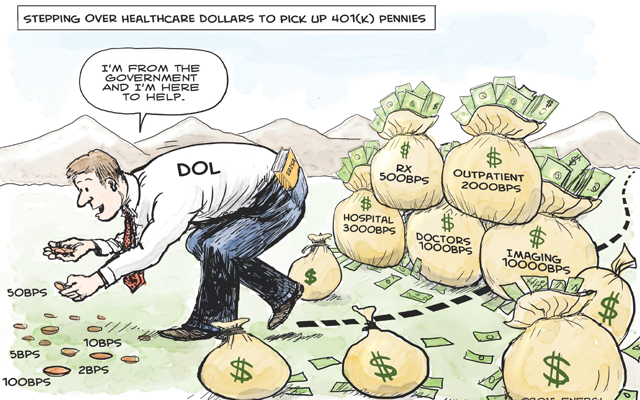
Stepping Over Dollars to Pick Up Pennies

Regulators worry about overcharges on investment plans but ignore issues with healthcare that can be 10 times as bad. That will change.

The U.S. Department of Labor (DOL) is determined to establish regulation over excessive loads and charges built into and sometimes hidden inside 401(k) plans. The costs are known as basis points, called "Bps" (Bips) in the industry, and they represent hundredths of a percent. For example, a load of 60 basis points equals 0.6%, and 100 basis points equals 1%. The DOL’s logic is that trustees and plan fiduciaries are too often oblivious to the excessive costs built into the plan and the resulting reduction in the investment performance for the plan participants. But why are we being distracted about 401(k) pennies when the real culprits have created a healthcare system where hundreds and thousands of excessive cost "Bps" are annually overcharged to plan participants and employers?
Where is the outrage over the lack of transparency for disclosing fees, charges, expenses and loads built into the healthcare system and health plans offered to employers by insurance companies and HMOs? Why is no one demanding accountability for massive claim payment errors, overcharges, hidden charges and compensation, excessive fees, hidden spread pricing or medical errors? Health plan fiduciaries are typically oblivious to the true costs hidden inside their plans in the same way they don’t understand the all-in costs of their 401(k) plan. The major difference is that healthcare waste can easily be 10 times greater than the "Bps” being scrutinized inside 401(k) plans. Imagine if the plan sponsor was held accountable to a fiduciary standard when managing the health plan. Ignorance is not a defense available to a fiduciary. How will you change the way you manage healthcare when the DOL’s Employee Benefit Security Administration declares that health plans are subject to 408(b)(2) regulations? Do you know what questions to ask? Here are a few to think about. See if you know the answers. If you don’t know the answers, then ask yourself, why not? Are you going to wait until regulations mandate that you act in a prudent manner in the best interest of the plan and the participants?
  1. What is the claims payment error rate by your insurance company, health maintenance organization (HMO) or third-party administrator (TPA)? What’s the impact when 3% to 10% of plan expenses are errors?
  2. How much does spread pricing by the pharmacy benefits manager (PBM) cost the health plan participant?
  3. Which physicians are the bad actors whose practice patterns are more than 300% outside established medical evidence protocols?
  4. Which hospitals charge 1000%-plus above Medicare payment rates?
  5. How much did iatrogenic disorders cost the plan?
  6. What percentage of readmissions were preventable?
  7. How much are labs, urgent care, MRIs and Emergency Departments upcoding and overcharging the health plan? What happens when you are accountable because your health plan and participants are paying four to 10 times more for the exact same services?
Health plan court cases about violating ERISA and fiduciary standards are starting to attract the attention of the DOL. Plan sponsors need to change their focus and look at what is really happening inside their health plan(s) and the all-in costs of their providers, just like they are doing now with the pennies in the 401(k) plan. The dollars you are stepping over will have a dramatic impact on the bottom line of the health plan and its participants. Be prepared in the not too distant future to manage healthcare to a fiduciary standard. But, what you should be thinking now is, why wait?

Craig Lack

Profile picture for user CraigLack

Craig Lack

Craig Lack is "the most effective consultant you've never heard of," according to Inc. magazine. He consults nationwide with C-suites and independent healthcare broker consultants to eliminate employee out-of-pocket expenses, predictably lower healthcare claims and drive substantial revenue.

How to Best Use Provider Networks

The ACA creates issues for provider networks, in their current configuration, but some simple strategies that build on PPOs can be effective.

We are all familiar with preferred provider organizations (PPOs), and many have utilized either subset networks (exclusive provider organizations) or other iterations to control escalating medical claim costs. While these approaches to provider networks had proven successful between 1970 and 2010, based on the impacts of the Affordable Care Act (ACA) they may no longer be sustainable in their current configuration. There are simple strategies that build on the current model for provider networks and that may help improve a health plan’s performance, and I will get into those shortly. But first let’s develop a common understanding of how PPOs contract. The marketability of a PPO is based on reducing the cost of claims and providing access to a large number of providers. Typically, PPOs use a variety of cost mitigation techniques including discounts, per diems, case or global rates and relative value schedules (RVS). For a PPO to negotiate its greatest savings, it must enroll a large number of members and be able to steer utilization. When negotiating for professional services, a PPO typically works with two models, though a third could be added when specialty care is involved. The first model is a discount off billed charges. This is a relatively easy agreement to secure because it doesn’t affect the provider’s practice unless highly utilized. The second model is based on a relative value schedule (RVS), which was implemented in the late 1950s when the California Foundation for Medical Care established a cost for services and applied factors by region. This model was known as the California Relative Value Schedule (CRVS). A similar approach was implemented by Medicare under the title of Regionally Based Relative Value Schedule (RBRVS), which has become a standard for contracting of professional services today. As a result, most professional contracts are now based on Medicare RBRVS plus 10% to 30% depending on the region, type of provider and enrollment population. In some cases, specialty providers may contract based on fixed fees, or a variation of other methods. Contracting with institutions is very different. In a traditional PPO, hospitals may contract through either a discount off what is billed, fixed per diems for room and board, ICU or CCU or a combination. The discount model is relatively straightforward. A contract that includes per diems will typically have a number of variations such as an “outlier.” The outlier or hospital deductible is a dollar threshold that, when exceeded, triggers re-pricing. In outliers' purest form, the claim reverts back to a discount off billed charges to first dollar. Some contracts may allow the re-pricing to begin with amounts above the outlier, but this is not the standard. In situations where treatment is standardized, such as childbirth and knee replacement surgery, a PPO may contract on a case rate basis, which establishes a fixed reimbursement for all care associated with the event. Some of the charges that may fall outside of the event would be physical therapy, durable medical equipment and medications. There will be other treatments, including transplantation, that may include case or global rates. While case and global rates may appear similar, they can vary greatly by network and provider organization. In some cases, the application of a case rate does not limit the claim liability to the contracted amount. As an example, we had an experience with a national network where the $1.8 million transplant charge was paid at $1.3 million even though the PPO had a $250,000 case rate. This method is not characteristic of case or global rate practices, but consultants and clients should be mindful of exposure as it could affect the plan’s claim reserves and medical excess coverage. The Affordable Care Act continues to affect claim costs in both fully insured and self-funded environments. Overall claim trends appear to be manageable, although some specialty care and acute care hospitals have changed billing practices as a result of unlimited lifetime benefits. An example is dialysis, where the total cost per patient has skyrocketed. In an audit of dialysis claim costs, we have identified two national provider groups as being abusive in the billing of services. Claims that prior to implementing ACA would average $28,000 to $40,000 per patient per month are now ranging between $60,000 and $105,000 per patient per month. These patients have not been of major concern to PPO contracting managers because of the low volume of claims. As a result, networks have settled for discounts of 15% to 35% off billed charges. Depending on the patient’s diagnosis, Medicare pricing could come into play, resulting in allowable charges closer to $10,000 per month, which may stabilize the group’s overall health plan spending. These and other tools will be discussed in future articles. In addition to contracting for cost control, most PPO agreements include claim filing requirements and auditing authority. In today’s electronic age, the use of clearing houses such as WebMD have significantly improved claim submission and processing times. As a result, many PPO contracts may require the professional provider to submit claims within 30 to 90 days of treatment, or sacrifice reimbursement. The same principle may apply to institutional contracts, though the timeline for submission may be 90 days. In some cases, a PPO contract may allow an institutional provider to submit claims for a premature birth or transplant patient as long as 150 to 180 days following discharge. Risk managers, consultants and claim payers need to be aware of exceptions to the claim submission rules as they could create a non-reimbursable event if the medical stop loss policy run-out period ends before the processing of the claim. As part of the due diligence process, it is in the client’s best interest to identify any barriers to audits of financial and medical appropriateness. A number of provider networks surrender the client’s audit authority to secure greater pricing concessions. While pricing concessions are important to the overall claim spending, it only takes one catastrophic claim to hurt a health plan’s performance. Many leaders in the PPO industry understand the need for transition, but it could take a few years to re-engineer existing provider contracts in the areas of auditing for appropriate pricing and care setting, cost to charge, captitation or other non-discounted approach to re-pricing, as well as a reduction in network size to efficiently manage the consumption. Now that we have a common understanding of PPO contracts and we agree that change will take time to implement, let’s briefly discuss simple strategies using the current PPO model that may help improve a health plan’s performance. A strong PPO can assist clients in controlling costs when the plan design encourages people to use in-network providers. Therefore, when offering a PPO, it is appropriate to include a minimum 20% differential benefit between in- and out-of-network providers. Additionally, providing for deductibles and out-of-pocket amounts will drive patients to network providers. To avoid emergency room frequent fliers, a health plan should have an appropriate co-payment as an inducement to have patients seek care in a clinical setting. In reviewing our block of business, which includes commercial employers, public agencies and healthcare clients, we have determined that over-utilization is not a significant concern. We have identified a number of areas where a properly crafted plan document coupled with specialty vendors may aid in the control of high-dollar claims. For example, implementing a dialysis management program can reduce average claim cost by 70%. Beware of vendors who require a percentage of savings, as their fees could double the net claim amount. Consider the addition of domestic medical tourism. While medical tourism is a hot topic, and many of these vendors redirect care outside of the U.S., a number of employers are finding local solutions through direct contracting of specialty care and adding these under domestic tourism provisions. An employer might include the addition of cost-plus or in-network allowable amounts and the maximum allowable reimbursements for out-of-network claims. One final concept is to utilize an exclusive provider organization-type plan design packaged with a PPO network. Essentially, the health plan would only offer in-network benefits unless care is on an emergency based outside the network's service area. This is the first in a series addressing all forms of provider networks. Future articles will introduce the reader to establishing local networks, direct provider contracting and capitation of medical groups, which generates provider engagement in health outcomes and financial management. Recent discussions with leaders of a number of national PPO networks found that many are currently attempting to apply these principles with varying success.

John Youngs

Profile picture for user JohnYoungs

John Youngs

John Youngs is the chairman and CEO of OneSource StopLoss Insurance Services. He entered the insurance industry in 1983, working as a broker, and moved to the insurer side in 1989, with a focus on large group self-funded, group life and long-term disability and development of community health plans, the precursor of affordable care organizations.

9 Key Factors for Drug Formularies

Drug formularies should be all about better outcomes for patients, not cost. Take care of the injured worker, and everyone else wins, too.

These remarks were prepared for testimony at a recent Assembly hearing in Sacramento on California’s consideration of a workers' comp drug formulary. Thank you for the opportunity to be part of this hearing on the potential development of a prescription drug formulary in California. My name is Mark Pew, senior vice president of PRIUM, a nationwide medication management company based in Duluth, GA, that has conducted business in California for more than 15 years and been a utilization review organization since 2009. I have followed the development of workers’ compensation drug formularies in other states since 2010 and, through observation and dialogue and corresponding deployment of services, have come to identify success criteria. I spoke on the subject at the National Workers’ Compensation and Disability Conference in November 2012 and at that time opined that California should consider a drug formulary. Since 2013, I have had several conversations with various California stakeholders to further that discussion, so I’m very pleased to see progress being made towardsthat goal. Because I value the time of this committee hearing, I will be brief in what I consider to be important foundational tenets when constructing a drug formulary. I will forego any statistics or rationale for a drug formulary as that has already been well articulated in the bill’s analysis.
  1. A drug formulary should be about better patient clinical outcomes, not cost. My opinion is that if you do what’s right for the patient, all other stakeholders win by side effect. While much of the discussion leading up to this hearing has been about cost savings, it would be shortsighted to think that should be the criteria for success. In my opinion, true success from a drug formulary would be a decrease in disability, a decrease in addiction and dependence, an increase in return-to-work and an increase in the use of less dangerous treatment options. If the focus is on better patient clinical outcomes, there should be no stakeholder in California workers’ compensation that can argue that this isn’t a good thing.
  2. A drug formulary should rely on evidence-based medicine. Robust clinical studies that indicate what drugs should be used when, and what non-pharmacological treatment options should be tried in advance, should dictate which drugs require additional evaluation before prescribing. There are some very dangerous drugs that are generic and inexpensive, so the trigger should be what produces the best clinical outcomes in proper sequence. Step therapy, the idea that you start with the most effective, least dangerous option, is built into evidence-based medicine and should be the template for prescribers. The optimal approach to evidence-based medicine is the adoption of third-party, peer-reviewed standards that are regularly updated to reflect contemporary medical practice standards.
  3. A drug formulary should not handle new and legacy claims in the same manner. By “legacy claims,” I mean those claims that exist before the formulary rules come into effect. A patient taking his first opioid is different than a patient who has taken opioids for many years. While new claims require primarily process education for the stakeholders, there should be a remediation period for “legacy” claims to allow time for appropriate weaning and development of alternative treatment methods. Based on my observations, there should be a one- to two-year period between the rollout of a drug formulary for new claims vs. “legacy” claims. Both implementation dates should be unchangeably enforced to ensure action is taken. To be clear, any formulary that applies to new claims should also apply to legacy claims, albeit at a later date. Not applying the formulary to legacy claims would result in two different standards of care for injured workers in California depending on when the worker was injured. This is clinically inconsistent with the application of evidence-based medicine.
  4. A drug formulary will change prescribing behavior. The extra steps required for a drug that is not allowed by the formulary requires the prescriber to think through the best options as opposed to just maintaining past practice patterns (however they were developed). For example, if carisoprodol was excluded from the formulary, the prescriber either needs to validate the medical necessity through a preponderance of evidence or choose a muscle relaxant that is included (which likely means it has less dangerous side effects, has proven to be more effective for certain conditions and does not have dangerous drug-to-drug interactions). Given experience in other states, the prescriber will often choose the less dangerous drug included in the formulary, which should result in better clinical outcomes for the patient.
  5. A drug formulary should be enforced at the point-of-sale. Allowing drugs to be given to the patient and THEN deciding whether they are clinically appropriate allows the start of a potentially dangerous path to polypharmacy regimens that create more harm than good. A workers’ compensation drug formulary, just like those we see in group health plans, should be implemented at pharmacies within their point-of-sale system. The information provided to pharmacists will help them better communicate with the patient and prescriber as necessary for an option that is allowed by the drug formulary. One advantage for California is that pharmacy benefit managers (PBMs) and pharmacy chains already have experience with implementing a workers’ compensation formulary in other states. If California is modeled after that same process, there should be less up-front time required to develop processes for California.
  6. A drug formulary should be the result of consensus among all stakeholders. While reaching consensus takes longer, providing a seat at the table for every workers’ compensation stakeholder in a very transparent process will ensure a smoother implementation. It’s extremely important to the ultimate success of a drug formulary that everyone be part of the deliberation process. And if everyone is involved in developing the drug formulary, ultimate implementation will be more easily achieved. A point of clarification: while the process surrounding the drug formulary should be based on stakeholder consensus, the medical treatment guidelines upon which the formulary is built should NOT be based on consensus, but rather on the best contemporary medical evidence available. California stakeholders should focus negotiations on the rules governing the formulary, not on the medical principles that underpin it.
  7. A drug formulary should educate all stakeholders clearly and consistently. Clear (and free) education needs to be provided to all prescribers, all attorneys, all payers, all employers and preferably all injured workers as to how the drug formulary was constructed, how it will be implemented and how best to comply. Preferably, this would be led by the Division of Workers’ Compensation. This education should not stop in the lead-up to implementation but should continue in a feedback loop during and after to ensure that issues are identified and resolved quickly.
  8. A drug formulary should be simplified for ease of implementation. States with workers’ compensation drug formularies have made the choice of drugs relatively binary. For instance, a drug may be classified as one that is recommended for first line therapy ("Y" drug) or a drug that is not recommended as first line therapy ("N" drug) and should not be used unless it has been reviewed and approved by a second clinical opinion. The definition of what is and is not included in the formulary should not be narrative or interpretive, but something easy to read and -- more importantly -- to program into pharmacy benefit management (PBM), utilization review (UR), independent medical review (IMR) and bill review systems.
  9. Drug formulary rules should include a well-defined dispute resolution process and expedited appeal process. The goal of a closed formulary is to ensure that there are safeguards in place to prevent unnecessary medications from being dispensed to injured workers. The exclusion of a drug from the formulary (for example, an "N" drug) should not mean it cannot be utilized, only that the prescriber should be required to validate its medical necessity vs. drugs that are included. California obviously already has that infrastructure, which is why I felt in 2012 that California was a candidate for a workers’ compensation drug formulary. The onus should be on the prescriber to provide necessary evidence as to why this particular drug is required for this patient at this time. If that can be established, then that drug should be allowed to be given to the patient.
If the above steps are taken and appropriate time is given for their completion, a properly constructed and implemented drug formulary in California should result in cost savings to the system. The primary savings will emerge over time as fewer and fewer of California’s injured workers are lost to dependence, addiction and overdose. The ability to settle and close claims more quickly will be a positive result for both employers and employees. A workers’ Compensation drug formulary could have a lasting and significant change in how prescription drugs are prescribed in California. I truly believe that by making everyone in the system think before prescribing, the injured workers will receive better care, and stress on the workers’ compensation system in California will be reduced. I would enjoy being a continued resource to this committee as deliberations evolve. Thank you again for the opportunity to be part of this hearing.

Mark Pew

Profile picture for user MarkPew

Mark Pew

Mark Pew is a senior vice president at Prium. He is an expert in workers' compensation medical management, with a focus on prescription drug management. Areas of expertise include: abuse and misuse of opioids and other prescription drugs; managing prescription drug utilization and cost; and best practices for weaning people off dangerous drug regimens.

Don't Drink the Kool-Aid on Opt-Out

A workers' comp case in Oklahoma demonstrates the true intent of at least ONE opt-out participant: to stick it to the worker.

Former President George W. Bush infamously said in 2005, “See, in my line of work you got to keep repeating things over and over and over again for the truth to sink in, to kind of catapult the propaganda.” Opt-out supporters and proponents repeat over and over again that opt-out is better for employees. They forgot to tell that to Rachel Jenkins. Jenkins, a 32-year-old single mother of four, was injured while working a double shift at a disabled care center in northwest Oklahoma City owned by ResCare, the nation’s largest privately owned home healthcare agency. Jenkins was injured on March 31 attempting to break up an assault of her disabled client by another patient. The incident was witnessed by Jenkins' supervisor. After her shift, Jenkins went to the emergency room, where she was administered medication and sent home to rest. Her employer sent her to a company doctor the next day. He provided medication and ordered physical therapy. But ResCare's opt-out contract with its employees requires claimants to call a designated toll free number to report accidents within 24 hours, and Jenkins did not call until the 27th hour. Her claim was denied. Three hours late on a phone call, and Jenkins is on her own. Bob Burke, her attorney, just filed a case in the District Court of Southern Oklahoma seeking declaratory judgment, saying the state insurance commissioner has obviated his responsibilities by approving ResCare's opt-out plan and others that don't give workers at least a one-year statute of limitations to report their injury, as required by Oklahoma law. “Every opt-out plan I have seen so far has a 24-hour requirement that bars benefits if notice is not given,” Burke wrote in an op-ed published Monday in the Journal-Record newspaper. “Even though state law requires opt-out plans to have the same one-year statute of limitations as regular workers’ comp, the insurance commissioner continues to approve the plans, and the legislature, in House Bill 2205, is trying to remove the plans from public inspection under the Open Records Act.” This case demonstrates the true intent of at least THIS opt-out participant: to stick it to the worker. The employer cannot claim lack of notice - the injury was witnessed by her supervisor, and Jenkins was sent by the company to its doctor! Burke says the insurance commissioner approves the 24-hour limitation because it is a notice requirement only. Apparently that translation got lost in practice, because ResCare and its administrators clearly are using the provision as a statute of limitations. I'm sure there's another side to the story. Opt-out proponents will have to spin that other side to preserve credibility. In the meantime, the wheel in the opt-out PR repetition machine has a broken cog. Opt-out had me semi-convinced that it was a valid alternative to traditional workers' compensation with its promises of less bureaucracy, better injured worker care, greater efficiency, competition and improved outcomes. Proponents kept repeating the benefits over and over and over again... The propaganda almost got catapulted, and I nearly drank the Kool-Aid. Not now. It smells poisoned.

David DePaolo

Profile picture for user DavidDePaolo

David DePaolo

David DePaolo is the president and CEO of WorkCompCentral, a workers' compensation industry specialty news and education publication he founded in 1999. DePaolo directs a staff of 30 in the daily publication of industry news across the country, including politics, legal decisions, medical information and business news.

The Best of Claims, the Worst of Claims

Two workers' comp claims show how little control we have over an employee’s attitude -- and how important it is in determining the outcome.

It was the best of claims; it was the worst of claims… the age of wisdom, the age of foolishness… belief vs. incredulity… hope vs. despair… etc., etc. The iconic opening paragraph from Charles Dickens' A Tale of Two Cities makes one realize such conflicts do exist in the same space and time, albeit through different personal perspectives. Such is the reality in workers’ comp claims, where the single biggest factor in outcome is often the claimant's attitude. A client claim-audit project offers a jarring comparison between two claim files from different parts of the country. The claims exemplify how little control we actually have over an employee’s attitude in the disability management process, and show how vastly different the human tolls can be. Both claims were in excess of 10 years old. Both involved exaggerated and evolving symptoms with eventual narcotic prescriptions for “pain management.” At approximately the same time, however, each took a different path. One claimant found her own reasons and will-power to end the years she spent on prescribed pain-killers. She entered a drug treatment process on her own, eventually stopped her prescriptions and found a full-time job. The other claimant dove deeper into narcotic addiction and exhibited classic drug seeking behavior – such as “losing” his prescriptions and requiring early refills. He tested positive for other illegal drugs once his rightfully suspicious physician initiated a monitoring program. There was no appreciably different set of claim management tools or tactics used for the claims – the stark difference in outcome came down to the want of the individual… an almost impossible aspect for the day-to-day claim practitioner or human-resources manager to reach or control. And, at the time of my audit, the claims were equally easy to close. The woman free of prescriptions and carrying a full-time job was simply no longer a claimant. She was probably very happy to have her case closed and the dark chapter of her life over. We decided on an administrative closure of the claim. On the other hand, the gentleman was barred from his erstwhile treating physician and pain management clinic for abusing meds and refusing a drug treatment program. A host of independent medical opinions indicated the man did not require further meds for the old injury. His everyday behavior was highly unfocused and erratic, apparently causing no attorney to take his WC case. He lived out of a tent in a relative’s backyard. The man’s claim was also an easy administrative closure because of lack of any foreseeable prosecution. I have to admit his situation nicked at my coat of cynicism, the one layered thick from years in this profession. I hated the plain fact that he was a doomed victim of a WC system enabling his addictive conditions. To my good readers, I ask: Which closure would you rather preside over? Quick-Tip: Know When to Hold ‘Em But Don’t Wait to Fold ‘Em Concept: When reasonable medical treatment has no impact, quickly consider other options. A claimant with misguided intentions or extraneous problems and no desire to be “cured” might just be his own worst enemy and using the WC claim as a primary enabler. Suggestions: – Find appropriate ways to incorporate employee assistance programs (EAPs) or other specialty counseling services to support employees or WC claimants who have debilitating outlooks or possible addiction issues. – Maintain a “no-fill” position on narcotic prescriptions. This will give you and your defense team at least an opportunity to block dangerous drugs before they are automatically initiated. – Consider any “chronic pain” diagnosis to indicate maximum medical improvement (MMI). “Chronic” as a term arguably fits MMI. Try to settle the case under that premise. Fight the diagnosis and treatment plan, as a means to pressure settlement. If the plaintiff's side argues against an MMI determination, then demand a treatment outlook and timeline that results in stopping pain medication. – For claims with long-term narcotic situations, seek peer reviews to ascertain if the regimes are excessive and if a recommendation for detoxification is appropriate. Specifically set up medical evaluations to confirm addiction and substance abuse tendencies. – Never presume a claimant with the wrong attitude and bleak outlook will be cured by any type of treatment. Know when you are wasting time and money. You must sense and act on this early. Don’t rely on adjusters to raise questions, as their inclination is to keep treating as long as medical opinion approves. You must take the role of disruptor. Bottom line" It is distressing that workers’ comp enables addiction. Closing such cases is not always pretty. Learn from the disasters and take more responsibility in the future. Recognize that claimant attitude and outlook are of primary importance, for good or for bad.

Barry Thompson

Profile picture for user BarryThompson

Barry Thompson

Barry Thompson is a 35-year-plus industry veteran. He founded Risk Acuity in 2002 as an independent consultancy focused on workers’ compensation. His expert perspective transcends status quo to build highly effective employer-centered programs.

How to Find Mobility Solutions (Part 1)

Until insurers (and agents and brokers) can operate entirely using apps on smart devices, they can't really say they have mobility solutions.

Please consider this post to be a sort of noodlin' around the ways insurers could apply mobility solutions. I do have a bias: I think that until insurers, and insurance agencies/brokers, can operate entirely using apps on smart devices they can't really call themselves "mobile-next." To find potential insurance mobility solutions, focus on the customer (you know, the rascal who pays the premiums) and enable him to:
  • Access the insurance company/insurance agency web site using a smart device. This means that the insurance firm (carrier or agency) has to have the ability to push requested information to the customer's smart device in a manner that fits the smart device. Fit for purpose, as it were.
  • Request and consume service on a smart device. This includes getting served in the manner the customer wants, whether text, voice or video and preferably in real time. This means the insurance firm must have the business operational service systems in the "state" necessary to provide effective and efficient service to the customer in the desired manner.
  • Self-serve by using a smart device. This would include accessing and downloading documents stored in the insurance firm or perhaps in a private cloud set up for the customer (whether COI, policy forms, claim forms or loan forms).
  • Begin and preferably finish a policy application entirely on the smart device using e-signatures (which were approved way back during President Clinton's administration). I realize that quotes/rates and underwriting decisions could very well mean that it is not a "sign on and get it done in one shot" kind of situation. However, whatever stops and starts happen, the policy application process should stay in the mobile realm and never require the customer, anyone in the agency or anyone in the carrier to have to re-enter information.
  • File the first notice of a loss and track the entire journey of the claim adjudication from beginning to end, including getting an alert when the claim check is deposited in the customer's requested banking account.
  • Use the smart device to pay a premium by taking a picture of a check rather than mailing in a check or even using a payment service to pay the premium amount.
  • Collaborate with claim managers, customer service representatives or others in the insurance firm (carrier or agency) using only the smart device.
Next post, I'll discuss potential mobility solutions for producers. Being wildly creative about blog titles, I'll call the post "How to Find Mobility Solutions (Part 2)." But sticking with the insurance customer, what mobility applications would you add to the list above?

Barry Rabkin

Profile picture for user BarryRabkin

Barry Rabkin

Barry Rabkin is a technology-focused insurance industry analyst. His research focuses on areas where current and emerging technology affects insurance commerce, markets, customers and channels. He has been involved with the insurance industry for more than 35 years.

Guidelines for Marijuana at Work

Marijuana use at work is a very complicated issue -- and not just because many state laws conflict with the federal ban on marijuana.

ACOEM/AAOHN recently published some guidance for employers on how to deal with the rapidly expanding legalization of marijuana in individual states across the U.S. that I believe are very important and that I wanted to share. Because "presence" -- having marijuana-related chemicals in the worker's body -- does not necessarily mean impairment, and presence lasts a lot longer than impairment, there is a conundrum on how to deal with workplace injuries and on what safety policies to enact to prevent injuries. Many legal issues arise because individual states have policies around medical and recreational use (related to age, amount, location, etc.) that are inconsistent with cannabis’ illegal status at the federal level. So we all need to be thinking about the issues. To quote myself from an article on Lexis-Nexis: “I personally think this should be required reading by general counsel and human resources at every employer, especially in states where legalization has already occurred but even for those where it isn’t, because it’s coming. Clear and proactive policies are absolutely required, and those can only be created by knowing every aspect of federal laws and their intersection with individual state laws (and not just your state, but surrounding states). To quote Facebook, ‘It’s complicated.’”

Mark Pew

Profile picture for user MarkPew

Mark Pew

Mark Pew is a senior vice president at Prium. He is an expert in workers' compensation medical management, with a focus on prescription drug management. Areas of expertise include: abuse and misuse of opioids and other prescription drugs; managing prescription drug utilization and cost; and best practices for weaning people off dangerous drug regimens.