Download

Don't Be Dissuaded

Medicaid carries a stigma, but it provides high-quality care to low-income people, while creating opportunities for brokers.

|

Brokers hesitate to offer Medicaid enrollment services to their clients because of the perceived stigma surrounding them.

But the reality is that those stigmas are all talk and no bite - most Americans don't have a problem with public benefits like Medicaid. In fact, those who qualify for it generally prefer it because it offers lower costs and better coverage than many private plans do. Brokers who offer this government-subsidized coverage give themselves an advantage over those who don't while better meeting workers' healthcare needs.

Busting the Medicaid Myths

The common notion that Medicaid provides inferior coverage when compared with private plans is patently false. Study after study has shown that Medicaid recipients are actually happier with their coverage than enrollees in individually purchased plans or employer-sponsored private plans. In three southern states, low-income residents said they preferred Medicaid's quality of care to that of private plans. Nationwide, 87% of Medicaid enrollees feel positive about their health insurance, compared with 73% of those with private plans.

Medicaid's doubters note that only 66% of those eligible for Medicaid are enrolled and say the figures demonstrates inadequacies in the program. Under-enrollment has many causes, but pride is not among them. Many people don't know they're eligible for Medicaid, and the application process is complex. In addition, the application process is largely online, and a significant number of low-income individuals lack computer skills or access to the Internet.

The Truth About Medicaid

The reality is that Medicaid provides affordable, high-quality care to working people. It also presents brokers and business leaders an opportunity to lower costs while increasing the number of employees who have health coverage.

Contrary to the misconception that Medicaid offers little coverage, the program provides more comprehensive coverage than most private plans. Medicaid includes vision and dental benefits for children throughout the country and for adults in most states. It also includes benefits like non-emergency transportation and substance abuse treatment.

What's more, care under Medicaid is just as accessible as care under private plans. Only 2.8% of Medicaid enrollees can't access nearby care - while that number isn't zero, it does suggest that the vast majority of enrollees can find primary and secondary care.

Not only does Medicaid cover a wide range of services, but it's also quite affordable. The vast majority of Medicaid enrollees pay no premiums, and employers pay no additional cash for their employees enrolled in Medicaid. Even in the handful of states that do have premiums, enrollees typically can't lose coverage for failing to pay. Medicaid has no deductibles and minimal co-pays, often charging just a few dollars for prescriptions and doctor visits. Medicaid covers the whole family; unlike many private plans, there are no drastic rate spikes for dependent coverage. For many families, Medicaid is the only path toward insuring the whole family.

In addition to saving money on premiums, people who have Medicaid are significantly less likely to incur significant medical debt than eligible people who do not sign up for Medicaid. Medical debt remains the most common cause of bankruptcies in the U.S., and Medicaid reduces the risk that a devastating medical complication will also bankrupt an individual.

When brokers help companies provide Medicaid enrollment services in the workplace, most employees are grateful to get help with this process in a comfortable and familiar venue without having to make appointments during their limited hours outside work.

How Brokers Can Benefit

It's clear that Medicaid benefits enrollees, but what about the brokers who provide the benefits? Medicaid helps them, too.

Offering Medicaid enrollment support sets brokers apart in a crowded field. By bringing a new solution to the table - particularly one that many people are unaware of - brokers distinguish themselves.

Medicaid options also represent cost savings for employers, so brokers can find footing among business clients if they choose to offer Medicaid. In an increasingly commodified health insurance market, the ability to provide an option that requires minimal or no payroll deductions while offering access to high-quality care gives brokers an edge over the competition.

If attracting business clients wasn't incentive enough, brokers can also earn sizable commissions through third-party enrollers on all workers they enroll in Medicaid, including those who were previously uninsured and thus generating no commission at all. At the end of the day, these additional commissions can actually generate more revenue for brokers than they would receive without offering Medicaid enrollment services.

Employers associate high costs with high quality, but that's not always the case in the world of healthcare. Brokers who help employees find the right coverage for the right price help everyone save money while providing high-quality care to those who need it.

With Medicaid myths busted, it's up to brokers to help individuals access care when they need it - and for a reasonable price. As the American population becomes increasingly insured, Medicaid enrollment continues to climb. Brokers who don't offer Medicaid enrollment support might find themselves on the outside looking in if they fail to provide their clients with the cost savings, coverage and care that Medicaid brings to the table.


Benjamin Geyerhahn

Profile picture for user BenjaminGeyerhahn

Benjamin Geyerhahn

Benjamin Geyerhahn is an experienced entrepreneur, a healthcare policy expert and a member of New York Gov. Andrew Cuomo's Health Benefit Exchange Regional Advisory Committee. He is the founder and CEO of BeneStream, which uses a combination of technology and a multilingual call center to guide employers and employees through the Medicaid enrollment process.

Tips for Bringing Kids Into Your Business

Working with your kids is tricky. Here are six tips that will help you, them, the rest of your family and your management team.

sixthings

Is your son or daughter your successor? What are some things you and they can do to make this a successful succession? Mistakes to avoid when trying to make your son or daughter your successor? Mistakes they should avoid?

As a succession coach who advises multi-­generational family businesses on how to bring in the next generation, and as a business professional whose daughter has been working with her for nearly 10 years, I can offer a few tips that I have found to be helpful:

  1. While your children are attending high school or completing college, provide work experiences during the summer that allow your children to try out different departments and tasks, working with different managers (best never for you personally).
  2. Develop a family business employment and expectations policy defining requirements for education, professional experience and behavioral and performance expectations. If you are thinking ahead, introduce this to them when they are in high school or college to help give them a sense of how they need to prepare, what they should be studying and what it will take if they are considering a career in the family enterprise. This will create a road map so that your children have an opportunity to succeed.
  3. Before designing a job description or entering into any kind of discussion regarding potential employment in the family enterprise, make sure you spend some time in thoughtful discussion together investigating each other's vision for the future. You may think you know what your children want to be "when they grow up," but you may be surprised when you actually inquire.
  4. It can be helpful to engage an experienced coach to conduct the interview, using a personality styles tool (like PDP, DISC or Meyers Briggs) to help frame the conversation related to their natural strengths. Many times, I have found kids feeling like they are being squeezed into their parents' shoes, and it's not a good fit. If Dad started the business, is a natural at sales, relationship-building and strategic thinking, and Son is a thoughtful, reserved communicator who is very process- and detail-oriented, I can promise you, it will be a difficult path for the Son to ever live up to his father's and the company's expectations. Additionally, he will be miserable.
  5. Once you have identified the ideal career path that excites and suits your son/daughter, bring in your senior management team and discuss what you would like to do with them. Enroll the team in creating the right on-boarding process, job placement and develop agreements for how you expect your children to be managed and mentored. Also, how you will support your managers so they can hold your daughter or son accountable without fear of repercussion.
  6. Lastly, establish a family council to share information with all your children, not just the one or two who are currently showing interest. Let all your children know that there are many ways to participate with the family enterprise. Some may want to be community cheerleaders, helping in events and philanthropic activities, while others may dream of managing a division or eventually becoming your successor. You can achieve succession in a multitude of ways. You don't have to always create a King of the Mountain, where your children have to vie to take your position upon your retirement.

Working with my daughter, watching her grow, keeping it real has been a great joy. I always, ALWAYS keep the most cherished element of our relationship in mind: She is my daughter. I wish her life to be happy, healthy and fulfilled. If that can happen while she's working with me, it's icing on the cake.


Ricci Victorio

Profile picture for user RicciVictorio

Ricci Victorio

Ricci M. Victorio is the managing partner of the Mosaic Family Business Center. Victorio is a certified succession planner and co-active coach for individuals, family businesses and management teams. She has been providing communication enhancement, leadership and teamwork training programs to Fortune 500 companies across the country since 1984.

5 Key Steps for Succession Planning

Many owners focus on the financial aspects of succession, but it's also crucial to take a disciplined approach to the human component.

Succession planning has two key components: the financial component and the human capital component. They are both critical. Many financial services professionals spend a career selling solutions for the financial component, but this means very little if the right people are not in place to step forward and assume responsibility for the future. My experience, working with companies on their human capital needs, is that producers, managers, general agents and brokerage general agents (life/ annuities, group insurance, money management, etc.) have the same challenge that all businesses face. In any business, succession is one of the most critical elements in attracting good people to maintain, grow and build on the foundation for the future.

If you are looking for a way to have a smooth transition with maximum benefit to all stakeholders, retain clients and key employees, you must take five key steps:

1. Identify the end goal.

2. Determine the kind of person needed for a successful succession.

3. Have a well-thought-out process for identifying the successor.

4. Set target dates, milestones and trigger points.

5. Put everything in writing.

CLEARLY IDENTIFY THE END GOAL

Do you know what you want to happen with your business when you exit? The goal might be as easy as selling to a peer, key employee or family member. But it might involve a lot more work and thought if you decide to split the business up into smaller pieces to sell it off or to look outside your current firm to find a successor. In many cases, executing your end goal and letting go isn't easy and requires doing a great deal of planning, asking tough questions and setting expectations for everyone involved.

DETERMINE THE KIND OF PERSON NEEDED FOR A SUCCESSFUL SUCCESSION

What type of individual should be stepping in to take over? Look at experience, background, character, shared vision and willingness to follow through on promises made. Once you have these basic skills/traits identified, you need to define what will be expected on a daily, weekly and monthly basis. Some of the questions you need to answer include:

  • What are the key performance expectations, both short-term and long-term, for the individual filling this role?
  • How will you define and measure successful performance in this role?
  • How will he know whether or not he is properly performing the critical functions in meeting the organization's expectations?

Once you have answered these questions you can move on to the next step.

HAVE A SET PROCESS FOR ATTRACTING THE RIGHT PERSON

Once you have identified the role requirements for a candidate, the search can begin. If you have internal candidates who might fit the description, now is the time to approach them regarding the role and your long-term plans. If you don't have any internal candidates, you need to go out to the marketplace yourself or hire someone to make appropriate introductions for you. You will need market research on the number of available candidates and the cost to attract them.

An outside consultant who knows your niche is your best source for obtaining the market research you need and for qualifying potential candidates. Even large companies that have human resources and strategic planning departments will find that an outside consultant can provide great help with an impartial viewpoint - and usually at a lower real net cost. You will also find that they can help you avoid some of the internal political battles that exist in larger companies.

Once you have a complete list of candidates, you can begin your evaluation of their background and desires to see if they align with what you are looking to accomplish and the legacy you wish to leave.

SET TARGET DATES, MILESTONES AND TRIGGER POINTS

No one likes uncertainty. Employees, clients, carrier partners and potential succession candidates all need to know what to expect and when to expect it. Owners often believe that an incoming owner will work harder if she is "hungry," but if she doesn't know what is expected of her, how will she know when your goal has been reached?

Both you and your successor need to agree on and accomplish specific goals. For example, if it's a general agent (GA) succession plan and the target is 15 new recruits each year, attach a number to both the incoming GA and outgoing GA. If the incoming GA doesn't hit the mark agreed to at each milestone, she doesn't get the additional stock in the organization. If the outgoing GA doesn't hit the milestones he agreed to, he doesn't get as rich a payout (this way they are both tied to the other's success). You can create this same kind of agreement in all sectors of the business and at all levels of an organization (president, manager and producer). You also need to set dates to sit down and review progress and successes (and potentially have a third party involved). This will help everyone focus on what's important and work together.

PUT EVERYTHING IN WRITING

I've often talked with an organization halfway through a succession plan, and I hear different stories from the partners, employees and carrier partners. Making sure the carriers and existing partners are all in agreement with the plan is essential to your success. No one wants to feel taken advantage of, and having a clear plan laid out in writing will keep everyone on the same page and pulling for each other. Have a written business plan with all timelines and expectations (without financial numbers) to share with clients, company partners, employees and prospective employees. Not only can this be an effective recruiting, business development and retention tool, but communicating that you have a well-thought-out succession plan can be critical to existing and potential new customers. As the saying goes, "The business that stays, pays."

This is certainly not a complete list of everything that is involved in succession planning, but these are the five foundational elements that should keep your quest for the right successor on track.


Kevin Dougherty

Profile picture for user KevinDougherty

Kevin Dougherty

Kevin Dougherty is the founder and president of GCL Group. Located in the Indianapolis area, GCL Group is one of the nation's premier consultants in executive search for the insurance industry, recruiting field executives and home office executives for positions across the U.S. and Canada.

The Most Effective Insurance Policy

The best insurance policy a business can buy requires an unusual focus on values and commitment to loyalty from the top down.

On Christmas Eve, 1944, somewhere in Europe, two U.S. Army soldiers, played by Bing Crosby and Danny Kaye, perform for the 151st Division, whose commander is leaving. Maj. Gen. Thomas F. Waverly arrives for the end of the show and delivers an emotional farewell. The men in the 151st Division give him a rousing ovation as the war rages in the background. This opening of the iconic movie "White Christmas," a holiday favorite, sets the foundation for a wonderful story and business principles.

Safety is at the forefront when Kaye saves Crosby's life from a falling brick building wall. Later, Crosby and Kaye reunite with the major general as civilians and come to his aid as his business and retirement funds are in jeopardy. At the end of the movie, the 151st Division remembers the general and his leadership, and there really is a white Christmas ending.

Watching this classic movie this holiday season with our business lenses on, we can learn about business and personal development.

As happened in World War II and during its aftermath, our world today is rapidly changing economically, technologically and culturally. For the financial success of businesses or individuals, the critical principle is the ability to continually and accurately assess risks-the exposure to potential damage or loss because of our decisions or individual activity. What are our risk exposures? What types of risk should we focus on? What are the magnitudes and probability that these risks could occur? What level of control do you have over the situation? While these questions can be answered in future articles, we want to focus on purchasing the most effective insurance policy you can purchase today for your business.

There's a great deal of talk about loyalty from the bottom to the top. Loyalty from the top down is even more necessary and is much less prevalent. One of the most noted characteristics of great men and women is loyalty to their subordinates. Crosby is poignant in the film when talking about how the general acted when rations were scarce; Crosby says, first we ate, and then he ate. The 151st Army Division was a team. It ate, lived slept and fought as a team for the war and for the general. There was no individuality.

As Gen. George S. Patton said in real life, "This individuality stuff is a bunch of bull...."

The most effective insurance policy you can purchase today, which we call "Insurance Plus," is developing and practicing a business mindset in finding, hiring and developing people in line with the core values of the company. There is a grand need to have individuals who can solve problems (even before it happens) and to capitalize on opportunities with the greatest efficiency and effectiveness with critical thinking and reasoning. Investing in people can create the greatest and fastest return on investment if the correct training tools are used. The greatest investment is the one made in human resources, and, if assessed correctly, carries the least risk. One cannot purchase a more effective insurance policy.

Patton said, "Moral courage is the most valuable and usually the most absent characteristic in men." Similarly, in the movie, Waverly's vision was paramount for the success of his troops, surviving the war and finding purpose in life. His troops returned the gesture by following him "wherever he wants to go." To be followed, become a better leader.

If you own a company or if you manage people, those who report to you usually get more from watching you than they do by listening to what you're saying. Never tell people how to do things. Tell them what to do, and they will surprise you with their ingenuity. Demonstrate a positive mental attitude in the workplace. Get back to the basics. You have to sell yourself before you can sell anybody anything. Success demands a high level of logistical and organizational competence.

Purchasing the most effective insurance policy includes getting some third party perspective--some coaching help. Much as Waverly had his team, you will find it easier to assess the risk with help by your side. And you have to focus on values.

To you as the business owner or manager, we raise a glass and toast, "May your days be merry and bright, and may all your Christmases be white (with Insurance Plus)!"

This article was co-written by Phil Wilder. With more than 30 years as an economic adviser and business strategist, he is committed to advise, educate and encourage individuals, as well as organizations, to achieve their full potential and to have hope through these unpredictable times.


Nancy Moorhouse

Profile picture for user NancyMoorhouse

Nancy Moorhouse

Nancy Moorhouse, CSP is a multi-faceted, multi-talented business partner in the risk management/workers' compensation/safety consulting industry. With more than 28 years of experience, she influences clients in culture change and progress.

6 Red Flags for Work Comp Premium Fraud

The presence of two or more should prompt independent agents to raise concerns about fraud and spur further investigation.

Workers' compensation insurance premium fraud is a major issue affecting our industry. Not only is it illegal, it hurts the bottom lines of both producers and carriers and leads to higher insurance premiums for honest businesses. It can also cause a loss in commission for agents, have a negative impact on a state's rate-making system and create an unfair business advantage for the perpetrator through artificially reduced operating costs.

To protect their interests as well as the interests of honest policyholders, agents need to be aware of the different types of premium fraud and their warning signs. Agents also need to know the steps to take if they suspect premium fraud. Armed with the right information, independent insurance agents - who are a key conduit between policyholders and insurance carriers - can play a crucial role in identifying and preventing workers' compensation insurance premium fraud.

Types of Workers' Compensation Insurance Premium Fraud

There are three basic types of premium fraud: under-reporting payroll, misclassification of employees and experience modification evasion.

Under-reporting of payroll occurs when a policyholder inaccurately reports its work staff to the insurance company, often by paying employees off the books or presenting employees as sub-contractors or independent contractors rather than actual company employees.

The second type of premium fraud is the misclassification of employees, which occurs when a high-risk employee such as a construction worker is classified as a person with lower risk, like an office clerk. This misclassification is intended to result in a lower workers' compensation premium for the perpetrator.

The third type of premium fraud is experience modification evasion. It occurs when an established company with a greater than average loss history attempts to re-emerge as a new company on paper to obtain a lower experience modification factor. However, the business is actually unchanged in its operations and still presents a greater than average risk.

Warning Signs for Agents

Here are common warning signs that indicate business owners may be attempting to commit workers' compensation premium fraud. The presence of two or more of the following should raise concern and warrant further examination:

  • The business address is a mail drop or P.O. box, or the business is physically located in another part of the state from its mailing address.
  • A prior carrier has dropped the business or the business frequently changes carriers.
  • An excessive number of certificates of insurance are issued on a small policy.
  • Reported injuries are not consistent with purported job titles or duties.
  • There is an unusual ratio of clerical to non-clerical staff for the type of business.
  • The business avoids audits or has never been audited.

How Agents Can Protect Themselves

Agents are not immune from being accused of advising policyholders to commit fraudulent acts. There are simple steps agents can take, however, to protect themselves and assist in workers' compensation fraud investigations. Foremost, they should be aware of and monitor for the common warning signs of fraud and work with carriers that offer active anti-fraud programs.

Agents should also maintain detailed records of their interactions with policyholders, including all e-mails. Agents should verify the identity of the policyholder or person of contact with a driver's license, and original signatures should be obtained on all applications. By keeping this information on file, agents can help protect themselves against false accusations and help prosecutors in a criminal case, if necessary.

If agents ever suspect a policyholder is engaging in workers' compensation premium fraud, they should inform the carrier's special investigation or fraud investigation unit. In certain cases, law enforcement may also need to get involved.

If criminal charges are eventually filed against a policyholder, the evidence agents possess will be important to the prosecution's case. When a prosecutor serves a subpoena or search warrant for an agent's records, the types of evidence most often required are applications, copies of checks used for payments, correspondence (including e-mail) with the accused policyholder and any documents signed by a person responsible for the business.

Agents play an important role as a critical front line defense against workers' compensation insurance premium fraud. It is important for agents to be aware of the different types of fraud and their common warning signs. They should never hesitate to report any suspicious activities to the carrier for further investigation.


Ranney Pageler

Profile picture for user RanneyPageler

Ranney Pageler

Ranney Pageler is vice president of the fraud investigations department at Employers, America's small business insurance specialist, which offers workers' compensation insurance and services through Employers Insurance Co. of Nevada, Employers Compensation Insurance Co., Employers Preferred Insurance Co. and Employers Assurance Co.

Is Research Ready for 'Gamification'?

It's getting harder to find a large enough, representative sample for consumer research. Gamification may be the answer.

It has been interesting that, after several years of excitement around the topic of "gamification," this year more commentators have suggested that it's "game over." I certainly agree that this concept has moved through the Gartner hype-cycle, into the wonderfully named "trough of disillusionment."

However, that is the springboard for entering into the stages of pragmatic realism. My experience is that it is often once technologies or ideas reach this stage that those interested in just delivering results can begin to realize benefits, without the distraction of hype/fashion.

Even though I can see the points made in this Forbes article, I think that the evidence cited concerns a failure to revolutionize business more broadly. What has not yet been exhausted, in my view, is the potential for gamification to help with market research.

One growing issue springs to mind. I'm thinking of the challenge faced by any client-side researcher seeking a representative sample for a large, quantitative study. The issue is that participation rates are falling, unless research is fun, interesting and rewarding. Coupled with that problem is the risk that some ways that agencies use to address it risk a higher skew toward "professional" research participants.

Gaining a sufficient sample, one that matches a company's own customer base's demographic or segments, can be important for experimentation. This issue is timely for financial services companies that are seeking to experiment with behavioral economics and need sufficient participation in tests to see choices made in response to "nudges." So, there is a need to freshen up research with methods of delivery that better engage the consumer.

No doubt the full hype will not be realized for gamification. But I hope that, as the dust settles, customer insight leaders will not give up on the idea of gamification as a research execution tool. Some pioneers like Upfront Analytics are seeing positive results. Let's hope others get a chance to "play" with this.


Paul Laughlin

Profile picture for user PaulLaughlin

Paul Laughlin

Paul Laughlin is the founder of Laughlin Consultancy, which helps companies generate sustainable value from their customer insight. This includes growing their bottom line, improving customer retention and demonstrating to regulators that they treat customers fairly.

Why to Simplify Corporate Structures

Insurers' corporate structures tend to be complicated. Simplifying them can reduce effort while raising capital.

|

With their variety of business strategies and product innovations, financial services organizations often have very complex corporate structures. The mix of regulated operating, distribution, investment, holding and dormant companies - together with various special-purpose vehicles - means that few employees fully know the complexity of an enterprise's legal entity structure.

Generally, management prefers simplicity and accountability. Accordingly, it typically organizes enterprises into distinct, separately managed, strategic business units (SBUs), which are overlaid on top of the existing legal entity structure, with the SBUs sharing various legal entities. This management approach creates a simplified internal view of financial performance relative to the legal entity structure; however, it often masks the considerable extra work (and therefore potentially avoidable cost) associated with the corporate structure within an organization's corporate accounting, tax and other back-office functions.

Few organizations start off with a complex corporate structure or seek to achieve one, but a combination of factors can lead to complexity:

  • Growth by acquisition - Entities inherited as part of an acquisition and entities (such as holding companies) formed to make acquisitions;
  • Tax strategies - Entities formed to minimize multi-jurisdictional taxation, preserve the utility of tax attributes (such as basis, losses and credits) or effectively manage product state taxes;
  • Historical regulatory requirements - Companies formed to facilitate various regulated pricing tiers (particularly in property and casualty (P&C) insurance); and,
  • Business line expansion and reorganization - Organic growth into new product areas, alignment within different market segments (sometimes under reinsurance pooling arrangements), discontinued business, etc.

Complexity adds to administrative costs and can slow production of management information. In the capital structure work that PwC performs, we frequently find that a company's structure is out of date; for example, the original rationale for a tax planning structure is no longer applicable because of a change in law, or a legal entity structure established to facilitate a line of business has survived even though the line of business has not. As another example, an entity that was established before the advent of the entity classification election regime (i.e. "check the box" rule) now may be unnecessary to achieve the intended tax benefits. Accordingly, organizations should examine the costs and benefits of maintaining current structures.

The complexity of corporate structures in financial services is evident in the insurance industry's use of legal entities. As the table below shows, among P&C and life and health (L&H) insurers, the top 25 insurance groups hold a majority of industry capital (69% in P&C, 58% in L&H). Despite this concentration, there is evidence that inefficiencies exist: There is a high number of dormant entities relative to total legal entities and the number of domiciles some groups are managing. The number of domiciles tends to be five or fewer for most insurers, but in some extreme cases there are as many as 12 domiciles for P&C companies and 31 for L&H companies (primarily because of health maintenance organization (HMO) entities). When factoring in the potential costs (real and opportunity costs) of maintaining unused or underutilized legal entities, the impact on the industry as a whole is very real.

Insurance industry capital is relatively concentrated
P&C L&H
Groups ~330 ~250
Legal entities ~2,700 ~1,800
Capital in top 25 groups 69% 58%

But there are indications of inefficiency

Dormant entities 150+ 300+
Fronting entities 500+ 100+
Range of domiciles/groups 1-12 1-31

Source: SNL, PwC Analysis

Legal entity cost

Organizations rightly consider the costs of administering legal entities a normal part of doing business. Such frictional costs vary by organization and entity usage and typically include:

  • Financial reporting costs - Licensed insurance companies require separate annual and quarterly financial statement preparation in their state of domicile. The time spent on statement preparation correlates to complexity. The greater the number of legal entities, the greater the complexity and the higher the risk of misstatement.
  • Auditing costs - These costs will vary with the size and complexity of the balance sheet. Again, costs tend to be correlated with complexity (e.g., degree of intercompany transactions, complex reinsurance structures, investments/financial products, etc.).
  • State assessments - Premium or loss-based assessments for a variety of state programs will vary in size relative to the business written in the legal entity. It is important to recognize that minimum assessments also can apply even when business is no longer written on a direct or net basis.
  • Regulatory exams - State regulators conduct both market conduct exams and financial exams of insurance companies domiciled in their respective jurisdictions. Market conduct exams occur on an as-needed basis and relate to examination of operational (sales, underwriting, claims) business practices. Certain domiciles are more challenging than others. Financial exams occur every three to five years, at the insurance company's expense.
  • Tax - Each legal entity in the structure adds to the company's overall compliance burden, as insurance companies are required to prepare and file forms with state and federal tax authorities on a periodic basis even when dormant. A company also may be required to respond to periodic inquiries about its activities, or lack thereof, and may be subject to minimum taxes and filing fees. Active operating companies must monitor and manage the interplay of premium tax rates and retaliatory taxes, which arise when states in lower tax jurisdictions increase state taxes to match the level of the domicile state, if it is higher.
  • Management time - Spans all of the above areas. The more complex a legal entity structure, the more time middle management and, in some cases, senior management have to spend on issues related to excess legal entities.

In light of these frictional costs, the expense of administering an overly complex legal entity structure can be considerable. Eliminating redundant or unused entities through merging companies, outright sale of the insurance company (or companies) or clearing out the liabilities and selling a "shell" company can result in significant savings.

Improving access to capital

Moving capital through legal entities can be complicated by regulatory constraints and often involves frictional costs such as sub-optimal tax consequences (e.g., withholding taxes on dividends from a foreign subsidiary and excise taxes on premiums paid to a foreign affiliate). Capital trapped in dormant or underutilized entities will provide sub-optimal returns and therefore serve as a drag on the overall group return on equity. For example, an organization with a 15% corporate required rate of return and a 5% average investment portfolio rate of return has a 10% opportunity cost of maintaining the capital in a redundant legal entity. Accordingly, one of the few positive outcomes of the financial crisis has been insurers' streamlining their corporate structures to simplify internal access to capital and gain capital efficiency.

One method of improving capital deployment in a dormant or underutilized entity is through merger with a continuing entity. However, before merging a licensed company out of existence, insurers need to consider the marketability of the unwanted entity in terms of the number and location of state licenses, the degree to which the company has gross liabilities, the type of liabilities (e.g., excluding asbestos and environmental), the domicile state, the credit quality of the counterparty backing the reinsurance contract or contracts used to create the shell, etc. In light of the regulatory hurdles and time delays that accompany the obtainment of state licenses, there is a market for selling licensed companies as "shell" companies. The process typically requires transferring insurance liabilities out of the legal entity through indemnity - or preferably assumption - reinsurance. This market has yielded significant value to its customers. That said, it is critical to gain proper restructuring advice before entering into these transactions because undesirable accounting and risk-based capital outcomes can result from poorly structured reinsurance transactions.

Simplifying corporate structure: Opportunities & challenges

Eliminating unnecessary organizational complexity and reducing associated frictional expenses are the main reasons to undertake a corporate simplification program. The benefits of corporate simplification are:

  • Streamlined financial management across a manageable number of entities;
  • Removal of unnecessary frictional costs;
  • Reduced overall state tax burden, leading to competitive advantages in market pricing;
  • Consolidation of entities within favorable state regulatory environments;
  • Identification of alternative capital structures or mechanisms to free trapped capital for the top-tier company to use for other purposes;
  • Generation of capital through the sale of unnecessary licensed companies as "shell" companies.

However, the simplification program does present some challenges:

  • Internal resource constraints may limit design and implementation of the simplification;
  • Regulatory approvals for material changes may prolong implementation;
  • Product filings may need to be updated;
  • Re-domestication of entities may present political or regulatory issues (including perceived or real job losses or transfers, closed block regulatory requirements, etc.) that can delay the process;
  • Changes in legal entity structure can affect near-term business operations and supporting technology platforms. For example, changes in legal entities used by the insurance underwriting organization may require process changes in the distribution channel as new and renewal business is mapped to different entities;
  • Selling or merging active operating companies can also present challenges for management, including: identifying intercompany accounts between merged entities; updating intercompany agreements, such as intercompany reinsurance pooling agreements, to reflect the changes; cleaning up outstanding legal entity accounting reconciliations, if any; re-mapping ledgers for historical data; re-mapping upstream company eliminations; creating and maintaining merged company historical financials for statutory and GAAP/IFRS financial statements; locating and analyzing details of historic tax attributes (such as basis and earnings and profits) and studying qualification for tax-free reorganization; potential reversal of subsidiary surplus impacts from asset purchase/sale transactions within the holding company structure; and potential scrutiny over differing methodologies, if any, used for accounting (e.g., deferred acquisition cost) or actuarial reserve methodologies used by the entities to be merged.

The corporate simplification process

Many large insurance organizations have some level of corporate simplification on their annual to-do list, but the initiative often gets pushed aside because of gaps between corporate and business priorities and available resources. The corporate simplification process requires a champion who can take into account and balance varying points of view, call upon required resources, facilitate project management and authorize access to subject-matter expertise. Moreover, a corporate simplification program must balance corporate (tax, regulatory, governance and financial reporting costs) and business (customer, distribution, products, process and technology) needs and considerations. Depending on the complexity of the organization and underlying challenges, a simplification initiative can take several months to well over a year.

The three stages of such an initiative include:

  1. Assess - The ultimate goal of a corporate simplification process is a streamlined corporate structure that corresponds to business core competencies and strategy. This structure will have an efficient balance of cost, risk, regulatory, tax, capital, governance and operational parameters that aligns business operations with the legal entity structure. In the initial phase of the initiative, representatives from corporate and business areas must come together to review the current use of legal entities and create the desired future organizational structure, as well as take into account the existing corporate environment (rather than what existed in the past). If the simplification effort is part of a broader business unit re-alignment, the assessment and design phase will require a significant commitment of time and effort to redefine the desired business strategy. If the simplification is taking place within a well-defined business unit structure, then the focus can be limited to streamlining and reducing overall cost within the existing business unit strategies.

A complete inventory of legal entities should be created outlining information such as the business use, applicable business unit, domicile, direct and net business written (for insurance companies only), required/minimum capital, actual capital, potential for elimination, and other information as defined by the group. Furthermore, to complete the assessment of the simplification effort, a business impact analysis that includes a premium tax analysis by state domicile and a regulatory domicile analysis should occur at this stage. Companies also need to carefully look at their portfolio of companies to ensure they have the entities they need today and for the near future.

  1. Design - As the plan starts to take shape, the project team must conduct a deeper analysis of accounting, business and technology transition issues. The deliverable will be a proposed road map that:
  • Outlines a streamlined legal entity organization structure with greater capital efficiency and alignment with business strategy;
  • Identifies the proposed combinations/eliminations of insurance and non-insurance entities;
  • Describes the proposed movement of capital (including extraordinary dividends required) and reinsurance transactions to effectuate the change (if applicable); and
  • Establishes a communication plan within a high-level timeline.

This outline of proposed changes must be well vetted internally before the organization approaches regulators, rating agencies and other constituents.

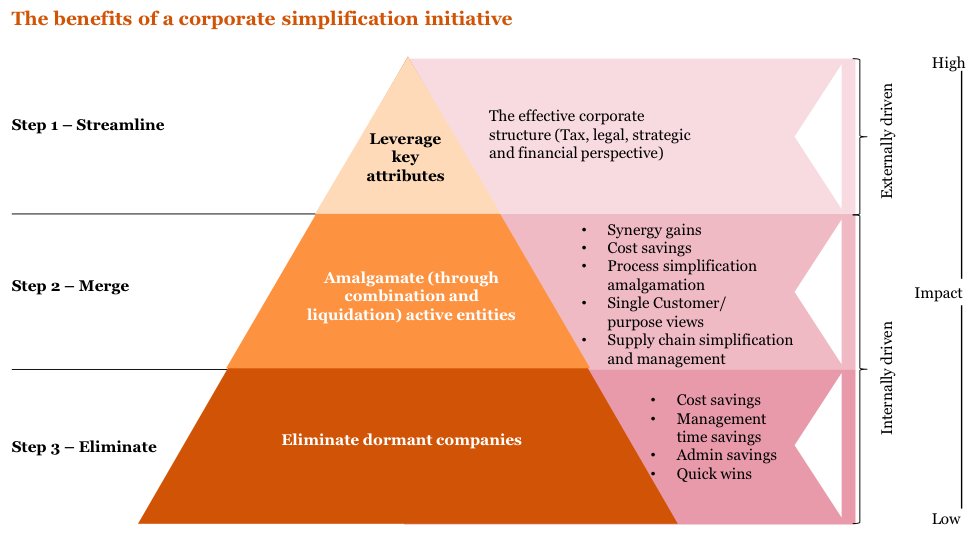
  1. Implement - Once the design is ready, project management and subject-matter expert resource requirements must be confirmed. Program and change management and associated governance structures are critical throughout the planning and implementation phases as the number of work streams, constituents, interdependencies and issues can be substantial for larger-scale simplification programs. Once the team is in place, it must create detailed implementation project plans, identify quick wins, establish an effective communication plan and establish an issue/dependency management process. Communication to all constituents - employees, sales force/agents, regulators, rating agencies and policyholders - is vital in any simplification initiative.

Following the design phase, those entities that have common activities, objectives, operational process or customer segmentation can be merged, which should effectively align business and legal entity structure. The remaining, redundant legal entities should be eliminated, sold as-is or sold as a shell. This final step will result in cost savings and the raising of new capital through the sale of licensed shell companies.

chart 2

Conclusion: Corporate simplification is a priority

In light of the need to be nimble while reducing costs, corporate simplification should be at the top of the corporate to-do list. A well-managed corporate simplification program provides strategic alignment of entities, reduces costs and facilitates more efficient use of capital. The companies that execute an effective corporate simplification process and maintain a commitment to simplification over time will succeed in reducing costs and be able to devote their time and attention to valuable activities.


Patrick Smyth

Profile picture for user PatrickSmyth

Patrick Smyth

Patrick Smyth is a managing director in the financial services advisory practice at PwC, with more than 20 years of insurance and investment management industry experience. He has held management roles in both operations and finance within a Fortune 100 organization.

Will Insurers Ever Learn From Amazon?

Every other industry seems to have learned Amazon's lessons on product selection and convenience -- but insurers still don't get it.

You may (or may not) remember that when Amazon.com began in the late 1990s, the single focus of the company was selling books online. One product category, one type of manufacturer, one market focus -- people who buy books. At the time, virtually everyone in the publishing industry scoffed at the idea that anyone would want to buy a book they couldn't first touch. Today, Amazon.com sells all types of products from all types of manufacturers to all types of individuals and businesses every day of the year. No one is scoffing any more -- except perhaps the insurance industry.

Just like the publishing industry two decades ago, the insurance industry in facing a once-in-a-generation digital disruption and transformation, and I'm not sure the industry knows it. Let's look at the distribution of insurance through the lens of an Amazon.com-like buying experience.

Most insurers and distributors automatically start with the typical objections: "Insurance is complex," they say; or, "What about the regulatory restrictions?"; or, "My agents have to explain the product benefits to the customer." The knee-jerk reactions make sense in an industry that is mostly agent-centric and that seemingly treats customers with at least some contempt.

We have, after all, built rules around every aspect of insurance: who can buy, what they can buy, when and how they can buy, who they are, where they are located, what they want to insure, how much insurance they need, how much it costs. There are licensing and appointment rules, compliance and regulatory issues, insurance company underwriting requirements, rating rules, policy issue guidelines, premium remittance standards and distributor channel conflict rules, and these may all be different depending on the kind of product - life, accident and health, property and casualty, individual, group, association, employer and so forth. While many of these rules make sense, many others are simply vestiges of "the way things have always been done." That is a problem for our industry.

The reality is that a consumer doesn't care about most of the nitty-gritty, inside baseball, that affects all of the above. The consumer cares about being in control of the insurance purchase experience like he is in control of every other shopping experience. That's not to say the consumer wants to go it alone without an agent necessarily. But it does mean the consumer wants to be able to make that choice -- and, today, she can't. Increasingly, consumers are being schooled on how to buy everything through the convenience of a digital market; why not all of their insurance?

It won't be long before insurance consumers will expect to access products from multiple carriers, shop, compare, buy their policy with the credit card they pull from their wallet and have their policies, ID cards, welcome letters, privacy notices, etc. instantly delivered to their own online account (not through a carrier). How about the convenience of going to a digital marketplace that remembers each consumer for subsequent transactions? Maybe like Amazon Prime?

I've always wondered what the executives at Barnes & Noble, Borders, Simon & Schuster, HarperCollins and Penguin (not to mention Circuit City and J.C. Penney and Sears) were thinking back in the 1990s as Amazon.com started to gain traction. I wonder the same thing now about some insurance executives.

Savvy insurers and distributors will meet consumers where they want to be met and transact business in the digital marketplace. Or they won't. But if the industry doesn't go there quickly, someone else will - of that, I'm sure.


Brian Harrigan

Profile picture for user BrianHarrigan

Brian Harrigan

Brian Harrigan, CEO of InsurIQ, a provider of insurance technology solutions, has spent over 40 years in the insurance industry, helping agents and carriers manage the purchasing of insurance and personal protection products.

Why Flood Is the New Fire (Insurance)

Because flood maps in general use are flawed, there are cherries to be picked. A mass market is now possible, too.

With our past few posts on ITL, we have been exploring how insurers can continue to bring more private capacity to U.S. flood (Note: Everything we talk about for U.S. flood is also relevant for Canada flood). We have explored here how technology, data and analytics exist to handle flood in an adequately sophisticated manner, and we have described here the market opportunity that exists. Now, it’s worth a look to explore how a flood program could be introduced, starting from scratch through cherry-picking mischaracterized risks and then to a full, mass-market solution.

What’s a FIRM? It’s not what you think

First, let’s take a quick look at how National Flood Insurance Program (NFIP) rates are determined: the Flood Insurance Rate Maps, or FIRMs. For the NFIP, FIRMs solve two core problems – identifying which properties must have flood insurance and how much to charge for it. The first function is for banks, giving them an easy answer for whether a property to be lent against requires flood insurance – this is what the Special Flood Hazard Area (SFHA) is for. Anything within the SFHA is deemed to be in a 100-year flood zone (basically, A and V zones), and requires flood insurance for a mortgage. The second function sets the pricing and conditions for the NFIP to sell the actual policies. The complexity of solving these two problems should not be underestimated for a country of this size. But it must be remembered that a FIRM is a marketing device and not a risk model.

Considering that FIRMs are a marketing device built on a huge scale, it makes perfect sense that some generalizations needed to be made on the delineation of the various flood zones. The banks needed a general guideline to know when flood insurance was needed, and the NFIP needed rates to be distributed in a way that could result in a broad enough risk pool to generate enough premium to be solvent. While the SFHA has served the banks well enough over the years, the rating of properties has not been so successful. There are plenty of reasons the NFIP is deep in debt (see page 6 of this report); suffice it to say that the rates set by FIRMs do not result in a solvent NFIP.

Cherry-picking

The fact that the FIRMs are a flawed rating device based on geographical generalizations means there are cherries to be picked. By applying location-based flood risk analytics to properties in the SFHA, a carrier can begin to find where the NFIP has overrated the risk. Using risk assessments based on geospatial analysis (such as measurements to water) and their own data (such as NFIP claims history), a carrier can undercut the NFIP on specific properties where the risk fits their own appetite. Note to cherry-pickers: Ensure you account for the height above ground of the building, because you won’t need elevation certificates for this type of underwriting. So far, cherry-picking has been focused on the SFHA for a couple reasons – homeowners need to have coverage, and the NFIP rates are the highest. There is no reason, though, that cherry picking can’t be done effectively in X zones and beyond.

Mass-market solution

The same data and analytics used for cherry-picking can be used more broadly to create a mass-market solution. By adjusting the dials on the flood risk analytics – and flood risk analytics really should be configurable – you can calibrate to calculate the flood risk at low-risk locations. In other words, flood risk can be parsed into however many bins are needed to underwrite flood risk on any property in the country. With the risk segmented, rates can be defined that can (and should) be applied as a standard peril on all homeowner policies. Flood risk can be underwritten like fire risk.

Insurers have traditionally been confident underwriting fire risk. But consider this: While fire is based on construction type, distance to fire hydrants and distance to fire station, flood risk can be assessed with parameters that can be measured with similar confidence but with greater correlation to a potential loss.

Flood will be the new fire

Insurers have been satisfied to leave flood risk to the Feds, and that was prudent for generations. But technology has evolved, and enterprising carriers can now craft an underwriting strategy to put flood risk on their books. Fire was once considered too high-risk to underwrite consistently, but as confidence grew on how to manage the risk it became a staple product of property insurers. Now, insurers are dipping their toes into flood risk. As others follow, confidence will grow, and flood will become the new fire.


Nick Lamparelli

Profile picture for user NickLamparelli

Nick Lamparelli

Nick Lamparelli is the managing partner of Insurance Nerds and chief program officer for Latin International Reinsurance Group. 

He is also CEO of the Insurance Advocacy Forum of Florida.

Lamparelli is a three-decade insurance executive, starting as a local agent and evolving to middle market broker, wholesaler, underwriter and catastrophe insurance expert.


Ivan Maddox

Profile picture for user IvanMaddox

Ivan Maddox

Ivan Maddox is a geospatial engineer who for 20 years has been solving problems with location-based solutions for a variety of industries, including geophysical, governmental, telecommunications, and, now, insurance.

Real Reason Health Insurance Is Broken

Health insurance will never work right until consumers can measure the quality of healthcare and have to care about its cost.

Healthcare is broken in this country; I don't think I really have to convince too many people of that. Whether your political leanings are blue or red, whether you're a senior citizen or a teenager, really whether you're rich or poor -- just about everybody senses that something is wrong with how we manage care. This is not a quality-of-service issue, not so much an access-to-care issue and not really a lack-of-options issue. No, the problem most Americans rightly recognize as being wrong in current system boils down to one word: price.

But how do you fix that? For 20 years now, I have tried to help employers manage their healthcare costs for employees and their families. For at least the first 15 years of my career, that job mostly entailed comparing options from the national and regional carriers, negotiating the lowest rates possible, making suggestions to help lower benefits to offset rising premiums and then preparing spreadsheets of all those options for our CEO, CFO and HR director. Basically, my job was to bring in bad news, but to try to bring in the least bad news. All to get new clients and keep old ones.

Any time a business owner would ask me, "Why are our premiums rising so much?" I'd turn the question around a bit and ask what she thought the causes were. Inevitably, I'd hear the same three things. First, those "staggering profits of the insurance companies." Closely behind that is America's notorious "increase in obesity." Then third -- every once in a while -- someone would actually get closer to the truth and say the reason is that "medical costs are rising." And all of these are true, no doubt, to one degree or another. But none explains how health insurance premiums have historically risen at a rate five times or more beyond normal inflation.

When pressed for an answer on higher premiums, I’d explain how we receive very little information from carriers (especially in the fully insured market), but you’ve got a higher-than-desirable loss ratio -- or I might mention the aging employee population, declining overall health, new taxes and regulations perhaps related to the Affordable Care Act. Again, all those reasons, to some degree or another, have a real impact.

The one that kept coming closest to the truth, at least from an insurance insider's perspective, is the steady rise in costs. Or, unfortunately, as most consumers see it, the outlandish profiteering manufactured from the suffering, confusion and fear of others.

To truly find a more meaningful answer -- something consumers and advocates and carriers and even legislatures could theoretically one day use to craft a lasting solution -- I started to look at the actual unit cost of medical care. That's vital, because it strips away taxes, fees, insurance profits and many other considerations like America's decreasing health, or the continued drop in smoking. It clears all that fog and gives you a hard-number comparison. And what I discovered was that we as a nation spend more per unit of care than the next seven most-expensive countries COMBINED.

That deserves repeating. Not only do we as a nation maintain the world's most expensive healthcare system as a whole, but at the individual level you are likely to be billed more for the same procedure than similar patients in China, France, Germany, Canada, Malaysia, India and the U.K. if all their bills were rolled into one.

Comparisons

To put things in better perspective, I looked at other common costs we incur going back as far as before the Industrial Revolution. And what I found was that the price of a car has not wildly changed in all those years. Nor do gas prices rise against inflation. Meanwhile, prices of computers and technology have historically gone down. So how then do healthcare premiums justify such leaps?

Housing is a great example. Since 1970, housing costs have only gone up 15% -- 15% in 45 years. In that same time period, medical care costs have jumped 1,800% -- 18 times greater since 1970. How about since 1935? According to Federal Bureau of Labor Statistics, costs have risen 4,200% in that time.

When further comparing health insurance and healthcare itself against any other goods and services we might buy, I realized that Americans, in general, tend to apply common sense and rational thinking to many other purchases, but that much of that practice somehow goes out the window when it comes to medical care.

We’ve become very good at consuming health insurance, but does that mean we're actually good consumers? The executives at businesses do what they're supposed to: compare costs, co-pays and deductibles presented by their broker/consultant each year. And when these executives do decide which plans to roll out to their employees, they are good shoppers. They compare their employers' costs with their spouses' employers, compare against the Obamacare exchanges (or individual plans pre-ACA) and consider other important factors -- your out-of-pockets, your deductible, your premiums....

The goal is to control overall healthcare costs. But look at other types of insurance.

Many of us likely will shop out our car insurance every few years. After all, 15 minutes could save us 15%, right? Yet we know that any savings only apply to the insurance. We don't expect shopping around for our car insurance to actually affect the price of the car. But the price of the car does affect insurance: A higher price tag means more expensive insurance.

The same is true in healthcare. We CANNOT lower our healthcare costs by shopping our insurance. Our healthcare costs are not at all affected by our insurance costs. This has been proven with the "consumer-driven" model of insurance (which has had limited to no impact on premiums long term). Yet our health insurance costs are almost fully driven by our actual healthcare costs. As a matter of fact, a provision of the Affordable Care Act known as "medical loss ratios" practically guarantees this.

Imagine that your teenager just got his driver's license. After some good old-fashioned consternation and badgering, you’ve agreed to let him take out the car out unsupervised for the very first time, only to go to the corner store to get some much-needed milk. You hand over the keys and try not to stress too much. Of course, less than 15 minutes later, you get the dreaded phone call: He's been in an accident.

Rushing to the scene, you're relieved to discover it's only a fender bender. The other driver, seemingly a reasonable person, agrees to accept your offer to not file an insurance claim, and instead pay him directly for what appears to be, let's say, $1,000 of damage. After all, you've got a $500 deductible, and a claim filed by your teenager just weeks after getting his license could jack your rates up much more than the difference. Or, worse, your carrier could drop you, jeopardizing your freedom completely! So paying out of pocket makes sense, right?

But would we do ever this with our healthcare? Can you imagine anyone walking into a cardiologist appointment, especially with a co-pay plan, and saying, "I don't want my insurance company knowing I may have heart disease, so let me just pay the $500 charge instead of submitting the claim and paying the co-pay"?

And let's look at how oddly blind we are to the actual quality of healthcare we receive. For instance, in an operating room, a strong argument can be made that the anesthesiologist is the second most important person on the surgical team. After all, when you're under general anesthesia, it's her job to control the machines that keep you breathing. She also controls how "under" you go. She makes sure you don't go so deep that you slip into a coma, but, equally important, makes sure you don't wake up mid-procedure. Yet, with all that responsibility in her hands, who among us has even known who the anesthesiologist would be until five minutes prior to being knocked out? After all, for such an important role, wouldn't it be nice to develop a relationship with this doctor, and maybe even have her be the one who administers sedatives for future surgeries? Maybe you'd just like to know if she only graduated medical school last week? That might be pertinent, too.

Instead, we juggle our healthcare purchases like nothing else we buy. Imagine if we consumed hotel stays like we do healthcare. We might have a high-deductible "hotel" plan. Say we had a $500 deductible before our plan covered stays at 100%. So if I'm only staying one night, I might look into cost and quality, maybe compare rooms on Trivago. But what if I needed a hotel room for a week, or a year, and I knew I'd be hitting that $500 threshold no matter where I stayed, from the most rat-infested hotel to a five-star resort? Wouldn't I be inclined to stay at the Ritz Carlton in a $1,000-a-night because I know I'm hitting my deductible either way.

One of the pushbacks I get is that we, as patients, are not doctors and must rely on the pros. After all, when faced with a major medical condition, we're usually not in the best frame of mind to make intelligent decisions. "I should just trust my doctor" is a common reaction, maybe the most common. And a very understandable one. But I'd argue that dealing with a major medical condition is the exact time to be most involved. Most aware. Most informed. The stakes couldn't be higher, and yet our awareness is disturbingly low.

If we bought houses as we buy healthcare, it'd be like finding a reputable real estate agent and then asking him to go ahead and pick out a neighborhood, a house and the price we'll pay. We'll just meet him at the closing. Sounds crazy, right?

Where Insurance Is to Blame

Please know that I'm not holding insurance companies blameless. I do, for instance, blame the insurance industry for a major shift in our overall thinking. I hold the industry responsible for creating an environment in which the cost of care, and therefore the quality of care, becomes irrelevant. This was mainly born out of HMOs, of course, which, you'll recall, lowered costs tremendously at first, and were hailed as the cure to all that ails our system, before things went so horribly wrong.

Here again, comparison can be useful. A while back, I was in a meeting with service department workers at a car dealership. I asked if they'd agree that most people, when paying for their own repair, would care about both the cost and quality. Everyone nodded -- of course they would. I asked how that differed from a customer whose car was still under warranty. In that situation, they told me, the customers generally don't care at all about cost, and, in fact, will likely come to a dealership on a warranty job specifically BECAUSE it's the most expensive. After all, someone else is paying, right?

What most people are unaware of -- mainly because they don't ask -- is that you can get warranty work done at many non-dealer repair shops.

Most people think of their health insurance a lot like they do a car warranty. The total cost, the competitively and fairly priced service, and, to a large extent, how good the work is just doesn't matter so much when we're not reaching into our pockets.

Doesn't that tell us precisely why the "consumer driven" model hasn't worked?

The idea was that if our plans have us paying higher deductible and co-pays, we'll care more about the overall cost. Yet in 2015, the highest out- of-pocket allowed by the Affordable Care Act is just $6,600. If I'm going in for a procedure that may range in cost from $25,000 to $125,000, what exactly is my incentive to go looking for a deal? Or even ask questions? Not when I know I'll be hitting my $6,600 threshold regardless of where I go.

And we inherently associate higher costs with greater quality of care. Is that a fair assumption? Not with the system we have. Actually, the opposite generally proves true.

Transparency

All of these things keep coming back to a singular issue for me: transparency. We simply don't have the information we need to make wise decisions. Like finding out how good a specific hospital is at replacing hips, or how much it actually charges compared with another facility.

However, I believe the reason this information is not systematically available is the same reason why, if it suddenly were available overnight, with the wave of my magic wand, there would still be little impact. What is that reason? Because today, under the system and mentality we have, there's simply no consumer demand for it.

Let's look at it from the pharmaceutical side. The cost at a retail pharmacy for the generic Lipitor can vary from $16 to almost $80, depending on where you go to. But if you have a $10 co-pay, or have already reached your 100% coverage, how can I convince someone to go three miles out of his way to get the lower-cost prescription? How do I get him to even ask the question?

Another argument I hear frequently when I ask customers to identify the problems with healthcare: "Isn't it the insurance company's job to control cost? Don't companies set up networks for this very purpose?"

Yes, they certainly do. But look at what really matters. Walmart started a list of $4 prescriptions. Many other pharmacies quickly followed suit. Try showing your insurance ID card for one of those drugs next time you go. In most cases, you'll find the insurance company would pay a significantly higher price. Why? Because you have much more power than the insurance company does. Having you be willing to spend your money at a store is far more compelling to the business than anything an insurance company can negotiate.

We treat our own health like a discount haircut. We basically know as much about the professionals and facilities charged with saving our lives as we do with the stylists at Supercuts. It's an insanely ill-informed way to manage the most important thing we have.

What can I leave you with in terms of possible solutions? They do exist, even though the Affordable Care Act limits some options.

What needs to happen is we have to encourage patients to care about the quality AND costs of the care they receive.

I envision a day when I can go on my smartphone and, using a basic app, find all the suitable places for replacing my hip, how well they're rated, how often they do the operation and, of course, how much they charge. How many of us would walk into a new restaurant without the benefit of any word-of-mouth or knowing anything about the specialties, pick from a menu but only find out the price when you get your check? We do that every day with sprained wrists, broken bones, personal addictions, genetic illnesses, respiratory issues and even open-heart surgery,

The bigger picture here is really using our consumer dollars to force providers -- meaning hospitals, doctors, drug manufacturers, pharmacies, etc. - to compete on the cost and quality of the services they provide, like nearly every other provider of any products or service we buy.

We've seen it work: In areas of healthcare that insurance typically doesn't cover, like laser eye surgery or even cosmetic surgery, the change is already happening. The costs in those areas have gone down considerably while the quality has increased.

Naturally, I recognize that making the comparisons available and getting consumers to use them would be a huge challenge. What can we do in the meantime?

Well, some tools do exist. There is an online service called MediBid that allows hospitals and providers to actually bid on your medical care. When providers respond, patients can compare costs and quality among those providers.

Another possible solution: Instead of an annual deductible of, say, $2,500, we could have a monthly resettable deductible of something like $200. How would that help? Well, it would give us, as consumers, a little skin in the game year-round. It would encourage us to participate in lowering overall costs by not applying the car dealership model to an already bloated and wasteful system.

Another push, an indirect result of the ACA, is more self-insured products. Many times, these are appropriate for smaller businesses. Not only does the self-insured employer have significantly more transparency on costs but also, more importantly, has real incentive to control those costs.

Some employers negotiate reasonable pricing and, if they use a service like MediBid and it results in a significant savings, may offer to pay the employee's deductible and even cover any travel expenses.

One innovative carrier has actually tied physical activity to a patient's out-of-pocket cost. Any adult on the plan can opt-in to wear a step tracker, like a Fitbit. If certain goals are met, people can earn as much as $4 a day, or $1,000 a year, off their deductible and out-of-pocket.

Which brings up the topic of wellness, which has become a real buzzword in the last five years or so. While I do agree that getting "well" can translate into consuming less care, wellness programs don't address the fact that nearly all people will consume care at some point in their lives and that many diseases are completely unrelated to lifestyle. My approach, the one I believe in: More transparency on the healthcare process and a community of well-informed consumers can help lower costs and improve quality on all care.

Conclusion

I believe that 90% of our problems would right themselves fairly quickly if only patients had the right incentives. If only information were made readily accessible. If only patients were allowed to be consumers, to shop for based on quality AND cost, just as we do with nearly everything else we buy.

This change would naturally force providers to improve their quality and lower their costs at a far more rapid pace. The pattern of unnecessary and duplicate testing would go down. Prices would quickly become far more competitive, as they should be.

And I believe Americans would start to see a more direct link between their financial picture and the decisions they make about their own health. If all this happened, if we had the transparency we need, then that dollar menu at McDonald's might not seem so affordable once we understand the health and cost impact a double-cheeseburger really has down the road.



David Contorno

Profile picture for user DavidContorno

David Contorno

David Contorno is president of Lake Norman Benefits. Contorno is a native New Yorker and entered this field at the young age of 14, doing marketing for a major life insurance company.